Richard C. Kessler Reformation Collection
The Richard C. Kessler Reformation Collection was established in 1987, when Richard and Martha Kessler donated their private collection of Reformation imprints and manuscripts to Emory University. These materials were combined with Reformation holdings at the Pitts Theology Library, and an effort was launched to enlarge and sustain this collection in the years to come. An advisory committee of Lutheran laypersons and clergy and of Candler School of Theology faculty and administrators oversees the nurture of the collection and its programs. The Reformation Notes newsletter provides semiannual updates on the growth of the collection, and the Reformation Day at Emory program of music and lectures each October celebrates the collection and its contributions to music, history, and theology.
In the sixteenth century the social and theological movements of central Europe, known collectively as the Reformation, critically shaped religion, law, education and other institutions in the West, and their long shadow has extended even to the present. The purpose of the Kessler Collection is to document these changes by collecting print and manuscript materials down to 1570 by Martin Luther (1483-1546) and those whom he influenced or engaged in debate. In this way historians and theologians will be able to hear the full range of voices that were raised in this dynamic period.
The holdings of the collection now exceed 4,000 items, a mark approximated by only two other libraries in North America; no American library approaches the Kessler Collection's 1,000+ publications by Luther himself.
-
 Text
TextOrdnu[n]g wie man tauffet, bissher im Latein gehalten, verteütscht : Hierin ist, auss etlichen Ursachen, was die andern, als uberflüssig, veracht haben, nicht aussgelassen
Catholic ChurchSummary: Osiander provides a fuller translation of the traditional Catholic rite of baptism than Münzer or Luther, who had both published baptism liturgies one year earlier, and who had eliminated certain ritual elements.Summary: Osiander provides a fuller translation of the traditional Catholic rite of baptism than Münzer or Luther, who had both published baptism liturgies one year earlier, and who had eliminated certain ritual elements. -
 Text
TextVon der Papisten Tauff : vnd andern Caeremonien oder Kirchendiensten ob die nach erkanter vnd angenomener Warheit durch jemand Christlich zu besuchen vnd zu gebrauchen sein
Summary: Only printing of a Lutheran pamphlet by an anonymous preacher from Southern Germany on the subject of baptism and other ceremonies in the Catholic church, with an introduction by Nicolaus Gallus.Summary: Only printing of a Lutheran pamphlet by an anonymous preacher from Southern Germany on the subject of baptism and other ceremonies in the Catholic church, with an introduction by Nicolaus Gallus. -
 Text
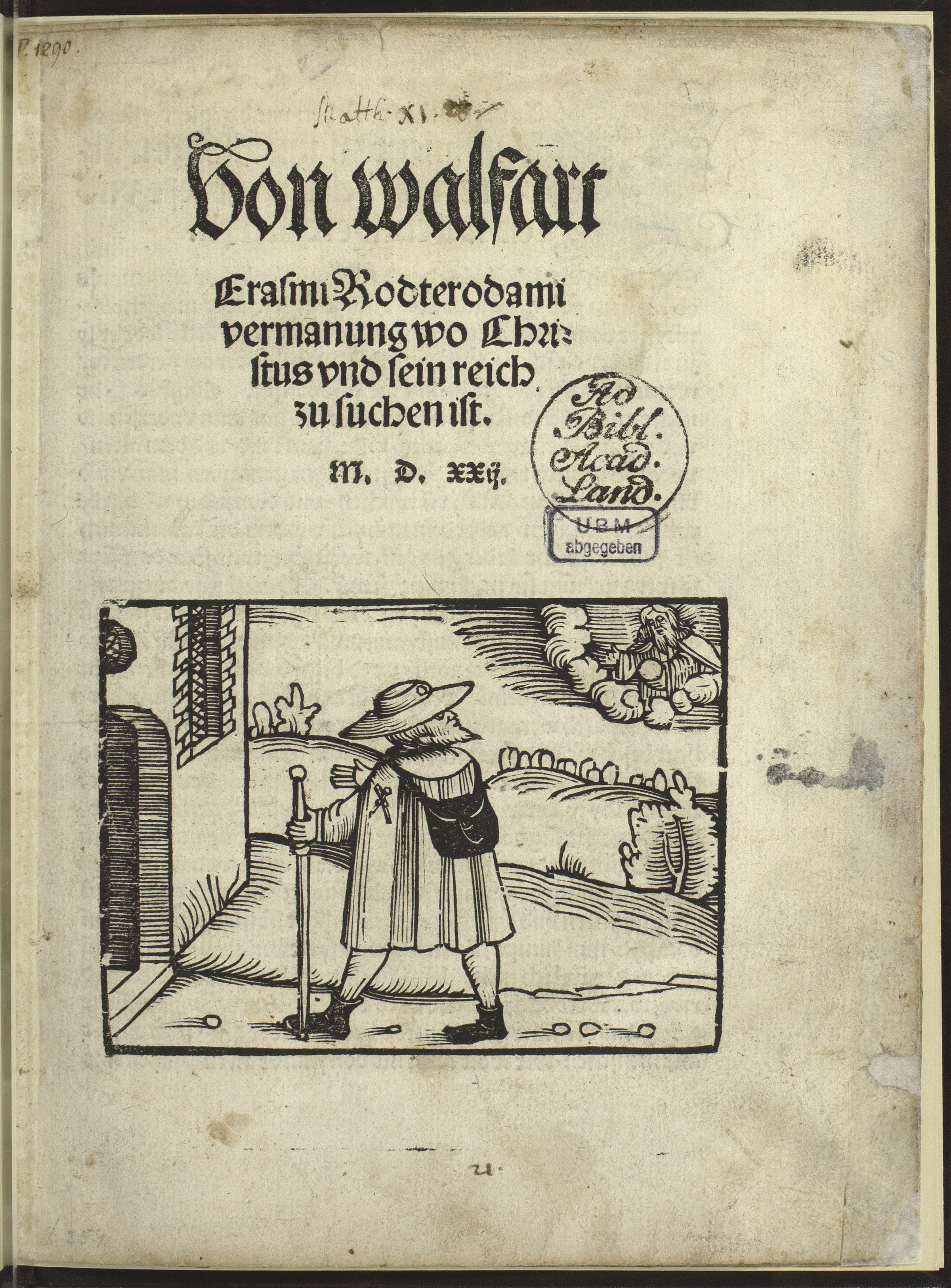
TextVon walfart
Erasmus, Desiderius, -1536Summary: Interpretive pamphlet by Erasmus on the true nature of pilgrimage, as espoused by Jesus in Matthew XI, 28. Erasmus says that true pilgrimage is undertaken with spiritual, and not with physical feet, and, that Jesus receives all sincere pilgrims equally, whether they be clergy or lay, rich or poor, etc.Summary: Interpretive pamphlet by Erasmus on the true nature of pilgrimage, as espoused by Jesus in Matthew XI, 28. Erasmus says that true pilgrimage is undertaken with spiritual, and not with physical feet, and, that Jesus receives all sincere pilgrims equally, whether they be clergy or lay, rich or poor, etc. -
 Text
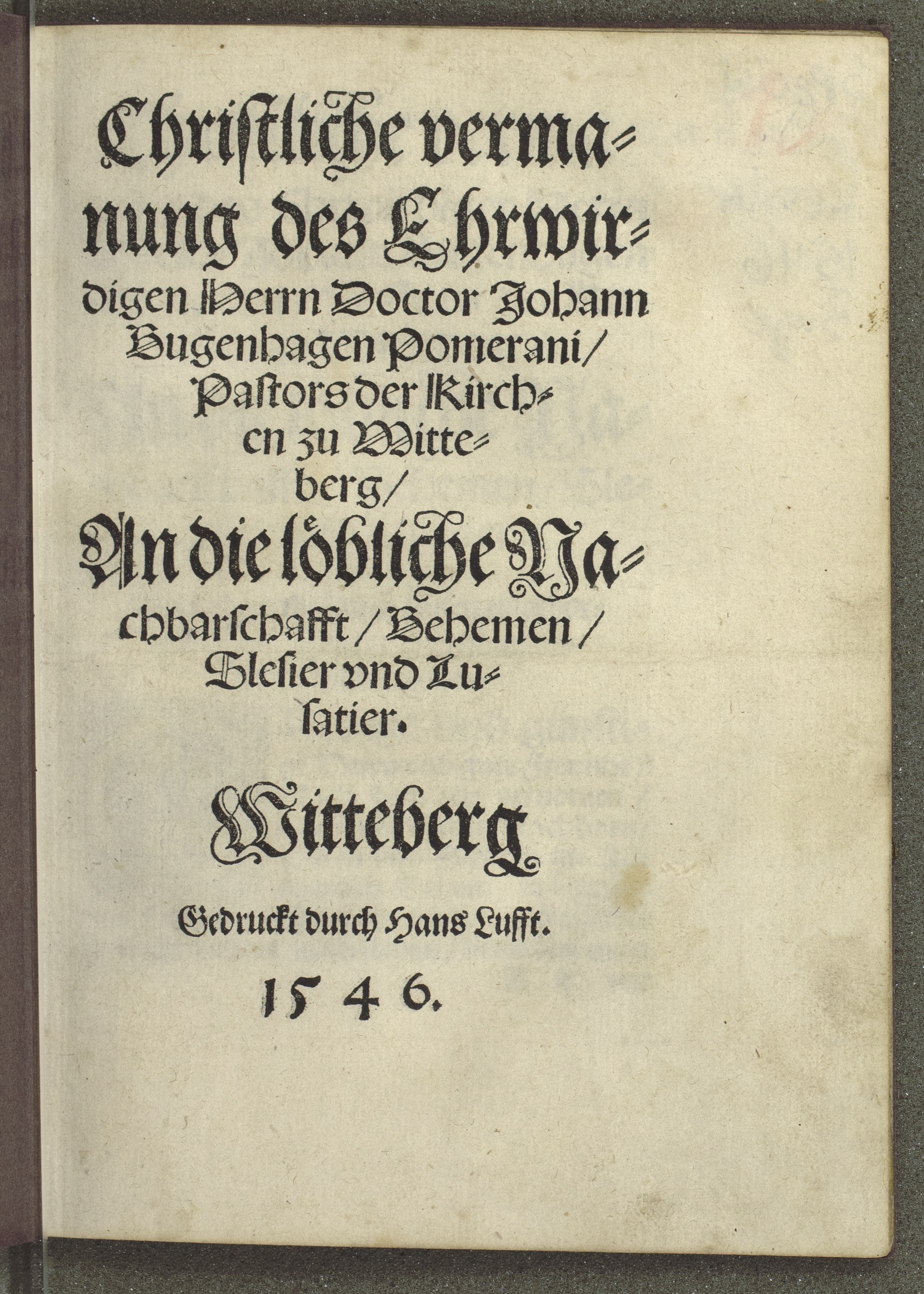
TextChristliche vermanung
Bugenhagen, Johann, 1485-1558Summary: A German translation of Bugenhagen's "Short Admonition Full of Piety" to his neighbors in Bohemia, Silesia, and Lusatia, asking that they not give assistance to the Emperor and his troops in their war against the Protestants.Summary: A German translation of Bugenhagen's "Short Admonition Full of Piety" to his neighbors in Bohemia, Silesia, and Lusatia, asking that they not give assistance to the Emperor and his troops in their war against the Protestants. -
 Text
TextVon dem falschen Blut vnd Abgott im Thum zu Schwerin. : mit einer schönen Vorrede
Faber, Aegidius, approximately 1490-1558Summary: A. Faber was a Lutheran pastor in Schwerin when he wrote this book in 1533 against the false "blood of Christ" and the "idol" (i.e., the shrine in which the blood was kept) in the Cathedral at Schwerin. Such Holy blood miracles made for exceedingly popular pilgrimage sites in pre-Reformation Germany.Summary: A. Faber was a Lutheran pastor in Schwerin when he wrote this book in 1533 against the false "blood of Christ" and the "idol" (i.e., the shrine in which the blood was kept) in the Cathedral at Schwerin. Such Holy blood miracles made for exceedingly popular pilgrimage sites in pre-Reformation Germany. -
 Text
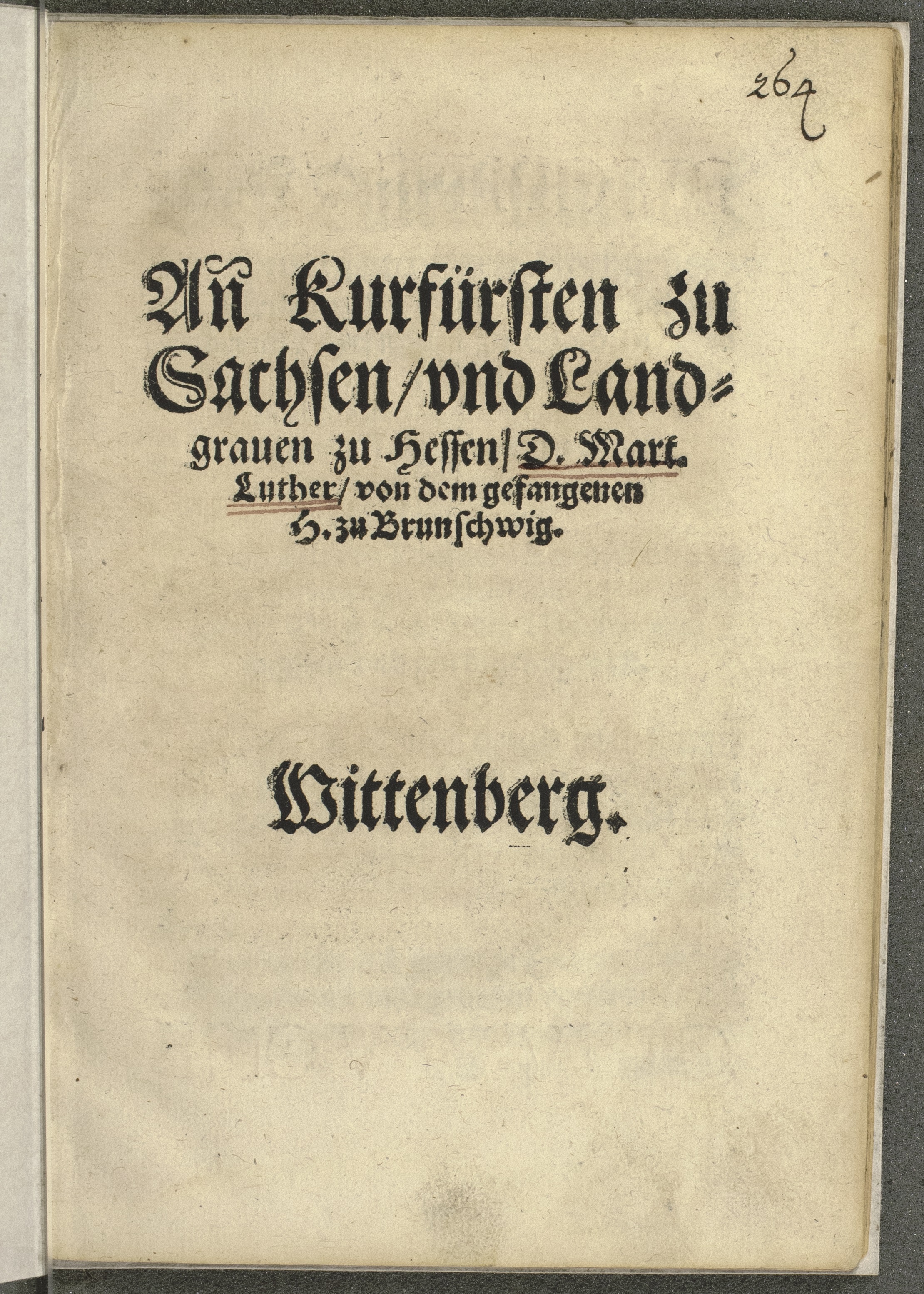
TextAn Kurfürsten zu Sachsen vnd Landgrauen zu Hessen
Luther, Martin, 1483-1546Summary: Addressed to Johann Friedrich of Saxony and Philipp of Hesse, relating to the imprisonment of Heinrich of Brunswick as a prisoner of war.Summary: Addressed to Johann Friedrich of Saxony and Philipp of Hesse, relating to the imprisonment of Heinrich of Brunswick as a prisoner of war. -
 Text
TextEin Predig vber die Epistel, so man liset von den heiligen Engeln. Apoc. xij. Wittenberg. M.D.Xliiij
Luther, Martin, 1483-1546Summary: Sermon preached September 21, 1544, on text: Revelation XII, 7-12 (St Michael Archangel).Summary: Sermon preached September 21, 1544, on text: Revelation XII, 7-12 (St Michael Archangel). -
 Text
TextConfessio fidei exhibita Inuictiss. Imp. Carolo V. Caesari Aug. in Comicijs Augustae, anno M.D.XXX. Addita est Apologia Confessionis. Wittenbergae
Summary: This is a fine, well-preserved copy of a sixteenth century edition of the "Confessio Augustana and Melanchthon's Apology."Summary: This is a fine, well-preserved copy of a sixteenth century edition of the "Confessio Augustana and Melanchthon's Apology." -
 Text
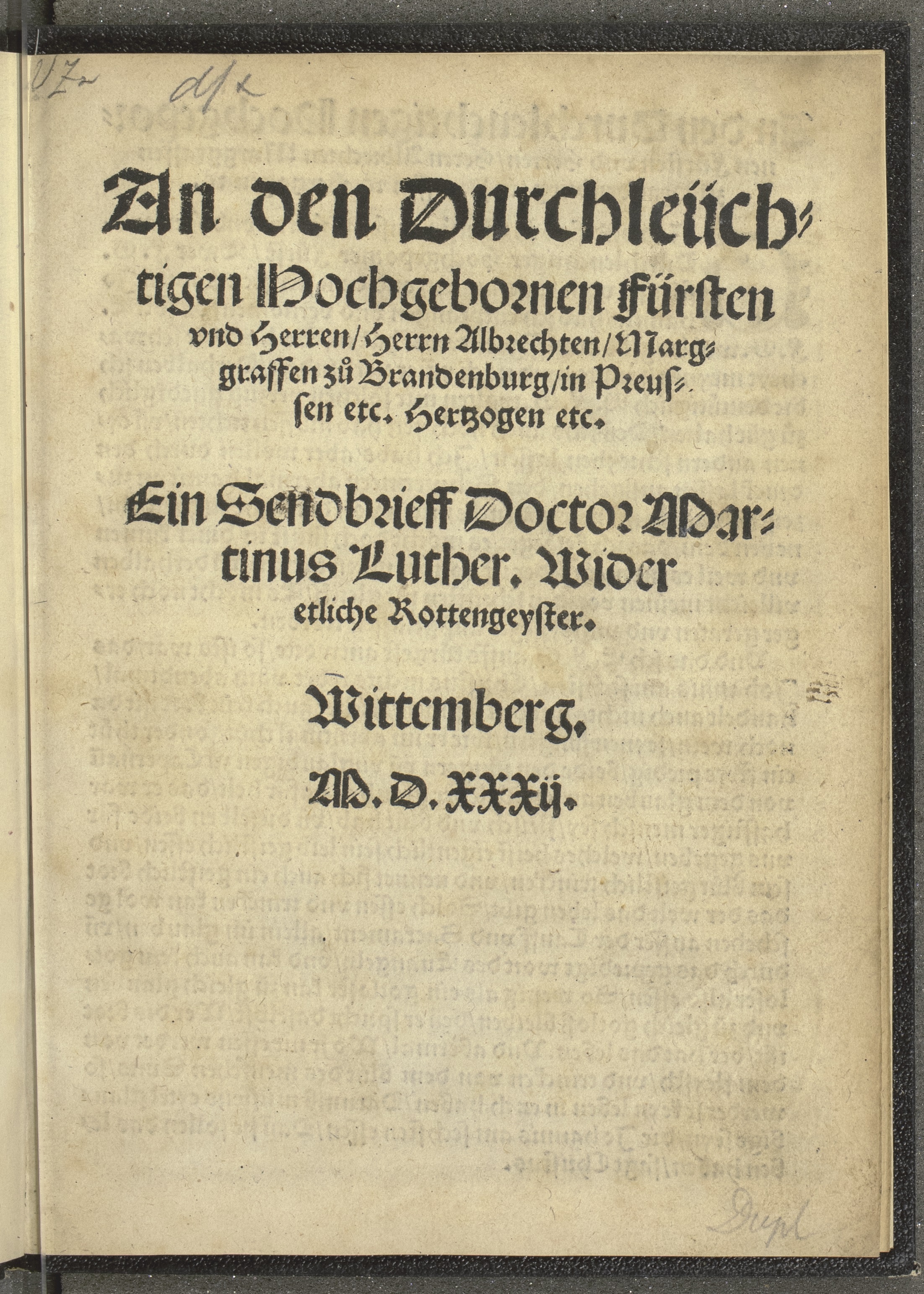
TextAn den Durchleüchtigen Hochgepornen Fürsten vnd Herrn, Herrn Albrechten, Marggraffen zuo Brandenburg, inn Preussen [et]c. Hertzogen [et]c. Ein Sendbrief Doct. Mart. Luth. Wider ettliche Rottengeyster : Wittemberg, M.D.XXXII
Luther, Martin, 1483-1546Summary: Luther's reply to a letter from Duke Albrecht of Brandenburg, concerning the interpretation of John VI with reference to the Lord's Supper.Summary: Luther's reply to a letter from Duke Albrecht of Brandenburg, concerning the interpretation of John VI with reference to the Lord's Supper. -
 Text
TextAn den Durchleüchtigen Hochgebornen Fürsten vnd Herren. Herrn Albrechten, Marggraffen zuo Brandenburg, in Preussen etc. Hertzogen etc.
Luther, Martin, 1483-1546Summary: After Albrecht, Duke of Prussia and last of the Masters of the Teutonic Knights, became a Protestant, he sought out preachers to fill the pulpits in his territory. Some were Lutherans, others were followers of Schwenckfeld. Luther here warns Albrecht about the heretical tendencies of the Schwenckfelders. Albrecht came increasingly under the influence of F. Von Heideck (a Schwenckfelder) and was not especially impressed by Luther's arguments against the use of John 6 in the interpretation of the Lord's Supper.Summary: After Albrecht, Duke of Prussia and last of the Masters of the Teutonic Knights, became a Protestant, he sought out preachers to fill the pulpits in his territory. Some were Lutherans, others were followers of Schwenckfeld. Luther here warns Albrecht about the heretical tendencies of the Schwenckfelders. Albrecht came increasingly under the influence of F. Von Heideck (a Schwenckfelder) and was not especially impressed by Luther's arguments against the use of John 6 in the interpretation of the Lord's Supper. -
 Text
TextDer CXLVII. Psalm Lauda Jerusalem
Luther, Martin, 1483-1546Summary: This is the second printing of Luther's exposition of Psalm 147. Text in German includes M. Luther's German translation of Psalms CXLVII from the Hebrew O.T.Summary: This is the second printing of Luther's exposition of Psalm 147. Text in German includes M. Luther's German translation of Psalms CXLVII from the Hebrew O.T. -
 Text
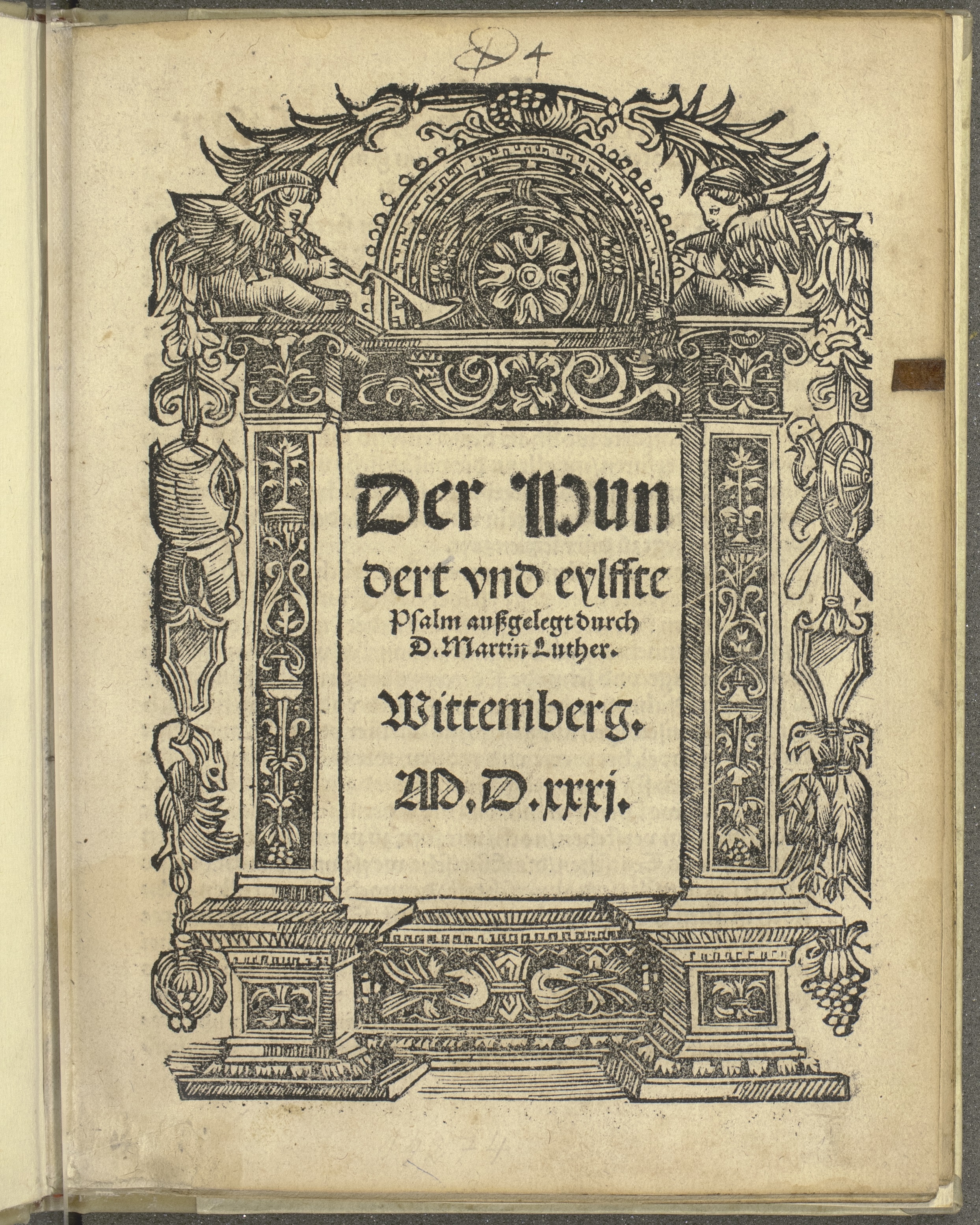
TextDer hundert vnd eylffte Psalm aussgelegt
Luther, Martin, 1483-1546Summary: 1531 printing of Luther's commentary on Psalm 111, written 1530 while he was staying at Coburg Fortress during the time of the Diet of Augsburg.Summary: 1531 printing of Luther's commentary on Psalm 111, written 1530 while he was staying at Coburg Fortress during the time of the Diet of Augsburg. -
 Text
TextVon Ehesachen
Luther, Martin, 1483-1546Summary: Second edition of the last of Luther's four tracts on marriage and married life. Luther addresses in particular the issue of secret or private engagements and their status in cases in which one of the parties enters into a public engagement.Summary: Second edition of the last of Luther's four tracts on marriage and married life. Luther addresses in particular the issue of secret or private engagements and their status in cases in which one of the parties enters into a public engagement. -
 Text
TextDas schön Confitemini an der zal der cxviij. Psalm
Luther, Martin, 1483-1546Summary: This is the third printing of Luther's German translation of his notes on Psalm 118. An Earlier German translation version had been published by Wenzeslaus Linck. Luther's expanded edition, as reprinted here, differs from Linck's in that it uses Eobanus Hessus' verse translation of the psalm, prepared with Luther's advice, as the scriptural text. Text in German includes Luther's German translation of Psalms CXVIII from the Hebrew O.T., and is Luther's expanded version of his earlier Latin work.Summary: This is the third printing of Luther's German translation of his notes on Psalm 118. An Earlier German translation version had been published by Wenzeslaus Linck. Luther's expanded edition, as reprinted here, differs from Linck's in that it uses Eobanus Hessus' verse translation of the psalm, prepared with Luther's advice, as the scriptural text. Text in German includes Luther's German translation of Psalms CXVIII from the Hebrew O.T., and is Luther's expanded version of his earlier Latin work. -
 Text
TextEyn Wyderrueff vom Fegfewr
Luther, Martin, 1483-1546Summary: One of several 1530 editions of a tract in which Luther rejects the Catholic doctrine of purgatory, a topic not addressed in the Augsburg Confessions.Summary: One of several 1530 editions of a tract in which Luther rejects the Catholic doctrine of purgatory, a topic not addressed in the Augsburg Confessions. -
 Text
TextEin Sendbrieff von Dolmetschen vnd Fürbitte der Heiligen
Luther, Martin, 1483-1546Summary: One of seven 1530 printings of a tract by Luther on his method of translating the Bible. Included is a short discussion on the possibility of intercessory prayer by the saints. The work is prefaced by Wenzeslaus Linck.Summary: One of seven 1530 printings of a tract by Luther on his method of translating the Bible. Included is a short discussion on the possibility of intercessory prayer by the saints. The work is prefaced by Wenzeslaus Linck. -
 Text
TextEine Heer predigt wider den Turcken
Luther, Martin, 1483-1546Summary: This is the third printing, second state, of Luther's sermon against the Turks.Summary: This is the third printing, second state, of Luther's sermon against the Turks. -
 Text
TextEyn Widerruff vom Fegefeur
Luther, Martin, 1483-1546Summary: Refutation, by Luther, of the teaching of Purgatory.Summary: Refutation, by Luther, of the teaching of Purgatory. -
 Text
TextVier trostliche Psalmen, an die Königin zu Hungern
Luther, Martin, 1483-1546Summary: An interpretation on 4 Consolation Psalms (Ps. 37, 62, 94, 109), written by Luther for Queen Mary of Hungary, sister of the Emperor Charles V, after the death of her husband Louis in the battle of Mohács.Summary: An interpretation on 4 Consolation Psalms (Ps. 37, 62, 94, 109), written by Luther for Queen Mary of Hungary, sister of the Emperor Charles V, after the death of her husband Louis in the battle of Mohács. -
 Text
TextDas der frey will nichts sey : Anntwort D. Martini Luther ann Erasmum Rotherdam
Luther, Martin, 1483-1546Summary: German translation by Martin Luther's colleague, Justus Jonas, of "De servo arbitrio". "De servo arbitrio (Concerning the Enslaved Will)" is considered one of Luther's greatest literary productions, and among the most important writings of the Reformation. In it, he defends the idea of the complete inability of the human being to please God, apart from Divine grace.Summary: German translation by Martin Luther's colleague, Justus Jonas, of "De servo arbitrio". "De servo arbitrio (Concerning the Enslaved Will)" is considered one of Luther's greatest literary productions, and among the most important writings of the Reformation. In it, he defends the idea of the complete inability of the human being to please God, apart from Divine grace. -
 Text
TextDas ander teyl widder die hymlischen Propheten, vom Sacrament.
Luther, Martin, 1483-1546Summary: The Second printing of Luther's book, "Against the Heavenly Prophets addresses A. Karlstadt's doctrine of the Sacraments. This is the second printing of this work in its year of issue.Summary: The Second printing of Luther's book, "Against the Heavenly Prophets addresses A. Karlstadt's doctrine of the Sacraments. This is the second printing of this work in its year of issue.

