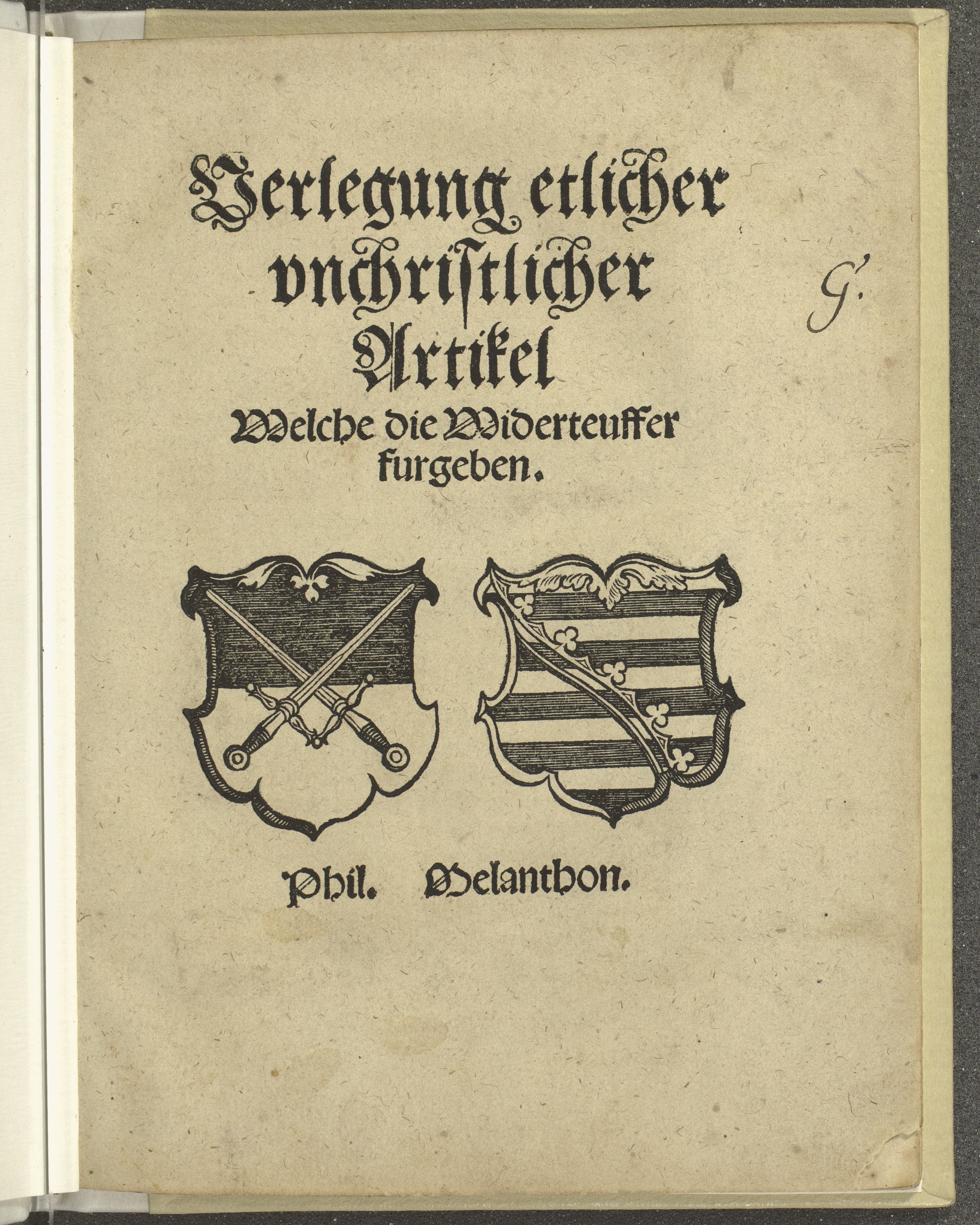
• Summary: In this piece, Melanchthon sharply attacks the major Anabaptist theological points. This is the second printing of the tract.
    Text

    Verlegung etlicher vnchristlicher Artikel : Welche die widerteuffer furgeben

    Melanchthon, Philipp, 1497-1560
    Summary: In this piece, Melanchthon sharply attacks the major Anabaptist theological points. This is the second printing of the tract.
    Summary: In this piece, Melanchthon sharply attacks the major Anabaptist theological points. This is the second printing of the tract.
  • Summary: First and only edition of an important source about the early relations between the Lutheran and Anabaptist movements.
    Text

    Wider den newen Taufforden : notwendige Warnung an alle Christgleubigen

    Rhegius, Urbanus, 1489-1541
    Summary: First and only edition of an important source about the early relations between the Lutheran and Anabaptist movements.
    Summary: First and only edition of an important source about the early relations between the Lutheran and Anabaptist movements.
  • Summary: In 1521, Melanchthon wrote the first Protestant dogmatics, the "Loci Communes." Eck countered in 1525 with his "handbook on Theological Topics". Possibly the most widely reprinted Catholic critique of Lutheran doctrine (Metzler lists 91 contemporary editions). Eck uses the same topical procedure and cites the Bible, Church Fathers, Councils, and Popes heavily in the presentation of his arguments.
    Text

    Enchiridion locorum communium aduersus Lutheranos

    Eck, Johann, 1486-1543
    Summary: In 1521, Melanchthon wrote the first Protestant dogmatics, the "Loci Communes." Eck countered in 1525 with his "handbook on Theological Topics". Possibly the most widely reprinted Catholic critique of Lutheran doctrine (Metzler lists 91 contemporary editions). Eck uses the same topical procedure and cites the Bible, Church Fathers, Councils, and Popes heavily in the presentation of his arguments.
    Summary: In 1521, Melanchthon wrote the first Protestant dogmatics, the "Loci Communes." Eck countered in 1525 with his "handbook on Theological Topics". Possibly the most widely reprinted Catholic critique of Lutheran doctrine (Metzler lists 91 contemporary editions). Eck uses the same topical procedure and cites the Bible, Church Fathers, Councils, and Popes heavily in the presentation of his arguments.
  • Summary: Polemical dialogue between a peasant and a monk, who had lost his livelihood after the dissolution of his monastery. The peasant advises the monk to try his hand at "real work".
    Text

    Ain schöner Dialogus wie ain Bawr mit aim Frawe[n] Brůder Münch redt : das er die Kutten von jm würfft, und dem Münch Arbayt zůgeben, lustbarlich und lieblich zů lesen

    Summary: Polemical dialogue between a peasant and a monk, who had lost his livelihood after the dissolution of his monastery. The peasant advises the monk to try his hand at "real work".
    Summary: Polemical dialogue between a peasant and a monk, who had lost his livelihood after the dissolution of his monastery. The peasant advises the monk to try his hand at "real work".
  • Summary: Anti-monastic tract by Hans Sachs, shoemaker, poet, and dramatist of Nürnberg, and strong supporter of Luther.
    Text

    Eyn gesprech vo[n] den Scheinwercke[n] der Gaystlichen, vnd jren gelübdten : damit sy zuouerlesterung des bluots Christi vermaynen selig zuowerden

    Sachs, Hans, 1494-1576
    Summary: Anti-monastic tract by Hans Sachs, shoemaker, poet, and dramatist of Nürnberg, and strong supporter of Luther.
    Summary: Anti-monastic tract by Hans Sachs, shoemaker, poet, and dramatist of Nürnberg, and strong supporter of Luther.
  • Summary: One of nine 1524 printings of this short anti-monastic tract by the Nuremberg cobbler and playright Hans Sachs.
    Text

    Eyn Gesprech vo[n] den Scheinwercke[n] der Gaystlichen, vnd jren gelübdten : damit sy zuouerlesterung des bluots Christi vermaynen selig zuowerden

    Sachs, Hans, 1494-1576
    Summary: One of nine 1524 printings of this short anti-monastic tract by the Nuremberg cobbler and playright Hans Sachs.
    Summary: One of nine 1524 printings of this short anti-monastic tract by the Nuremberg cobbler and playright Hans Sachs.
  • Summary: H. Sachs the Nuremberg "Master-Singer" and shoemaker became an early and ardent supporter of Luther and the Protestant cause. In this "trio-logue" a baker named Peter, a monk named Heinrich, and a shoemaker named Hans discuss questions relating to monastic life and monastic vows. The work is in prose, a change from Sachs' usual rhymed couplet format. This printing is from the same year as the first printing and re-uses the woodcut from the title page of the first printing.
    Text

    Ain Gesprech von den Scheynwercken der Gaystlichen, vnd jren gelübdten, : damit sy zuouerlesterung des blouts Christi vermayne[n] selig zuowerden

    Sachs, Hans, 1494-1576
    Summary: H. Sachs the Nuremberg "Master-Singer" and shoemaker became an early and ardent supporter of Luther and the Protestant cause. In this "trio-logue" a baker named Peter, a monk named Heinrich, and a shoemaker named Hans discuss questions relating to monastic life and monastic vows. The work is in prose, a change from Sachs' usual rhymed couplet format. This printing is from the same year as the first printing and re-uses the woodcut from the title page of the first printing.
    Summary: H. Sachs the Nuremberg "Master-Singer" and shoemaker became an early and ardent supporter of Luther and the Protestant cause. In this "trio-logue" a baker named Peter, a monk named Heinrich, and a shoemaker named Hans discuss questions relating to monastic life and monastic vows. The work is in prose, a change from Sachs' usual rhymed couplet format. This printing is from the same year as the first printing and re-uses the woodcut from the title page of the first printing.
  • Summary: Radical reformers such as Karlstadt believed that education was unnecessary for faith. Luther argued against such a position, asking all cities to set up schools to teach correct doctrine. He also emphasized the need for teaching Latin and Greek as part of Christian education. This is the first printing of this important tract.
    Text

    An die Radherrn aller stedte deutsches lands : das sie Christliche schulen auffrichten vnd halten sollen

    Luther, Martin, 1483-1546
    Summary: Radical reformers such as Karlstadt believed that education was unnecessary for faith. Luther argued against such a position, asking all cities to set up schools to teach correct doctrine. He also emphasized the need for teaching Latin and Greek as part of Christian education. This is the first printing of this important tract.
    Summary: Radical reformers such as Karlstadt believed that education was unnecessary for faith. Luther argued against such a position, asking all cities to set up schools to teach correct doctrine. He also emphasized the need for teaching Latin and Greek as part of Christian education. This is the first printing of this important tract.
  • Summary: Early sixteenth century Europe experienced a serious agrarian crisis, resulting in widespread discontent among the peasants. Luther often had to defend his views, as he does in a letter to the Saxon princes, against accusations that his writing influenced "the spirit of rebellion."
    Text

    Eyn brieff an die Fürsten zu Sachsen von dem auffrurischen geyst

    Luther, Martin, 1483-1546
    Summary: Early sixteenth century Europe experienced a serious agrarian crisis, resulting in widespread discontent among the peasants. Luther often had to defend his views, as he does in a letter to the Saxon princes, against accusations that his writing influenced "the spirit of rebellion."
    Summary: Early sixteenth century Europe experienced a serious agrarian crisis, resulting in widespread discontent among the peasants. Luther often had to defend his views, as he does in a letter to the Saxon princes, against accusations that his writing influenced "the spirit of rebellion."
  • Summary: Sixth printing of a letter addressed to Albrecht von Brandenburg (later Albert, Duke of Prussia) the new General of the Teutonic Knights. In response to a question by the general, Luther applies his critique of monastic celibacy to military orders, stressing that it is pleasing to God to have families and to raise children.
    Text

    An die Herren deütschs Ordens : das sye falsche Keüscheit meyden, und zuor rechten eelichen Keuscheit greiffen, Ermanung

    Luther, Martin, 1483-1546
    Summary: Sixth printing of a letter addressed to Albrecht von Brandenburg (later Albert, Duke of Prussia) the new General of the Teutonic Knights. In response to a question by the general, Luther applies his critique of monastic celibacy to military orders, stressing that it is pleasing to God to have families and to raise children.
    Summary: Sixth printing of a letter addressed to Albrecht von Brandenburg (later Albert, Duke of Prussia) the new General of the Teutonic Knights. In response to a question by the general, Luther applies his critique of monastic celibacy to military orders, stressing that it is pleasing to God to have families and to raise children.
  • Summary: In 1523, Albert of Brandenburg-Ansbach, Grand Master of the Teutonic Knights formerly embraced Lutheranism and secularized the lands of the order in Prussia. Luther was named as his court preacher, and was one of Duke Albert's most trusted advisors. This is a letter to the members of the order, advising them to reject their vows of celibacy and marry.
    Text

    An die herren Deutschs Ordens, das sy falsche keuschhait meyden, : Vnd zuor rechten Eelichen Keuschhait greyffen, Ermanu[n]g

    Luther, Martin, 1483-1546
    Summary: In 1523, Albert of Brandenburg-Ansbach, Grand Master of the Teutonic Knights formerly embraced Lutheranism and secularized the lands of the order in Prussia. Luther was named as his court preacher, and was one of Duke Albert's most trusted advisors. This is a letter to the members of the order, advising them to reject their vows of celibacy and marry.
    Summary: In 1523, Albert of Brandenburg-Ansbach, Grand Master of the Teutonic Knights formerly embraced Lutheranism and secularized the lands of the order in Prussia. Luther was named as his court preacher, and was one of Duke Albert's most trusted advisors. This is a letter to the members of the order, advising them to reject their vows of celibacy and marry.
  • Summary:
    Text

    Was man halten, vnnd Antwurtten soll, von der spaltung zwischen Martin Luther, vnnd Andres Carolstadt

    Capito, Wolfgang, 1478-1541
    Summary:
    Summary:
  • Summary: One of six 1523 editions of a collection of sermons delivered by Luther in 1522, directed against A. Karlstadt.
    Text

    Acht Sermon. D. M. Luthers vo[n] im gepredigt zu[o] Wittemberg inn der Fasten : Darinn kurtzlich begryffen von den Messen, Bildtnussen bayderlay gestalt des Sacramennts von denn speysen vnd haimlichen beycht. c. Wittemberg. 1.5.23

    Luther, Martin, 1483-1546
    Summary: One of six 1523 editions of a collection of sermons delivered by Luther in 1522, directed against A. Karlstadt.
    Summary: One of six 1523 editions of a collection of sermons delivered by Luther in 1522, directed against A. Karlstadt.
  • Summary: C. Schatzgeyer here writes on the veneration of the saints, the "friends of God". Catholic theology makes a sharp distinction between paying honor to saints (dulia) and worship of God (latria). This is the first printing of this work. No one knows for sure when it was written and printed.
    Text

    Caspar Sasgerus Minorita De cultu & ueneratione sanctorum

    Schatzgeyer, Kaspar, 1463 or 1464-1527
    Summary: C. Schatzgeyer here writes on the veneration of the saints, the "friends of God". Catholic theology makes a sharp distinction between paying honor to saints (dulia) and worship of God (latria). This is the first printing of this work. No one knows for sure when it was written and printed.
    Summary: C. Schatzgeyer here writes on the veneration of the saints, the "friends of God". Catholic theology makes a sharp distinction between paying honor to saints (dulia) and worship of God (latria). This is the first printing of this work. No one knows for sure when it was written and printed.
  • Summary: Johann Eberlin von Günzburg was a former Franciscan who had left the order and joined the Lutheran Reformation in 1521. This is the second edition of his tract on the dangers of priestly celibacy. He himself was married in 1524 and had four children. The title page woodcut shows the wedding of three different priests, including one to a nun.
    Text

    Wie gar geferlich sey. So ein Priester kein Eeweyb hat : Wie unchristlich, und schedlich eim Gemeynenn nutz die menschenn seind, weliche hindern die Pfaffẽ am Eelichen stand.

    Eberlin von Günzburg, Johann, approximately 1470-1533
    Summary: Johann Eberlin von Günzburg was a former Franciscan who had left the order and joined the Lutheran Reformation in 1521. This is the second edition of his tract on the dangers of priestly celibacy. He himself was married in 1524 and had four children. The title page woodcut shows the wedding of three different priests, including one to a nun.
    Summary: Johann Eberlin von Günzburg was a former Franciscan who had left the order and joined the Lutheran Reformation in 1521. This is the second edition of his tract on the dangers of priestly celibacy. He himself was married in 1524 and had four children. The title page woodcut shows the wedding of three different priests, including one to a nun.
  • Summary: This sermon on marriage is an elaboration of an earlier work no longer extant. In its present form there is no set Bible text, nor is the sermon designed for a particular place in the Church year.
    Text

    Uom eelichen Leben

    Luther, Martin, 1483-1546
    Summary: This sermon on marriage is an elaboration of an earlier work no longer extant. In its present form there is no set Bible text, nor is the sermon designed for a particular place in the Church year.
    Summary: This sermon on marriage is an elaboration of an earlier work no longer extant. In its present form there is no set Bible text, nor is the sermon designed for a particular place in the Church year.
  • Summary: Luther always felt a special fondness for this work. Nearly two decades after writing it, he remembered it as being especially powerful. It elicited response from Catholic opponents five years hence. Luther felt so strongly about this material that he translated it into German himself. The abuse of the title refers to the masses sung by chantry priests for individuals. Luther opposed any celebration of the Eucharist that was not accessible to or provided for the congregation at large. This edition written in German by Luther himself was preceded by a Latin edition of the same year with title: De abroganda missa privata Martini Lutheri sententia.
    Text

    Uom miszbrauch der Messen

    Luther, Martin, 1483-1546
    Summary: Luther always felt a special fondness for this work. Nearly two decades after writing it, he remembered it as being especially powerful. It elicited response from Catholic opponents five years hence. Luther felt so strongly about this material that he translated it into German himself. The abuse of the title refers to the masses sung by chantry priests for individuals. Luther opposed any celebration of the Eucharist that was not accessible to or provided for the congregation at large.
    Summary: Luther always felt a special fondness for this work. Nearly two decades after writing it, he remembered it as being especially powerful. It elicited response from Catholic opponents five years hence. Luther felt so strongly about this material that he translated it into German himself. The abuse of the title refers to the masses sung by chantry priests for individuals. Luther opposed any celebration of the Eucharist that was not accessible to or provided for the congregation at large.
  • Summary: A treatise by Luther on the relationship of belief and practice, intended for those "poor consciences, that lie captive to human laws in cloisters and monastic foundations", as he puts it in his preface. It is also noteworthy that Luther assumes his audience includes both those who could read his writings directly, and those who heard them read by others, when he dedicates his pamphlet "to all who read or hear this little book".
    Text

    Uon Menschenn Lere zu meyden

    Luther, Martin, 1483-1546
    Summary: A treatise by Luther on the relationship of belief and practice, intended for those "poor consciences, that lie captive to human laws in cloisters and monastic foundations", as he puts it in his preface. It is also noteworthy that Luther assumes his audience includes both those who could read his writings directly, and those who heard them read by others, when he dedicates his pamphlet "to all who read or hear this little book".
    Summary: A treatise by Luther on the relationship of belief and practice, intended for those "poor consciences, that lie captive to human laws in cloisters and monastic foundations", as he puts it in his preface. It is also noteworthy that Luther assumes his audience includes both those who could read his writings directly, and those who heard them read by others, when he dedicates his pamphlet "to all who read or hear this little book".
  • Summary: The tribulation of monks-turned Protestant, and then turned out of their monasteries, made fascinating reading for the newly-converted Protestants. In style, it is analogous to martyrologies, such as Foxe's "Book of Martyrs." G. Korn here relates his sufferings on account of the Gospel as one such monk in Nuremberg.
    Text

    Ein Worhafft geschicht wie es kürtzlich einem prediger Münch zuo Nürmberg mit seinen Ordens brüdern von wegen seiner Eua[n]gelischen predig ergangen ist

    Korn, Gallus
    Summary: The tribulation of monks-turned Protestant, and then turned out of their monasteries, made fascinating reading for the newly-converted Protestants. In style, it is analogous to martyrologies, such as Foxe's "Book of Martyrs." G. Korn here relates his sufferings on account of the Gospel as one such monk in Nuremberg.
    Summary: The tribulation of monks-turned Protestant, and then turned out of their monasteries, made fascinating reading for the newly-converted Protestants. In style, it is analogous to martyrologies, such as Foxe's "Book of Martyrs." G. Korn here relates his sufferings on account of the Gospel as one such monk in Nuremberg.
  • Summary: This is a copy of A. von Alveld's defense of the Catholic Church's doctrine of clerical celibacy.
    Text

    Vo[n] dem elichen sta[n]dt widder Bruder Martin Luter Doctor tzu Witte[n]berg

    Alveldt, Augustin von, active 16th century
    Summary: This is a copy of A. von Alveld's defense of the Catholic Church's doctrine of clerical celibacy.
    Summary: This is a copy of A. von Alveld's defense of the Catholic Church's doctrine of clerical celibacy.
  • Summary: First edition and first printing of Luther's address "To the Christian nobility of the German nation" is the first of three great Reformation booklets Luther wrote 1520. This piece was completed in August and divided into three parts: (1) an attack on the Papacy and denial of its claims, (2) a list of abuses by the papacy and curia, and (3) a list of necessary reforms.
    Text

    An den Christlichen Adel deutscher Nation : von des Christlichen standes besserung

    Luther, Martin, 1483-1546
    Summary: First edition and first printing of Luther's address "To the Christian nobility of the German nation" is the first of three great Reformation booklets Luther wrote 1520. This piece was completed in August and divided into three parts: (1) an attack on the Papacy and denial of its claims, (2) a list of abuses by the papacy and curia, and (3) a list of necessary reforms.
    Summary: First edition and first printing of Luther's address "To the Christian nobility of the German nation" is the first of three great Reformation booklets Luther wrote 1520. This piece was completed in August and divided into three parts: (1) an attack on the Papacy and denial of its claims, (2) a list of abuses by the papacy and curia, and (3) a list of necessary reforms.
Close