Search
430 resources
430 items
Quarto
-
 Still image
Historiated title page of Wider die mordischen vnd reubischen Rotten der Pawren
The title page of Martin Luther's Wider die mordischen vnd reubischen Rotten der Pawren featuring an architectural frame including floral patterns, columns, and a pair of fish.The title page of Martin Luther's Wider die mordischen vnd reubischen Rotten der Pawren featuring an architectural frame including floral patterns, columns, and a pair of fish. -
![The title page of Hans Baumann's Wie, vnd inn wölcher gestalt, der Eömischer [i.e. Römischer] Kayserlichen Mayestat, Landtgraff Philips von Hessen, auff dem neüntzehenden tag Junij, zuo Hall in Sachsen den fuossfall gethon. M.D.XLVII featuring the coat of arms of Holy Roman Emperor Charles V, which features the two-headed eagle of the Holy Roman Empire, bearing a quartered shield representing the regions he rules. The eagle is flanked by a pair of columns representing the Pillars of Hercules and his motto, "Plus Oultre," translated as "Further Beyond."](https://s3.us-west-2.amazonaws.com/omekacloud-main/large/P_000015270780_P00X/1547BAUM_000015270780_P00X.jpg) Still image
Still imageHistoriated title page of Wie, vnd inn wölcher gestalt, der Eömischer [i.e. Römischer] Kayserlichen Mayestat, Landtgraff Philips von Hessen, auff dem neüntzehenden tag Junij, zuo Hall in Sachsen den fuossfall gethon. M.D.XLVII
The title page of Hans Baumann's Wie, vnd inn wölcher gestalt, der Eömischer [i.e. Römischer] Kayserlichen Mayestat, Landtgraff Philips von Hessen, auff dem neüntzehenden tag Junij, zuo Hall in Sachsen den fuossfall gethon. M.D.XLVII featuring the coat of arms of Holy Roman Emperor Charles V, which features the two-headed eagle of the Holy Roman Empire, bearing a quartered shield representing the regions he rules. The eagle is flanked by a pair of columns representing the Pillars of Hercules and his motto, "Plus Oultre," translated as "Further Beyond."The title page of Hans Baumann's Wie, vnd inn wölcher gestalt, der Eömischer [i.e. Römischer] Kayserlichen Mayestat, Landtgraff Philips von Hessen, auff dem neüntzehenden tag Junij, zuo Hall in Sachsen den fuossfall gethon. M.D.XLVII featuring the coat of arms of Holy Roman Emperor Charles V, which features the two-headed eagle of the Holy Roman Empire, bearing a quartered shield representing the regions he rules. The eagle is flanked by a pair of columns representing the Pillars of Hercules and his motto, "Plus Oultre," translated as "Further Beyond." -
 Still image
Historiated title page of Wolfgang Wulffer's pamphlet calling Luther a false prophet
A woodcut border on the title page of Wolfgang Wulffer's pamphlet against Luther, calling him a "false prophet." The border is composed of a single woodcut depicting cherubs (top and sides), dragons (top left and right), and a man reclining while wearing a hood with pointed ears (bottom).A woodcut border on the title page of Wolfgang Wulffer's pamphlet against Luther, calling him a "false prophet." The border is composed of a single woodcut depicting cherubs (top and sides), dragons (top left and right), and a man reclining while wearing a hood with pointed ears (bottom). -
![The title page of Ptolemy's [Klaudiou Ptolemaiou Alexandreōs ... Peri tēs geōgraphias biblia octō meta pasēs akribeias entupothenta (romanized form)] = Claudii Ptolemaei Alexandrini De geographia libri octo : summa cum uigilantia excusi featuring the printer's mark of Johann Froben, a pair of hands supporting a caduceus.](https://s3.us-west-2.amazonaws.com/omekacloud-main/large/P_000015280561_P00X/1533PTOL_000015280561_P00X.jpg) Still image
Still imageHistoriated title page of [Klaudiou Ptolemaiou Alexandreōs ... Peri tēs geōgraphias biblia octō meta pasēs akribeias entupothenta (romanized form)] = Claudii Ptolemaei Alexandrini De geographia libri octo : summa cum uigilantia excusi
The title page of Ptolemy's [Klaudiou Ptolemaiou Alexandreōs ... Peri tēs geōgraphias biblia octō meta pasēs akribeias entupothenta (romanized form)] = Claudii Ptolemaei Alexandrini De geographia libri octo : summa cum uigilantia excusi featuring the printer's mark of Johann Froben, a pair of hands supporting a caduceus.The title page of Ptolemy's [Klaudiou Ptolemaiou Alexandreōs ... Peri tēs geōgraphias biblia octō meta pasēs akribeias entupothenta (romanized form)] = Claudii Ptolemaei Alexandrini De geographia libri octo : summa cum uigilantia excusi featuring the printer's mark of Johann Froben, a pair of hands supporting a caduceus. -
 Still image
Historiated title page to Johann Eck's pamphlet in support of Hieronymus Emser
A woodcut border on the title page of Johann Eck's pamphlet in support of Hieronymus Emser printed in 1519. The entire border is created using four different woodcuts on each side. The bottom woodcut features a pair of cherubs holding up the coat of arms of Chemintz (possibly a reversed coat of arms of Leipzig). The left hand woodcut includes a cherub holding up a decorative stand upon which is a man battling a boar. The right hand woodcut includes a bent over cherub supporting a decorative stand on top of which stands a drummer.A woodcut border on the title page of Johann Eck's pamphlet in support of Hieronymus Emser printed in 1519. The entire border is created using four different woodcuts on each side. The bottom woodcut features a pair of cherubs holding up the coat of arms of Chemintz (possibly a reversed coat of arms of Leipzig). The left hand woodcut includes a cherub holding up a decorative stand upon which is a man battling a boar. The right hand woodcut includes a bent over cherub supporting a decorative stand on top of which stands a drummer. -
 Still image
Historiated title page to Johann Lange's Oratio
A woodcut border on the title page of Johann Lange's Oratio published in 1519. The border is comprised of one complete woodcut and depicts a group of angels playing music as the Virgin Mary, Jesus, and several other saints watch. Additional scenes of cherubs picking fruit and climbing trees appear in the left and right border sections.A woodcut border on the title page of Johann Lange's Oratio published in 1519. The border is comprised of one complete woodcut and depicts a group of angels playing music as the Virgin Mary, Jesus, and several other saints watch. Additional scenes of cherubs picking fruit and climbing trees appear in the left and right border sections. -
 Still image
Historiated title page to Luther's In epistolam Pauli ad Galatas commentarius
Cranach, Lucas, 1472-1553A woodcut border on the title page of Luther's In epistolam Pauli ad Galatas commentarius printed in 1519. The border depicts philosophers gathered around the Castalian spring, where historically the Delphi priestesses bathed before announcing their oracles, with the twin peaks of Mount Parnassus in the background. Along the sides and top of the border are a series of musicians playing flutes, harps, bagpipes, lutes, horns, and violins.A woodcut border on the title page of Luther's In epistolam Pauli ad Galatas commentarius printed in 1519. The border depicts philosophers gathered around the Castalian spring, where historically the Delphi priestesses bathed before announcing their oracles, with the twin peaks of Mount Parnassus in the background. Along the sides and top of the border are a series of musicians playing flutes, harps, bagpipes, lutes, horns, and violins. -
 Still image
Historiated title page to Luther's In epistolam Pauli ad Galatas commentarius
Cranach, Lucas, 1472-1553A woodcut border on the title page of Luther's In epistolam Pauli ad Galatas commentarius printed in 1519. The border depicts philosophers gathered around the Castalian spring, where historically the Delphi priestesses bathed before announcing their oracles, with the twin peaks of Mount Parnassus in the background. Along the sides and top of the border are a series of musicians playing flutes, harps, bagpipes, lutes, horns, and violins.A woodcut border on the title page of Luther's In epistolam Pauli ad Galatas commentarius printed in 1519. The border depicts philosophers gathered around the Castalian spring, where historically the Delphi priestesses bathed before announcing their oracles, with the twin peaks of Mount Parnassus in the background. Along the sides and top of the border are a series of musicians playing flutes, harps, bagpipes, lutes, horns, and violins. -
 Still image
Historiated title page to Luther's Resolutiones Lutherianae super propositionibus suis Lipsiae disputatis
A woodcut border on the title page of Luther's Resolutiones Lutherianae super propositionibus suis Lipsiae disputatis printed in 1519. The border depicts a fox chasing a bird (bottom), three boars (one holding a sword, one stirring a pot, and one wearing a crown and holding a scepter; right), a man with a comb (?) (top), and two men (one with a bucket and the other working a printing press; left).A woodcut border on the title page of Luther's Resolutiones Lutherianae super propositionibus suis Lipsiae disputatis printed in 1519. The border depicts a fox chasing a bird (bottom), three boars (one holding a sword, one stirring a pot, and one wearing a crown and holding a scepter; right), a man with a comb (?) (top), and two men (one with a bucket and the other working a printing press; left). -
 Still image
Historiated title page to Luther's exposition of Psalm 109
A woodcut border on the title page of Luther's exposition of Psalm 109 printed in 1518. Along the bottom margin, the border features three portraits, one of the Virgin Mary holding Jesus, one of a saint holding a spear and a book (possibly Saint Longinus), and one of a pope. Along both side margins are a series of decorative elements, including a cherub, two men chasing each other around a column, a pair of cats, a goose, and a trio of women. At the top of the page, there is a scene of two women with fish tails for legs (possibly a reference to Scylla) flanking a running boy and bird.A woodcut border on the title page of Luther's exposition of Psalm 109 printed in 1518. Along the bottom margin, the border features three portraits, one of the Virgin Mary holding Jesus, one of a saint holding a spear and a book (possibly Saint Longinus), and one of a pope. Along both side margins are a series of decorative elements, including a cherub, two men chasing each other around a column, a pair of cats, a goose, and a trio of women. At the top of the page, there is a scene of two women with fish tails for legs (possibly a reference to Scylla) flanking a running boy and bird. -
 Still image
Historiated title page to Luther's sermon on the Sacrament of Penance
Cranach, Lucas, 1472-1553A woodcut border on the title page of the fifth printing of Luther's sermon on the sacrament of penance. The border depicts philosophers gathered around the Castalian spring, where historically the Delphi priestesses bathed before announcing their oracles, with the twin peaks of Mount Parnassus in the background. Along the sides and top of the border are a series of musicians playing flutes, harps, bagpipes, lutes, horns, and violins.A woodcut border on the title page of the fifth printing of Luther's sermon on the sacrament of penance. The border depicts philosophers gathered around the Castalian spring, where historically the Delphi priestesses bathed before announcing their oracles, with the twin peaks of Mount Parnassus in the background. Along the sides and top of the border are a series of musicians playing flutes, harps, bagpipes, lutes, horns, and violins. -
 Still image
Historiated title page to Silvestro da Prierio Mazzolini's refutation of Luther's 95 Theses
A woodcut border on the title page of Silvestro da Prierio Mazzolini's refutation of Luther's 95 Theses printed in 1518. Along the bottom margin, the border features three portraits, one of the Virgin Mary holding Jesus, one of a saint holding a spear and a book (possibly Saint Longinus), and one of a pope. Along both side margins are a series of decorative elements, including a cherub, two men chasing each other around a column, a pair of cats, a goose, and a trio of women.A woodcut border on the title page of Silvestro da Prierio Mazzolini's refutation of Luther's 95 Theses printed in 1518. Along the bottom margin, the border features three portraits, one of the Virgin Mary holding Jesus, one of a saint holding a spear and a book (possibly Saint Longinus), and one of a pope. Along both side margins are a series of decorative elements, including a cherub, two men chasing each other around a column, a pair of cats, a goose, and a trio of women. -
 Still image
Illuminated introduction page to Opus restitutionum usuarum et excommunicationum by Franciscus de Platea
An illuminated page from Franciscus de Platea's Opus restitutionum usurarum et excommunicationum. The illumination includes an initial letter "R" woven into a floral patterned border. The illumination uses red, green, and blue color with gold accents.An illuminated page from Franciscus de Platea's Opus restitutionum usurarum et excommunicationum. The illumination includes an initial letter "R" woven into a floral patterned border. The illumination uses red, green, and blue color with gold accents. -
 Still image
Illuminated page from the first sermon in Sermones quadragesimales de poenitentia by Roberto Caracciolo
An illuminated page from the first sermon in the 1472 printing of Roberto Caracciolo's Sermones quadragesimales de poenitentia. The illumination includes an initial letter "M" with accompanying floral imagery. At the bottom of the page is a coat of arms bearing a griffin surrounded by a laurel wreath. The illumination is done in red, green, blue, and black color with gold accents.An illuminated page from the first sermon in the 1472 printing of Roberto Caracciolo's Sermones quadragesimales de poenitentia. The illumination includes an initial letter "M" with accompanying floral imagery. At the bottom of the page is a coat of arms bearing a griffin surrounded by a laurel wreath. The illumination is done in red, green, blue, and black color with gold accents. -
 Text
TextIn Epistolam Pauli Ad Galatas, F. Martini Lutheri Augustiniani, commentarius
Luther, Martin, 1483-1546Summary: A commentary on Paul's letter to the Galatians.Summary: A commentary on Paul's letter to the Galatians. -
 Text
TextIn Epistolam Pauli ad Galatas, F. Martini Lutheri Augustiniani, commentarius ..
Luther, Martin, 1483-1546Summary: One of six 1519 printings of Luther's lectures on Paul's letter to the Galatians, first held in 1516. Galatians was Luther's favorite biblical book, which had a profound infulence on the formation of his theological thought and his understanding of law and grace.Summary: One of six 1519 printings of Luther's lectures on Paul's letter to the Galatians, first held in 1516. Galatians was Luther's favorite biblical book, which had a profound infulence on the formation of his theological thought and his understanding of law and grace. -
 Text
TextIn incendium Lutherianum Exclamatio
Hutten, Ulrich von, 1488-1523Summary: This poem is Hutten's reaction to the burning of Luther's books at Mainz by papal legates.Summary: This poem is Hutten's reaction to the burning of Luther's books at Mainz by papal legates. -
 Text
TextIngolstadii XI. Aprilis anni pr[a]esentis vicesimiquarti, publica disputatione per sacr[a]e theologi[a]e professores, examinabuntur : Septemdecim articuli per M. Arsatium Seehouer nuper reuocati : centum conclusiones per D. Leonardum Marstaller Nurnberge.
Universität IngolstadtSummary: A. Seehofer had been a student of Melanchthon. He taught at Ingolstadt until the authorities became cognizant of his heretical Protestant views. His books and papers were seized and he was forced to recant. This pamphlet includes his heretical theses as well as the refutations by L. Marstaller and N. Apell, both members of the university faculty. A German note at the end of the pamphlet warns against the spreading of false rumors and lies about these matters.Summary: A. Seehofer had been a student of Melanchthon. He taught at Ingolstadt until the authorities became cognizant of his heretical Protestant views. His books and papers were seized and he was forced to recant. This pamphlet includes his heretical theses as well as the refutations by L. Marstaller and N. Apell, both members of the university faculty. A German note at the end of the pamphlet warns against the spreading of false rumors and lies about these matters. -
 Text
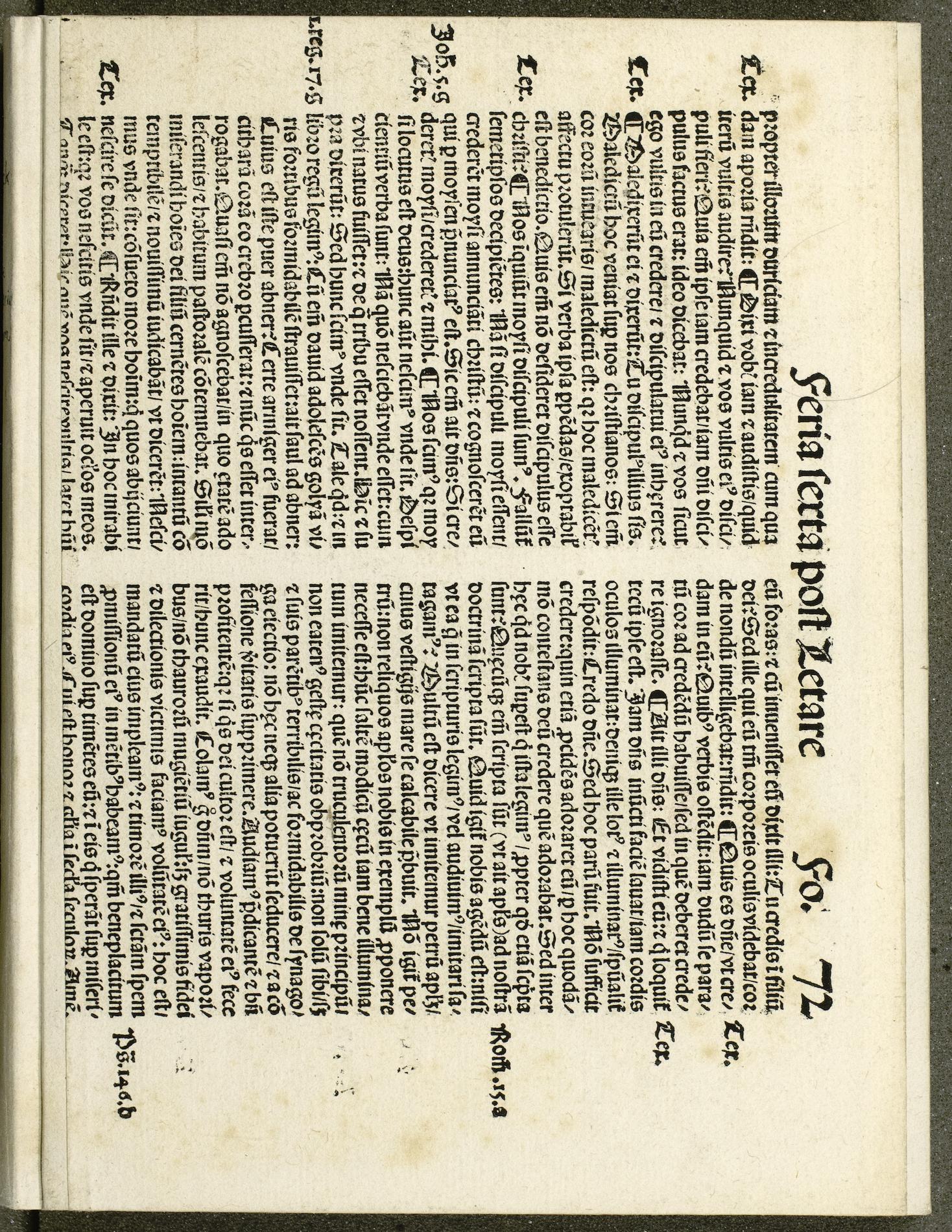
TextIoan. Eccii theologi Ingolstadii Procancellarij ... de materia iuramenti acutiss. decisio ad Georgium Kungspergium Augustanum
Eck, Johann, 1486-1543Summary: As professor of Logic and Rhetoric at Ingolstadt, Eck had the duty of writing the theses his students defended as part of the requirement for obtaining their doctorates. This one on oaths and vows was written and defended in 1516. M. Kretz was the respondent. This is a very early example of a printed dissertation.Summary: As professor of Logic and Rhetoric at Ingolstadt, Eck had the duty of writing the theses his students defended as part of the requirement for obtaining their doctorates. This one on oaths and vows was written and defended in 1516. M. Kretz was the respondent. This is a very early example of a printed dissertation. -
 Text
TextIohannes Fabri, episcopi Constantiensis In spiritualibus uicarii responsiones duae : quinquagesimaquinta uidelicet, & CXXVI. ex grandi eius uolumine excerptae & selectae, quarum prior est : De Antilogiis seu contradictionibus Martini Lutheri, altera, De Sacramentis scripturisq[ue] & fide.
Faber, Johannes, 1487-1541Summary: This rare anti-Lutheran tract was directed chiefly against Luther's views on the power of the Papacy, but includes material on the Word and Sacraments as well.Summary: This rare anti-Lutheran tract was directed chiefly against Luther's views on the power of the Papacy, but includes material on the Word and Sacraments as well. -
 Text
TextIudicium Martini Lutheri de votis : scriptum ad episcopos & diaconos Vuittembergen[sis] ecclesiae
Luther, Martin, 1483-1546Summary: First edition of a short tract written by Luther at Wartburg castle and addressed to the bishop and religious leaders in Wittenberg. In 139 brief statements, Luther warns that religious vows and monastic life do not by themselves bring about the forgiveness of sins.Summary: First edition of a short tract written by Luther at Wartburg castle and addressed to the bishop and religious leaders in Wittenberg. In 139 brief statements, Luther warns that religious vows and monastic life do not by themselves bring about the forgiveness of sins.