Search
430 resources
430 items
Quarto
-
 Still image
Medallion portraits of Erasmus, Hutten, Luther, and Melanchthon
A set of three woodcuts: two medallion portraits of Erasmus Desidarius and Ulrich van Hutten and one medallion schematic caricature double portrait of Martin Luther and Philip Melanchthon.A set of three woodcuts: two medallion portraits of Erasmus Desidarius and Ulrich van Hutten and one medallion schematic caricature double portrait of Martin Luther and Philip Melanchthon. -
 Still image
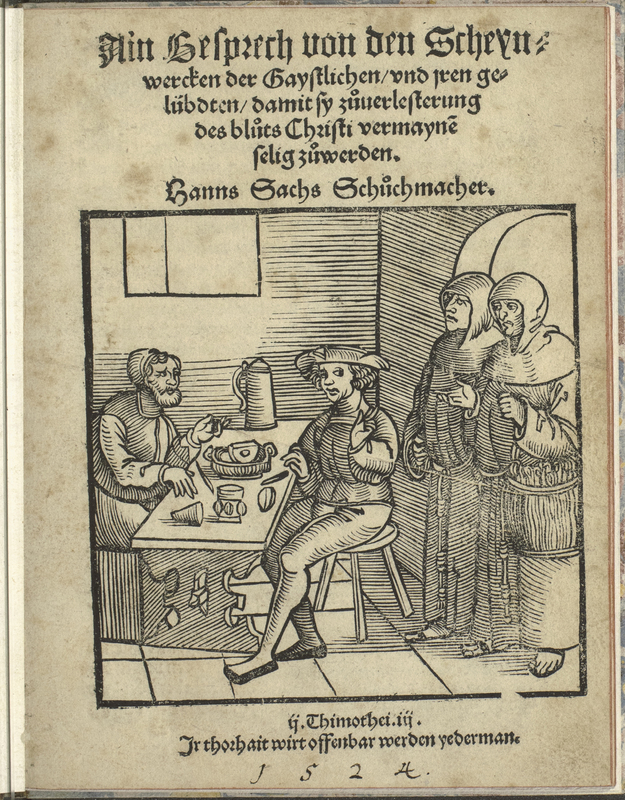
Mendicant Monks
A woodcut depicting a pair of mendicant monks standing beneath an archway as a pair of men sit at a table and wave them away.A woodcut depicting a pair of mendicant monks standing beneath an archway as a pair of men sit at a table and wave them away. -
 Still image
Mendicant Monks
A woodcut depicting a pair of mendicant monks standing beneath an archway as a pair of men sit at a table and wave them away.A woodcut depicting a pair of mendicant monks standing beneath an archway as a pair of men sit at a table and wave them away. -
 Still image
Mendicant Monks
A woodcut depicting a pair of mendicant monks standing beneath an archway as a pair of men sit at a table and wave them away.A woodcut depicting a pair of mendicant monks standing beneath an archway as a pair of men sit at a table and wave them away. -
 Still image
Monstrance
A woodcut depicting an elaborate monstrance, or an ostensorium, somewhat in the shape of a cathedral with a crucefix on top.A woodcut depicting an elaborate monstrance, or an ostensorium, somewhat in the shape of a cathedral with a crucefix on top. -
 Text
TextMultiloquus de co[n]citata ex dictis Lutheri seditio[n]e, : ad Inuictissimu[m] & optimu[m] Imperatore[m] ac multo[rum] regno[rum] Rege[m] inclitu[m] etc[etera]. Carolu[m] S.
Dungersheim, Hieronymus, 1465-1540Summary: H. Dungersheim had had a long academic career before the Reformation started. He proved to be a determined foe of Luther. In this rare book he presents "over a hundred" citations from Luther's books written before the Peasants' War (1525) to prove that Luther was a teacher of sedition and tumult.Summary: H. Dungersheim had had a long academic career before the Reformation started. He proved to be a determined foe of Luther. In this rare book he presents "over a hundred" citations from Luther's books written before the Peasants' War (1525) to prove that Luther was a teacher of sedition and tumult. -
 Text
TextNewe zeyttung, Wie zu Magdenburg ein Carmeliten Münch, auss der Sudenburg, der einen Christlichen Prediger, vor eyner gantzen Gemeyne hat liegen heissen, Von eynem Ersamen weysen Rat, der Alten stat, in gefencknus gezogen worden. : Reim weis gestelt.
Summary: Polemic ballad with a total of 142 rhymed lines, relating the story of a drunk Carmelite monk who attends a sermon preached outside the city by a righteous (Lutheran) pastor and who interrupts the preacher, accusing him of lying and misrepresenting Scripture. The people in response rise up and begin to beat him, almost killing him, but the monk is taken away and brought before the city council and the mayor who calls for calm and instructs that the monk should be locked up to await the executioner and thus be placed under God's justice rather than the mob's anger.Summary: Polemic ballad with a total of 142 rhymed lines, relating the story of a drunk Carmelite monk who attends a sermon preached outside the city by a righteous (Lutheran) pastor and who interrupts the preacher, accusing him of lying and misrepresenting Scripture. The people in response rise up and begin to beat him, almost killing him, but the monk is taken away and brought before the city council and the mayor who calls for calm and instructs that the monk should be locked up to await the executioner and thus be placed under God's justice rather than the mob's anger. -
 Text
TextOb man fur dem sterben fliehen muge
Luther, Martin, 1483-1546Summary: The Black Death ravaged Europe from the fourteenth century onward. Dr. Johann Hess, a pastor from Breslau, asked Luther in 1527 whether it was permissible for a person to flee from plague-infested areas. Luther replied that it was, and then added some public health advice for town and city government officials in plague-ravaged areas.Summary: The Black Death ravaged Europe from the fourteenth century onward. Dr. Johann Hess, a pastor from Breslau, asked Luther in 1527 whether it was permissible for a person to flee from plague-infested areas. Luther replied that it was, and then added some public health advice for town and city government officials in plague-ravaged areas. -
 Text
TextOpus restitutionum usurarum et excommunicationum
Platea, Franciscus de, -1460Summary: This work on restitution usury and excommunication by Franciscus de Platea, an Italian Franciscan, was printed nine times in the 15th century, this edition being the second.Summary: This work on restitution usury and excommunication by Franciscus de Platea, an Italian Franciscan, was printed nine times in the 15th century, this edition being the second. -
 Text
TextOratio
Eck, Johann, 1486-1543Summary: This is the first printing of Eck's speech to the Diet of Regensburg on April 5, 1541, defining the Catholic understanding of the Lord's Supper. The Diet of Regensburg proved to be Eck's last appearance as a major theological political leader, for his health declined and he could no longer bear the weight of these grueling encounters.Summary: This is the first printing of Eck's speech to the Diet of Regensburg on April 5, 1541, defining the Catholic understanding of the Lord's Supper. The Diet of Regensburg proved to be Eck's last appearance as a major theological political leader, for his health declined and he could no longer bear the weight of these grueling encounters. -
 Text
TextOratio
Lange, Johann, 1485-1565Summary: This is the speech by J. Lange von Lemberg, Rector of the University of Leipzig, given at the end of the Leipzig Disputation. Lange von Lemberg takes no sides in the Disputation but praises all the contestants, especially Luther. This is the only printing of the work.Summary: This is the speech by J. Lange von Lemberg, Rector of the University of Leipzig, given at the end of the Leipzig Disputation. Lange von Lemberg takes no sides in the Disputation but praises all the contestants, especially Luther. This is the only printing of the work. -
 Text
TextOrdenung vn[d] bericht wie es furterhin (mit yenen so das hochwirdig Sacrament empfahen wolle[n]) gehalten soll werden
Luther, Martin, 1483-1546Summary: Early guidance by Luther on how a Christian ought to approach and receive the Lord's Supper. Includes the Words of Institution, the Aaronic Benediction, and a series of questions that ought to be put to everyone wishing to receive the Sacrament, with appropriate answers.Summary: Early guidance by Luther on how a Christian ought to approach and receive the Lord's Supper. Includes the Words of Institution, the Aaronic Benediction, and a series of questions that ought to be put to everyone wishing to receive the Sacrament, with appropriate answers. -
 Text
TextOrdnu[n]g wie man tauffet, bissher im Latein gehalten, verteütscht : Hierin ist, auss etlichen Ursachen, was die andern, als uberflüssig, veracht haben, nicht aussgelassen
Catholic ChurchSummary: Osiander provides a fuller translation of the traditional Catholic rite of baptism than Münzer or Luther, who had both published baptism liturgies one year earlier, and who had eliminated certain ritual elements.Summary: Osiander provides a fuller translation of the traditional Catholic rite of baptism than Münzer or Luther, who had both published baptism liturgies one year earlier, and who had eliminated certain ritual elements. -
 Text
TextPassional Christi vnnd Antichristi
Luther, Martin, 1483-1546Summary: A polemic in the form of thirteen pairs of woodcuts (with captions) depicting scenes from the life of Christ contrasted with scenes from the life of the Pope. The text for the Latin edition was by P. Melanchthon and J. Schwertfeger, while that for the German edition was by M. Luther. The text consists of quotations from the Gospels and the canon law. This collaborative effort between Lukas Cranach and Luther is among the more famous pieces of popular propaganda provided during the reformation. Luther wrote the German texts to accompany Cranach's woodcuts.Summary: A polemic in the form of thirteen pairs of woodcuts (with captions) depicting scenes from the life of Christ contrasted with scenes from the life of the Pope. The text for the Latin edition was by P. Melanchthon and J. Schwertfeger, while that for the German edition was by M. Luther. The text consists of quotations from the Gospels and the canon law. This collaborative effort between Lukas Cranach and Luther is among the more famous pieces of popular propaganda provided during the reformation. Luther wrote the German texts to accompany Cranach's woodcuts. -
 Text
TextPhilipps Melanchtons Sendtbrieff an ein Kartheüser, von den dreyen Clostergelübten : Von der Keüschait, Von der Armuot, Und von der gehorsam ; wittenberg, 1524
Melanchthon, Philipp, 1497-1560Summary: First German printing of this treatise by Philipp Melanchthon on the three monastic vows of poverty, chastity, and obedience.Summary: First German printing of this treatise by Philipp Melanchthon on the three monastic vows of poverty, chastity, and obedience. -
 Still image
Plate 22: Differentes sortes de Pêches
Bénard, 1731-1794Plate 22 from Recueil de planches de l'Encyclopédie, par ordre de matières. Pêches displaying implements used in beachcombing and shoreline fishing, including a depiction of the tools in use at the top of the page.Plate 22 from Recueil de planches de l'Encyclopédie, par ordre de matières. Pêches displaying implements used in beachcombing and shoreline fishing, including a depiction of the tools in use at the top of the page. -
 Still image
Pope Leo X's Coat of Arms
A woodcut of Pope Leo X's coat of arms, appearing on the title page of the official papal bull excommunicating Martin Luther. The coat of arms features the crossed keys to the kingdom of Heaven and the Papal crown, the traditional symbols of the Papacy, and the coat of arms of the Medici family, to which Pope Leo X belonged.A woodcut of Pope Leo X's coat of arms, appearing on the title page of the official papal bull excommunicating Martin Luther. The coat of arms features the crossed keys to the kingdom of Heaven and the Papal crown, the traditional symbols of the Papacy, and the coat of arms of the Medici family, to which Pope Leo X belonged. -
 Still image
Portrait of Ulrich von Hutten
A woodcut portrait of Ulrich van Hutten dressed in armor and wearing a laurel crown. Below the portrait is the motto "IACTA EST ALEA," translated as "the die is cast." In the four corners of the portrait are coats of arms.A woodcut portrait of Ulrich van Hutten dressed in armor and wearing a laurel crown. Below the portrait is the motto "IACTA EST ALEA," translated as "the die is cast." In the four corners of the portrait are coats of arms. -
 Text
TextR.P. Fratris Siluestri Prieratis ordinis praedicatorum et sacre Theologie p[ro]fessoris celeberrimi sacriq[ue] palatij apostolici magistri: in p[re]sumptuosas Martini Luther co[n]clusio[n]es de p[otes]tate pape dialog[us]
Mazzolini, Silvestro, da Prierio, 1456?-1527?Summary: S. Mazzolini was Master of the Sacred Palace (Vatican) in Rome, censor of books, and one of the first Catholic literary opponents of Luther. This is an early printing of the first work issued in opposition to Luther. Where the printing fits in bibliographically is still a matter of dispute. The work is in dialogue form and contains a refutation of Luther's 95 theses.Summary: S. Mazzolini was Master of the Sacred Palace (Vatican) in Rome, censor of books, and one of the first Catholic literary opponents of Luther. This is an early printing of the first work issued in opposition to Luther. Where the printing fits in bibliographically is still a matter of dispute. The work is in dialogue form and contains a refutation of Luther's 95 theses. -
 Still image
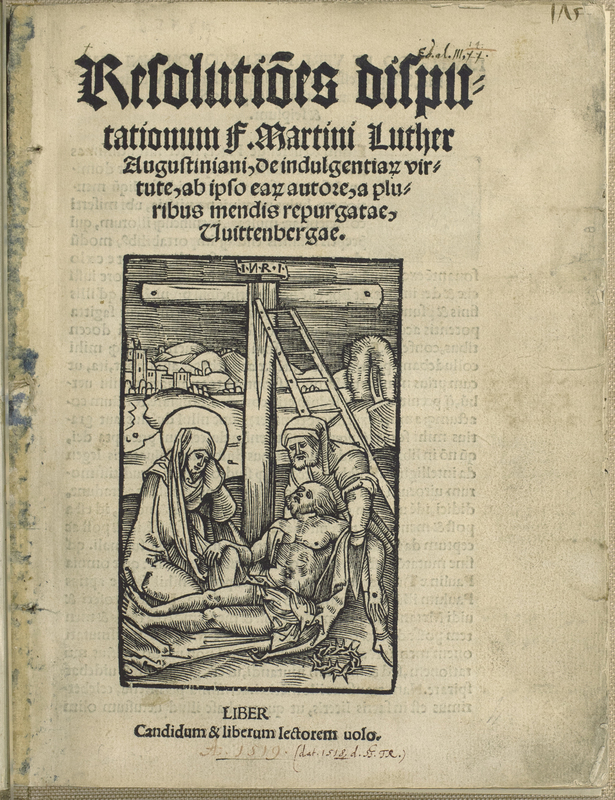
Removal of Jesus from the Cross
A woodcut depicting Mary and Joseph of Arimathea taking the body of Jesus down from the cross. The crown of thorns lies on the ground beside Jesus and the inscription "INRI" appears above the cross.A woodcut depicting Mary and Joseph of Arimathea taking the body of Jesus down from the cross. The crown of thorns lies on the ground beside Jesus and the inscription "INRI" appears above the cross. -
 Text
TextReplica F. Sylvestri Prieriat[is] : sacri Palatii Apostolici Magistri, ad F. Martinum Luther Ordinis Eremitaru[m] ; Martinus Luther, optimo lectori salutem ...
Mazzolini, Silvestro, da Prierio, 1456?-1527?Summary: When Luther received the replies of S. Mazzolini, the first man to take up the cudgels against Luther, he found the best course of reply to be a reprinting with notes of Mazzolini's inept rejoinders. Even the Catholics had to admit that Mazzolini's answers simply did not meet Luther's objections. This is the second printing of the work.Summary: When Luther received the replies of S. Mazzolini, the first man to take up the cudgels against Luther, he found the best course of reply to be a reprinting with notes of Mazzolini's inept rejoinders. Even the Catholics had to admit that Mazzolini's answers simply did not meet Luther's objections. This is the second printing of the work.