Search
398 resources
398 items
Language
Latin
-
 Still image
Martin Luther as an Augustinian Monk
A woodcut depicting Martin Luther in the garb of an Augustinian Monk. Below Luther is a traditional Luther rose. Surrounding the portrait is an inscription, mirrored as the image was printed in reverse, reading "DOCTOR MARTINUS LUTTER AUGUSTINER: WITTENB:". This is purported to be the earliest depiction of Luther.A woodcut depicting Martin Luther in the garb of an Augustinian Monk. Below Luther is a traditional Luther rose. Surrounding the portrait is an inscription, mirrored as the image was printed in reverse, reading "DOCTOR MARTINUS LUTTER AUGUSTINER: WITTENB:". This is purported to be the earliest depiction of Luther. -
 Still image
Martin Luther as an Augustinian Monk
A woodcut depicting Martin Luther in the garb of an Augustinian Monk. Below Luther is a traditional Luther rose. Surrounding the portrait is an inscription, mirrored as the image was printed in reverse, reading "DOCTOR MARTINUS LUTTER AUGUSTINER: WITTENB:". This is purported to be the earliest depiction of Luther.A woodcut depicting Martin Luther in the garb of an Augustinian Monk. Below Luther is a traditional Luther rose. Surrounding the portrait is an inscription, mirrored as the image was printed in reverse, reading "DOCTOR MARTINUS LUTTER AUGUSTINER: WITTENB:". This is purported to be the earliest depiction of Luther. -
 Still image
Martinus Lutherus Septiceps
A woodcut depicting Martin Luther as a seven-headed monster, critiquing his deviation from Catholicism. Each head is labeled (from left to right): Doctor, Martinus, Lutherus, Ecclesiastes, Suermerus, Visitactor, and Barrabas. This was a classic piece of Catholic propaganda, portraying Luther not only as a Doctor and Churchman, but as a Turk, a wild enthusiast (Suermerus) and "Barrabas."A woodcut depicting Martin Luther as a seven-headed monster, critiquing his deviation from Catholicism. Each head is labeled (from left to right): Doctor, Martinus, Lutherus, Ecclesiastes, Suermerus, Visitactor, and Barrabas. This was a classic piece of Catholic propaganda, portraying Luther not only as a Doctor and Churchman, but as a Turk, a wild enthusiast (Suermerus) and "Barrabas." -
 Still image
Martinus V Papa Romanus
Soye, Philippe deAn engraved portrait of Pope Martin V, who sat as pope from 1417-1431. The portrait shows Martin V wearing a simple vestments with his coat of arms featured in the upper right corner. The portrait is labeled "MARTINVS. V. PAPA. ROMANVS".An engraved portrait of Pope Martin V, who sat as pope from 1417-1431. The portrait shows Martin V wearing a simple vestments with his coat of arms featured in the upper right corner. The portrait is labeled "MARTINVS. V. PAPA. ROMANVS". -
 Still image
Medallion portraits of Erasmus, Hutten, Luther, and Melanchthon
A set of three woodcuts: two medallion portraits of Erasmus Desidarius and Ulrich van Hutten and one medallion schematic caricature double portrait of Martin Luther and Philip Melanchthon.A set of three woodcuts: two medallion portraits of Erasmus Desidarius and Ulrich van Hutten and one medallion schematic caricature double portrait of Martin Luther and Philip Melanchthon. -
 Still image
Monstrance
A woodcut depicting an elaborate monstrance, or an ostensorium, somewhat in the shape of a cathedral with a crucefix on top.A woodcut depicting an elaborate monstrance, or an ostensorium, somewhat in the shape of a cathedral with a crucefix on top. -
 Still image
Monumentum Pii Papae V. in quo et effigies et res eius pontificis preclare gestae eleganter in marmore exprimuntur
An engraving depicting the papal monument of Pius V in the Sistine Chapel in the Basilica di Santa Maria Maggiore. The monument sits on the western wall of the chapel and includes a statue of the pope as well as depictions of his life and works.An engraving depicting the papal monument of Pius V in the Sistine Chapel in the Basilica di Santa Maria Maggiore. The monument sits on the western wall of the chapel and includes a statue of the pope as well as depictions of his life and works. -
 Text
TextMoralia in Job
Gregory I, Pope, approximately 540-604Manuscript leaf with rotunda script from the early part of the high Middle Ages. The text is from a copy of the commentary on Job by Gregory the Great, who applied a threefold exegesis to the biblical text, including the literal sense, the tropoligical (or moral) sense and the allegorical sense.Manuscript leaf with rotunda script from the early part of the high Middle Ages. The text is from a copy of the commentary on Job by Gregory the Great, who applied a threefold exegesis to the biblical text, including the literal sense, the tropoligical (or moral) sense and the allegorical sense. -
 Still image
Moses Returning the Red Sea
Raphael, 1483-1520An engraving depicting Moses kneeling beside the Red Sea and reaching out his hand so that the waters could comeback over the Egyptians along with their chariots and horsemen. The men dressed in armor and on horseback depict the Egyptians, and the men standing behind Moses depict the Israelites.An engraving depicting Moses kneeling beside the Red Sea and reaching out his hand so that the waters could comeback over the Egyptians along with their chariots and horsemen. The men dressed in armor and on horseback depict the Egyptians, and the men standing behind Moses depict the Israelites. -
 Text
TextMultiloquus de co[n]citata ex dictis Lutheri seditio[n]e, : ad Inuictissimu[m] & optimu[m] Imperatore[m] ac multo[rum] regno[rum] Rege[m] inclitu[m] etc[etera]. Carolu[m] S.
Dungersheim, Hieronymus, 1465-1540Summary: H. Dungersheim had had a long academic career before the Reformation started. He proved to be a determined foe of Luther. In this rare book he presents "over a hundred" citations from Luther's books written before the Peasants' War (1525) to prove that Luther was a teacher of sedition and tumult.Summary: H. Dungersheim had had a long academic career before the Reformation started. He proved to be a determined foe of Luther. In this rare book he presents "over a hundred" citations from Luther's books written before the Peasants' War (1525) to prove that Luther was a teacher of sedition and tumult. -
 Still image
Nicolaus V Papa Sergianensis
Soye, Philippe deAn engraved portrait of Pope Nicholas V, who sat as pope from 1447-1455. The portrait shows Nicholas V wearing a papal miter with his coat of arms featured in the upper right corner. The portrait is labeled "NICOLAVS. V. PAPA. SERGIANENSIS".An engraved portrait of Pope Nicholas V, who sat as pope from 1447-1455. The portrait shows Nicholas V wearing a papal miter with his coat of arms featured in the upper right corner. The portrait is labeled "NICOLAVS. V. PAPA. SERGIANENSIS". -
 Still image
Non marcescet
Chauveau, François, 1613-1676An engraved tailpiece to the second, fifth, and eleventh books of Moyne's epic, "Saint Louys," depicting a laurel crown above a monogram, above which is a banner with the Latin motto, "non marcescet" (it will not fade/wither).An engraved tailpiece to the second, fifth, and eleventh books of Moyne's epic, "Saint Louys," depicting a laurel crown above a monogram, above which is a banner with the Latin motto, "non marcescet" (it will not fade/wither). -
 Text
TextNote on Old Testament Chronology
Luther, Martin, 1483-1546A manuscript in Martin Luther's own hand, "Notes on Two Chronological Difficulties in the Old Testament" (see Weimar Edition of The Works of Martin Luther, Volume 60, page 163). The document is a seven line author's note written in 1541, in which Luther discussed the accuracy of the computations in his 1541 work, Computation of the Years of the World. (Weimar Edition of The Works of Martin Luther, Volume 53, pages 177-182).A manuscript in Martin Luther's own hand, "Notes on Two Chronological Difficulties in the Old Testament" (see Weimar Edition of The Works of Martin Luther, Volume 60, page 163). The document is a seven line author's note written in 1541, in which Luther discussed the accuracy of the computations in his 1541 work, Computation of the Years of the World. (Weimar Edition of The Works of Martin Luther, Volume 53, pages 177-182). -
 Still image
Obeliscus Pamphilius
An engraving depicting detailed representations of the four sides of the Obelisk of Domitian, which had been moved by Pope Innocent X from the Via Appia to his family home, the Palazzo Pamphilj. Between the four sides, there is a small representation of the obelisk with a decorative ribbon proclaiming it the "Obelisus Pamphilius" (bottom), a cherub holding a pair of medallions with a portrait of Innocent X (left) and the obelisk (right) (middle), and an angel lying on a cloud supporting Innocent X's coat of arms.An engraving depicting detailed representations of the four sides of the Obelisk of Domitian, which had been moved by Pope Innocent X from the Via Appia to his family home, the Palazzo Pamphilj. Between the four sides, there is a small representation of the obelisk with a decorative ribbon proclaiming it the "Obelisus Pamphilius" (bottom), a cherub holding a pair of medallions with a portrait of Innocent X (left) and the obelisk (right) (middle), and an angel lying on a cloud supporting Innocent X's coat of arms. -
 Still image
Offensam remittere
Galle, Philippe, 1537-1612The act of forgiving offenses, illustrated and accompanied by scriptural references.The act of forgiving offenses, illustrated and accompanied by scriptural references. -
 Still image
Olim efflorescet
Chauveau, François, 1613-1676An engraved tailpiece to the first, fourth, seventh, and thirteenth books of Moyne's epic, "Saint Louys," depicting a crown of thorns above a monogram, above which is a banner with the Latin motto, "olim efflorescet" (In the future, it will bloom/grow/flourish).An engraved tailpiece to the first, fourth, seventh, and thirteenth books of Moyne's epic, "Saint Louys," depicting a crown of thorns above a monogram, above which is a banner with the Latin motto, "olim efflorescet" (In the future, it will bloom/grow/flourish). -
 Text
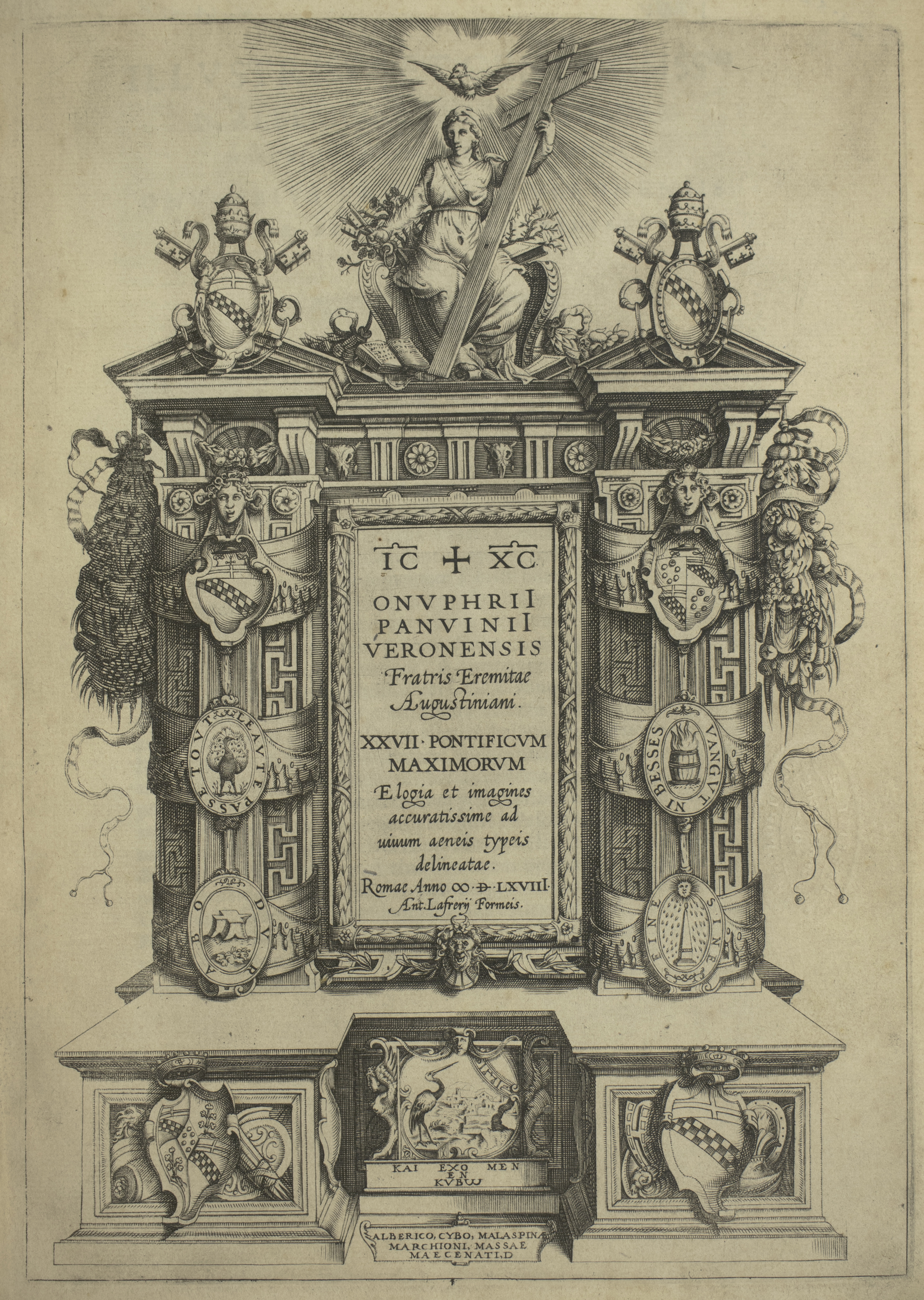
TextOnuphrii Panuinii Veronensis Fratris Eremitae Augustiniani. XXVII. Pontificum Maximorum elogia et imagines
Panvinio, Onofrio, 1529-1568Summary:Summary: -
 Text
TextOpus restitutionum usurarum et excommunicationum
Platea, Franciscus de, -1460Summary: This work on restitution usury and excommunication by Franciscus de Platea, an Italian Franciscan, was printed nine times in the 15th century, this edition being the second.Summary: This work on restitution usury and excommunication by Franciscus de Platea, an Italian Franciscan, was printed nine times in the 15th century, this edition being the second. -
 Text
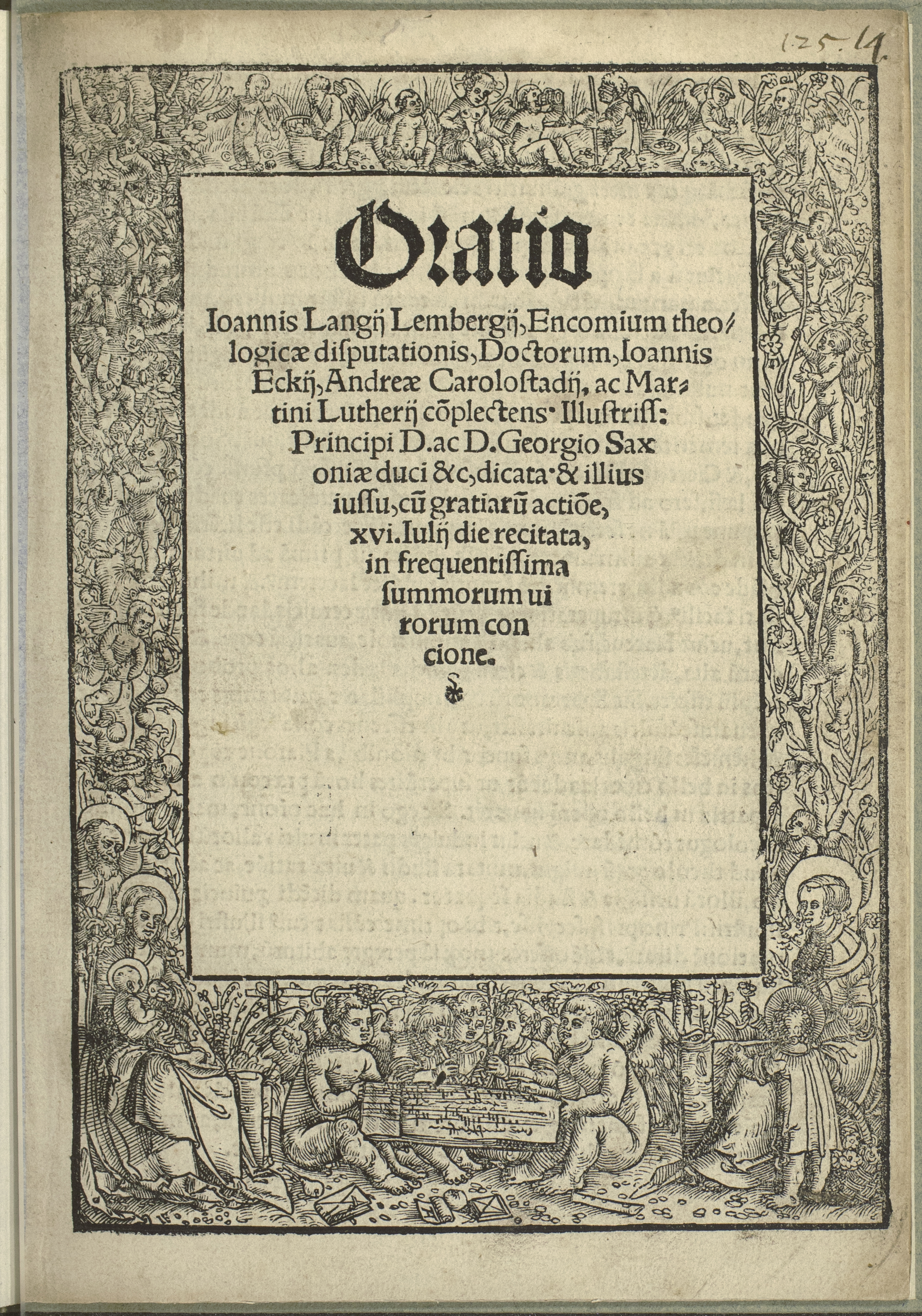
TextOratio
Lange, Johann, 1485-1565Summary: This is the speech by J. Lange von Lemberg, Rector of the University of Leipzig, given at the end of the Leipzig Disputation. Lange von Lemberg takes no sides in the Disputation but praises all the contestants, especially Luther. This is the only printing of the work.Summary: This is the speech by J. Lange von Lemberg, Rector of the University of Leipzig, given at the end of the Leipzig Disputation. Lange von Lemberg takes no sides in the Disputation but praises all the contestants, especially Luther. This is the only printing of the work. -
 Text
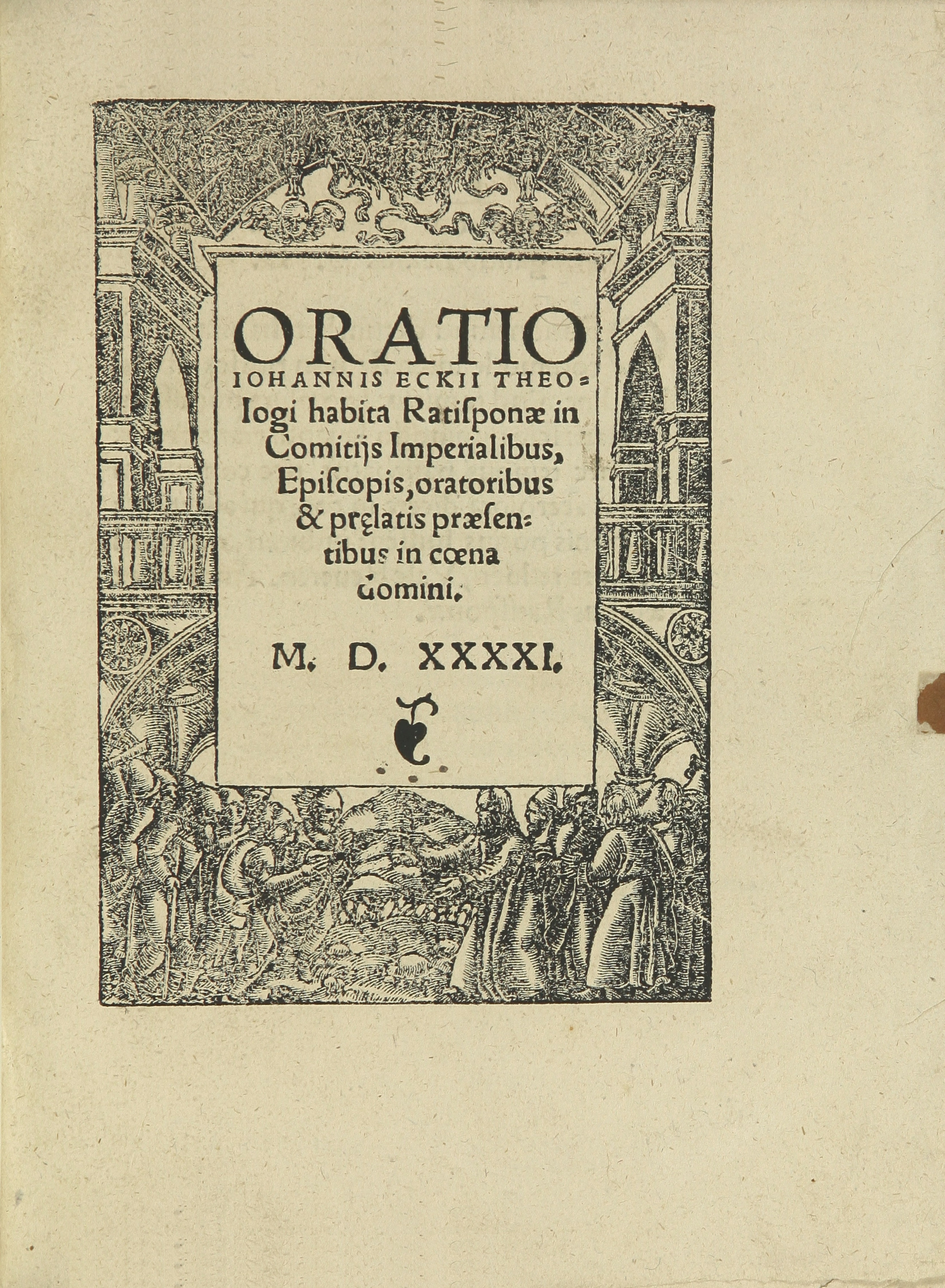
TextOratio
Eck, Johann, 1486-1543Summary: This is the first printing of Eck's speech to the Diet of Regensburg on April 5, 1541, defining the Catholic understanding of the Lord's Supper. The Diet of Regensburg proved to be Eck's last appearance as a major theological political leader, for his health declined and he could no longer bear the weight of these grueling encounters.Summary: This is the first printing of Eck's speech to the Diet of Regensburg on April 5, 1541, defining the Catholic understanding of the Lord's Supper. The Diet of Regensburg proved to be Eck's last appearance as a major theological political leader, for his health declined and he could no longer bear the weight of these grueling encounters. -
 Text
TextOratio in funere Reverendi viri D. Martini Lutheri
Melanchthon, Philipp, 1497-1560Summary: This is the original Latin version of Melanchthon's funeral oration for Luther, preached in Wittenberg, February 22, 1546. The friendship between Luther and Melanchthon was almost legendary, even in their own lifetimes, and this deeply moving oration is an eloquent testimony to the depth of Melanchthon's feelings for his friend of twenty-eight years.Summary: This is the original Latin version of Melanchthon's funeral oration for Luther, preached in Wittenberg, February 22, 1546. The friendship between Luther and Melanchthon was almost legendary, even in their own lifetimes, and this deeply moving oration is an eloquent testimony to the depth of Melanchthon's feelings for his friend of twenty-eight years.