Search
398 resources
398 items
Language
Latin
-
 Still image
Latus aquilonare Liberianae Basilicae idemq[ue] dexterum ab ortu intranti cui ab summo versus orientem pars ext[...] praenobilis sacrarii a Paulo V extructi ab imo atem sacelli quod praecipuo splendore Sixtus V aedificavit posteriores partes in[...]
An engraving of the northern facade of the Basilica di Santa Maria Maggiore.An engraving of the northern facade of the Basilica di Santa Maria Maggiore. -
 Still image
Leo X Papa Florentinus
Soye, Philippe deAn engraved portrait of Pope Leo X, who sat as pope from 1513-1521. The portrait shows Leo X wearing a simple miter with his coat of arms featured in the upper right corner. The portrait is labeled "LEO. X. PAPA. FLORENTINVS".An engraved portrait of Pope Leo X, who sat as pope from 1513-1521. The portrait shows Leo X wearing a simple miter with his coat of arms featured in the upper right corner. The portrait is labeled "LEO. X. PAPA. FLORENTINVS". -
 Text
TextLetter from Johannes Cochlaeus to Julius von Pflug
Cochlaeus, Johannes, 1479-1552This letter was written by Cochlaeus on June 6, 1547 to Julius von Pflug, the last Prince Bishop of Naumburg. Cochlaeus congratulates von Pflug on his reinstatemnnt into his office following the defeat and capture of Elector John Frederick of Saxony in the Schmalkald War. The letter also contains a reference by Cochlaus to the transfer to Bologna of the meetings that became known as the Council of Trent.This letter was written by Cochlaeus on June 6, 1547 to Julius von Pflug, the last Prince Bishop of Naumburg. Cochlaeus congratulates von Pflug on his reinstatemnnt into his office following the defeat and capture of Elector John Frederick of Saxony in the Schmalkald War. The letter also contains a reference by Cochlaus to the transfer to Bologna of the meetings that became known as the Council of Trent. -
 Text
TextLetter from Kaspar Cruciger to Viet Dietrich, July 8, 1544
Cruciger, Kaspar, 1504-1548This letter was written by Cruciger on July 8, 1544 to Veit Dietrich, pastor of St. Sebald’s Church at Nuremberg. In the letter Cruciger discussed personal matters related to himself, Dietrich, Martin Luther, and Philipp Melanchthon. He also writes about the collection of Luther’s sermons he and Dietrich were to publish together in the following year.This letter was written by Cruciger on July 8, 1544 to Veit Dietrich, pastor of St. Sebald’s Church at Nuremberg. In the letter Cruciger discussed personal matters related to himself, Dietrich, Martin Luther, and Philipp Melanchthon. He also writes about the collection of Luther’s sermons he and Dietrich were to publish together in the following year. -
 Text
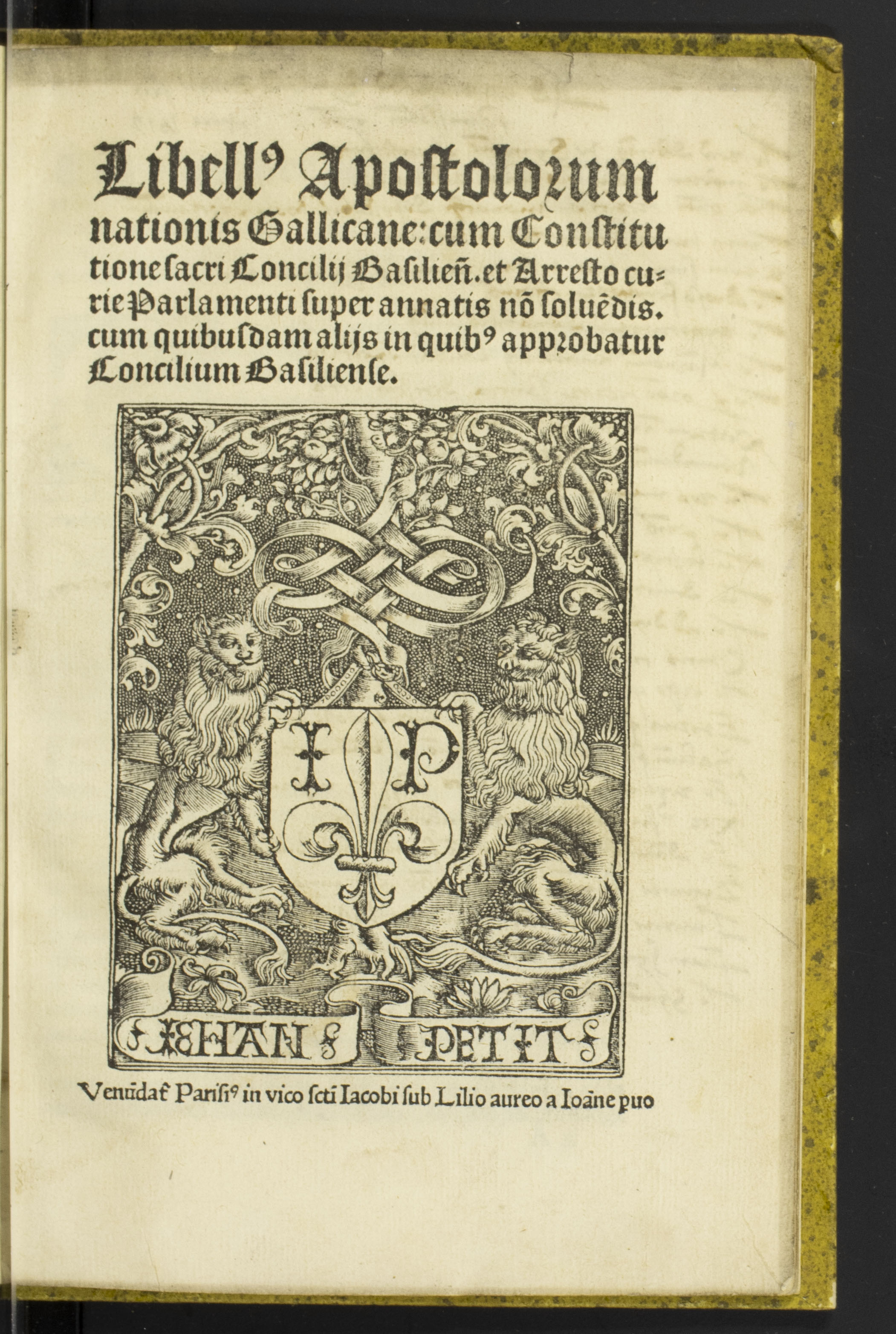
TextLibell[us] Apostolorum nationis Gallicane: cum Constitutione Sacri Concilij Basilien[sis] et arresto curie parlamenti supper annatis no[n] solve[n]dis, cum quibusdam alijs in quib[us] approbatur Concilium Basiliense.
Summary: The Second Council of Pisa (1511-1512), also known as the Conciliabulum of Pisa, was a French initiative to limit the power of Pope Julius II and to strengthen the power of the conciliarists. Pope Julius II condemned the meeting and in response convoked the Fifth Lateran Council, which secured papal authority over conciliarism. This is the first edition of a record of the council published by Jean Petit for a French readership.Summary: The Second Council of Pisa (1511-1512), also known as the Conciliabulum of Pisa, was a French initiative to limit the power of Pope Julius II and to strengthen the power of the conciliarists. Pope Julius II condemned the meeting and in response convoked the Fifth Lateran Council, which secured papal authority over conciliarism. This is the first edition of a record of the council published by Jean Petit for a French readership. -
 Text
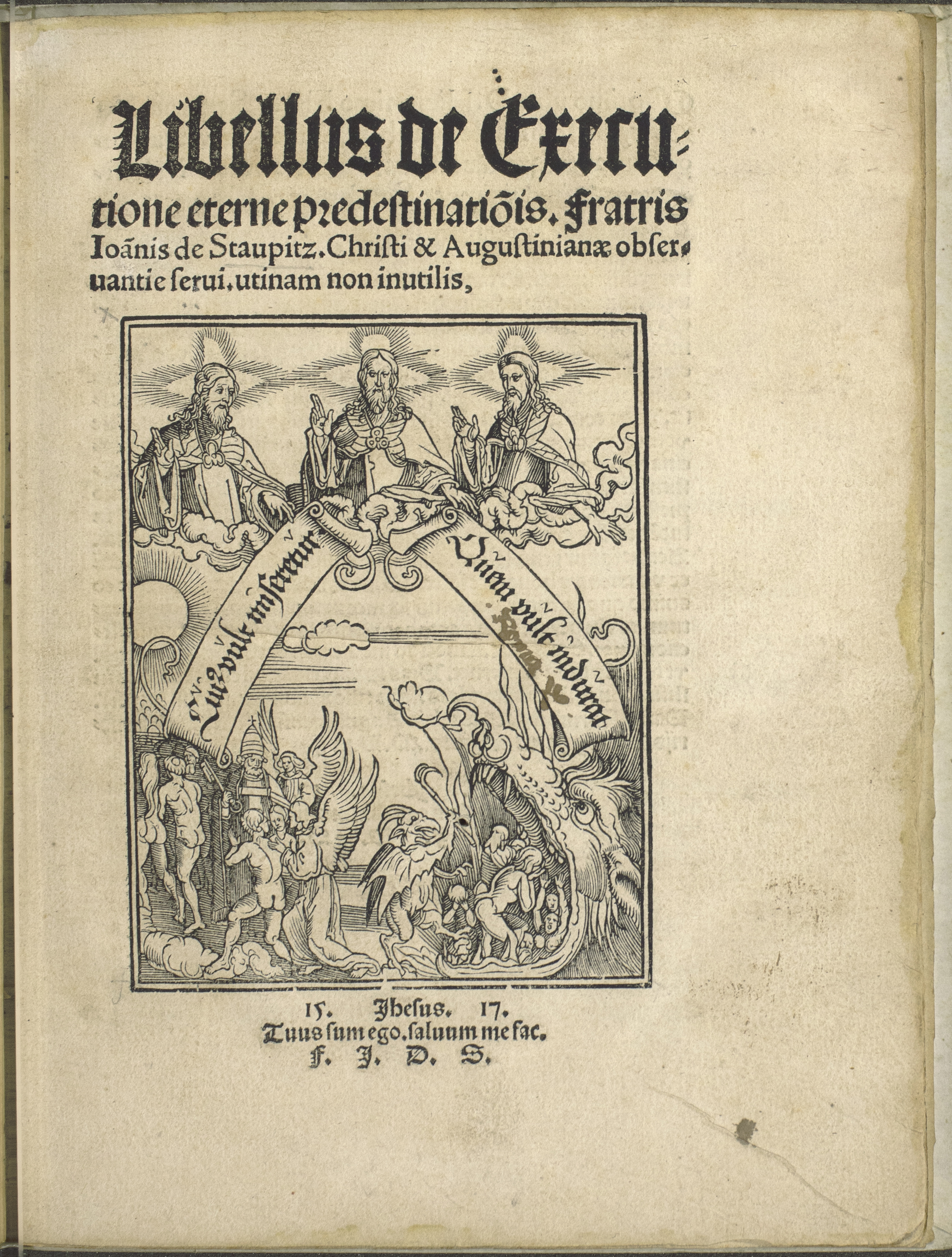
TextLibellus de executione etern[a]e predestinatio[n]is
Staupitz, Johann von, -1524Summary: This is a short work by Staupitz on predestination.Summary: This is a short work by Staupitz on predestination. -
 Text
TextLiber
Sacro Bosco, Joannes de, active 1230Summary: J. de Sacro Bosco was an English mathematician who taught in Paris after 1230. This work on astronomy was only the second by a Western scholar based on Arabic researches to be printed (1472). The book was frequently reprinted as here with a commentary by a famous modern scholar, in this case Melanchthon. Melanchthon's interest in astrology is well known, so it was natural for him to edit this material.Summary: J. de Sacro Bosco was an English mathematician who taught in Paris after 1230. This work on astronomy was only the second by a Western scholar based on Arabic researches to be printed (1472). The book was frequently reprinted as here with a commentary by a famous modern scholar, in this case Melanchthon. Melanchthon's interest in astrology is well known, so it was natural for him to edit this material. -
 Text
TextLiber sententiae magistri Petri Lom. una cum conclusionibus magistri Henrici Gorichen
Peter Lombard, Bishop of Paris, approximately 1100-1160Summary: The Four Books of Sentences by Peter Lombard are a compilation of biblical text, writings of the Church Fathers and of medieval thinkers on various theological topics. It became the standard theological textbook of the Late Middle Ages.Summary: The Four Books of Sentences by Peter Lombard are a compilation of biblical text, writings of the Church Fathers and of medieval thinkers on various theological topics. It became the standard theological textbook of the Late Middle Ages. -
 Text
TextLitany of Saints (Book of Hours)
A vellum leaf from a Latin Book of Hours. The leaf contains 1/4 panel borders of flowers and tree trunks in liquid gold and tempera.A vellum leaf from a Latin Book of Hours. The leaf contains 1/4 panel borders of flowers and tree trunks in liquid gold and tempera. -
 Text
TextLiturgical prayers
A leaf featuring liturgical prayers surrounded by a historiated boarder, including the image of a woman and an angel.A leaf featuring liturgical prayers surrounded by a historiated boarder, including the image of a woman and an angel. -
 Text
TextLoci communes seu hypotyposes theologicae
Melanchthon, Philipp, 1497-1560Summary: A 1525 printing of this most famous of all Melanchthon's theological works, first published in Wittenberg in 1521. The Loci Communes represent the most comrehensive systematic theology of the Lutheran reformation. Melanchthon continued to revise this work throughout his life.Summary: A 1525 printing of this most famous of all Melanchthon's theological works, first published in Wittenberg in 1521. The Loci Communes represent the most comrehensive systematic theology of the Lutheran reformation. Melanchthon continued to revise this work throughout his life. -
 Text
TextLuctus et testimonia ecclesiae quae est in Comitatu Mansfeldensi de obitu reuerendi viri Matthaei Judicis : adiecta sunt, epitaphia Sanctae Matronae Annae, Vxoris: viri D. Til : Heshusii
Summary: Funeral sermons and tributes for the Lutheran theologian Matthaeus Richter (also known as Matthaeus Judex). Also included are epitaphs for Anna von Bert (1533–1564), wife of the theologian Tilemann Heshusius.Summary: Funeral sermons and tributes for the Lutheran theologian Matthaeus Richter (also known as Matthaeus Judex). Also included are epitaphs for Anna von Bert (1533–1564), wife of the theologian Tilemann Heshusius. -
 Text
TextLutheri, Melanch. Carolostadii &c. Propositiones, Wittembergae uiua uoce tractatae, in hocq[ue] pleraeq[ue] aeditae ab auctoribus, ut uel nos absentes cum ipsis agamus, uel certe ut ueritatis, et seductionum admonea[n]tur boni.
Luther, Martin, 1483-1546Summary: It was the practice at Wittenberg for the students to sharpen their logical and debating skills by responding to a set of theses proposed by the professor in the discipline in which they were working. These theses were often collected into book form for the use of the students and for the study of the topics by interested non-students. This group is from the early years of the Reformation, 1521-1522. Theses proposed in the Universität Wittenberg for the granting of doctoral degrees. In most cases the "respondents" are not indicated.Summary: It was the practice at Wittenberg for the students to sharpen their logical and debating skills by responding to a set of theses proposed by the professor in the discipline in which they were working. These theses were often collected into book form for the use of the students and for the study of the topics by interested non-students. This group is from the early years of the Reformation, 1521-1522. Theses proposed in the Universität Wittenberg for the granting of doctoral degrees. In most cases the "respondents" are not indicated. -
 Text
TextMagnencij Rabani Mauri de laudi[bus] Sancte Crucis opus. : erudicione versu posa[que] mirificum
Rabanus Maurus, Archbishop of Mainz, 784?-856Summary: De laudibus sanctae crucis (On the praise of the Holy Cross) is a collection of poems and figures, including geometric shapes, letters, drawings and even complex miniatures produced in the early 9th century in the scriptorium of the Abbey at Fulda under the direction of Hrabanus Maurus, archbishop of Mainz, who also provided the commentary found in the work. The book is an important testimony to Carolingian book art.Summary: De laudibus sanctae crucis (On the praise of the Holy Cross) is a collection of poems and figures, including geometric shapes, letters, drawings and even complex miniatures produced in the early 9th century in the scriptorium of the Abbey at Fulda under the direction of Hrabanus Maurus, archbishop of Mainz, who also provided the commentary found in the work. The book is an important testimony to Carolingian book art. -
 Still image
Man of Sorrows
A woodcut depicting Jesus as the "man of sorrows" (Isaiah 53:3), surrounded by the instruments of his suffering and death, including a spear, cross, hammer, scourge, and crown of thorns, as three die sit stacked at his feet. The phrase "Ecce homo" appears behind the form of Jesus.A woodcut depicting Jesus as the "man of sorrows" (Isaiah 53:3), surrounded by the instruments of his suffering and death, including a spear, cross, hammer, scourge, and crown of thorns, as three die sit stacked at his feet. The phrase "Ecce homo" appears behind the form of Jesus. -
![A map depicting the Levant region, including Syria, Coele-Syria, Sophene, Ammon, and the regions of five of the twelve tribes fo Israel (Naphtali, Zebulun, Isaschar, Aser, and Gesuri [Manasseh]).](https://digital.pitts.emory.edu/files/large/P_300000076744_P004x/1536ZIEG_300000076744_P004x.jpg) Still image
Still imageMap of the Ancient Levant Region
A map depicting the Levant region, including Syria, Coele-Syria, Sophene, Ammon, and the regions of five of the twelve tribes fo Israel (Naphtali, Zebulun, Isaschar, Aser, and Gesuri [Manasseh]).A map depicting the Levant region, including Syria, Coele-Syria, Sophene, Ammon, and the regions of five of the twelve tribes fo Israel (Naphtali, Zebulun, Isaschar, Aser, and Gesuri [Manasseh]). -
 Still image
Map of the Four Beasts from Daniel's Vision
A woodcut depicting the four beasts described in Daniel's vision placed on a map, one each in Europe and Africa, and two in Asia. The beasts are placed in such a way that they surround the holy land.A woodcut depicting the four beasts described in Daniel's vision placed on a map, one each in Europe and Africa, and two in Asia. The beasts are placed in such a way that they surround the holy land. -
 Still image
Marcellus II Papa Politianensis Tuscus
Soye, Philippe deAn engraved portrait of Pope Marcellus II, who sat as pope in 1555. The portrait shows Marcellus II wearing elaborate vestments with his coat of arms featured in the upper left corner. The portrait is labeled "MARCELLVS. II. PAPA. POLITIANENSIS. TVSCVS".An engraved portrait of Pope Marcellus II, who sat as pope in 1555. The portrait shows Marcellus II wearing elaborate vestments with his coat of arms featured in the upper left corner. The portrait is labeled "MARCELLVS. II. PAPA. POLITIANENSIS. TVSCVS". -
 Text
TextMargarita theologica, continens praecipuos locos doctrinae Christianae, per quaestiones breuiter & ordine explicatos : Omnibus pastoribus, verbi praeconibus, & ecclesiae ministris summè utilis & necessaria
Spangenberg, JohannSummary: Popular doctrinal theology by the Lutheran reformer Johann Spangenberg, based on Melanchthon's Loci Communes, and written for use by pastors and ministers. The work was first published in 1540 and was re-issued and translated numerous times.Summary: Popular doctrinal theology by the Lutheran reformer Johann Spangenberg, based on Melanchthon's Loci Communes, and written for use by pastors and ministers. The work was first published in 1540 and was re-issued and translated numerous times. -
 Still image
Martin Luther
Baldung, Hans, -1545A woodcut portrait of Martin Luther dressed in the traditional garb of an Augustinian monk and holding a book, likely a Bible. This woodcut appears on the title page of Luther's work De captivitate Babylonica ecclesiae praeludium.A woodcut portrait of Martin Luther dressed in the traditional garb of an Augustinian monk and holding a book, likely a Bible. This woodcut appears on the title page of Luther's work De captivitate Babylonica ecclesiae praeludium. -
 Still image
Martin Luther and the Holy Spirit
Baldung, Hans, -1545A woodcut portrait of Martin Luther dressed in the traditional garb of an Augustinian monk and holding a book, likely a Bible, with a dove above him, representing the Holy Spirit.A woodcut portrait of Martin Luther dressed in the traditional garb of an Augustinian monk and holding a book, likely a Bible, with a dove above him, representing the Holy Spirit.