Search
398 resources
398 items
Language
Latin
-

-
 Text
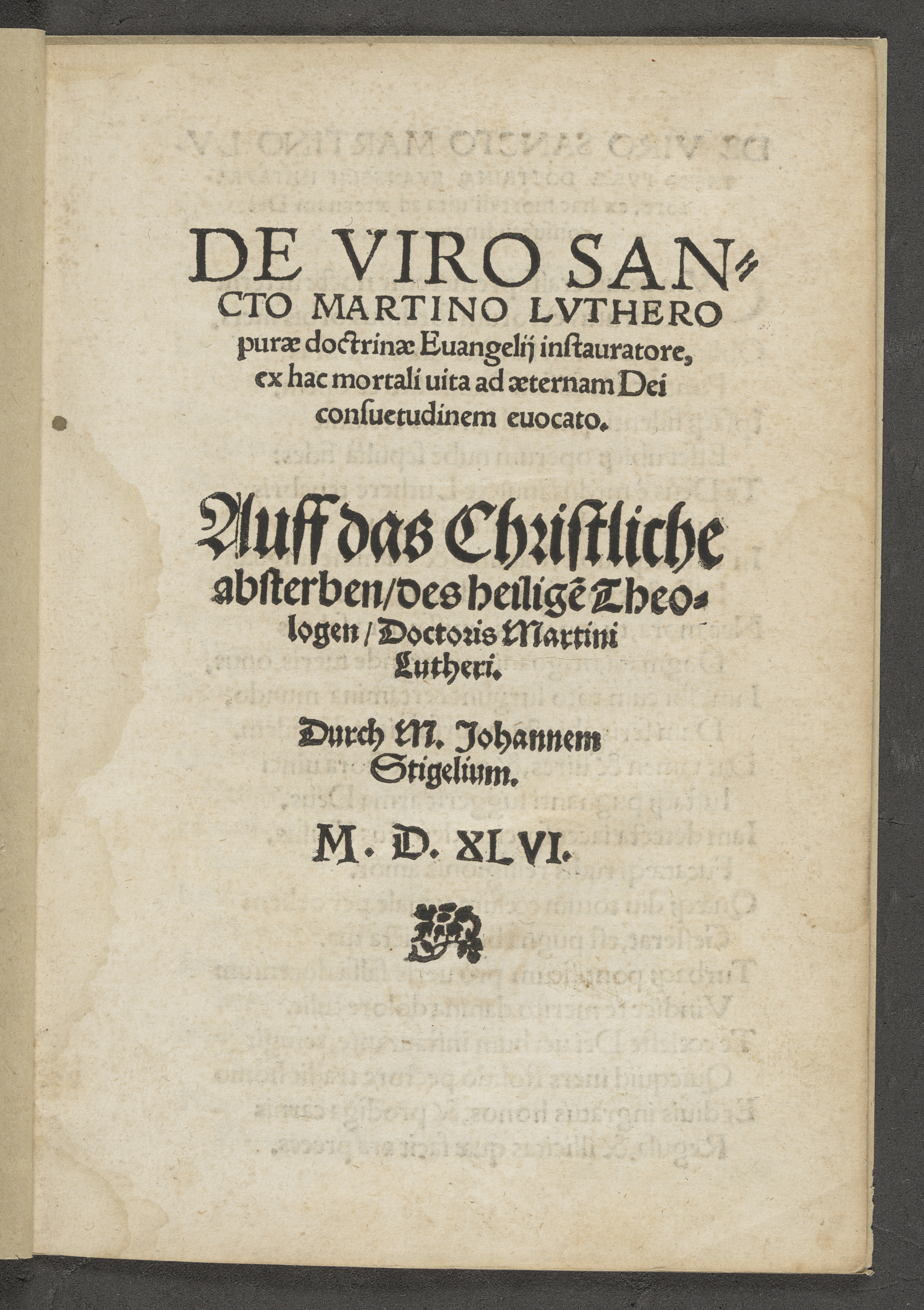
TextDe coniugio episcoporum et diaconorum : ad venerandum doctorem VVolffgangum Reissenbusch monasterij Lichtembergensis Praeceptorem
Bugenhagen, Johann, 1485-1558Summary: Essay on the historical and Scriptural foundations of clerical marriage, written following the marriage of Wolfgang Reissenbusch, Praeceptor of the Collegial Church of St. Antonius in Lichtenberg.Summary: Essay on the historical and Scriptural foundations of clerical marriage, written following the marriage of Wolfgang Reissenbusch, Praeceptor of the Collegial Church of St. Antonius in Lichtenberg. -
 Text
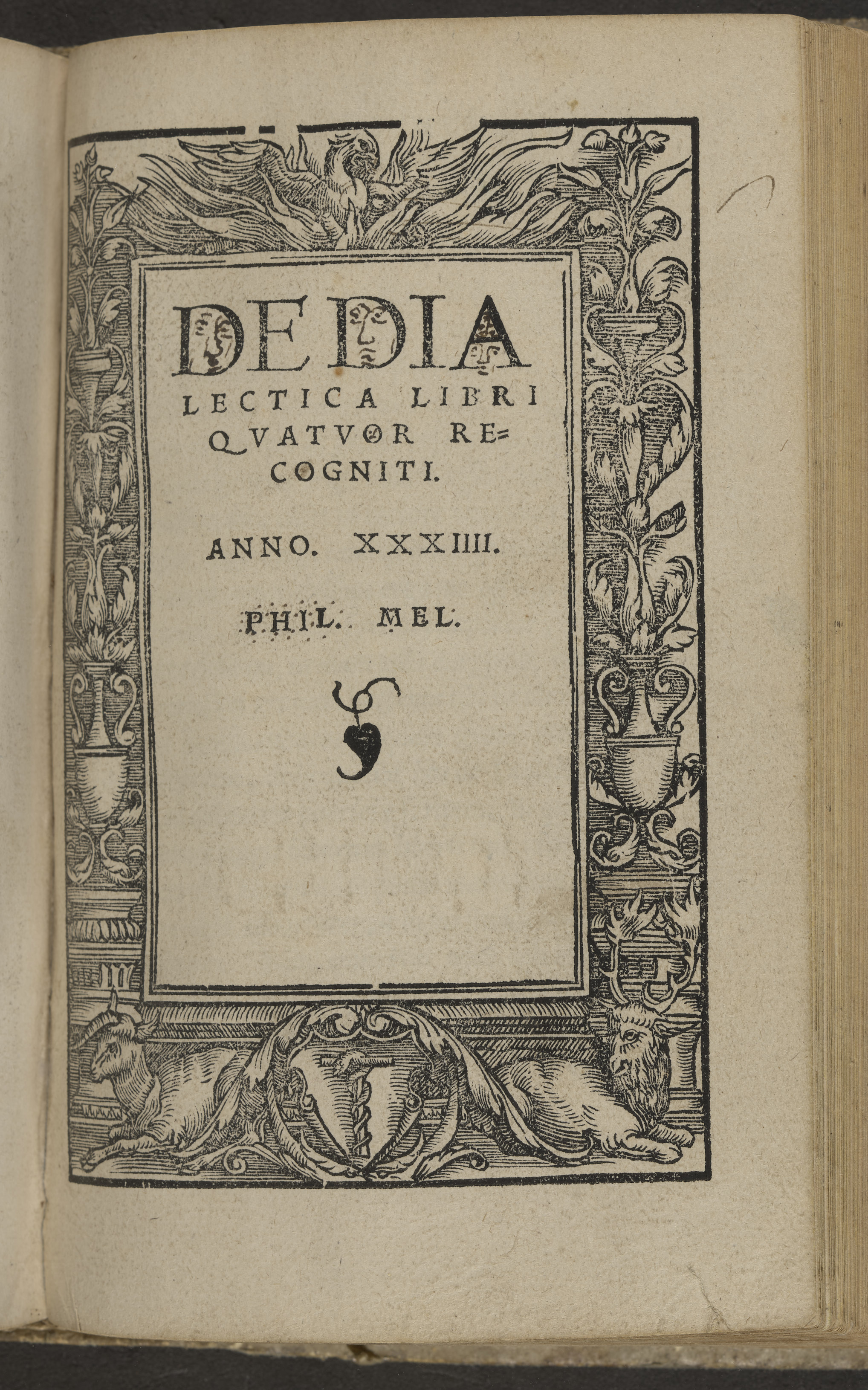
TextDe dialectica libri quatuor recogniti. Anno. XXXIIII
Melanchthon, Philipp, 1497-1560Summary: Melanchthon wrote three versions of his book on dialectic, considering only the third to be truly successful. This is a printing from 1534 of the second (1528) version.Summary: Melanchthon wrote three versions of his book on dialectic, considering only the third to be truly successful. This is a printing from 1534 of the second (1528) version. -
 Text
TextDe disputatio[n]e Lipsicensi : quantum ad Boemos obiter deflexa est
Emser, Hieronymus, 1478-1527Summary: A letter by Hieronymus Emser, early opponent of Luther concerning the Leipzig Disputation of 1519, describing Luther's debate with Johann Eck, and Luther's admitting that councils could err.Summary: A letter by Hieronymus Emser, early opponent of Luther concerning the Leipzig Disputation of 1519, describing Luther's debate with Johann Eck, and Luther's admitting that councils could err. -
 Text
TextDe disputatione lipsicensi quantum ad Boemos obiter deflexa est Epistola
Emser, Hieronymus, 1478-1527Summary: This volume includes both Emser's letter on the Leipzig Disputation, and Luther's sharp reply. Luther and Emser became lifelong enemies, a situation only exacerbated by Emser's use of Luther's New Testament as a basis for his own German translation in which he attacks Luther and Lutheranism. The woodcut on the title page shows Emser's coat-of-arms with the prominent goat, which gave Luther the title of his work, "To the Goat in Leipzig." The manuscript note on the title page says the book was purchased in 1520.Summary: This volume includes both Emser's letter on the Leipzig Disputation, and Luther's sharp reply. Luther and Emser became lifelong enemies, a situation only exacerbated by Emser's use of Luther's New Testament as a basis for his own German translation in which he attacks Luther and Lutheranism. The woodcut on the title page shows Emser's coat-of-arms with the prominent goat, which gave Luther the title of his work, "To the Goat in Leipzig." The manuscript note on the title page says the book was purchased in 1520. -
 Text
TextDe diuina institutione Pontificatus Romani Pontificis super tota[m] ecclesiam: a Christo in Petro
Cajetan, Tommaso de Vio, 1469-1534Summary: This is a finely executed and rare edition, dealing with the office of the Pope, with special emphasis on the person of St. Peter. Tommaso de Vio, also called Cajetan, taught philosophy and theology at Padua, Pavia, and Rome, and played an important part in the ecclesiastical affairs of the time, urging the cause of reform.Summary: This is a finely executed and rare edition, dealing with the office of the Pope, with special emphasis on the person of St. Peter. Tommaso de Vio, also called Cajetan, taught philosophy and theology at Padua, Pavia, and Rome, and played an important part in the ecclesiastical affairs of the time, urging the cause of reform. -
 Text
TextDe donatione Constantini quid ueri habeat, eruditorum quorundam iudicium, ut in uersa pagella uidebis
Summary: The Donation of Constantine was a work that told of how the Emperor Constantine I gave secular domination over Italy to the Bishops of Rome. Although purported to have been written in the fourth century, the humanist scholar Lorenzo Valla proved the work, long suspect to be an eighth century forgery. Vall's treatise was one of the first important works of comparative philology, a method invaluable to later biblical scholars and translators.Summary: The Donation of Constantine was a work that told of how the Emperor Constantine I gave secular domination over Italy to the Bishops of Rome. Although purported to have been written in the fourth century, the humanist scholar Lorenzo Valla proved the work, long suspect to be an eighth century forgery. Vall's treatise was one of the first important works of comparative philology, a method invaluable to later biblical scholars and translators. -
 Text
TextDe legis litera, siue carne, & spiritu
Karlstadt, Andreas Rudolff-Bodenstein von, 1486-1541Summary: One of two printings of Karlstadt's treatise on the dichotomy of law and grace.Summary: One of two printings of Karlstadt's treatise on the dichotomy of law and grace. -
 Still image
De loco conclavis primum deligendo
A woodcut depicting the pope and twelve cardinals sitting in conclave, a petitioner kneeling before them.A woodcut depicting the pope and twelve cardinals sitting in conclave, a petitioner kneeling before them. -
 Text
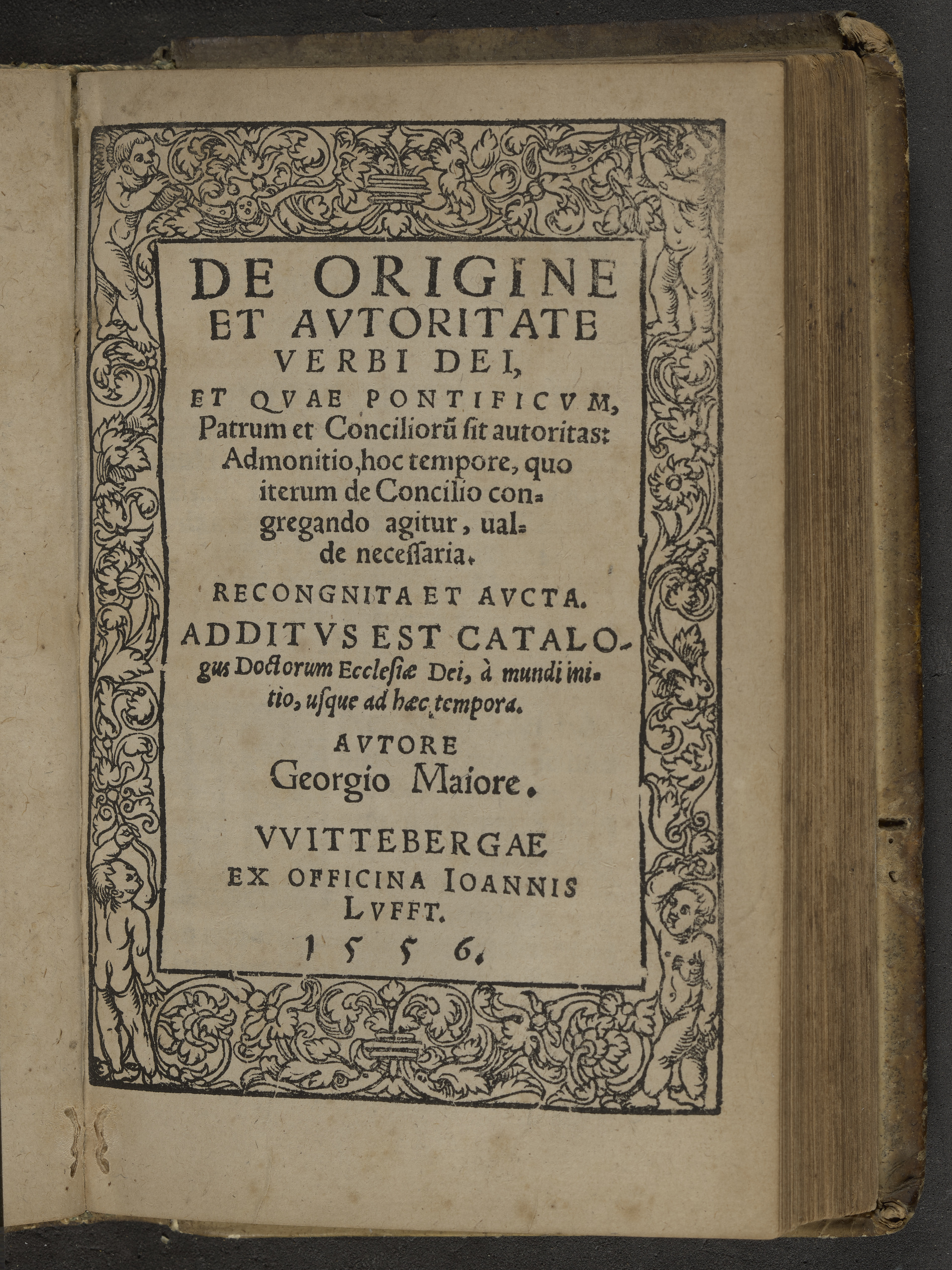
TextDe origine et autoritate Verbi Dei, et quae pontificum, patrum, et concilioru[m] sit autoritas admonitio, hoc tempore, quo iterum de concilio congregando agitur, ualde necessaria : recongnita [sic] et aucta additus est catalogus doctorum ecclesiae Dei, à mundi initio, usque ad haec tempora
Major, Georg, 1502-1574Summary: Tract on the history of Divine Revelation, tracing the teachers of the church from the Creation to the author's own time, by Georg Major, a student of Luther and Melanchthon, and professor at Wittenberg from 1536, with a few brief interruptions, until his death.Summary: Tract on the history of Divine Revelation, tracing the teachers of the church from the Creation to the author's own time, by Georg Major, a student of Luther and Melanchthon, and professor at Wittenberg from 1536, with a few brief interruptions, until his death. -
 Text
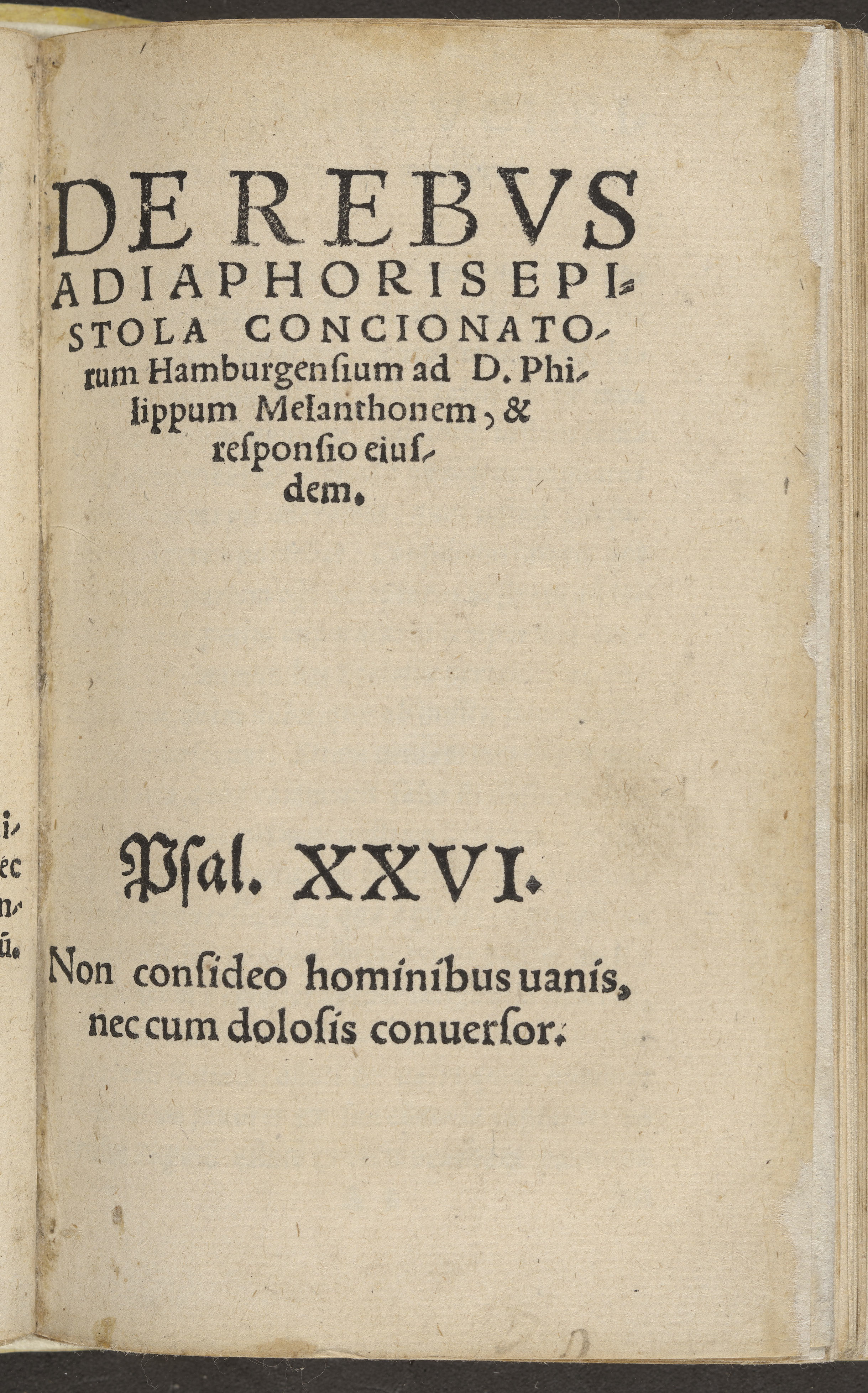
TextDe rebus adiaphoris epistola concionatorum Hamburgensium ad D. Philippum Melanthonem, & responsio eiusdem
Summary: Letter by a counsel of preachers in the city of Hamburg to Philipp Melanchthon regarding the adiaphoristic controversy regarding the re-introduction of some Catholic elements into the liturgy, which Melanchthon viewed as harmless and permissible. Melanchthon's reply is also included in this short booklet.Summary: Letter by a counsel of preachers in the city of Hamburg to Philipp Melanchthon regarding the adiaphoristic controversy regarding the re-introduction of some Catholic elements into the liturgy, which Melanchthon viewed as harmless and permissible. Melanchthon's reply is also included in this short booklet. -
 Text
TextDe servo arbitrio
Luther, Martin, 1483-1546Summary: An important treatise on human free will by Martin Luther, responding to Erasmus' work De libero arbitrio.Summary: An important treatise on human free will by Martin Luther, responding to Erasmus' work De libero arbitrio. -
 Text
TextDe servo arbitrio Martini Lutheri, ad Desiderium Erasmum Roterodamu[m]
Luther, Martin, 1483-1546Summary: "De servo arbitrio (Concerning the Enslaved Will)" is considered one of Martin Luther' greatest literary productions, and among the most important writings of the Reformation. In it, he defends the idea of the complete inability of the human being to please God, apart from Divine grace. His tract is a response to Desiderius Erasmus', "De libero arbitrio (Concerning Free Will)." Erasmus defends the view that salvation is by Divine grace, but wants to leave some room for a person's moral motivation.Summary: "De servo arbitrio (Concerning the Enslaved Will)" is considered one of Martin Luther' greatest literary productions, and among the most important writings of the Reformation. In it, he defends the idea of the complete inability of the human being to please God, apart from Divine grace. His tract is a response to Desiderius Erasmus', "De libero arbitrio (Concerning Free Will)." Erasmus defends the view that salvation is by Divine grace, but wants to leave some room for a person's moral motivation. -
 Text
TextDe votis monasticis
Luther, Martin, 1483-1546Summary: This is the third printing of Luther's treatise on monastic vows.Summary: This is the third printing of Luther's treatise on monastic vows. -
 Text
TextDecades rerum Venetarum
Sabellico, 1436?-1506Summary: A history of Venice.Summary: A history of Venice. -
 Text
TextDecem praecepta Witte[n]berge[n]si praedicata populo
Luther, Martin, 1483-1546Summary: The sermons on which this commentary on the Ten Commandments is based were delivered in Wittenberg in 1516-1517. This is the first work of Luther's to be translated into a modern European language. This is the first printing of the work.Summary: The sermons on which this commentary on the Ten Commandments is based were delivered in Wittenberg in 1516-1517. This is the first work of Luther's to be translated into a modern European language. This is the first printing of the work. -
 Still image
Decorated title page of Thalmut. : Obiectiones in dicta Thalmut seductoris Iudeorum
Four medallions decorating the title page of Thalmut. : Obiectiones in dicta Thalmut seductoris Iudeorum. Each medallion features a portrait of a bearded man wearing different vestments associated with the Jewish tradition.Four medallions decorating the title page of Thalmut. : Obiectiones in dicta Thalmut seductoris Iudeorum. Each medallion features a portrait of a bearded man wearing different vestments associated with the Jewish tradition. -
![An engraved tailpiece to the sixth, ninth, tenth, and twelfth books of Moyne's epic, "Saint Louys," depicting the standard of the Kingdom of France encircled by a crown of thorns beneath a banner with the Latin motto, "decus et tutamen" (glory/honor and [a means of] protection).](https://digital.pitts.emory.edu/files/large/P_300000202024_P312/P_300000202024_P312-cr.jpg) Still image
Still imageDecus et tutamen
Chauveau, François, 1613-1676An engraved tailpiece to the sixth, ninth, tenth, and twelfth books of Moyne's epic, "Saint Louys," depicting the standard of the Kingdom of France encircled by a crown of thorns beneath a banner with the Latin motto, "decus et tutamen" (glory/honor and [a means of] protection).An engraved tailpiece to the sixth, ninth, tenth, and twelfth books of Moyne's epic, "Saint Louys," depicting the standard of the Kingdom of France encircled by a crown of thorns beneath a banner with the Latin motto, "decus et tutamen" (glory/honor and [a means of] protection). -
 Still image
Dedicatory Headpiece
Raphael, 1483-1520An engraved dedicatory headpiece to a collection of engravings based on the work of Raphael. The engraving depicts a pair of columns, one with a man's head crowned in laurels and the other with a bearded man's head, (sides) and a pair of lions standing above orbs and flanking a trio of feathers and a wreath (top).An engraved dedicatory headpiece to a collection of engravings based on the work of Raphael. The engraving depicts a pair of columns, one with a man's head crowned in laurels and the other with a bearded man's head, (sides) and a pair of lions standing above orbs and flanking a trio of feathers and a wreath (top). -
 Text
TextDefensio D. Petri Martyris Vermilii ...
Vermigli, Pietro Martire, 1499-1562Summary: Response by Pietro Martire Vermigli, Italian Visitor General of the Augustinian Order, who fled to Switzerland rather than face charges of heresy, to the books of English Catholic, Richard Smith, on celibacy and monastic vows.Summary: Response by Pietro Martire Vermigli, Italian Visitor General of the Augustinian Order, who fled to Switzerland rather than face charges of heresy, to the books of English Catholic, Richard Smith, on celibacy and monastic vows.