Search
398 resources
398 items
Language
Latin
-
 Text
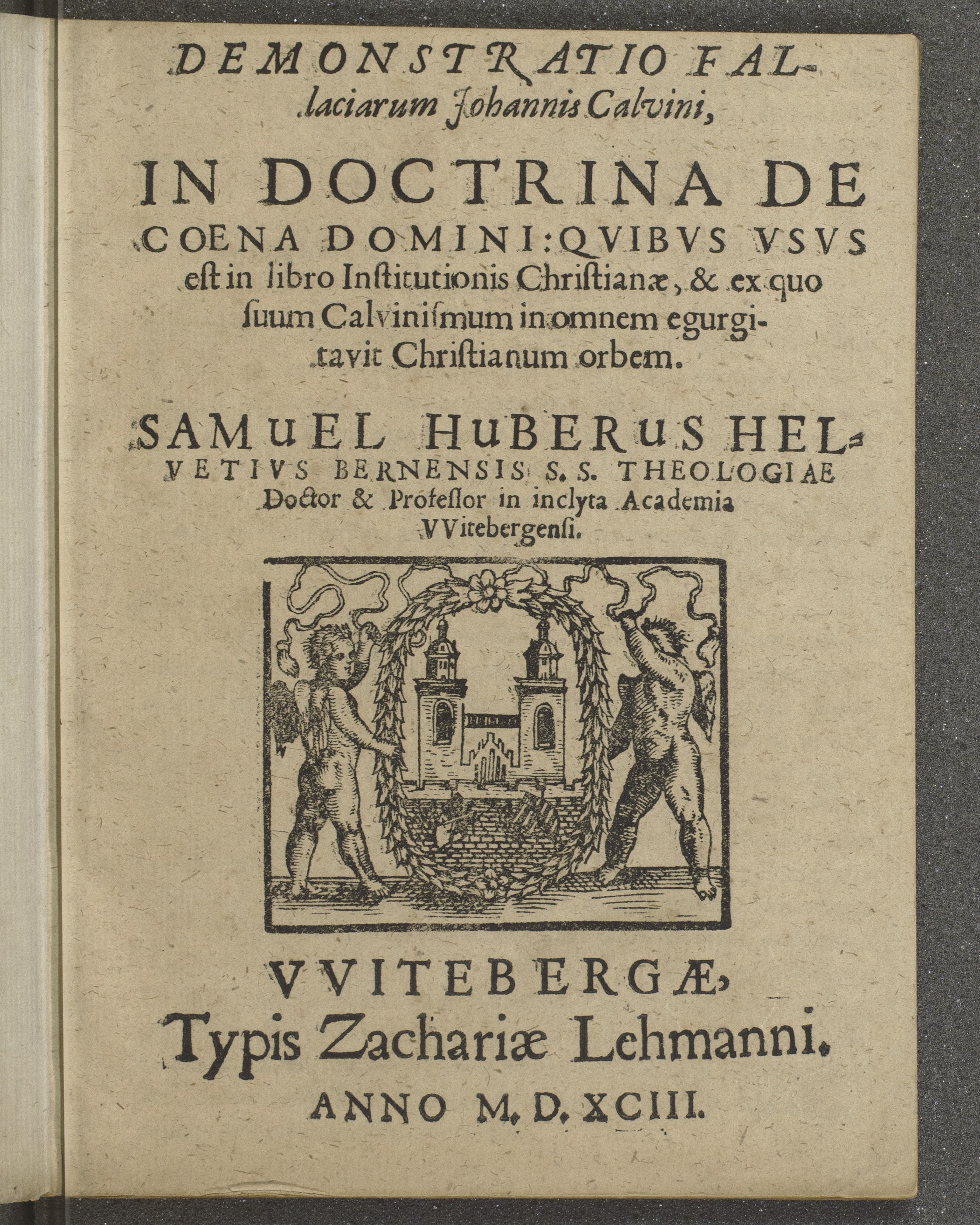
TextDemonstratio fallaciarum Johannis Calvini :in doctrina de Coena Domini : quibus usus est in libro Institutionis Christianae, & ex quo suum Calvinismum in omnem egurgitavit Christanum orbem
Huber, Samuel, 1547?-1624Summary: A text written against the teachings of Jean Calvin and the Calvinist approach to the Lord's Supper.Summary: A text written against the teachings of Jean Calvin and the Calvinist approach to the Lord's Supper. -
 Text
TextDemonstrationes evidentissimae XXX. praesentiae, distributionisq[ue] corporis ac sanguinis Christi in sacra coena, hactenus multis minus cognitae
Flacius Illyricus, Matthias, 1520-1575Summary: A tract by Matthias Flacius asserting the real presence of Christ in the eucharist.Summary: A tract by Matthias Flacius asserting the real presence of Christ in the eucharist. -
 Still image
Desid. Erasmus Roterod.
An engraved portrait of Desiderius Erasmus based on a portrait pained by Hans Holbein. The caption reads "Desid: Erasmus Roterod: Natus 1467. Den: et Sepult: Basiliae 1556. Ad Archetypum I: Holbenii in Biblioth: bupl: Basil: adservatum pictum cum annum ageret Erasmus LV."An engraved portrait of Desiderius Erasmus based on a portrait pained by Hans Holbein. The caption reads "Desid: Erasmus Roterod: Natus 1467. Den: et Sepult: Basiliae 1556. Ad Archetypum I: Holbenii in Biblioth: bupl: Basil: adservatum pictum cum annum ageret Erasmus LV." -
 Text
TextDialogus ad Martinu[m] Lutherum : pro responsione ad impertinentem quanda[m] ipsius epistolam super posita[m] veluti collocutoris vice intermixtam
Dungersheim, Hieronymus, 1465-1540Summary: H. Dungersheim had exchanged several letters with Luther before he wrote this dialogue. It was his first formal controversialist tract, written in 1520, but not published until 1531. Luther burned a manuscript copy of this work when he burned the bull Exsurge Domine on December 10, 1520.Summary: H. Dungersheim had exchanged several letters with Luther before he wrote this dialogue. It was his first formal controversialist tract, written in 1520, but not published until 1531. Luther burned a manuscript copy of this work when he burned the bull Exsurge Domine on December 10, 1520. -
 Still image
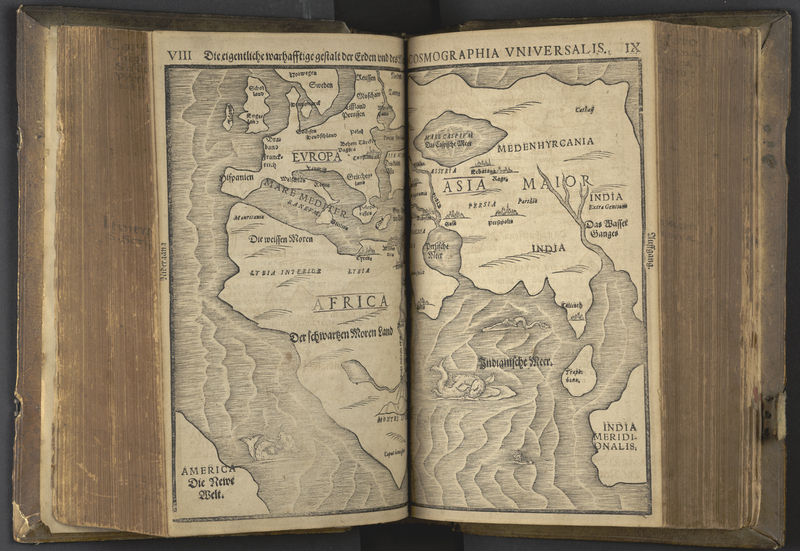
Die eigentliche warhafftige gestalt der Erden und des [...]
A map of the world including Europe, Africa ("Der schwarzen Moren Land"), Asia (Major), America ("Die Newe Welt"), and India Meridionalis (a so called "phantom" peninsula that was often depicted in Medieval and Rennaissance maps). A number of monstrous sea creatures are depicted in the various oceans and seas.A map of the world including Europe, Africa ("Der schwarzen Moren Land"), Asia (Major), America ("Die Newe Welt"), and India Meridionalis (a so called "phantom" peninsula that was often depicted in Medieval and Rennaissance maps). A number of monstrous sea creatures are depicted in the various oceans and seas. -
 Still image
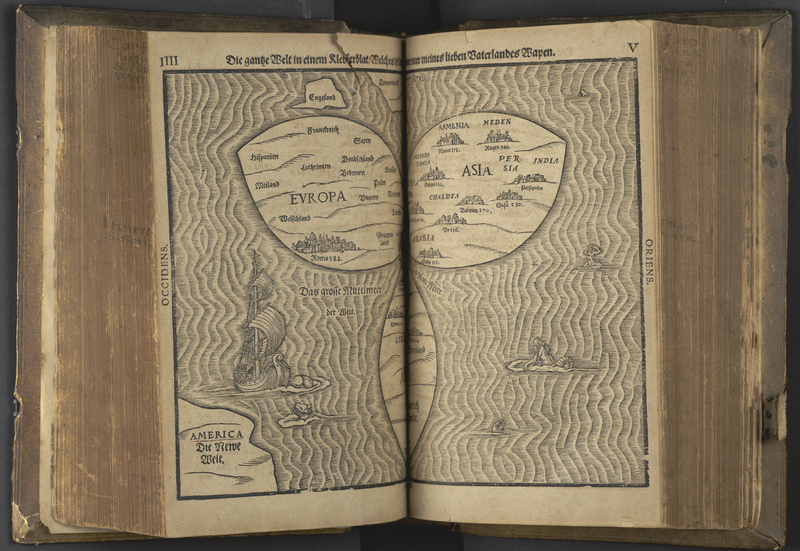
Die ganze Welt in einem [K]leberblat Welches [...] meines lieben Vaterlandes [W]apen
A map of the world including Europe, Africa, and Asia as three leaf or petal shaped continents with America ("Die Newe Welt") draw in the bottom left corner. A ship and numerous sea creatures are depicted in the oceans.A map of the world including Europe, Africa, and Asia as three leaf or petal shaped continents with America ("Die Newe Welt") draw in the bottom left corner. A ship and numerous sea creatures are depicted in the oceans. -
 Still image
Die neuwen Inseln - so hinder Hispanien gegen Orient bey dem land Indic ligen.
A map of the western hemisphere, identified as the New World, and the western coast of Asia. A spanish style galleon ship is depicted sailing in the Pacific ocean, and a rough shelter built of sticks featureing a dismembered leg is depicted in the general region of Brazil with the label, "Canibali".A map of the western hemisphere, identified as the New World, and the western coast of Asia. A spanish style galleon ship is depicted sailing in the Pacific ocean, and a rough shelter built of sticks featureing a dismembered leg is depicted in the general region of Brazil with the label, "Canibali". -
 Text
TextDisputaciones circulatim expediendae
Luther, Martin, 1483-1546Summary: This disputation centered around the question of whether the German princes could offer armed resistance to the Emperor, and whether they ought to support him in his war against the Turks. Luther came to believe that any support of the Emperor when he was acting in a religious capacity (in league with the pope) was wrong, because the pope was acting contrary to the Gospel. This is the first (and only) printing of this revised version of these theses. It contains 91 theses, whereas the first version (written before the Emperor and princes had come to terms) contained only 70 theses.Summary: This disputation centered around the question of whether the German princes could offer armed resistance to the Emperor, and whether they ought to support him in his war against the Turks. Luther came to believe that any support of the Emperor when he was acting in a religious capacity (in league with the pope) was wrong, because the pope was acting contrary to the Gospel. This is the first (and only) printing of this revised version of these theses. It contains 91 theses, whereas the first version (written before the Emperor and princes had come to terms) contained only 70 theses. -
 Text
TextDisputatio D. Iohannis Eccij et P. Martini Luther in Studio Lipsensi. futura
Luther, Martin, 1483-1546Summary: Response by Luther to the theses of Johann Eck, who had previously been in debate with Luther's colleague, Karlstadt. The face to face clash would come some six months later at the end of June, 1519.Summary: Response by Luther to the theses of Johann Eck, who had previously been in debate with Luther's colleague, Karlstadt. The face to face clash would come some six months later at the end of June, 1519. -
 Text
TextDisputatio domini Johannis Eccij et P. Martini Luther in Studio Lipsiensi futura
Luther, Martin, 1483-1546Summary: This is Luther's first public attack on Johannes Eck. Included in this volume are Eck's letter of Dec. 24, 1518 in which he records his theological differences with Karlstadt, and Eck's own 12 theses with Luther's response.Summary: This is Luther's first public attack on Johannes Eck. Included in this volume are Eck's letter of Dec. 24, 1518 in which he records his theological differences with Karlstadt, and Eck's own 12 theses with Luther's response. -
 Text
TextDisputatio. Secundum, & Octauum Decalogi praecepta, thesibus theologicis explicata, : quae publicè ad disputandum proponentur, pridiè idus Septemb. Quando reuerentia, dignitate, & eruditione praestanti uiro, D. Ioanni Schauppio Eckio, liberalium disciplinarum magistro, et ss. theologiae Licentiato, Officiali Passauiensi, etc. Supremus in professione theologica gradus decernetur.
Theander, Georg, 1508-1570Summary: An academic disputation presented Georg Theander, professor at the University of Ingolstadt, and defended by Sebastian Haydlauff, priest at the church of St. Moritz in Ingolstadt. The disputation was based on 30 theses on the 2nd and 8th commandments.Summary: An academic disputation presented Georg Theander, professor at the University of Ingolstadt, and defended by Sebastian Haydlauff, priest at the church of St. Moritz in Ingolstadt. The disputation was based on 30 theses on the 2nd and 8th commandments. -
 Text
TextDisticha de uita et praecipuis rebus gestis uiri Dei et...
Stoltz, Johann, circa 1514-1556Twenty distichs (couplets) inspired by important events in the life of Martin Luther. The couplets, in Latin, were composed ca. 1550 and are written on paper. The author's name is found at the end of the piece as is his dedication of it to Johann Kestner. Pencil markings of a later owner are located in the upper left corner of the first page. Originally part of a signature, each of the two leaves has been encapsulated in Mylar for protection.Twenty distichs (couplets) inspired by important events in the life of Martin Luther. The couplets, in Latin, were composed ca. 1550 and are written on paper. The author's name is found at the end of the piece as is his dedication of it to Johann Kestner. Pencil markings of a later owner are located in the upper left corner of the first page. Originally part of a signature, each of the two leaves has been encapsulated in Mylar for protection. -

-
![An engraving which depicts Emperor Constantine, Pope Sylvester I and the apocryphal “Donation of Constantine,” which gave the pope control of the imperial palace in Rome along with all the regions of the Western Empire, while Constantine will locate his government in the East. The document is likely an 8th century Carolingian invention, and it supports the idea that the papacy should hold some secular as well as sacred authority. The engraving includes the inscription: "Seleucus filio ob adulterium utriusq oculi poena damnato Populi precib[us]- ita consensit ut sibi unus filio alter oculus erueretur."](https://digital.pitts.emory.edu/files/large/P_300000215192_P037/P_300000215192_P037_PROD.jpg) Still image
Still imageDonation of Constantine
Raphael, 1483-1520An engraving which depicts Emperor Constantine, Pope Sylvester I and the apocryphal “Donation of Constantine,” which gave the pope control of the imperial palace in Rome along with all the regions of the Western Empire, while Constantine will locate his government in the East. The document is likely an 8th century Carolingian invention, and it supports the idea that the papacy should hold some secular as well as sacred authority.An engraving which depicts Emperor Constantine, Pope Sylvester I and the apocryphal “Donation of Constantine,” which gave the pope control of the imperial palace in Rome along with all the regions of the Western Empire, while Constantine will locate his government in the East. The document is likely an 8th century Carolingian invention, and it supports the idea that the papacy should hold some secular as well as sacred authority. -
 Still image
Dubitantibus recte consulere
Galle, Philippe, 1537-1612The act of guiding the doubtful to the correct path, illustrated and accompanied by scriptural reference.The act of guiding the doubtful to the correct path, illustrated and accompanied by scriptural reference. -
 Still image
Effigies Reverendi Viri, D. Philippi Melanchthonis, Expressa VVitebergae Anno M. D. LXIII
Cranach, Lucas, 1515-1586An impression done in 1564 of a woodcut made in 1561 depicting Philipp MelanchthonAn impression done in 1564 of a woodcut made in 1561 depicting Philipp Melanchthon -
 Still image
Effigies Tychonis Brahe Ottonidis Dani Dni de Knvdstrvpet archis Vranienbvrg in inscla hellisponti danici Hvenna fvndatoris instrvmentorvmqve astronomicorvm in eadem dispositorvm incentoris et strvctoris. ætatis svæ anno 40. anno dni. 1586 compl.
A portrait of Danish astronomer Tycho Brahe surrounded by an architectural border featuring sixteen labeled coats of arms of his ancestor's families.A portrait of Danish astronomer Tycho Brahe surrounded by an architectural border featuring sixteen labeled coats of arms of his ancestor's families. -
 Still image
Elector Joachim II of Brandenburg Kneeling before a Crucifix
Friedrich, Franz, approximately 1520-1584A woodcut containing a portrait of Elector Joachim II of Brandenburg kneeling before a crucifix. This woodcut likekly originated as a broadsheet since there are no signs of letterpress on the back. The same woodcut appeared in Grabriel Schnellboltz' Wahrhafftige Bildnisse etlicher Fuersten (Wittenberg, 1562) and the Augspurgische Confession (Frankfurt an der Oder:, Eichorn, 1572).A woodcut containing a portrait of Elector Joachim II of Brandenburg kneeling before a crucifix. This woodcut likekly originated as a broadsheet since there are no signs of letterpress on the back. The same woodcut appeared in Grabriel Schnellboltz' Wahrhafftige Bildnisse etlicher Fuersten (Wittenberg, 1562) and the Augspurgische Confession (Frankfurt an der Oder:, Eichorn, 1572). -
![A woodcut containing a portrait of John Frederick (Johann Friedrich) reading a book and praying before a crucifix. Frederick was a leader of the Schmalkaldic League and fought for Luther's cause against the Imperial troops. The league was defeated in the Battle of Muehlberg in April of 1547. Frederick was wounded by a slash across his left cheek, captured, condemned to death, but ultimately pardoned and reinstated as duke in Weimar. After 1547, however, the Electoral power had fallen to the rivalling Albertininian line of the dynasty residing in Dresden. The print depicts Frederick with the scar on his cheek. The book contains the words, "Hilf Got[t]" (help me God). Cranach marked the woodcut plate with his device and dated it to 1552, but the broadsheet in its current manifestation was printed in 1557.](https://digital.pitts.emory.edu/files/large/P_MSS400_B001_F005_I001/P_MSS400_B001_F005_I001_P001_PROD.jpg) Still image
Still imageElector John Frederick the Magnanimous with Book and Crucifix
Cranach, Lucas, 1515-1586A woodcut containing a portrait of John Frederick (Johann Friedrich) reading a book and praying before a crucifix. Frederick was a leader of the Schmalkaldic League and fought for Luther's cause against the Imperial troops. The league was defeated in the Battle of Muehlberg in April of 1547. Frederick was wounded by a slash across his left cheek, captured, condemned to death, but ultimately pardoned and reinstated as duke in Weimar. After 1547, however, the Electoral power had fallen to the rivalling Albertininian line of the dynasty residing in Dresden.A woodcut containing a portrait of John Frederick (Johann Friedrich) reading a book and praying before a crucifix. Frederick was a leader of the Schmalkaldic League and fought for Luther's cause against the Imperial troops. The league was defeated in the Battle of Muehlberg in April of 1547. Frederick was wounded by a slash across his left cheek, captured, condemned to death, but ultimately pardoned and reinstated as duke in Weimar. After 1547, however, the Electoral power had fallen to the rivalling Albertininian line of the dynasty residing in Dresden. -
 Text
TextElementorum rhetorices libri duo. : His adiectae sunt epistolae contrariae, Pici & Hermolai Barbari. Vnà cum dispositione Phil. Mel. accessit demum index & rerum & uerborum locupletissimus
Melanchthon, Philipp, 1497-1560Summary: A 1558 printing of a work on rhetoric by Philipp Melanchthon. The work includes correspondence on the subject by two late-15th century Italian humanists.Summary: A 1558 printing of a work on rhetoric by Philipp Melanchthon. The work includes correspondence on the subject by two late-15th century Italian humanists. -
 Text
TextEnarratio Psalmi Sexagesimi octavi, Exvrgat Deus & dissipentur inimici eius &c.
Major, Georg, 1502-1574Summary: Interpretation of Psalm 68 by Georg Major, a student of Luther and Melanchthon, and professor at Wittenberg from 1536, with a few brief interruptions, until his death.Summary: Interpretation of Psalm 68 by Georg Major, a student of Luther and Melanchthon, and professor at Wittenberg from 1536, with a few brief interruptions, until his death.