Search
61 resources
61 items
Subject
Lord's Supper
-
 Text
TextAcht Sermon. D. M. Luthers vo[n] im gepredigt zu[o] Wittemberg inn der Fasten : Darinn kurtzlich begryffen von den Messen, Bildtnussen bayderlay gestalt des Sacramennts von denn speysen vnd haimlichen beycht. c. Wittemberg. 1.5.23
Luther, Martin, 1483-1546Summary: One of six 1523 editions of a collection of sermons delivered by Luther in 1522, directed against A. Karlstadt.Summary: One of six 1523 editions of a collection of sermons delivered by Luther in 1522, directed against A. Karlstadt. -
 Text
TextAin Sermon uon der frucht vnd nutzbarkait des hayligen Sacraments
Luther, Martin, 1483-1546Summary: Sermon preached April 2, 1523 (Maundy Thursday), on the value and efficacy of the Holy Sacrament.Summary: Sermon preached April 2, 1523 (Maundy Thursday), on the value and efficacy of the Holy Sacrament. -
 Text
TextAn answer to Sir Thomas More's Dialogue : The supper of the Lord after the true meaning of John VI. and 1 Cor. XI. And Wm. Tracy's Testament expounded
Tyndale, William, -1536Summary:Summary: -
 Text
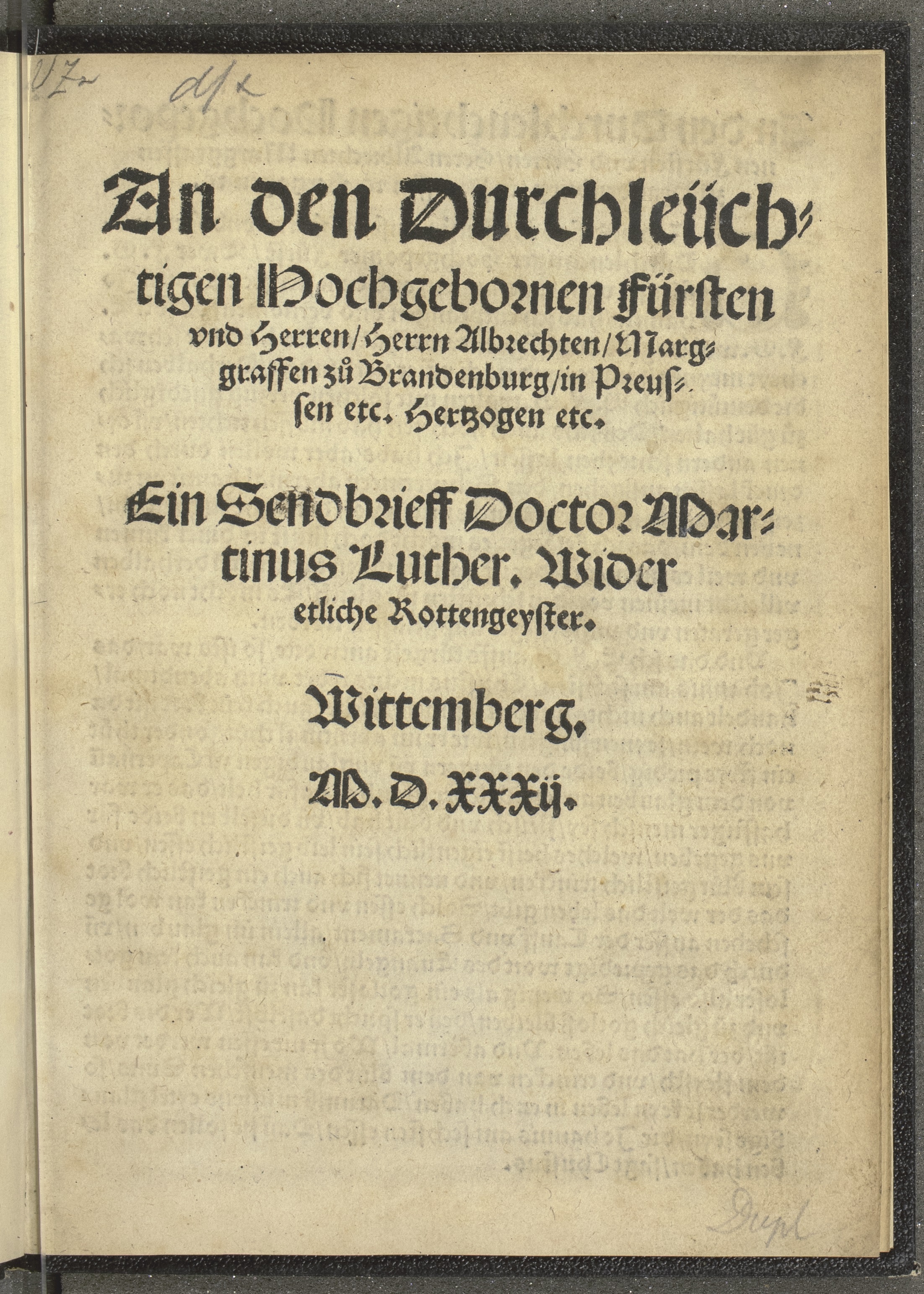
TextAn den Durchleüchtigen Hochgebornen Fürsten vnd Herren. Herrn Albrechten, Marggraffen zuo Brandenburg, in Preussen etc. Hertzogen etc.
Luther, Martin, 1483-1546Summary: After Albrecht, Duke of Prussia and last of the Masters of the Teutonic Knights, became a Protestant, he sought out preachers to fill the pulpits in his territory. Some were Lutherans, others were followers of Schwenckfeld. Luther here warns Albrecht about the heretical tendencies of the Schwenckfelders. Albrecht came increasingly under the influence of F. Von Heideck (a Schwenckfelder) and was not especially impressed by Luther's arguments against the use of John 6 in the interpretation of the Lord's Supper.Summary: After Albrecht, Duke of Prussia and last of the Masters of the Teutonic Knights, became a Protestant, he sought out preachers to fill the pulpits in his territory. Some were Lutherans, others were followers of Schwenckfeld. Luther here warns Albrecht about the heretical tendencies of the Schwenckfelders. Albrecht came increasingly under the influence of F. Von Heideck (a Schwenckfelder) and was not especially impressed by Luther's arguments against the use of John 6 in the interpretation of the Lord's Supper. -
 Text
TextAn den Durchleüchtigen Hochgepornen Fürsten vnd Herrn, Herrn Albrechten, Marggraffen zuo Brandenburg, inn Preussen [et]c. Hertzogen [et]c. Ein Sendbrief Doct. Mart. Luth. Wider ettliche Rottengeyster : Wittemberg, M.D.XXXII
Luther, Martin, 1483-1546Summary: Luther's reply to a letter from Duke Albrecht of Brandenburg, concerning the interpretation of John VI with reference to the Lord's Supper.Summary: Luther's reply to a letter from Duke Albrecht of Brandenburg, concerning the interpretation of John VI with reference to the Lord's Supper. -
 Text
TextAn die durchtlüchtige[n] Fürsten Tütscher nation zuo Ougspurg versammlot ein Sendtbrieff Huldrych Zuinglis : die schelckwort Eggens so er wider die warheyt vszgossen betreffendt
Zwingli, Ulrich, 1484-1531Summary: Exemplar of a unique contemporary printing of Swiss Reformer Ulrich Zwingli's apology for his theological position, sent to the assembled princes at the Diet of Augsburg in 1530. Zwingli focusses especially on the Lord's Supper, in view of the criticisms of his position by Johann Eck.Summary: Exemplar of a unique contemporary printing of Swiss Reformer Ulrich Zwingli's apology for his theological position, sent to the assembled princes at the Diet of Augsburg in 1530. Zwingli focusses especially on the Lord's Supper, in view of the criticisms of his position by Johann Eck. -
 Text
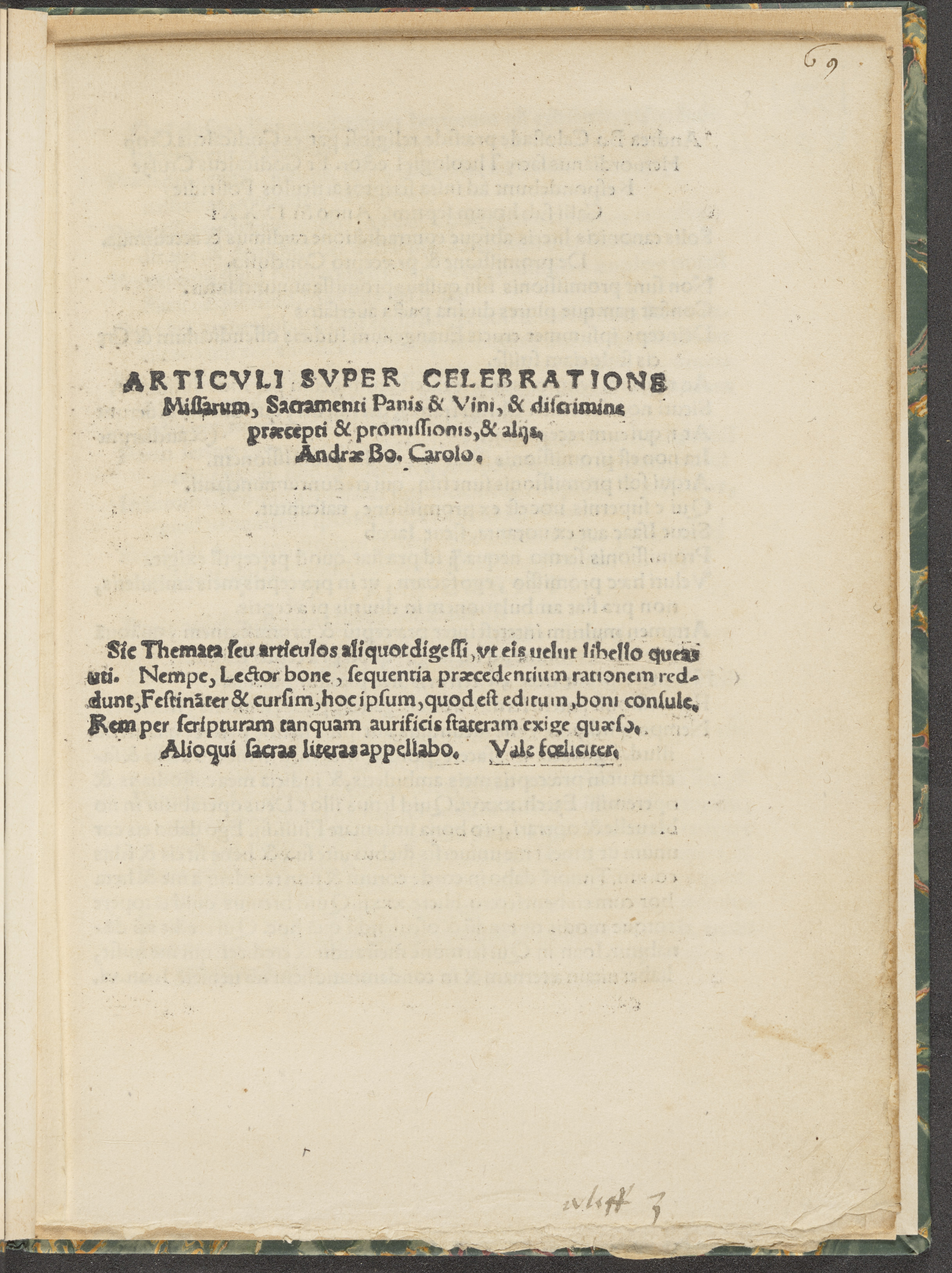
TextArticuli super celebratione Missarum, Sacramenti Panis & Vini : & discrimine praecepti & promissionis, & alijs
Karlstadt, Andreas Rudolff-Bodenstein von, 1486-1541Summary: Karlstadt wrote a great deal on the sacrament of the Lord's Supper. His determination to afford the laity and active part in the celebration was to have disastrous consequences for him both professionally and personally.Summary: Karlstadt wrote a great deal on the sacrament of the Lord's Supper. His determination to afford the laity and active part in the celebration was to have disastrous consequences for him both professionally and personally. -
 Text
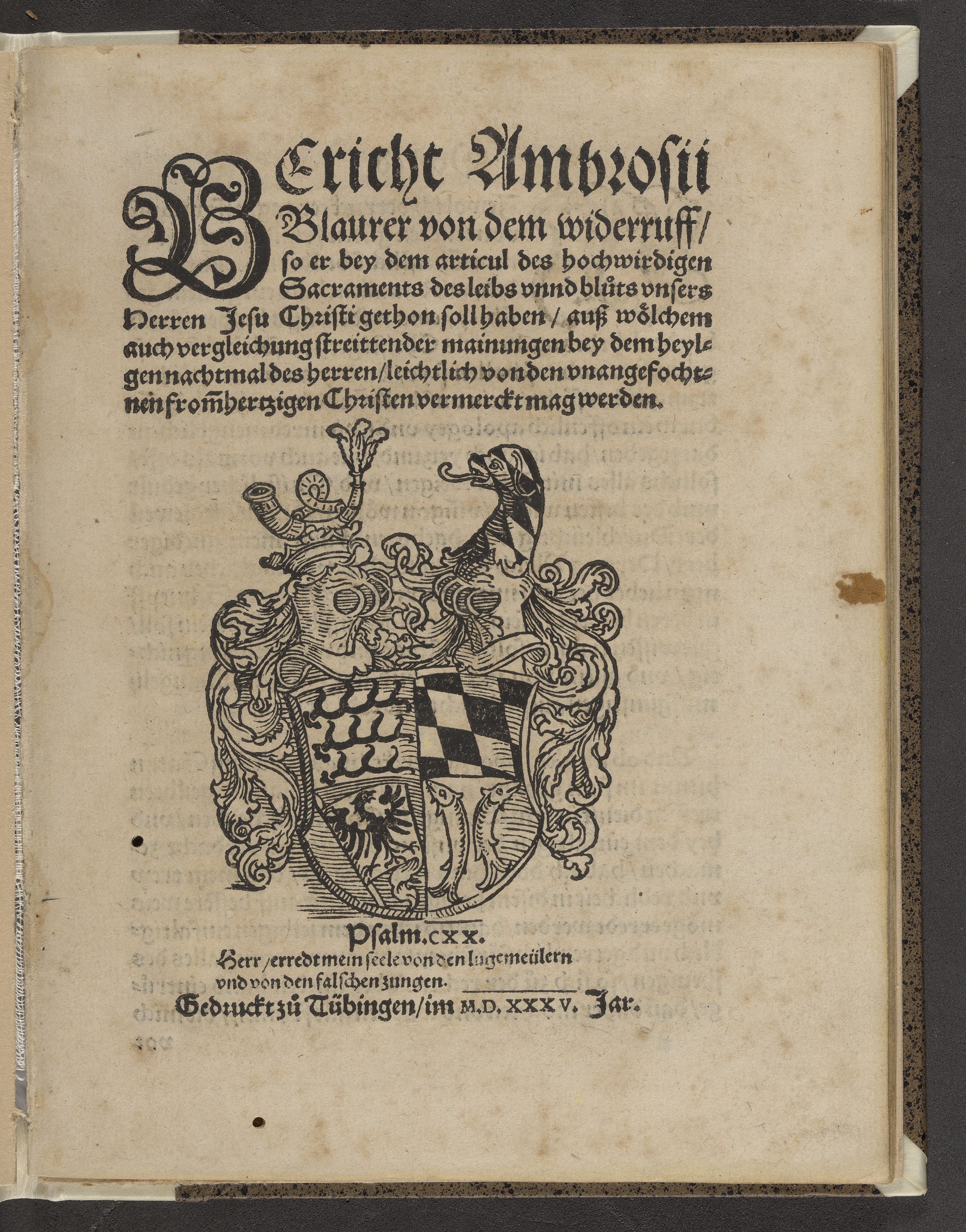
TextBericht Amb[r]osii Blaurer von dem Widerruff, so er bey dem articul des hochwirdigen Sacraments des Leibs vnnd Blůts vnsers Herren Jesu Christi gethon soll haben, : auss wölchem auch Vergleichung streittender Mainungen bey dem heylgen Nachtmal des Herren, leichtlich von den vnangefochtnen from[m]hertzigen Christen vermerckt mag werden
Blarer, Ambrosius, 1492-1564Summary: When Blarer was asked by Duke Ulrich of Württemberg to introduce the Reformation in the duchy, he tried to mediate between Zwingli and the Lutherans in the matter of the eucharist. He came to Stuttgart in 1534 to support a compromise and was criticized for abandoning the position he had held while still in Konstanz. In this tract he defends himself against these criticisms and affirms his support of the Stuttgart Concord.Summary: When Blarer was asked by Duke Ulrich of Württemberg to introduce the Reformation in the duchy, he tried to mediate between Zwingli and the Lutherans in the matter of the eucharist. He came to Stuttgart in 1534 to support a compromise and was criticized for abandoning the position he had held while still in Konstanz. In this tract he defends himself against these criticisms and affirms his support of the Stuttgart Concord. -
 Still image
Blessing of a Tabernacle for Conserving the Holy Eucharist
A woodcut depicting the blessing of a tabernacle for the Eucharist. A bishop raises a hand in blessing as the tabernacle sits upon an altar. The scene is flanked by ornamental scroll work featuring cherubs. The woodcut is reused throughout the work.A woodcut depicting the blessing of a tabernacle for the Eucharist. A bishop raises a hand in blessing as the tabernacle sits upon an altar. The scene is flanked by ornamental scroll work featuring cherubs. The woodcut is reused throughout the work. -
 Text
TextChriste[n]lich Antwurt Burgermeisters vnd radts zů Zürich, dem hochwirdigen [et]c. Herren Hugen, Byschoffe zů Costantz, über die vnderricht beyd[er] articklen der Bilder vn[d] der Messz inen zůgeschickt ...
Zurich (Switzerland). StadtratSummary: This is a response, written by Zwingli and adopted by the Council of Zurich, to a warning letter from Hugo von Hohenlandenberg (1457-1532), Bishop of Constance, about the destruction of images (Simulacra) and the reform of the Holy Mass. The bishop argued that the Bible forbade only heathen images; Christian imagery was entirely licit and its use sanctioned by the Council of Nicaea. The book was circulated at the Diet of Lucerne in April 1524 but did not reach Zurich until early June.Summary: This is a response, written by Zwingli and adopted by the Council of Zurich, to a warning letter from Hugo von Hohenlandenberg (1457-1532), Bishop of Constance, about the destruction of images (Simulacra) and the reform of the Holy Mass. The bishop argued that the Bible forbade only heathen images; Christian imagery was entirely licit and its use sanctioned by the Council of Nicaea. The book was circulated at the Diet of Lucerne in April 1524 but did not reach Zurich until early June. -
 Still image
Ciborium
A woodcut depicting an elaborate ciborium featuring several decorative spires and a crucifix at the top.A woodcut depicting an elaborate ciborium featuring several decorative spires and a crucifix at the top. -
 Text
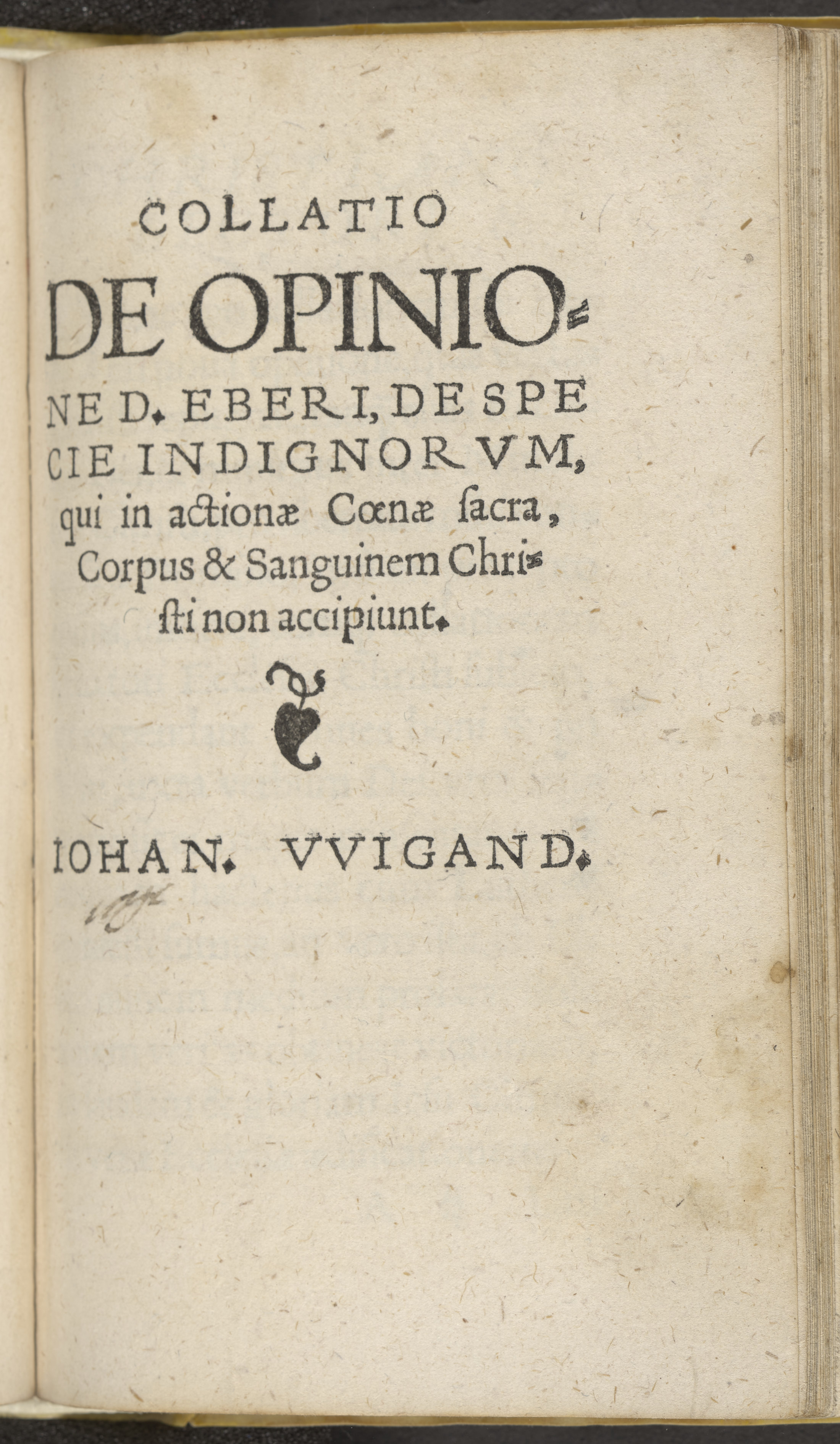
TextCollatio de opinione D. Eberi, de specie Indignorum, qui in actionae coenae sacra, corpus & sanguinem Christi non accipiunt
Wigand, Johann, 1523-1587Summary: Compilation by Johann Wigand of arguments made by the Reformer Paul Eber in support of the real presence of Christ in the eucharist.Summary: Compilation by Johann Wigand of arguments made by the Reformer Paul Eber in support of the real presence of Christ in the eucharist. -
 Text
TextDas ander teyl widder die hymlischen Propheten, vom Sacrament.
Luther, Martin, 1483-1546Summary: The Second printing of Luther's book, "Against the Heavenly Prophets addresses A. Karlstadt's doctrine of the Sacraments. This is the second printing of this work in its year of issue.Summary: The Second printing of Luther's book, "Against the Heavenly Prophets addresses A. Karlstadt's doctrine of the Sacraments. This is the second printing of this work in its year of issue. -
 Text
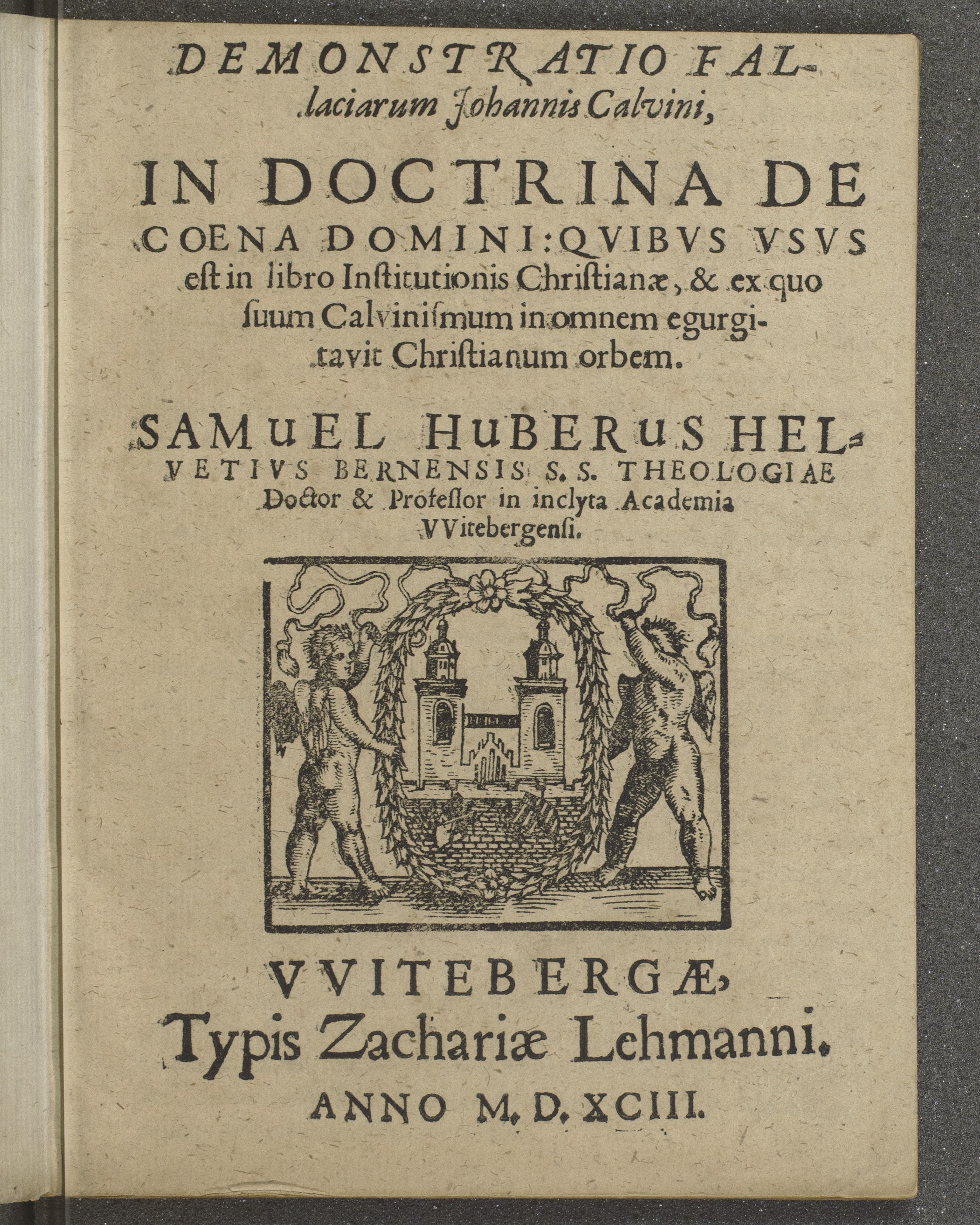
TextDemonstratio fallaciarum Johannis Calvini :in doctrina de Coena Domini : quibus usus est in libro Institutionis Christianae, & ex quo suum Calvinismum in omnem egurgitavit Christanum orbem
Huber, Samuel, 1547?-1624Summary: A text written against the teachings of Jean Calvin and the Calvinist approach to the Lord's Supper.Summary: A text written against the teachings of Jean Calvin and the Calvinist approach to the Lord's Supper. -
 Text
TextDemonstrationes evidentissimae XXX. praesentiae, distributionisq[ue] corporis ac sanguinis Christi in sacra coena, hactenus multis minus cognitae
Flacius Illyricus, Matthias, 1520-1575Summary: A tract by Matthias Flacius asserting the real presence of Christ in the eucharist.Summary: A tract by Matthias Flacius asserting the real presence of Christ in the eucharist. -
 Text
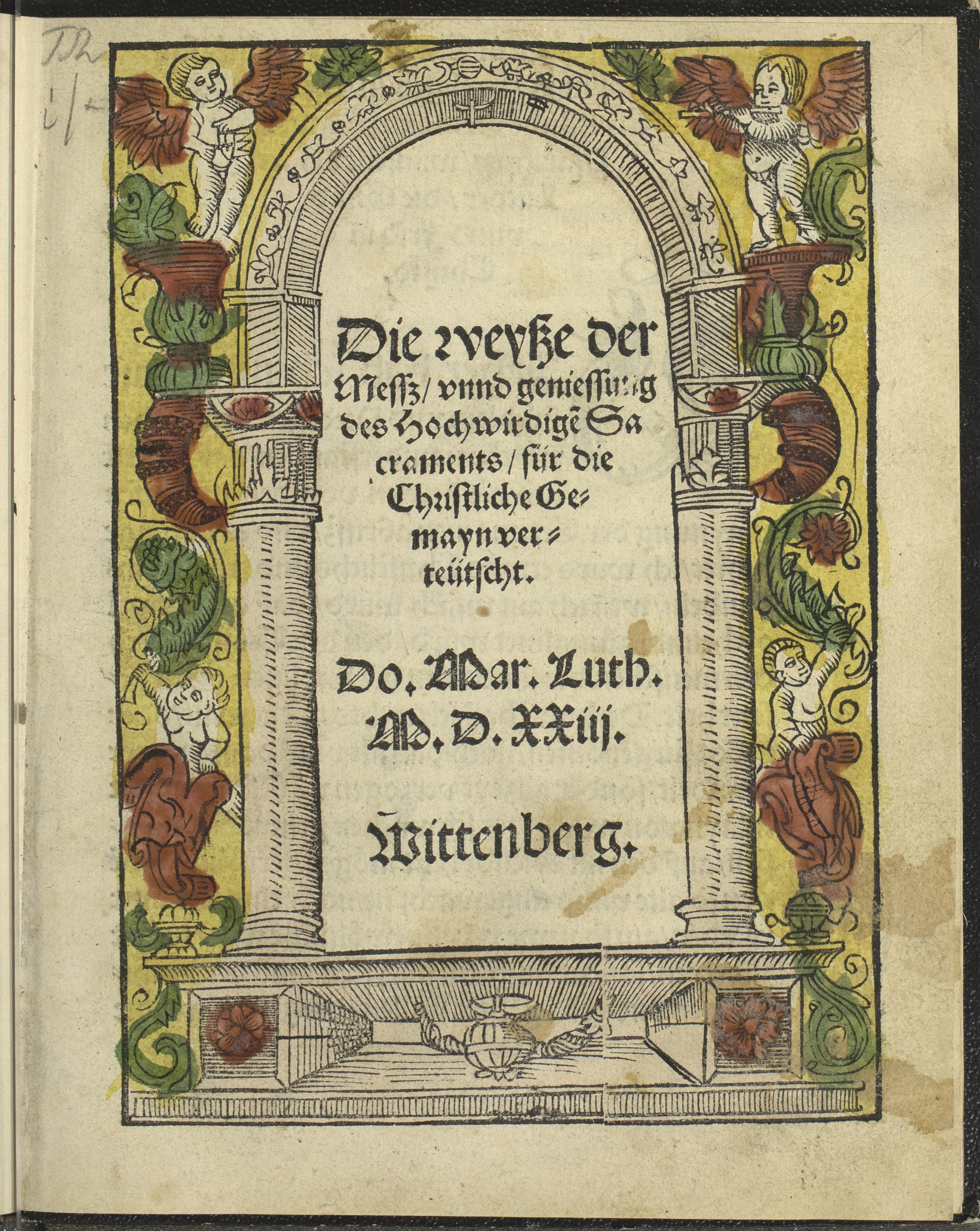
TextDie weysse der Messz, : vnnd geniesung des Hochwirdigen Sacraments, für die Christliche Gemayn verteütscht
Luther, Martin, 1483-1546Summary: Luther wrote his "Formula of the Mass and Communion" in 1523 at the insistence of N. Hausmann, the preacher at the Marienkirche, in Zwickau. Hausmann then wanted a German version to be used in his church. P. Speratus supplied one, and an unnamed Nuremberg translator supplied another. This is that Nuremberg work's first printing.Summary: Luther wrote his "Formula of the Mass and Communion" in 1523 at the insistence of N. Hausmann, the preacher at the Marienkirche, in Zwickau. Hausmann then wanted a German version to be used in his church. P. Speratus supplied one, and an unnamed Nuremberg translator supplied another. This is that Nuremberg work's first printing. -
 Text
TextDiscourse for Palm Sunday; Matthew 21:5
Archer, James, 1751-1834This sermon cautions against accepting Jesus Christ into your heart under false pretenses, but that all good Christians must accept him fully as their Lord and give up their sinful desires.This sermon cautions against accepting Jesus Christ into your heart under false pretenses, but that all good Christians must accept him fully as their Lord and give up their sinful desires. -
 Text
TextDiss ist ain Anzayg: ainem meinem, etwann vertrawten Gesellen, über seyne harte Widerpart, des Sacrament vnd annders betreffend
Langenmantel, Eitelhans, -1528Summary: Since the city of Augsburg was fairly evenly divided between Catholic and Protestant in the early 1520s, several Anabaptists hoped that their movement might benefit from this stalemate. Eitelhans Langenmantel attacks both Catholics and Lutherans, whom he called neo-Papists. His critique in this pamphlet focuses on the eucharist, which Langenmantel views in Zwinglian terms as a symbolic commemoration of the Last Supper. Like many other Anabaptists in Augsburg, Langenmantel was arrested and executed in 1527.Summary: Since the city of Augsburg was fairly evenly divided between Catholic and Protestant in the early 1520s, several Anabaptists hoped that their movement might benefit from this stalemate. Eitelhans Langenmantel attacks both Catholics and Lutherans, whom he called neo-Papists. His critique in this pamphlet focuses on the eucharist, which Langenmantel views in Zwinglian terms as a symbolic commemoration of the Last Supper. Like many other Anabaptists in Augsburg, Langenmantel was arrested and executed in 1527. -
-
 Text
TextEine kurtze schöne christliche Prediget, vom hochwirdigen Sacrament des Abentmals vnsers Herrn Jhesu Christi : Sampt einer Predigt, Wie ein Christ hie auff Erden seliglich reisen vnd wandeln sol, Vnd was jm jn solcher Reise hindern mag, gestellet auff die Wort S. Paulus, Ephe. v. Seid Gottes nach Folger, als die lieben Kinder. Mit einer Kurtzen Auslegung des ersten Psalmen
Spangenberg, JohannSummary: Two sermons by the Lutheran preacher Johann Spangenberg on the sacrament of the eucharist and on Christian life, based on Ephesians 5, as well as a short exegesis of Psalm 1.Summary: Two sermons by the Lutheran preacher Johann Spangenberg on the sacrament of the eucharist and on Christian life, based on Ephesians 5, as well as a short exegesis of Psalm 1. -
 Text
TextEpitome colloquij inter illustrissimorum Principum D. Friderici Palantini Electoris, & D. Christophori Ducis Wirtengergensis theologos, de maiestate hominis Christi, de[ni]q[ue] vera eius in eucharistia praesentia, Maulbrunnae instituti
Colloquy of Maulbronn (1564)Summary: Summary of the transactions of teh Colloquy of Maulbronn, a council involving theologians from Lutheran Würtemberg and the Reformed (Zwinglian) Palatinate. The main point of debate was the presence of Christ in the Eucharist.Summary: Summary of the transactions of teh Colloquy of Maulbronn, a council involving theologians from Lutheran Würtemberg and the Reformed (Zwinglian) Palatinate. The main point of debate was the presence of Christ in the Eucharist.