Search
65 resources
65 items
Subject
Luther, Martin, 1483-1546
-
 Still image
Martin Luther and the Holy Spirit
Baldung, Hans, -1545A woodcut portrait of Martin Luther dressed in the traditional garb of an Augustinian monk and holding a book, likely a Bible, with a dove above him, representing the Holy Spirit.A woodcut portrait of Martin Luther dressed in the traditional garb of an Augustinian monk and holding a book, likely a Bible, with a dove above him, representing the Holy Spirit. -
 Still image
Martin Luther as an Augustinian Monk
A woodcut depicting Martin Luther in the garb of an Augustinian Monk. Below Luther is a traditional Luther rose. Surrounding the portrait is an inscription, mirrored as the image was printed in reverse, reading "DOCTOR MARTINUS LUTTER AUGUSTINER: WITTENB:". This is purported to be the earliest depiction of Luther.A woodcut depicting Martin Luther in the garb of an Augustinian Monk. Below Luther is a traditional Luther rose. Surrounding the portrait is an inscription, mirrored as the image was printed in reverse, reading "DOCTOR MARTINUS LUTTER AUGUSTINER: WITTENB:". This is purported to be the earliest depiction of Luther. -
 Still image
Martin Luther as an Augustinian Monk
A woodcut depicting Martin Luther in the garb of an Augustinian Monk. Below Luther is a traditional Luther rose. Surrounding the portrait is an inscription, mirrored as the image was printed in reverse, reading "DOCTOR MARTINUS LUTTER AUGUSTINER: WITTENB:". This is purported to be the earliest depiction of Luther.A woodcut depicting Martin Luther in the garb of an Augustinian Monk. Below Luther is a traditional Luther rose. Surrounding the portrait is an inscription, mirrored as the image was printed in reverse, reading "DOCTOR MARTINUS LUTTER AUGUSTINER: WITTENB:". This is purported to be the earliest depiction of Luther. -
 Still image
Martin Luther as an Augustinian Monk
A woodcut depicting Martin Luther in the garb of an Augustinian Monk. Below Luther is a traditional Luther rose. Surrounding the portrait is an inscription, mirrored as the image was printed in reverse, reading "DOCTOR MARTINUS LUTTER AUGUSTINER: WITTENB:". This is purported to be the earliest depiction of Luther.A woodcut depicting Martin Luther in the garb of an Augustinian Monk. Below Luther is a traditional Luther rose. Surrounding the portrait is an inscription, mirrored as the image was printed in reverse, reading "DOCTOR MARTINUS LUTTER AUGUSTINER: WITTENB:". This is purported to be the earliest depiction of Luther. -
![A woodcut depicting Martin Luther as a seven-headed monster, critiquing his deviation from Catholicism. Each head is labeled (from left to right): Doctor, Martinus, Luther, Ecclesiast, Schwirmer [Schwärmer], Visitieter, and Barrabas. This was a classic piece of Catholic propaganda, portraying Luther not only as a Doctor and Churchman, but as a Turk, a wild enthusiast (Schwarmer) and "Barrabas."](https://digital.pitts.emory.edu/files/large/P_000015280452_P005/P_000015280452_P005_PROD.jpg) Still image
Still imageMartinus Luther Sieben Kopff
A woodcut depicting Martin Luther as a seven-headed monster, critiquing his deviation from Catholicism. Each head is labeled (from left to right): Doctor, Martinus, Luther, Ecclesiast, Schwirmer [Schwärmer], Visitieter, and Barrabas. This was a classic piece of Catholic propaganda, portraying Luther not only as a Doctor and Churchman, but as a Turk, a wild enthusiast (Schwarmer) and "Barrabas."A woodcut depicting Martin Luther as a seven-headed monster, critiquing his deviation from Catholicism. Each head is labeled (from left to right): Doctor, Martinus, Luther, Ecclesiast, Schwirmer [Schwärmer], Visitieter, and Barrabas. This was a classic piece of Catholic propaganda, portraying Luther not only as a Doctor and Churchman, but as a Turk, a wild enthusiast (Schwarmer) and "Barrabas." -
 Still image
Martinus Lutherus Septiceps
A woodcut depicting Martin Luther as a seven-headed monster, critiquing his deviation from Catholicism. Each head is labeled (from left to right): Doctor, Martinus, Lutherus, Ecclesiastes, Suermerus, Visitactor, and Barrabas. This was a classic piece of Catholic propaganda, portraying Luther not only as a Doctor and Churchman, but as a Turk, a wild enthusiast (Suermerus) and "Barrabas."A woodcut depicting Martin Luther as a seven-headed monster, critiquing his deviation from Catholicism. Each head is labeled (from left to right): Doctor, Martinus, Lutherus, Ecclesiastes, Suermerus, Visitactor, and Barrabas. This was a classic piece of Catholic propaganda, portraying Luther not only as a Doctor and Churchman, but as a Turk, a wild enthusiast (Suermerus) and "Barrabas." -
 Still image
Medallion portraits of Erasmus, Hutten, Luther, and Melanchthon
A set of three woodcuts: two medallion portraits of Erasmus Desidarius and Ulrich van Hutten and one medallion schematic caricature double portrait of Martin Luther and Philip Melanchthon.A set of three woodcuts: two medallion portraits of Erasmus Desidarius and Ulrich van Hutten and one medallion schematic caricature double portrait of Martin Luther and Philip Melanchthon. -
 Text
TextMultiloquus de co[n]citata ex dictis Lutheri seditio[n]e, : ad Inuictissimu[m] & optimu[m] Imperatore[m] ac multo[rum] regno[rum] Rege[m] inclitu[m] etc[etera]. Carolu[m] S.
Dungersheim, Hieronymus, 1465-1540Summary: H. Dungersheim had had a long academic career before the Reformation started. He proved to be a determined foe of Luther. In this rare book he presents "over a hundred" citations from Luther's books written before the Peasants' War (1525) to prove that Luther was a teacher of sedition and tumult.Summary: H. Dungersheim had had a long academic career before the Reformation started. He proved to be a determined foe of Luther. In this rare book he presents "over a hundred" citations from Luther's books written before the Peasants' War (1525) to prove that Luther was a teacher of sedition and tumult. -
 Text
TextReplica F. Sylvestri Prieriat[is] : sacri Palatii Apostolici Magistri, ad F. Martinum Luther Ordinis Eremitaru[m] ; Martinus Luther, optimo lectori salutem ...
Mazzolini, Silvestro, da Prierio, 1456?-1527?Summary: When Luther received the replies of S. Mazzolini, the first man to take up the cudgels against Luther, he found the best course of reply to be a reprinting with notes of Mazzolini's inept rejoinders. Even the Catholics had to admit that Mazzolini's answers simply did not meet Luther's objections. This is the second printing of the work.Summary: When Luther received the replies of S. Mazzolini, the first man to take up the cudgels against Luther, he found the best course of reply to be a reprinting with notes of Mazzolini's inept rejoinders. Even the Catholics had to admit that Mazzolini's answers simply did not meet Luther's objections. This is the second printing of the work. -
 Text
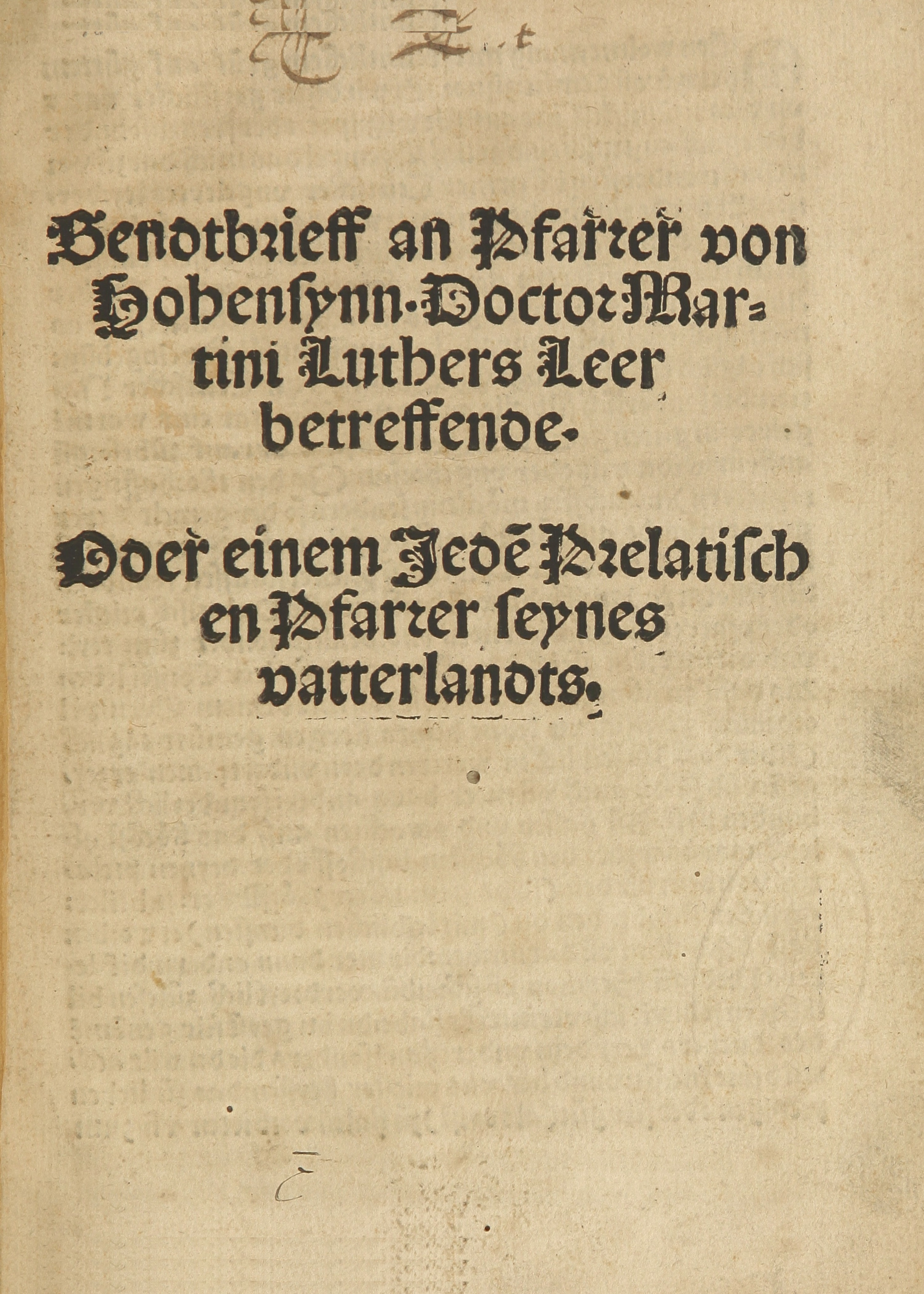
TextSendtbrieff an Pfarrer von Hohensynn. Doctor Martini Luthers Leer betreffende. Oder einem Jede[n] Prelatischen Pfarrer Seynes vaterlandes.
Summary: This is a Catholic pamphlet warning against Luther's errors. "Pastor Highmind" may be pseudonym or the name of a real Pastor von Hohensynn.Summary: This is a Catholic pamphlet warning against Luther's errors. "Pastor Highmind" may be pseudonym or the name of a real Pastor von Hohensynn. -
 Text
TextSepticeps Lutherus : ubiq[ue] sibi, suis scriptis, co[n]trari[us], in visitatione[m] Saxonica[m]
Cochlaeus, Johannes, 1479-1552Summary: J. Cochaeus here portrays Luther as a seven headed monster like Cerebrus who guarded the gate to hell in Greek/Latin mythology. The picture on the title page is one of the most famous images to emerge from the anti-Luther polemics of the period. Each head has a caption and is explained in detail in the text. Doctor (of false doctrine), Martinus (faithless, unlike the saint whose name he bore) Lutherus (untrue to his Catholic family tradition)Ưetc.Summary: J. Cochaeus here portrays Luther as a seven headed monster like Cerebrus who guarded the gate to hell in Greek/Latin mythology. The picture on the title page is one of the most famous images to emerge from the anti-Luther polemics of the period. Each head has a caption and is explained in detail in the text. Doctor (of false doctrine), Martinus (faithless, unlike the saint whose name he bore) Lutherus (untrue to his Catholic family tradition)Ưetc. -
 Text
TextSieben Kopffe Martin Luthers, von acht hohen sachen des Christlichen glaubens
Cochlaeus, Johannes, 1479-1552Summary: This volume consists of translations from J. Cochaeus' Latin work "Septiceps Lutherus. It is cast in dialogue form and discusses eight topics of religion, showing how Luther had departed from Catholic truth in these areas. The title page woodcut was a classic piece of Catholic propaganda, portraying Luther not only as a Doctor and Churchman, but as a Turk, a wild enthusiast (Schwarmer) and "Barrabas."Summary: This volume consists of translations from J. Cochaeus' Latin work "Septiceps Lutherus. It is cast in dialogue form and discusses eight topics of religion, showing how Luther had departed from Catholic truth in these areas. The title page woodcut was a classic piece of Catholic propaganda, portraying Luther not only as a Doctor and Churchman, but as a Turk, a wild enthusiast (Schwarmer) and "Barrabas." -
![A woodcut depicting Martin Luther as a seven-headed monster, critiquing his deviation from Catholicism. Each head is labeled (from left to right): Doctor, Martinus, Luther, Ecclesiast, Schwirmer [Schwärmer], Visitieter, and Barrabas. This was a classic piece of Catholic propaganda, portraying Luther not only as a Doctor and Churchman, but as a Turk, a wild enthusiast (Schwarmer) and "Barrabas."](https://digital.pitts.emory.edu/files/large/P_300000132224_P005/P_300000132224_P005-cr_PROD.jpg) Still image
Still imageSieben Köpffe Martini Luthers vom hochwirdigen Sacrament des Altars
A woodcut depicting Martin Luther as a seven-headed monster, critiquing his deviation from Catholicism. Each head is labeled (from left to right): Doctor, Martinus, Luther, Ecclesiast, Schwirmer [Schwärmer], Visitieter, and Barrabas. This was a classic piece of Catholic propaganda, portraying Luther not only as a Doctor and Churchman, but as a Turk, a wild enthusiast (Schwarmer) and "Barrabas."A woodcut depicting Martin Luther as a seven-headed monster, critiquing his deviation from Catholicism. Each head is labeled (from left to right): Doctor, Martinus, Luther, Ecclesiast, Schwirmer [Schwärmer], Visitieter, and Barrabas. This was a classic piece of Catholic propaganda, portraying Luther not only as a Doctor and Churchman, but as a Turk, a wild enthusiast (Schwarmer) and "Barrabas." -
 Still image
Sketch of Martin Luther
Sketch of Martin Luther, based on a 1546 woodcut portrait of Luther by Lucas Cranach.Sketch of Martin Luther, based on a 1546 woodcut portrait of Luther by Lucas Cranach. -
 Text
TextSo That It Pierces & Rings Through the Heart: Activity Guide
Miller, ElizabethAn activity guide designed to accompany the "So That It Pierces & Rings Through The Heart: Martin Luther's September Testament and 500 Years of Vernacular Scripture" exhibition, including a scavenger hunt, matching game, word search, coloring page, and guiding questions.An activity guide designed to accompany the "So That It Pierces & Rings Through The Heart: Martin Luther's September Testament and 500 Years of Vernacular Scripture" exhibition, including a scavenger hunt, matching game, word search, coloring page, and guiding questions. -
 Text
TextVo[n] dem elichen sta[n]dt widder Bruder Martin Luter Doctor tzu Witte[n]berg
Alveldt, Augustin von, active 16th centurySummary: This is a copy of A. von Alveld's defense of the Catholic Church's doctrine of clerical celibacy.Summary: This is a copy of A. von Alveld's defense of the Catholic Church's doctrine of clerical celibacy. -
 Text
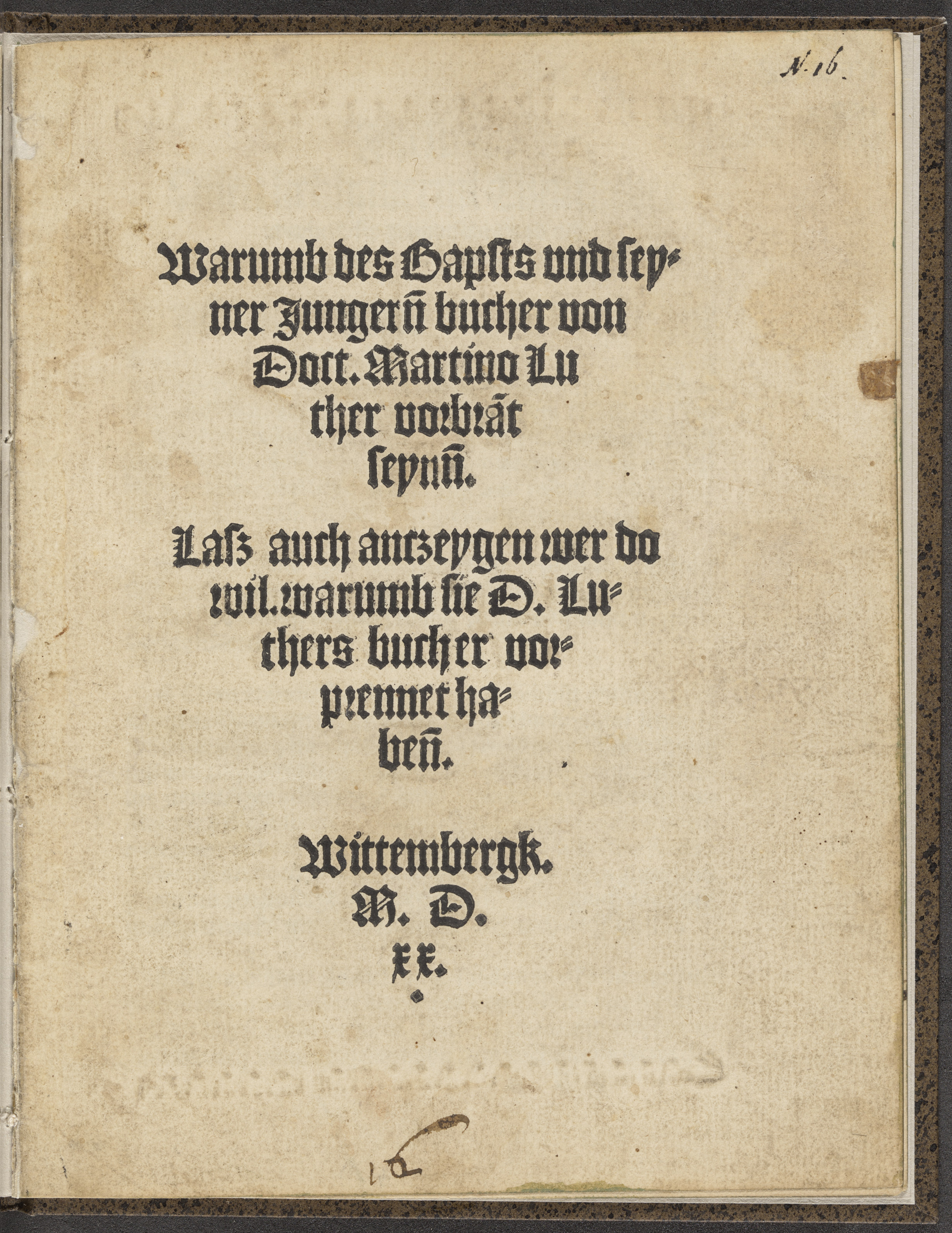
TextWarumb des Bapsts vnd seyner Jungern[n] Bucher von Doct. Martino Luther vorbra[n]t seynn[n] : lass auch anczeygen wer do wil, warumb sie D. Luthers Bucher vorprennet haben[n]
Luther, Martin, 1483-1546Summary: When the time stipulated in the Pope's bull of excommunication had elapsed on December 10, 1520, Luther and some of his students burned the bull and copies of the canon law. This pamphlet details their reasons for doing so. This is the third (of three) printings of the first edition.Summary: When the time stipulated in the Pope's bull of excommunication had elapsed on December 10, 1520, Luther and some of his students burned the bull and copies of the canon law. This pamphlet details their reasons for doing so. This is the third (of three) printings of the first edition. -
 Text
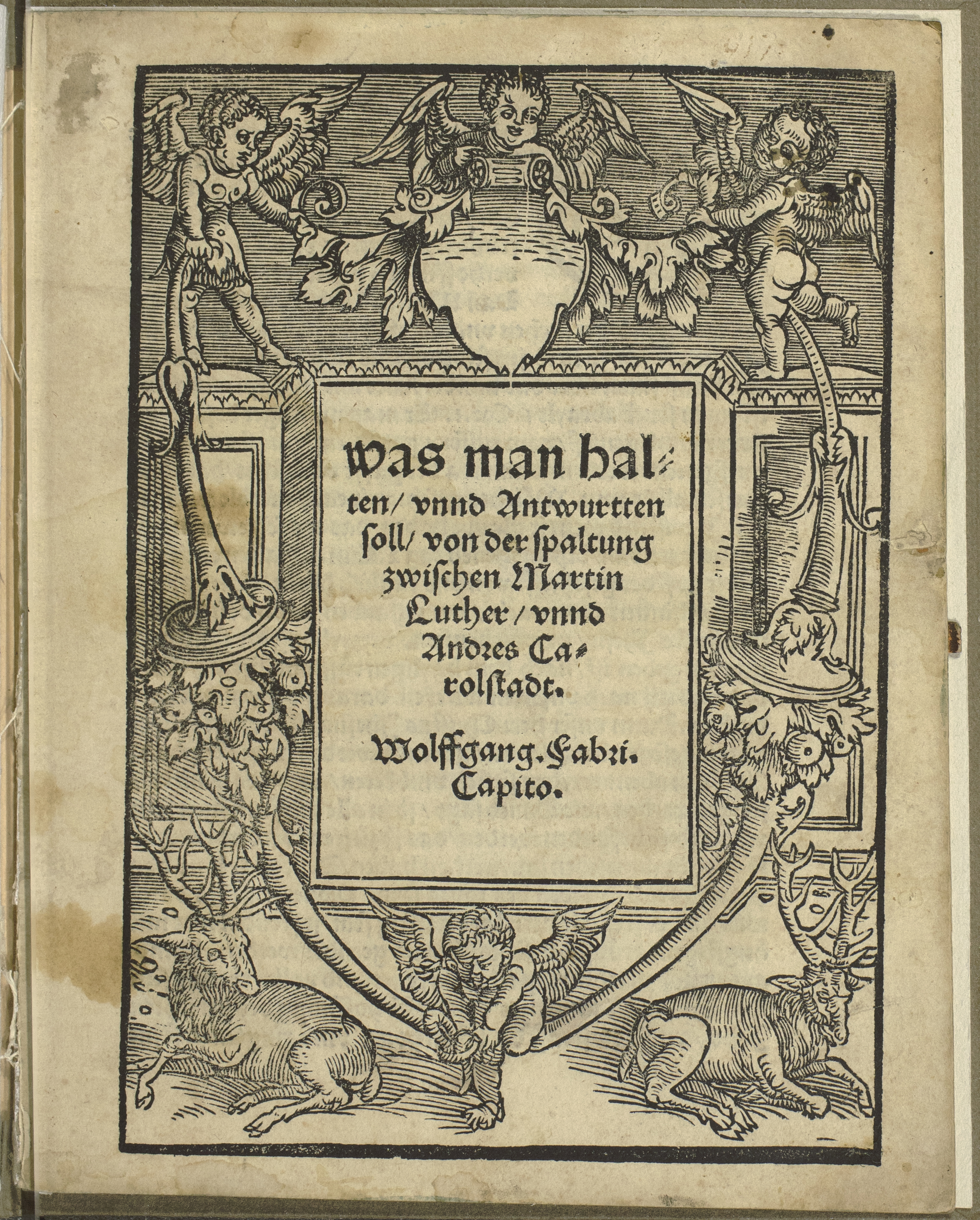
TextWas man halten, vnnd Antwurtten soll, von der spaltung zwischen Martin Luther, vnnd Andres Carolstadt
Capito, Wolfgang, 1478-1541Summary:Summary: -
 Text
TextWes sich D. Martinus Luther. etc. mit Huldrich Zwinglin. etc. der streitigen Articulen halb, vereynet vnd verglichen auff der Conuocation zu[o] Marpurg, den dritten Tag Octob. Im Jar, M. D. xxix
Colloquy of Marburg (1529)Summary: The Colloquy of Marburg was a meeting arranged at the initiative of Philip of Hessen in an attempt to forge religious unity in Germany and mediate theological differences between Lutherans and Zwinglians. Besides Luther and Zwingli, the meeting was also attended by Johannes Agricola, Johannes Brenz, Martin Bucer, Caspar Hedio, Justus Jonas, Philipp Melanchthon, Johannes Oecolampadius, and Andreas Osiander.Summary: The Colloquy of Marburg was a meeting arranged at the initiative of Philip of Hessen in an attempt to forge religious unity in Germany and mediate theological differences between Lutherans and Zwinglians. Besides Luther and Zwingli, the meeting was also attended by Johannes Agricola, Johannes Brenz, Martin Bucer, Caspar Hedio, Justus Jonas, Philipp Melanchthon, Johannes Oecolampadius, and Andreas Osiander. -
 Text
TextWid' die unselige Auffrure Merten Luders von Wolffgango Wulffer un[d] andern Christgleubige[n] euch zw Wittenberg tzugeschribenn.
Wulffer, Wolfgang, -1538Summary: First printing of a rare pamphlet directed against Martin Luther. Wulffer calls Luther a false prophet and claims that his teachings contain no love, but only self-aggrandizement.Summary: First printing of a rare pamphlet directed against Martin Luther. Wulffer calls Luther a false prophet and claims that his teachings contain no love, but only self-aggrandizement. -
 Text
TextWidder Luthers trostung ann die Christen zu Hall : vber er Georgen yhres Predigers todt, szo viel die entpfahung des hochwirdigen Sacraments belangt
Alveldt, Augustin von, active 16th centurySummary: Luther's Consolation to the Protestants of Halle, published in 1527, provoked this reply from Agustin von Alveld, garuden of the Franciscan Monastery in Halle from 1524-29. Alveld condemns Luther's tract as "Hussisch," in particular with respect to his teachings on the sacrament. Alveld dedicated the work to Albert of Brandenburg, Archbishop of Mainz.Summary: Luther's Consolation to the Protestants of Halle, published in 1527, provoked this reply from Agustin von Alveld, garuden of the Franciscan Monastery in Halle from 1524-29. Alveld condemns Luther's tract as "Hussisch," in particular with respect to his teachings on the sacrament. Alveld dedicated the work to Albert of Brandenburg, Archbishop of Mainz.