Search
932 resources
932 items
Time Period
Sixteenth century
-
 Still image
Ferre patieter iniuriam
Galle, Philippe, 1537-1612The act of patiently bearing those who wrong you, illustrated and accompanied by scriptural references.The act of patiently bearing those who wrong you, illustrated and accompanied by scriptural references. -
 Still image
Floral printer's ornament
A decorative woodcut depicting a floral printer's ornament below the date of printing, "1523."A decorative woodcut depicting a floral printer's ornament below the date of printing, "1523." -
 Text
TextForma Inquisitionis Hispanicae instituta in inferiori Germania anno 1550
Summary: Instructions for inquisitors in the Netherlands (Lower Germany), published by the Lutheran reformer Matthias Flacius to call attention to the persecution of Protestants. Flacius intended this report to underscore his opposition to any compromises with the Catholic Church, even in liturgical matters, as permitted by the Augsburg Interim of 1548.Summary: Instructions for inquisitors in the Netherlands (Lower Germany), published by the Lutheran reformer Matthias Flacius to call attention to the persecution of Protestants. Flacius intended this report to underscore his opposition to any compromises with the Catholic Church, even in liturgical matters, as permitted by the Augsburg Interim of 1548. -
 Still image
Four Horsemen of the Apocalypse
Cranach, Lucas, 1472-1553A woodcut depicting the Four Horsemen of the Apocalypse: the first, a conquerer with a crown and bow, the second, with a sword, tasked with taking peace from the earth, the third holding scales, and the fourth, Death itself. The image appears in the September Testament, Martin Luther's first printing of his German New Testament.A woodcut depicting the Four Horsemen of the Apocalypse: the first, a conquerer with a crown and bow, the second, with a sword, tasked with taking peace from the earth, the third holding scales, and the fourth, Death itself. The image appears in the September Testament, Martin Luther's first printing of his German New Testament. -
 Text
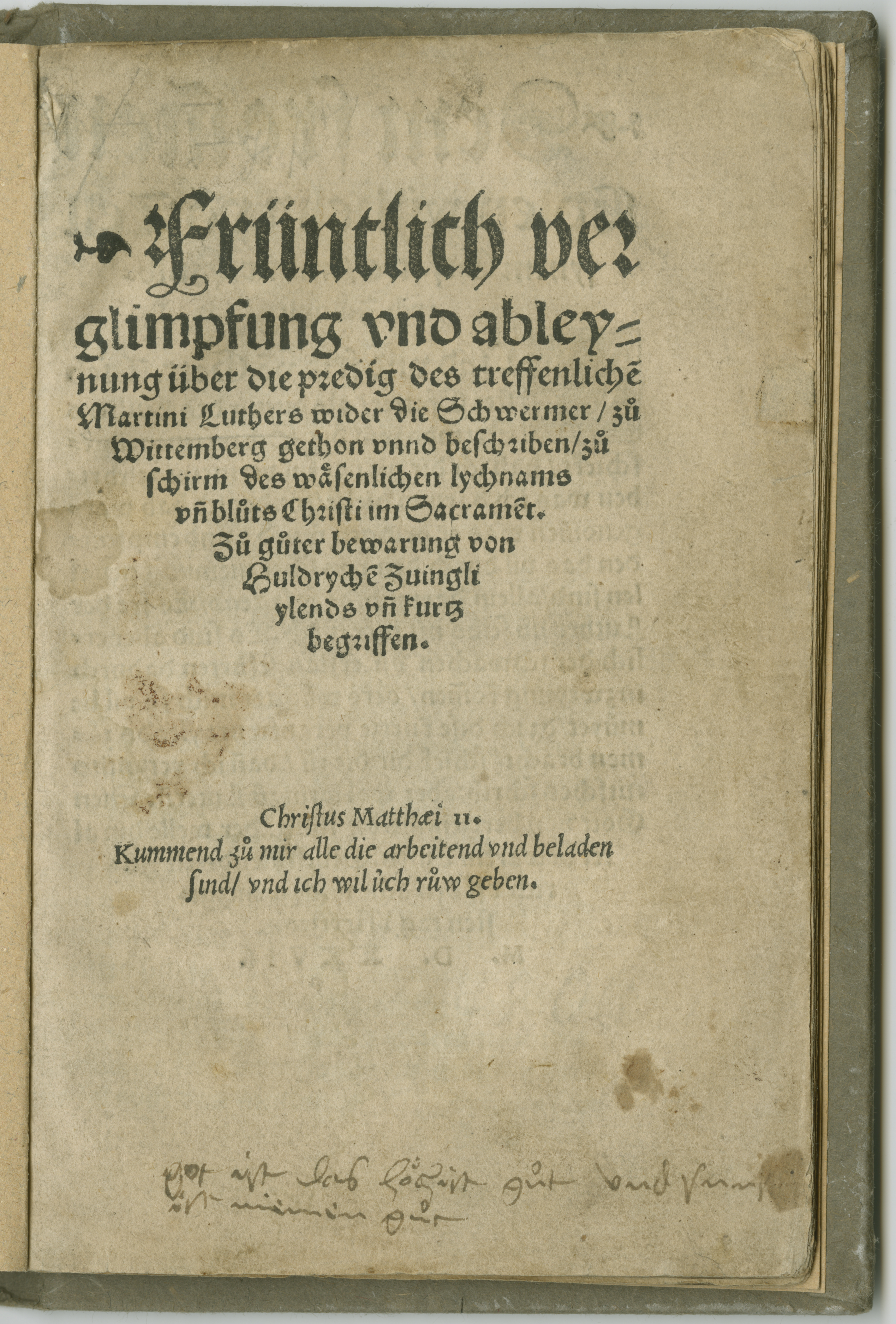
TextFrüntlich verglimpfung vnd ableynung über die predig des treffenliche[n] Martini Luthers wider die Schwermer : zuo Wittemberg gethon vnnd beschriben zuo schirm des wäsenlichen lychnams vn[d] bluts Christi im Sacrame[n]t
Zwingli, Ulrich, 1484-1531Summary: In a sermon against religious fanatics (Wider die Schwärmer), Luther had asserted the real presence of Christ in the eucharist. Zwingli responds by affirming the Reformed position that the practice of communion is to be seen as a symbolic act.Summary: In a sermon against religious fanatics (Wider die Schwärmer), Luther had asserted the real presence of Christ in the eucharist. Zwingli responds by affirming the Reformed position that the practice of communion is to be seen as a symbolic act. -
 Text
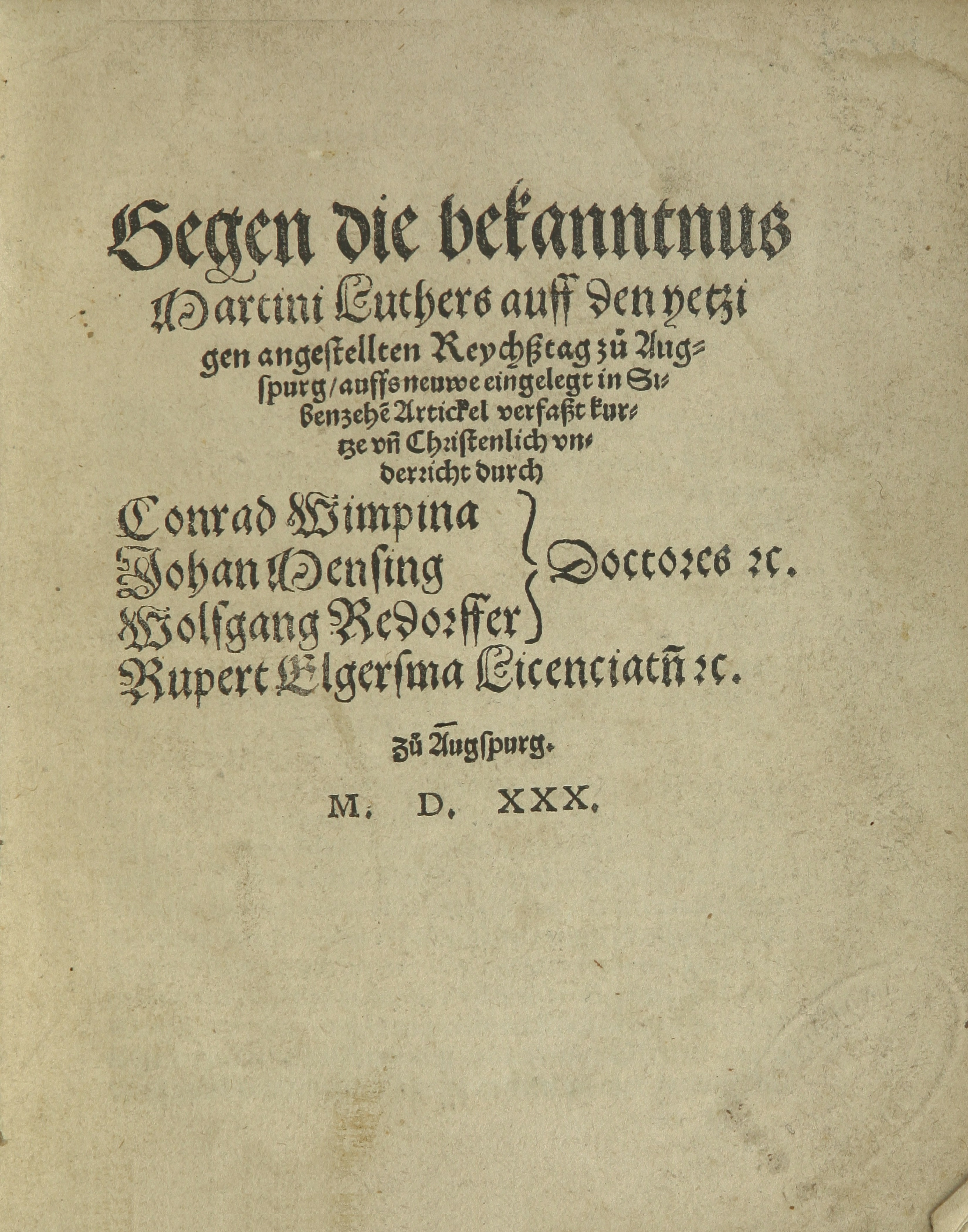
TextGegen die bekanntnus Martini Luthers auff den yetzigen angestellten Reychsstag zuo Augsburg, auff neuwe eingelegt in sibenzehe[n] Artickel verfasst. Kurtze vn[d] Christenlich vnderricht
Wimpina, Konrad, 1460-1531Summary: This pamphlet contains the Catholic response to the first, unauthorized edition of the Schwabach Articles, published in Coburg in 1530. Among the authors of this tract, Konrad Wimpina and Johannes Mensing helped draft the Catholic Confutation of the Augsburg Confession.Summary: This pamphlet contains the Catholic response to the first, unauthorized edition of the Schwabach Articles, published in Coburg in 1530. Among the authors of this tract, Konrad Wimpina and Johannes Mensing helped draft the Catholic Confutation of the Augsburg Confession. -
 Text
TextGeistliche Lieder zu Wittemberg / Anno 1543
Luther, Martin, 1483-1546Summary: Joseph Klug printed the first collection of hymns that Luther prepared specifically for congregational use in Wittenberg in 1529. It followed the church year closely and was revised and reprinted several times. The renowned hymnal printed by Valentin Bapst (Geystlicher Lieder'; Leipzig, 1545) may be seen as a later edition of the Klug hymnal. (Robin Leaver, "Hymnals," in 'The Oxford Encyclopedia of the Reformation' (1996) 2:286-89.)Summary: Joseph Klug printed the first collection of hymns that Luther prepared specifically for congregational use in Wittenberg in 1529. It followed the church year closely and was revised and reprinted several times. The renowned hymnal printed by Valentin Bapst (Geystlicher Lieder'; Leipzig, 1545) may be seen as a later edition of the Klug hymnal. (Robin Leaver, "Hymnals," in 'The Oxford Encyclopedia of the Reformation' (1996) 2:286-89.) -
 Still image
Gespängst der bösen geist
A woodcut depicting a hairy, bipedal beast, labeled as the "spook of the evil ghost," which is found in a vast desert beyond India in the land of Cathay. This type of ghost is said to lead travellers astray by mimicking the voices of their travelling companions.A woodcut depicting a hairy, bipedal beast, labeled as the "spook of the evil ghost," which is found in a vast desert beyond India in the land of Cathay. This type of ghost is said to lead travellers astray by mimicking the voices of their travelling companions. -

-
 Text
TextGirolamo [Hieronomo] Aleandro letter to Raffaele de' Medici, June 1, 1521
Aleandro, Girolamo, 1480-1542A letter from Girolamo Aleandro to his patron, Raffaele de' Medici, concerning the work done at the Diet, including the condemnation and arguments made against Luther. Aleandro discusses the drafting of an offical Imperial decree against Luther and discusses political tensions between the Holy Roman Empire and France.A letter from Girolamo Aleandro to his patron, Raffaele de' Medici, concerning the work done at the Diet, including the condemnation and arguments made against Luther. Aleandro discusses the drafting of an offical Imperial decree against Luther and discusses political tensions between the Holy Roman Empire and France. -
 Text
TextGirolamo [Hieronomo] Aleandro letter to Raffaele de' Medici, May 5, 1520
Aleandro, Girolamo, 1480-1542A letter from Girolamo Aleandro to his patron, Raffaele de' Medici, mentioning Luther's presence in Worms and commending himself further to Raffaele.A letter from Girolamo Aleandro to his patron, Raffaele de' Medici, mentioning Luther's presence in Worms and commending himself further to Raffaele. -
 Still image
Grapes and grapevines
An ornamental woodcut depicting bunches of grapes on the vine.An ornamental woodcut depicting bunches of grapes on the vine. -
 Still image
Gregorius XII Papa Venetus
Soye, Philippe deAn engraved portrait of Pope Gregory XII, who sat as pope from 1406-1415. The portrait shows Gregory XII wearing a simple miter with his coat of arms featured in the upper left corner. The portrait is labeled "GREGORIVS. XII. PAPA. VENETVS".An engraved portrait of Pope Gregory XII, who sat as pope from 1406-1415. The portrait shows Gregory XII wearing a simple miter with his coat of arms featured in the upper left corner. The portrait is labeled "GREGORIVS. XII. PAPA. VENETVS". -
 Text
TextGründtliche anzaygung vnd bericht, ausz was vrsachen (deren fürnemlich siben seind) so mancherley, vnnd vilfaltige Ketzereyen, zwispaltung vnnd jtzthumb in Christlicher Religion, vnd der hailigen Catholischen Kirchen, von anfang biss auff dise zeit erwachsen seind, vnd jren grund genommen haben
Leib, Kilian, 1471-1553Summary: Second printing of a an anti-Protestant tract by Kilian Leib, prior of the Augustinian monastery at Rebdorf. Leib was a Catholic theologian in the humanist tradition who was a firm opponent of Martin Luther's reforms. In 1530 he had participated in drafting the Catholic response to the Augsburg Confession. In this work, Leib outlines 7 causes for the Lutheran heresy, which include among others an unfavorable constellation of the stars, ordained by God to punish humanity.Summary: Second printing of a an anti-Protestant tract by Kilian Leib, prior of the Augustinian monastery at Rebdorf. Leib was a Catholic theologian in the humanist tradition who was a firm opponent of Martin Luther's reforms. In 1530 he had participated in drafting the Catholic response to the Augsburg Confession. In this work, Leib outlines 7 causes for the Lutheran heresy, which include among others an unfavorable constellation of the stars, ordained by God to punish humanity. -
 Still image
Henry II and Cunigunde of Luxembourg
A woodcut showing Holy Roman Emperor Henry II and Cunigunde of Luxembourg holding up a model of the Bamberg Cathedral (left) and the coat of arms of Georg Schenk von Limpurg (right).A woodcut showing Holy Roman Emperor Henry II and Cunigunde of Luxembourg holding up a model of the Bamberg Cathedral (left) and the coat of arms of Georg Schenk von Limpurg (right). -
 Text
TextHenry de Lesomet letter to Raffaele de' Medici, April 29, 1521
Lesomet, Henry deA letter from Henry de Lesomet to Raffaele de' Medici concerning correspondence with a Monsieur de Hoochstrate as well as mentioning Luther's departure from Worms and Lesomet's disdain for Luther's opinionsA letter from Henry de Lesomet to Raffaele de' Medici concerning correspondence with a Monsieur de Hoochstrate as well as mentioning Luther's departure from Worms and Lesomet's disdain for Luther's opinions -
 Still image
Hieronymus Emser's Coat of Arms
A woodcut depicting Hieronymus Emser's coat of arms which features a shield emblazoned with a goat's head and a helmet crowned with a goat's head. A label to the side of the crest reads "ARMA HIERONYMI EMSER".A woodcut depicting Hieronymus Emser's coat of arms which features a shield emblazoned with a goat's head and a helmet crowned with a goat's head. A label to the side of the crest reads "ARMA HIERONYMI EMSER". -
 Still image
Hieronymus Emser's Coat of Arms
A woodcut depicting Hieronymus Emser's coat of arms which features a shield emblazoned with a goat's head and a helmet crowned with a goat's head. A label to the side of the crest reads "ARMA HIERONYMI EMSER".A woodcut depicting Hieronymus Emser's coat of arms which features a shield emblazoned with a goat's head and a helmet crowned with a goat's head. A label to the side of the crest reads "ARMA HIERONYMI EMSER". -
 Still image
Hieronymus Emser's Coat of Arms
A woodcut depicting Hieronymus Emser's coat of arms which features a shield emblazoned with a goat's head and a helmet crowned with a goat's head. A label to the side of the crest reads "ARMA HIERONYMI EMSER".A woodcut depicting Hieronymus Emser's coat of arms which features a shield emblazoned with a goat's head and a helmet crowned with a goat's head. A label to the side of the crest reads "ARMA HIERONYMI EMSER". -
 Text
TextHistoria de uita et actis reuerendiss. viri D. Mart. Lutheri : uerae theologiae doctoris
Melanchthon, Philipp, 1497-1560Summary: Rare early printing of Melanchthon's biography of Luther.Summary: Rare early printing of Melanchthon's biography of Luther. -
 Text
TextHistoria de uita et actis reuerendissimi uiri D. Martini Lutheri, uerae theologiae doctoris
Melanchthon, Philipp, 1497-1560Summary: Philipp Melanchthon's biography of Martin Luther was first printed in 1548 and reissued numerous times. Included are Melanchthon's obituary of Martin Luther as well as his funeral sermon. The work was edited by Johannes Pollicarius who added some Latin and Greek poetry on Luther's "Here I stand" statement.Summary: Philipp Melanchthon's biography of Martin Luther was first printed in 1548 and reissued numerous times. Included are Melanchthon's obituary of Martin Luther as well as his funeral sermon. The work was edited by Johannes Pollicarius who added some Latin and Greek poetry on Luther's "Here I stand" statement.