Search
932 resources
932 items
Time Period
Sixteenth century
-
 Still image
Martinus Lutherus Septiceps
A woodcut depicting Martin Luther as a seven-headed monster, critiquing his deviation from Catholicism. Each head is labeled (from left to right): Doctor, Martinus, Lutherus, Ecclesiastes, Suermerus, Visitactor, and Barrabas. This was a classic piece of Catholic propaganda, portraying Luther not only as a Doctor and Churchman, but as a Turk, a wild enthusiast (Suermerus) and "Barrabas."A woodcut depicting Martin Luther as a seven-headed monster, critiquing his deviation from Catholicism. Each head is labeled (from left to right): Doctor, Martinus, Lutherus, Ecclesiastes, Suermerus, Visitactor, and Barrabas. This was a classic piece of Catholic propaganda, portraying Luther not only as a Doctor and Churchman, but as a Turk, a wild enthusiast (Suermerus) and "Barrabas." -
 Still image
Martinus V Papa Romanus
Soye, Philippe deAn engraved portrait of Pope Martin V, who sat as pope from 1417-1431. The portrait shows Martin V wearing a simple vestments with his coat of arms featured in the upper right corner. The portrait is labeled "MARTINVS. V. PAPA. ROMANVS".An engraved portrait of Pope Martin V, who sat as pope from 1417-1431. The portrait shows Martin V wearing a simple vestments with his coat of arms featured in the upper right corner. The portrait is labeled "MARTINVS. V. PAPA. ROMANVS". -
 Still image
Medallion portraits of Erasmus, Hutten, Luther, and Melanchthon
A set of three woodcuts: two medallion portraits of Erasmus Desidarius and Ulrich van Hutten and one medallion schematic caricature double portrait of Martin Luther and Philip Melanchthon.A set of three woodcuts: two medallion portraits of Erasmus Desidarius and Ulrich van Hutten and one medallion schematic caricature double portrait of Martin Luther and Philip Melanchthon. -
 Still image
Mendicant Monks
A woodcut depicting a pair of mendicant monks standing beneath an archway as a pair of men sit at a table and wave them away.A woodcut depicting a pair of mendicant monks standing beneath an archway as a pair of men sit at a table and wave them away. -
 Still image
Mendicant Monks
A woodcut depicting a pair of mendicant monks standing beneath an archway as a pair of men sit at a table and wave them away.A woodcut depicting a pair of mendicant monks standing beneath an archway as a pair of men sit at a table and wave them away. -
 Still image
Mendicant Monks
A woodcut depicting a pair of mendicant monks standing beneath an archway as a pair of men sit at a table and wave them away.A woodcut depicting a pair of mendicant monks standing beneath an archway as a pair of men sit at a table and wave them away. -
 Still image
Mendicant Monks
A woodcut depicting a pair of mendicant monks standing beneath an archway as a pair of men sit at a table and wave them away.A woodcut depicting a pair of mendicant monks standing beneath an archway as a pair of men sit at a table and wave them away. -
 Still image
Monstrance
A woodcut depicting an elaborate monstrance, or an ostensorium, somewhat in the shape of a cathedral with a crucefix on top.A woodcut depicting an elaborate monstrance, or an ostensorium, somewhat in the shape of a cathedral with a crucefix on top. -
![A woodcut depicting two boys, one born with four [feet] and one born without hands or eyes and the lower body of a fish. These beings are described in the text as being portents of the coming of Islam, implying that Islam was a danger to Christians.](https://digital.pitts.emory.edu/files/large/P_3000000205074_P3xx/P_300000205074_P3xx-cr_PROD.jpg) Still image
Still imageMonstrous Portents of Islam
A woodcut depicting two boys, one born with four [feet] and one born without hands or eyes and the lower body of a fish. These beings are described in the text as being portents of the coming of Islam, implying that Islam was a danger to Christians.A woodcut depicting two boys, one born with four [feet] and one born without hands or eyes and the lower body of a fish. These beings are described in the text as being portents of the coming of Islam, implying that Islam was a danger to Christians. -
 Text
TextMultiloquus de co[n]citata ex dictis Lutheri seditio[n]e, : ad Inuictissimu[m] & optimu[m] Imperatore[m] ac multo[rum] regno[rum] Rege[m] inclitu[m] etc[etera]. Carolu[m] S.
Dungersheim, Hieronymus, 1465-1540Summary: H. Dungersheim had had a long academic career before the Reformation started. He proved to be a determined foe of Luther. In this rare book he presents "over a hundred" citations from Luther's books written before the Peasants' War (1525) to prove that Luther was a teacher of sedition and tumult.Summary: H. Dungersheim had had a long academic career before the Reformation started. He proved to be a determined foe of Luther. In this rare book he presents "over a hundred" citations from Luther's books written before the Peasants' War (1525) to prove that Luther was a teacher of sedition and tumult. -
 Text
TextNew deudsch Psalter
Summary: Luther's first major revision of his translation of the Hebrew book of Psalms. Luther and his translation committee worked diligently on the German Bible throughout Luther's life. Every word came under repeated scrutiny; the translators never felt completely satisfied. The Psalter was revised repeatedly, always with the aim of seeking clarity of expression. This is the first revision of the work. This copy is annotated, dated 5 February, 1541, by A. Blarer, a Swabian reformer who was deeply influenced by Luther.Summary: Luther's first major revision of his translation of the Hebrew book of Psalms. Luther and his translation committee worked diligently on the German Bible throughout Luther's life. Every word came under repeated scrutiny; the translators never felt completely satisfied. The Psalter was revised repeatedly, always with the aim of seeking clarity of expression. This is the first revision of the work. This copy is annotated, dated 5 February, 1541, by A. Blarer, a Swabian reformer who was deeply influenced by Luther. -
 Text
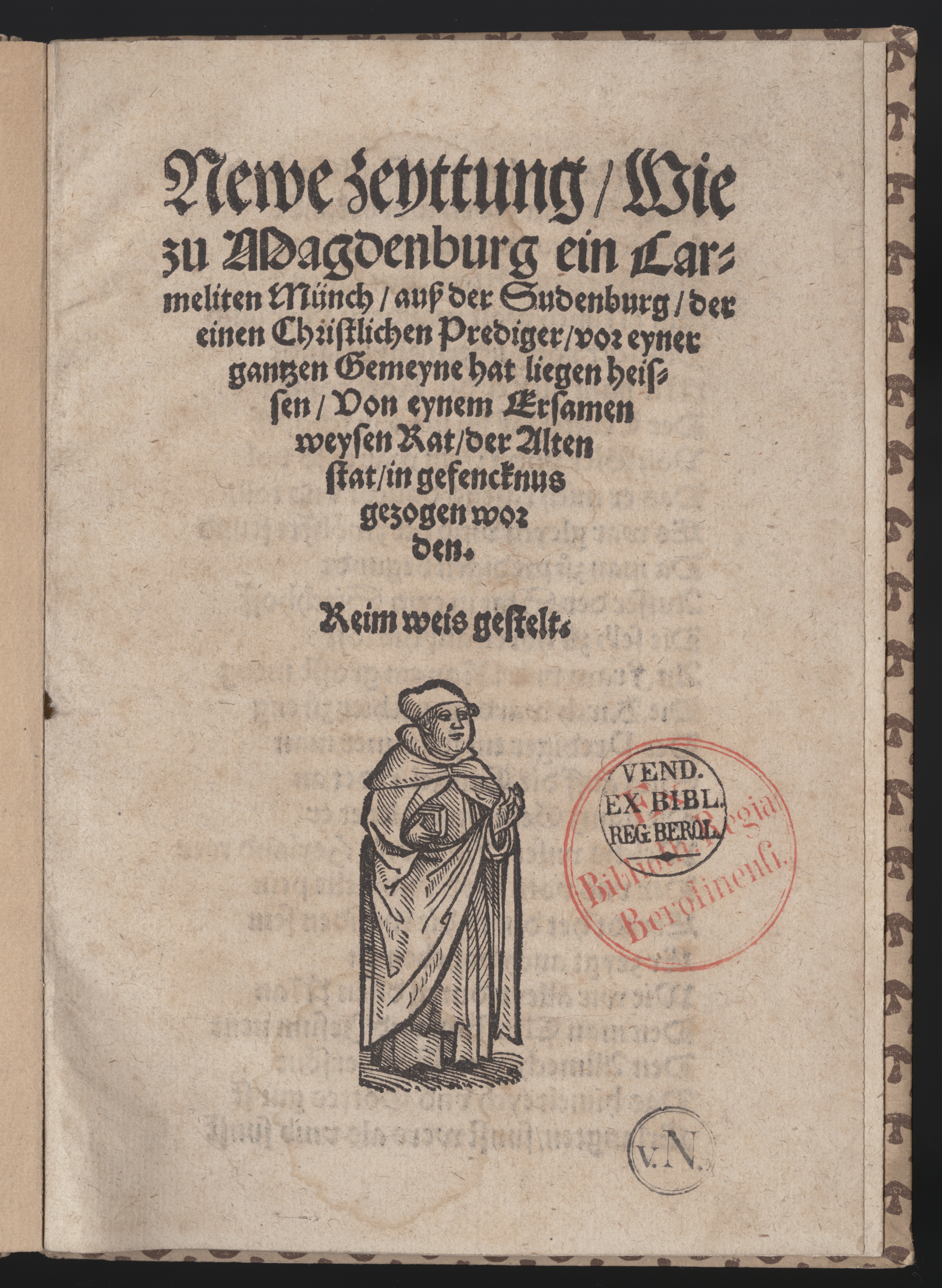
TextNewe zeyttung, Wie zu Magdenburg ein Carmeliten Münch, auss der Sudenburg, der einen Christlichen Prediger, vor eyner gantzen Gemeyne hat liegen heissen, Von eynem Ersamen weysen Rat, der Alten stat, in gefencknus gezogen worden. : Reim weis gestelt.
Summary: Polemic ballad with a total of 142 rhymed lines, relating the story of a drunk Carmelite monk who attends a sermon preached outside the city by a righteous (Lutheran) pastor and who interrupts the preacher, accusing him of lying and misrepresenting Scripture. The people in response rise up and begin to beat him, almost killing him, but the monk is taken away and brought before the city council and the mayor who calls for calm and instructs that the monk should be locked up to await the executioner and thus be placed under God's justice rather than the mob's anger.Summary: Polemic ballad with a total of 142 rhymed lines, relating the story of a drunk Carmelite monk who attends a sermon preached outside the city by a righteous (Lutheran) pastor and who interrupts the preacher, accusing him of lying and misrepresenting Scripture. The people in response rise up and begin to beat him, almost killing him, but the monk is taken away and brought before the city council and the mayor who calls for calm and instructs that the monk should be locked up to await the executioner and thus be placed under God's justice rather than the mob's anger. -
 Still image
Nicolaus V Papa Sergianensis
Soye, Philippe deAn engraved portrait of Pope Nicholas V, who sat as pope from 1447-1455. The portrait shows Nicholas V wearing a papal miter with his coat of arms featured in the upper right corner. The portrait is labeled "NICOLAVS. V. PAPA. SERGIANENSIS".An engraved portrait of Pope Nicholas V, who sat as pope from 1447-1455. The portrait shows Nicholas V wearing a papal miter with his coat of arms featured in the upper right corner. The portrait is labeled "NICOLAVS. V. PAPA. SERGIANENSIS". -
 Still image
Noah's Ark surviving the flood
Cranach, Lucas, 1472-1553A woodcut depicting Noah's Ark (Der Kaste Noe) safe and afloat amidst the torential rains (center). At the bottom of the image there is a field of fallen trees and dead people and animals left behind by the receeding waters. in the top left of the image there is a dove carrying an olive branch, signalling the receeding of the waters.A woodcut depicting Noah's Ark (Der Kaste Noe) safe and afloat amidst the torential rains (center). At the bottom of the image there is a field of fallen trees and dead people and animals left behind by the receeding waters. in the top left of the image there is a dove carrying an olive branch, signalling the receeding of the waters. -
 Text
TextNote on Old Testament Chronology
Luther, Martin, 1483-1546A manuscript in Martin Luther's own hand, "Notes on Two Chronological Difficulties in the Old Testament" (see Weimar Edition of The Works of Martin Luther, Volume 60, page 163). The document is a seven line author's note written in 1541, in which Luther discussed the accuracy of the computations in his 1541 work, Computation of the Years of the World. (Weimar Edition of The Works of Martin Luther, Volume 53, pages 177-182).A manuscript in Martin Luther's own hand, "Notes on Two Chronological Difficulties in the Old Testament" (see Weimar Edition of The Works of Martin Luther, Volume 60, page 163). The document is a seven line author's note written in 1541, in which Luther discussed the accuracy of the computations in his 1541 work, Computation of the Years of the World. (Weimar Edition of The Works of Martin Luther, Volume 53, pages 177-182). -
 Text
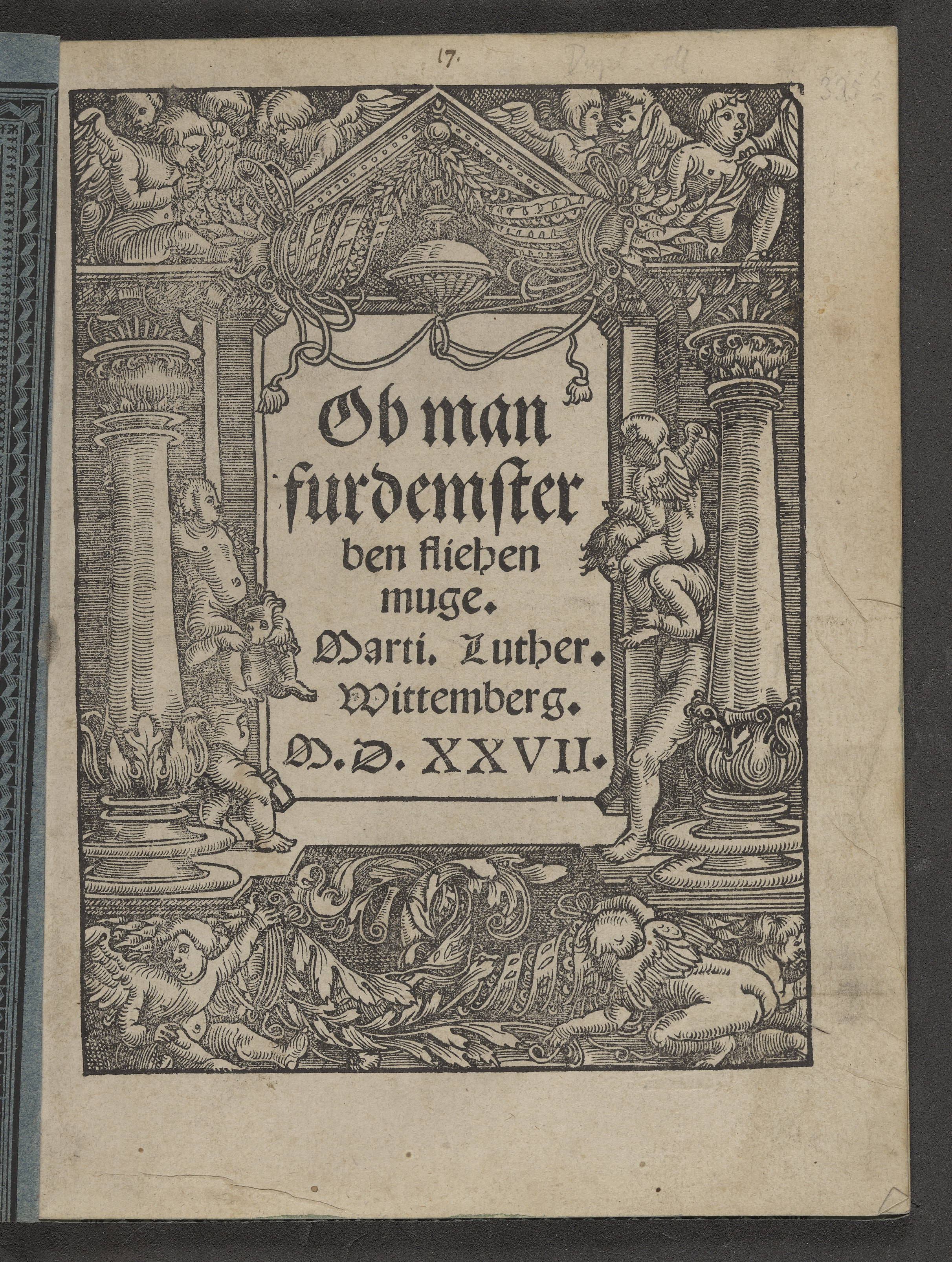
TextOb man fur dem Sterben fliehen muge
Luther, Martin, 1483-1546Summary: The Black Death ravaged Europe from the fourteenth century onward. Dr. Johann Hess, a pastor from Breslau, asked Luther in 1527 whether it was permissible for a person to flee from plague-infested areas. Luther replied that it was, and then added some public health advice for town and city government officials in plague-ravaged areas. He advocated fumigation of this, the seventh printing of the work.Summary: The Black Death ravaged Europe from the fourteenth century onward. Dr. Johann Hess, a pastor from Breslau, asked Luther in 1527 whether it was permissible for a person to flee from plague-infested areas. Luther replied that it was, and then added some public health advice for town and city government officials in plague-ravaged areas. He advocated fumigation of this, the seventh printing of the work. -
 Text
TextOb man fur dem sterben fliehen muge
Luther, Martin, 1483-1546Summary: The Black Death ravaged Europe from the fourteenth century onward. Dr. Johann Hess, a pastor from Breslau, asked Luther in 1527 whether it was permissible for a person to flee from plague-infested areas. Luther replied that it was, and then added some public health advice for town and city government officials in plague-ravaged areas.Summary: The Black Death ravaged Europe from the fourteenth century onward. Dr. Johann Hess, a pastor from Breslau, asked Luther in 1527 whether it was permissible for a person to flee from plague-infested areas. Luther replied that it was, and then added some public health advice for town and city government officials in plague-ravaged areas. -
 Still image
Obadiah Receives a Vision from an Angel
A woodcut depicting Obadiah receiving his vision from an angel. The text of the first verse of Obadiah is printed above.A woodcut depicting Obadiah receiving his vision from an angel. The text of the first verse of Obadiah is printed above. -
 Still image
Offensam remittere
Galle, Philippe, 1537-1612The act of forgiving offenses, illustrated and accompanied by scriptural references.The act of forgiving offenses, illustrated and accompanied by scriptural references. -
 Text
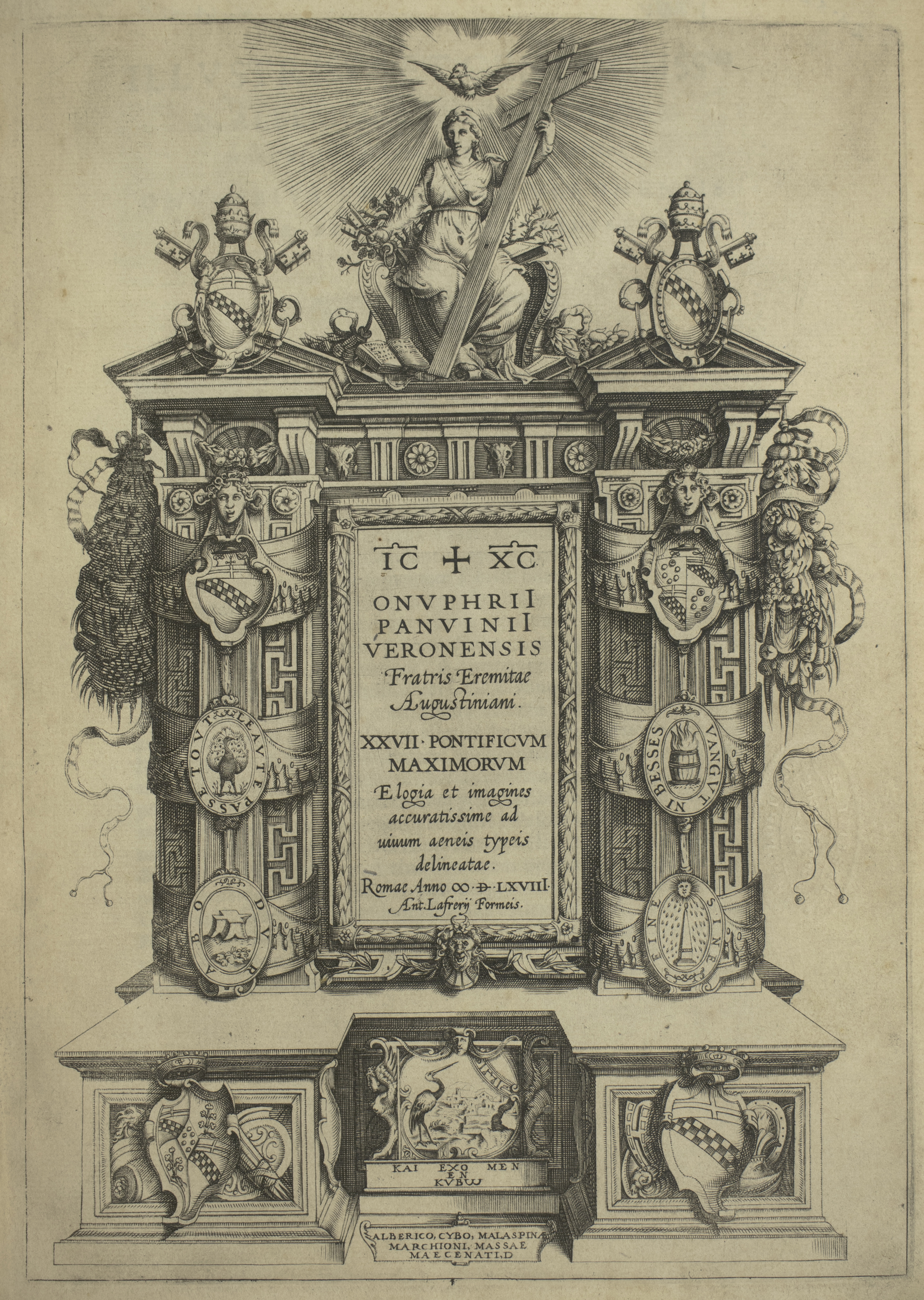
TextOnuphrii Panuinii Veronensis Fratris Eremitae Augustiniani. XXVII. Pontificum Maximorum elogia et imagines
Panvinio, Onofrio, 1529-1568Summary:Summary: -
 Text
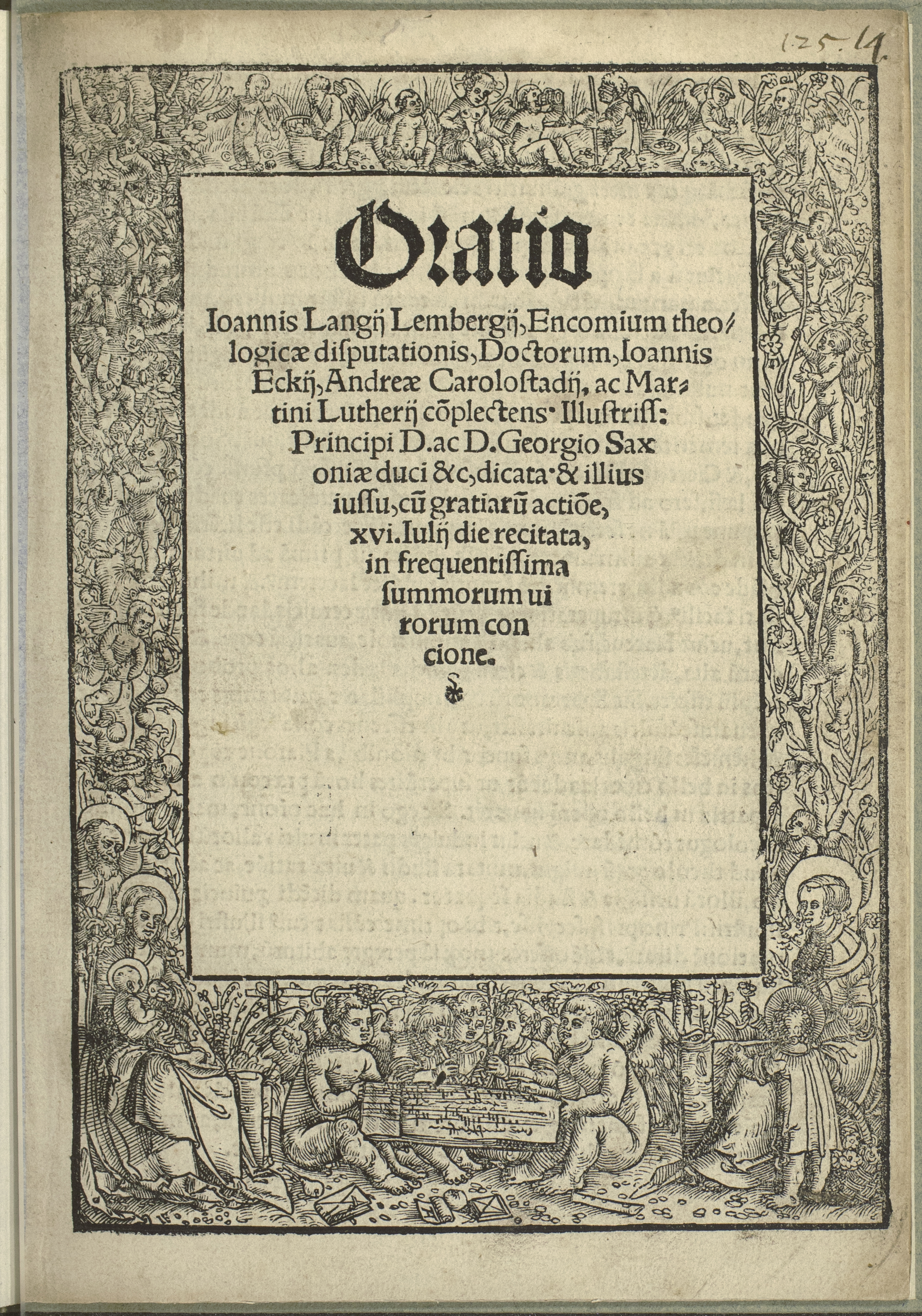
TextOratio
Lange, Johann, 1485-1565Summary: This is the speech by J. Lange von Lemberg, Rector of the University of Leipzig, given at the end of the Leipzig Disputation. Lange von Lemberg takes no sides in the Disputation but praises all the contestants, especially Luther. This is the only printing of the work.Summary: This is the speech by J. Lange von Lemberg, Rector of the University of Leipzig, given at the end of the Leipzig Disputation. Lange von Lemberg takes no sides in the Disputation but praises all the contestants, especially Luther. This is the only printing of the work.