Search
932 resources
932 items
Time Period
Sixteenth century
-
 Still image
Blessing and Coronation of a Queen: Presentation by the King
A woodcut depicting the blessing and coronation of a queen. The queen kneels behind the king who petitions the bishop to bless and crown her. The scene is flanked by a pair of cherubs holding rings and kneeling on helmets. The woodcut is reused throughout the work.A woodcut depicting the blessing and coronation of a queen. The queen kneels behind the king who petitions the bishop to bless and crown her. The scene is flanked by a pair of cherubs holding rings and kneeling on helmets. The woodcut is reused throughout the work. -
 Still image
Blessing and Coronation of a Queen: Speaking the Litany
A woodcut depicting the blessing and coronation of a queen. The queen kneels before a bishop who is reciting a litany from a book of the Gospels held by an attendant. The scene is flanked by a pair of cherubs holding rings and kneeling on helmets. The woodcut is reused throughout the work.A woodcut depicting the blessing and coronation of a queen. The queen kneels before a bishop who is reciting a litany from a book of the Gospels held by an attendant. The scene is flanked by a pair of cherubs holding rings and kneeling on helmets. The woodcut is reused throughout the work. -
 Still image
Blessing of Travellers
A woodcut depicting the pope blessing travelers. The pope sits upon a horse, attendants holding a canopy above him, and holds his hand out to bless a trio of travelers while three bishops on horses watch. The scene is flanked by ornamental scroll work featuring masks. The woodcut is reused throughout the work.A woodcut depicting the pope blessing travelers. The pope sits upon a horse, attendants holding a canopy above him, and holds his hand out to bless a trio of travelers while three bishops on horses watch. The scene is flanked by ornamental scroll work featuring masks. The woodcut is reused throughout the work. -
 Still image
Blessing of a Soldier or Knight
A woodcut depicting the blessing of a soldier or knight. The armored soldier or knight kneels before a bishop, holding his sword before him as the bishop takes hold of the hilt. The scene is flanked by a pair of cherubs standing on eagles and holding bags of snakes. The woodcut is reused throughout the work.A woodcut depicting the blessing of a soldier or knight. The armored soldier or knight kneels before a bishop, holding his sword before him as the bishop takes hold of the hilt. The scene is flanked by a pair of cherubs standing on eagles and holding bags of snakes. The woodcut is reused throughout the work. -
 Still image
Blessing of a Tabernacle for Conserving the Holy Eucharist
A woodcut depicting the blessing of a tabernacle for the Eucharist. A bishop raises a hand in blessing as the tabernacle sits upon an altar. The scene is flanked by ornamental scroll work featuring cherubs. The woodcut is reused throughout the work.A woodcut depicting the blessing of a tabernacle for the Eucharist. A bishop raises a hand in blessing as the tabernacle sits upon an altar. The scene is flanked by ornamental scroll work featuring cherubs. The woodcut is reused throughout the work. -
 Still image
Blessing of the Military Standard
A woodcut depicting the blessing of a military standard. A soldier kneels and holds forward a banner, which a bishop holds to bless. The scene is flanked by a pair of cherubs holding rings and kneeling on helments. The woodcut is reused throughout the work.A woodcut depicting the blessing of a military standard. A soldier kneels and holds forward a banner, which a bishop holds to bless. The scene is flanked by a pair of cherubs holding rings and kneeling on helments. The woodcut is reused throughout the work. -
 Still image
Bonifacius IX Papa Neapolitanus
Soye, Philippe deAn engraved portrait of Pope Boniface IX, who sat as pope from 1389-1404. The portrait shows Boniface IX wearing a papal miter with his coat of arms featured in the upper left corner. The portrait is labeled "BONIFACIVS. IX. PAPA. NEAPOLITANVS".An engraved portrait of Pope Boniface IX, who sat as pope from 1389-1404. The portrait shows Boniface IX wearing a papal miter with his coat of arms featured in the upper left corner. The portrait is labeled "BONIFACIVS. IX. PAPA. NEAPOLITANVS". -
 Text
TextBook of Hours
A vellum leaf from a Latin Book of Hours. The leaf contains 1/4 panel borders, 1-line and 2-line decoratored initials, and decorated line endings all of liquid gold and tempera.A vellum leaf from a Latin Book of Hours. The leaf contains 1/4 panel borders, 1-line and 2-line decoratored initials, and decorated line endings all of liquid gold and tempera. -
 Text
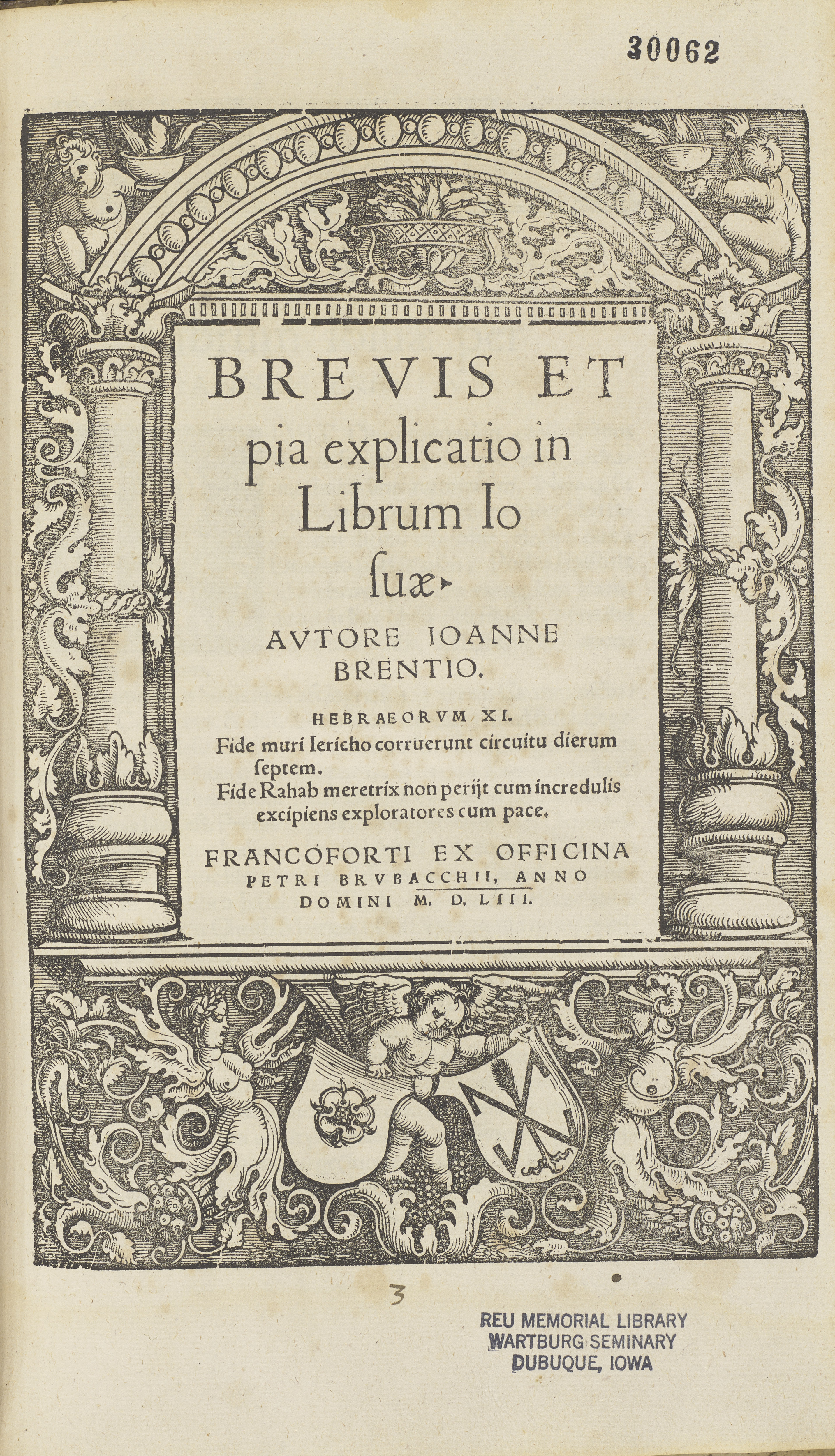
TextBreuis et pia explicatio in librum Josuae
Brenz, Johannes, 1499-1570Summary: Johannes Brenz's commentary on the book of Joshua, first published in 1549.Summary: Johannes Brenz's commentary on the book of Joshua, first published in 1549. -
 Text
TextBreuissima maximque compendiaria consiciendaru[m] epistolarum formula
Erasmus, Desiderius, -1536Summary: A short tract by Erasmus on the composition of letters.Summary: A short tract by Erasmus on the composition of letters. -
 Text
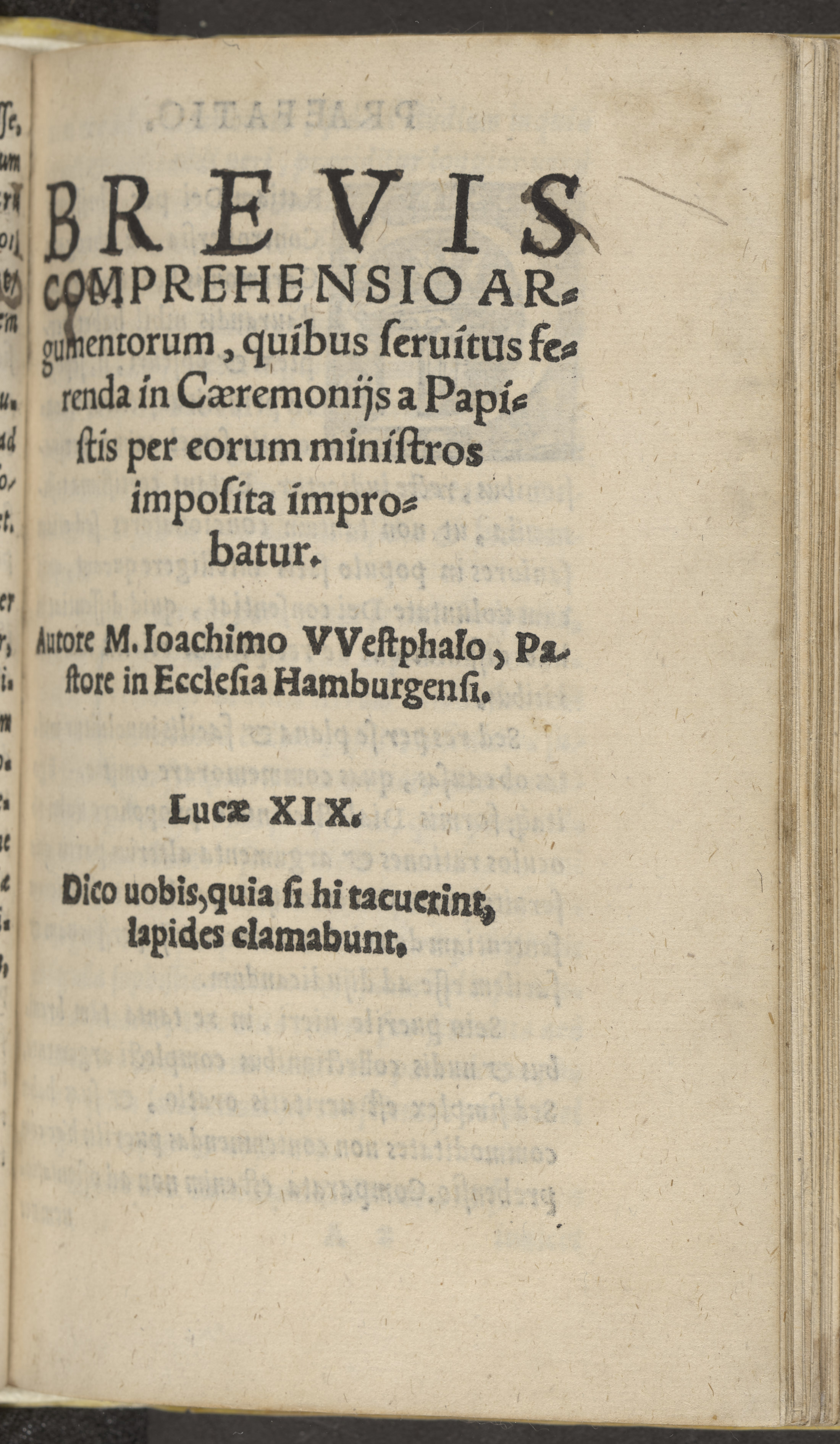
TextBrevis comprehensio argumentorum, quibis seruitus ferenda in caeremonijs a papistis per eorum ministros imposita improbatur
Westphal, Joachim, 1510 or 1511-1574Summary: Joachim Westphal was a gnesio-Lutheran theologian and Superintendent in Hamburg. A major opponent of the Interims of Augsburg and Leipzig, he argued that Catholic liturgical practices were not adiaphora (morally indifferent acts that were either required nor prohibited), but needed to be rejected completely.Summary: Joachim Westphal was a gnesio-Lutheran theologian and Superintendent in Hamburg. A major opponent of the Interims of Augsburg and Leipzig, he argued that Catholic liturgical practices were not adiaphora (morally indifferent acts that were either required nor prohibited), but needed to be rejected completely. -
 Text
TextBvlla decimi Leonis, contra errores Martini Lutheri, & sequacium
Summary: First printing of the first edition of Hutten's edition of the papal bull Exsurge Domine, which condemns as heretical 41 statements by Martin Luther and offers Luther 60 days to recant. Hutten issued the bull with the papal coat of arms on the title page, and offers his own glosses, introduction, and call to Leo to keep his bulls to himself, and not to bother the German Protestants any longer.Summary: First printing of the first edition of Hutten's edition of the papal bull Exsurge Domine, which condemns as heretical 41 statements by Martin Luther and offers Luther 60 days to recant. Hutten issued the bull with the papal coat of arms on the title page, and offers his own glosses, introduction, and call to Leo to keep his bulls to himself, and not to bother the German Protestants any longer. -
 Still image
Calixtus III Papa Valentinus Hispanus
Soye, Philippe deAn engraved portrait of Pope Callistus III, who sat as pope from 1455-1458. The portrait shows Callistus III wearing elaborate vestments with his coat of arms featured in the upper right corner. The portrait is labeled "CALIXTVS. III. PAPA. VALENTINVS. HISPANVS".An engraved portrait of Pope Callistus III, who sat as pope from 1455-1458. The portrait shows Callistus III wearing elaborate vestments with his coat of arms featured in the upper right corner. The portrait is labeled "CALIXTVS. III. PAPA. VALENTINVS. HISPANVS". -
 Text
TextCantio de papa romanaque ecclesia, per Boemum quendam ante annos circiter 100 composita, secundum ordinem alphabeti
Summary: Satirical song about the office of the Pope, composed anonymously in response to the execution of Jan Hus in 1415 and published by Matthias Flacius to underscore his opposition to the Catholic Church in all matters following the Interim of Augsburg in 1548.Summary: Satirical song about the office of the Pope, composed anonymously in response to the execution of Jan Hus in 1415 and published by Matthias Flacius to underscore his opposition to the Catholic Church in all matters following the Interim of Augsburg in 1548. -
 Text
TextCaspar Sasgerus Minorita De cultu & ueneratione sanctorum
Schatzgeyer, Kaspar, 1463 or 1464-1527Summary: C. Schatzgeyer here writes on the veneration of the saints, the "friends of God". Catholic theology makes a sharp distinction between paying honor to saints (dulia) and worship of God (latria). This is the first printing of this work. No one knows for sure when it was written and printed.Summary: C. Schatzgeyer here writes on the veneration of the saints, the "friends of God". Catholic theology makes a sharp distinction between paying honor to saints (dulia) and worship of God (latria). This is the first printing of this work. No one knows for sure when it was written and printed. -
 Text
TextCatechesis Dauidis Chytraei recens recognita, et multis definitionibus aucta
Chytraeus, David, 1531-1600Summary: Catechism by David Chytraeus, a student of Philipp Melanchthon's.Summary: Catechism by David Chytraeus, a student of Philipp Melanchthon's. -
 Text
TextCatechismus
Brenz, Johannes, 1499-1570Summary: Johannes Brenz had written the first Protestant catechism in 1527, two years before Luther issued his large and small catechisms. This is a 1552 printing of the work.Summary: Johannes Brenz had written the first Protestant catechism in 1527, two years before Luther issued his large and small catechisms. This is a 1552 printing of the work. -
 Text
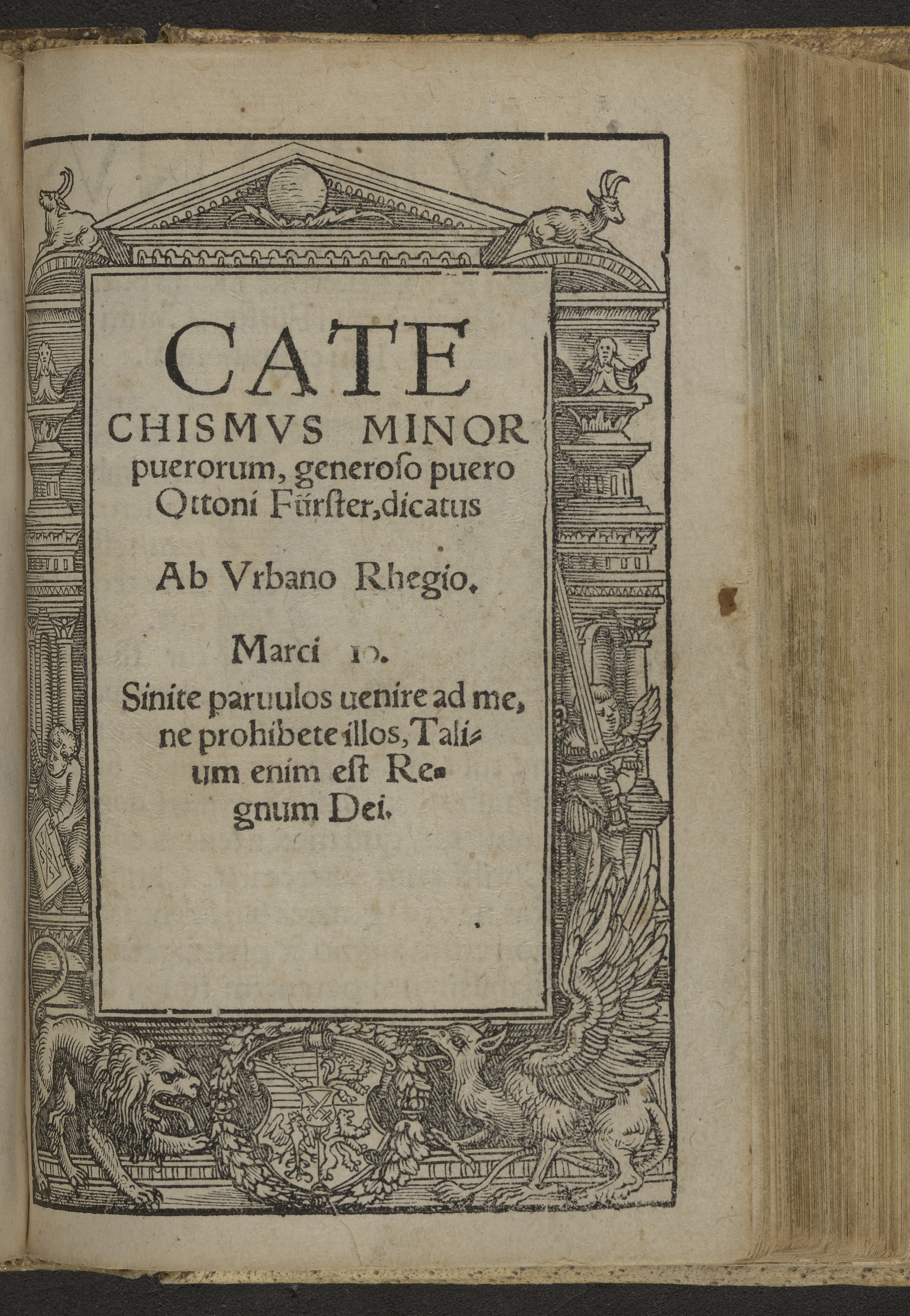
TextCatechismus minor puerorum, generoso puero Ottoni Fürster
Rhegius, Urbanus, 1489-1541Summary: Rhegius was a Reformer, active throughout Germany promoting Lutheran unity in the Holy Roman Empire. In 1530 at the Diet of Augsburg he was befriended by Ernest I, Duke of Brunswick-Luneburg, under whose patronage he returned to Brunswick where he wrote the present work for Ernest's son, Francis Otto (1530-1559). Like many 16th c. catechisms, Rhegius' is in the form of a dialogue, in this instance between the teacher and the pupil (paedagogus et discipulus).Summary: Rhegius was a Reformer, active throughout Germany promoting Lutheran unity in the Holy Roman Empire. In 1530 at the Diet of Augsburg he was befriended by Ernest I, Duke of Brunswick-Luneburg, under whose patronage he returned to Brunswick where he wrote the present work for Ernest's son, Francis Otto (1530-1559). Like many 16th c. catechisms, Rhegius' is in the form of a dialogue, in this instance between the teacher and the pupil (paedagogus et discipulus). -
 Text
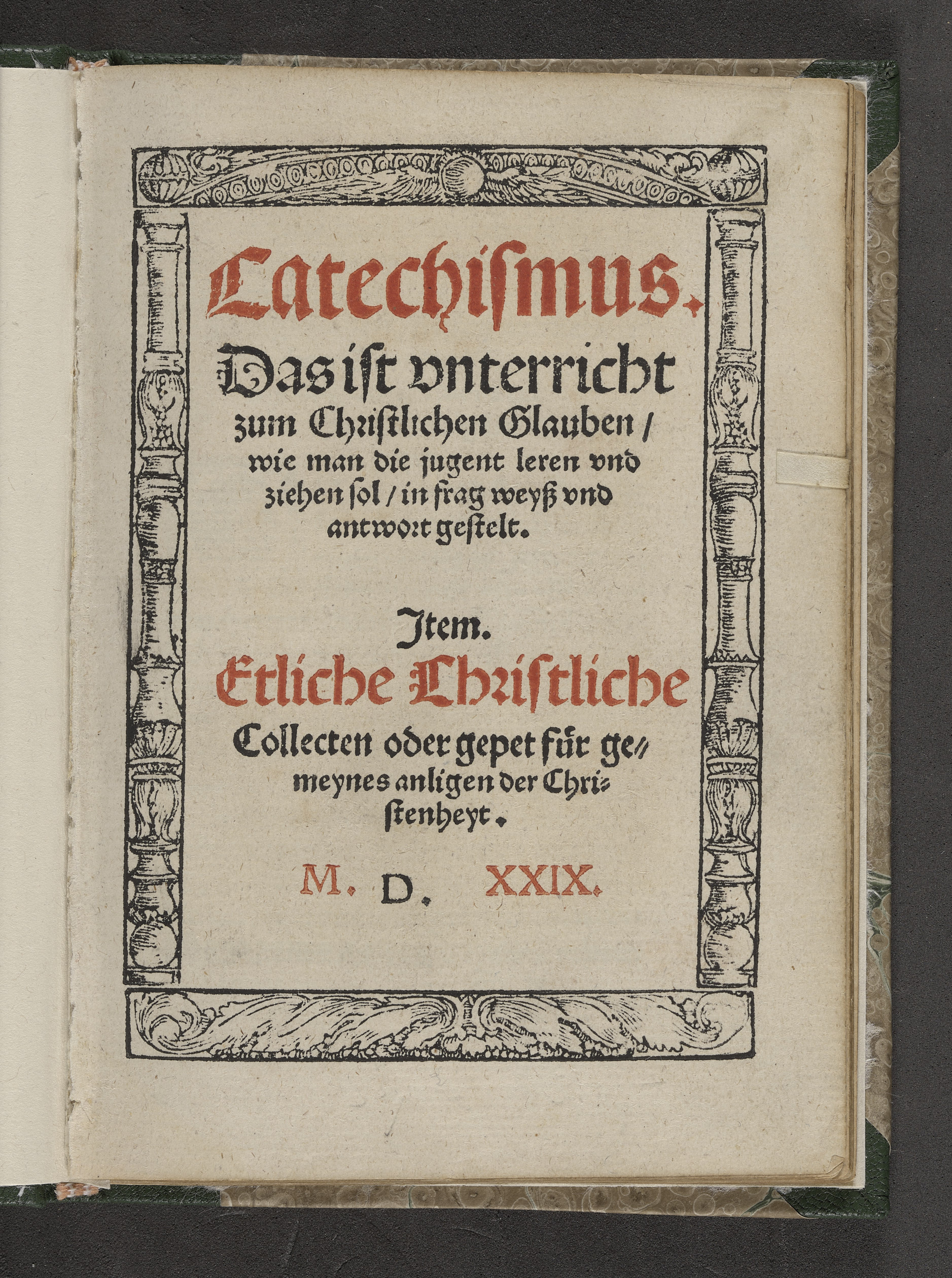
TextCatechismus. Das ist Vnterricht zum christlichen Glauben wie man die Jugent leren vnd ziehen sol, in Frag Weyss vnd Antwort gestelt : Jtem etliche christliche Collecten oder Gepet für gemeynes Anligen der Christenheyt
Althamer, Andreas, approximately 1500-1539Summary: Third printing of the Ansbach Catechism by Andreas Althamer and Johannes Rurer, commissioned by Margrave Georg of Brandenburg. It has been called the first regional catechism of the Protestant movement. It contains 92 questions and answers as well as an appendix with 18 prayers.Summary: Third printing of the Ansbach Catechism by Andreas Althamer and Johannes Rurer, commissioned by Margrave Georg of Brandenburg. It has been called the first regional catechism of the Protestant movement. It contains 92 questions and answers as well as an appendix with 18 prayers. -
 Text
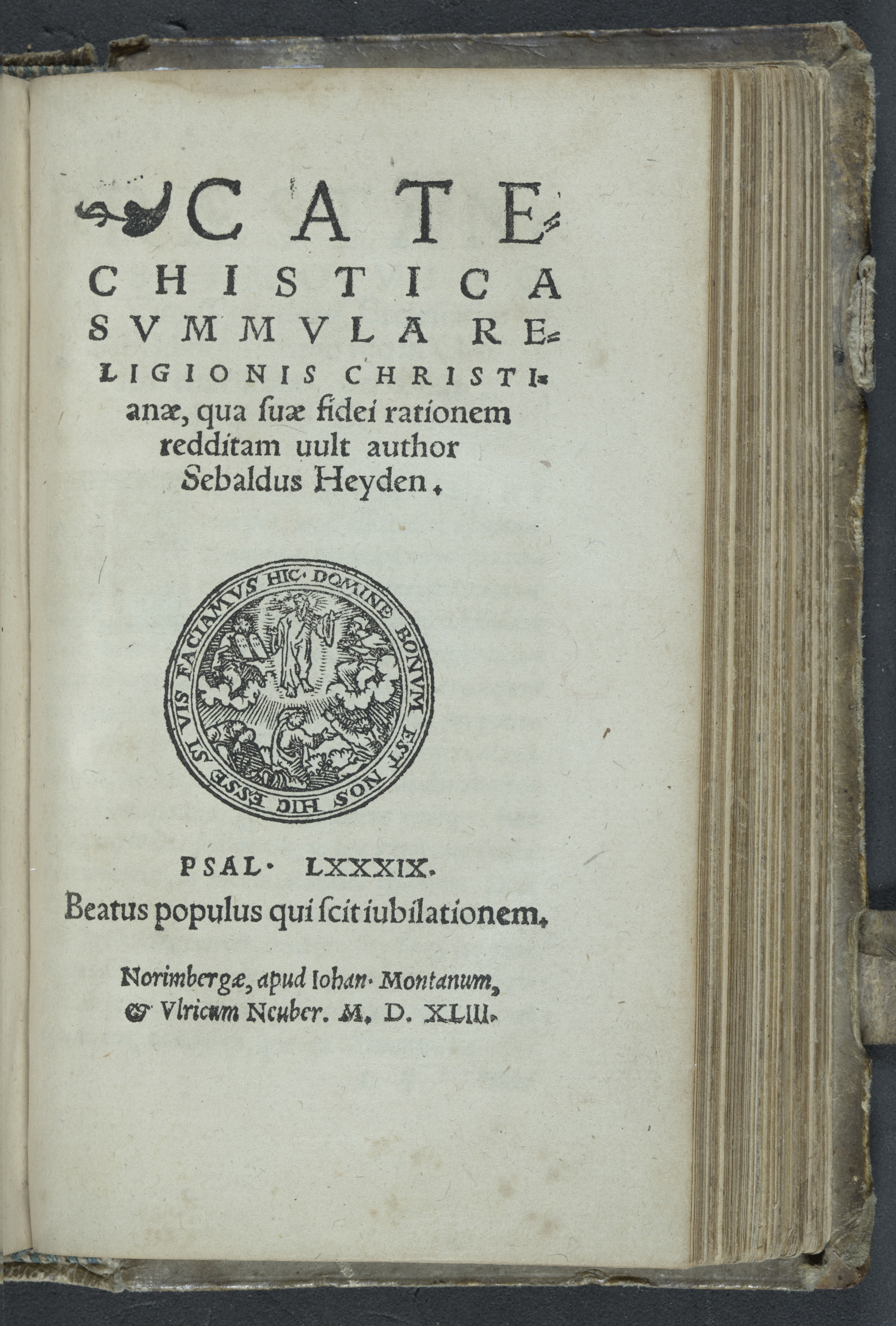
TextCatechistica summula religionis Christianae
Heyden, Sebald, -1561Summary: Summary-style Lutheran catechism by Sebald Heyden, a humanist scholar and educator in Nuremberg. He was well known as a poet and composer of hymns and his book "De arte candendi" (On the art of singing) had a significant impact on the study and teaching of music.Summary: Summary-style Lutheran catechism by Sebald Heyden, a humanist scholar and educator in Nuremberg. He was well known as a poet and composer of hymns and his book "De arte candendi" (On the art of singing) had a significant impact on the study and teaching of music. -
 Still image
Ceux qui ont leur uentre pour leur Dieu
Holbein, Hans, 1497-1543A woodcut depicting a group of putti (cherubs) parading with grapes and vines. The woodcut is accompanied by a verse from Philippians 3 translated into French (top) and then reformatted into verse (bottom).A woodcut depicting a group of putti (cherubs) parading with grapes and vines. The woodcut is accompanied by a verse from Philippians 3 translated into French (top) and then reformatted into verse (bottom).