Search
741 resources
741 items
Collection
Richard C. Kessler Reformation Collection
-
 Still image
A Monk and a Knight
A woodcut depicting a monk in conversation with a knight. The woodcut appears on the title page of Luther's letter to the head of the Teutonic Order of Knights arguing against the requirement of celibacy.A woodcut depicting a monk in conversation with a knight. The woodcut appears on the title page of Luther's letter to the head of the Teutonic Order of Knights arguing against the requirement of celibacy. -
 Still image
A Pilgrim guided by God
A woodcut depicting a pilgrim outfitted with a hat, cloak, staff, and bag for his journey, being directed by God from Heaven (top right).A woodcut depicting a pilgrim outfitted with a hat, cloak, staff, and bag for his journey, being directed by God from Heaven (top right). -
 Text
TextAcht Sermon. D. M. Luthers vo[n] im gepredigt zu[o] Wittemberg inn der Fasten : Darinn kurtzlich begryffen von den Messen, Bildtnussen bayderlay gestalt des Sacramennts von denn speysen vnd haimlichen beycht. c. Wittemberg. 1.5.23
Luther, Martin, 1483-1546Summary: One of six 1523 editions of a collection of sermons delivered by Luther in 1522, directed against A. Karlstadt.Summary: One of six 1523 editions of a collection of sermons delivered by Luther in 1522, directed against A. Karlstadt. -
 Text
TextAcht sermon
Luther, Martin, 1483-1546Summary: Second printing of the eight sermons Luther preached on his return from Wartburg Castle, March 9-16, 1522. They dealt with the mass, the Lord's Supper, images, fating, auricular confession, and other topics. These sermons allowed Luther to restore order in Wittenberg and put and end to the Tumults that had griped the city during his absence.Summary: Second printing of the eight sermons Luther preached on his return from Wartburg Castle, March 9-16, 1522. They dealt with the mass, the Lord's Supper, images, fating, auricular confession, and other topics. These sermons allowed Luther to restore order in Wittenberg and put and end to the Tumults that had griped the city during his absence. -
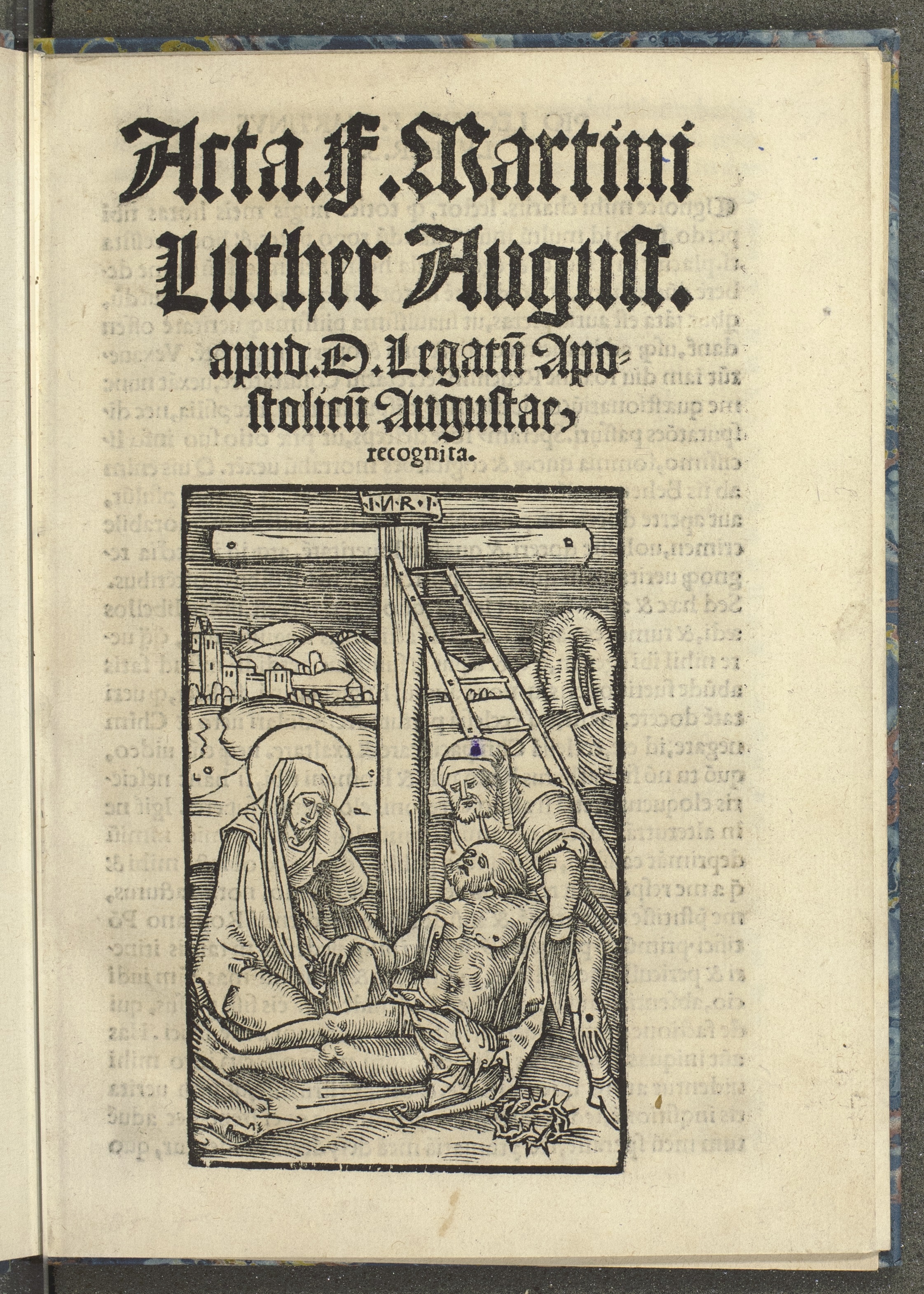 Text
TextActa f. Martini Luther august. apud D. legatu[m] apostolicu[m] Augustae recognitum
Luther, Martin, 1483-1546Summary: In 1518 Luther was summoned to Rome. He appealed to Frederick, Elector of Saxony who was attending the imperial Diet in Augsburg. Frederick negotiated with the Papal Legate Cajetan who finally agreed to a hearing in Augsburg. Luther went there with an imperial escort and then returned safely to Wittenberg. This is Luther's report of what took place in Augsburg. It is the fifth printing of the "Acta Augustana."Summary: In 1518 Luther was summoned to Rome. He appealed to Frederick, Elector of Saxony who was attending the imperial Diet in Augsburg. Frederick negotiated with the Papal Legate Cajetan who finally agreed to a hearing in Augsburg. Luther went there with an imperial escort and then returned safely to Wittenberg. This is Luther's report of what took place in Augsburg. It is the fifth printing of the "Acta Augustana." -
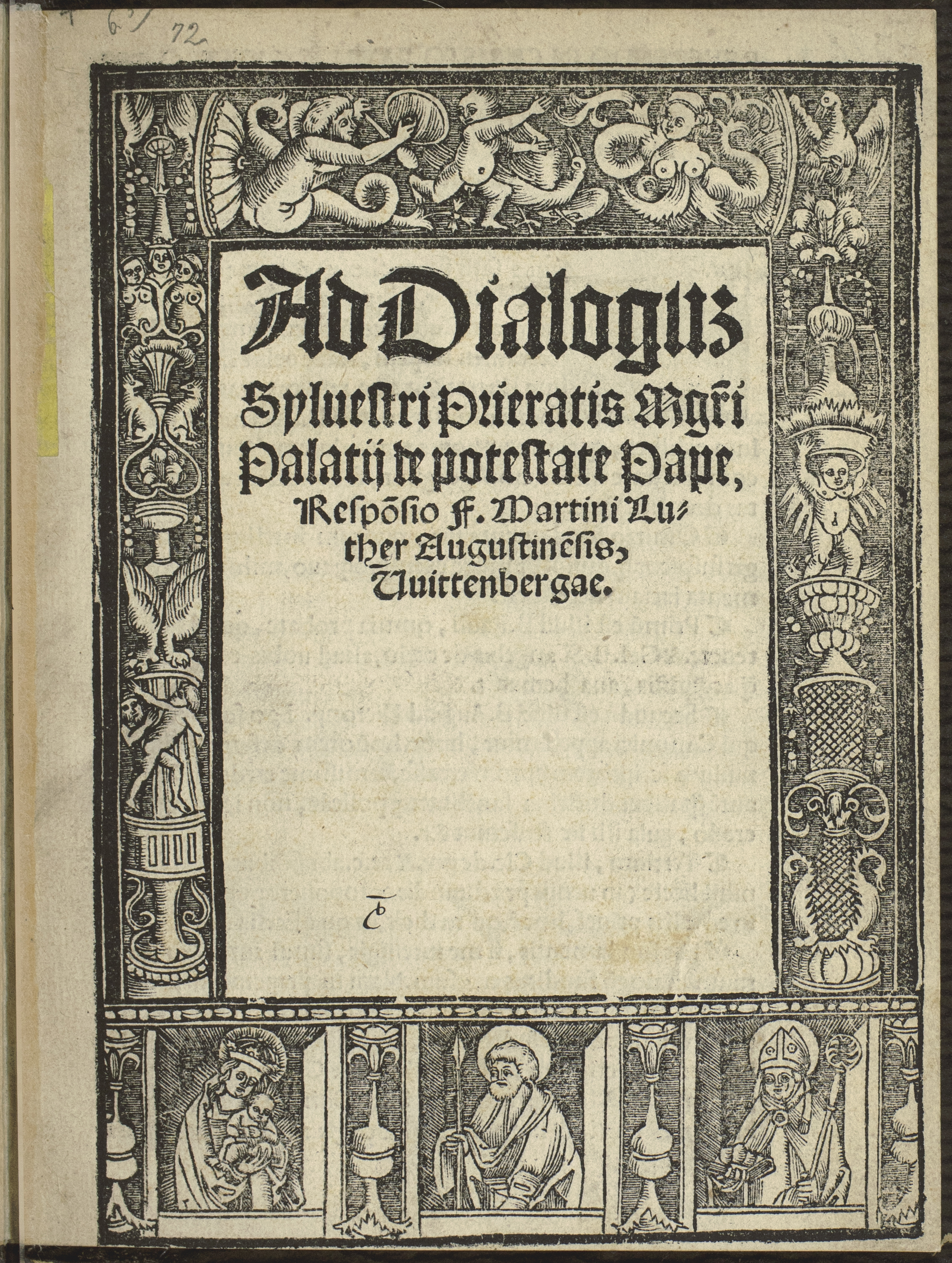 Text
TextAd Dialoguz [i.e. Dialogum] Syluestri Prieratis M[a]g[ist]ri Palatii de potestate Pape Respo[n]sio
Luther, Martin, 1483-1546Summary: When Luther received S. Mazzolini's Dialogue on the 95 Theses, he put it into print at once to show just how weak a piece Mazzolini had written. He followed it up with the present work which includes Mazzolini's text and Luther's reply to it. Even the Pope is said to have been embarrassed by Mazzolini's poor performance in this work. The Dominicans are reported to have bought up the first edition, presumably to prevent its further circulation.Summary: When Luther received S. Mazzolini's Dialogue on the 95 Theses, he put it into print at once to show just how weak a piece Mazzolini had written. He followed it up with the present work which includes Mazzolini's text and Luther's reply to it. Even the Pope is said to have been embarrassed by Mazzolini's poor performance in this work. The Dominicans are reported to have bought up the first edition, presumably to prevent its further circulation. -
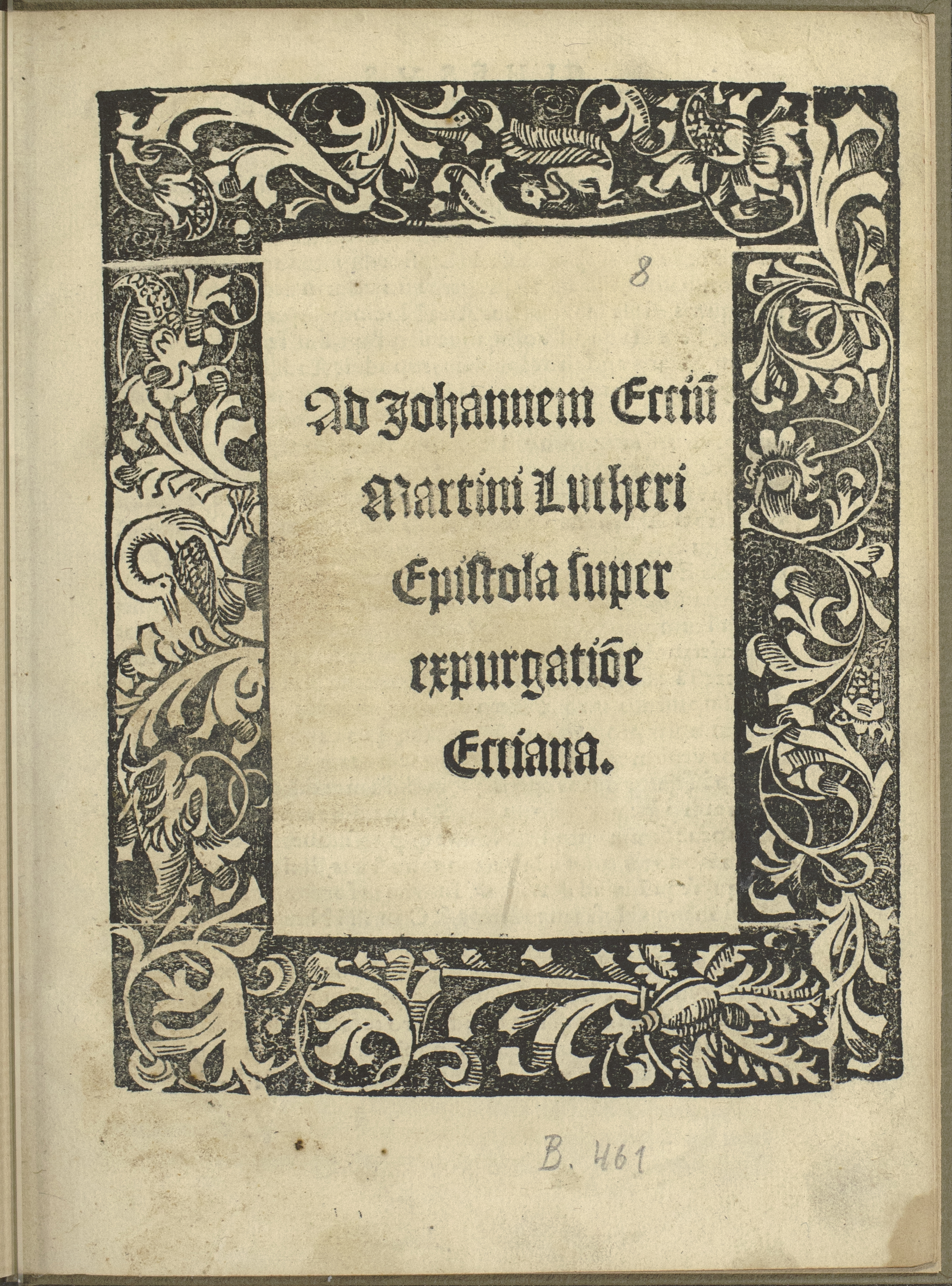 Text
TextAd Johannem Ecciu[m]
Luther, Martin, 1483-1546Summary: A unique printing of an answer by Luther to the attacks of one his earliest opponents, Johann Eck.Summary: A unique printing of an answer by Luther to the attacks of one his earliest opponents, Johann Eck. -
 Text
TextAd Serenissimu[m] Principem [et] D[omi]n[u]m Do. Carolum V. : Rho. Caes. Impe. Aug. Hispaniarum rc̄. Rege[m]. Archiducem Austrie rc̄
Luther, Martin, 1483-1546Summary: Fredrick the Wise asked Luther to write to Emperor Charles V after the publication of his Open letter to the Christian Nobility in order to express his loyalty. Spalatin convinced Luther to write this letter of submission and edited it for publication.Summary: Fredrick the Wise asked Luther to write to Emperor Charles V after the publication of his Open letter to the Christian Nobility in order to express his loyalty. Spalatin convinced Luther to write this letter of submission and edited it for publication. -
 Text
TextAd aegocerotem Emserianum
Luther, Martin, 1483-1546Summary: First edition of Luther's response to Hieronymus Emser's report of the Leipzig Disputation between Martin Luther, Andreas Bodenstein Karlstadt and Johann Eck. Emser, who had been initially sympathetic to Luther's position had accompanied Eck to Leipzig, where he broke with the reformer. In his report, he tried to associate Luther with the Bohemian reformer Jan Hus, who had been burnt at the stake during the Council of Constance in 1415.Summary: First edition of Luther's response to Hieronymus Emser's report of the Leipzig Disputation between Martin Luther, Andreas Bodenstein Karlstadt and Johann Eck. Emser, who had been initially sympathetic to Luther's position had accompanied Eck to Leipzig, where he broke with the reformer. In his report, he tried to associate Luther with the Bohemian reformer Jan Hus, who had been burnt at the stake during the Council of Constance in 1415. -
 Text
TextAd criminatricem Martini Luders Uitte[n]bergen[sis] offensione[m] super iudicio iustissimo facto : ad articulos quosdam per minoritas de obserua[n]tia Reuere[n]dissimo Episcopo Brandenburgen[si] oblatos Eckiana responsio; Quia hactenus abusus est Mar. Luderus modestia Eckiana : tande[m] extorsit, vt mordaci, mordaciter quo[que] responderem ...
Eck, Johann, 1486-1543Summary: Johann Eck responds in this early work to Luther's pamphlet "Contra malignum Iohannis Eccii iudicium."Summary: Johann Eck responds in this early work to Luther's pamphlet "Contra malignum Iohannis Eccii iudicium." -
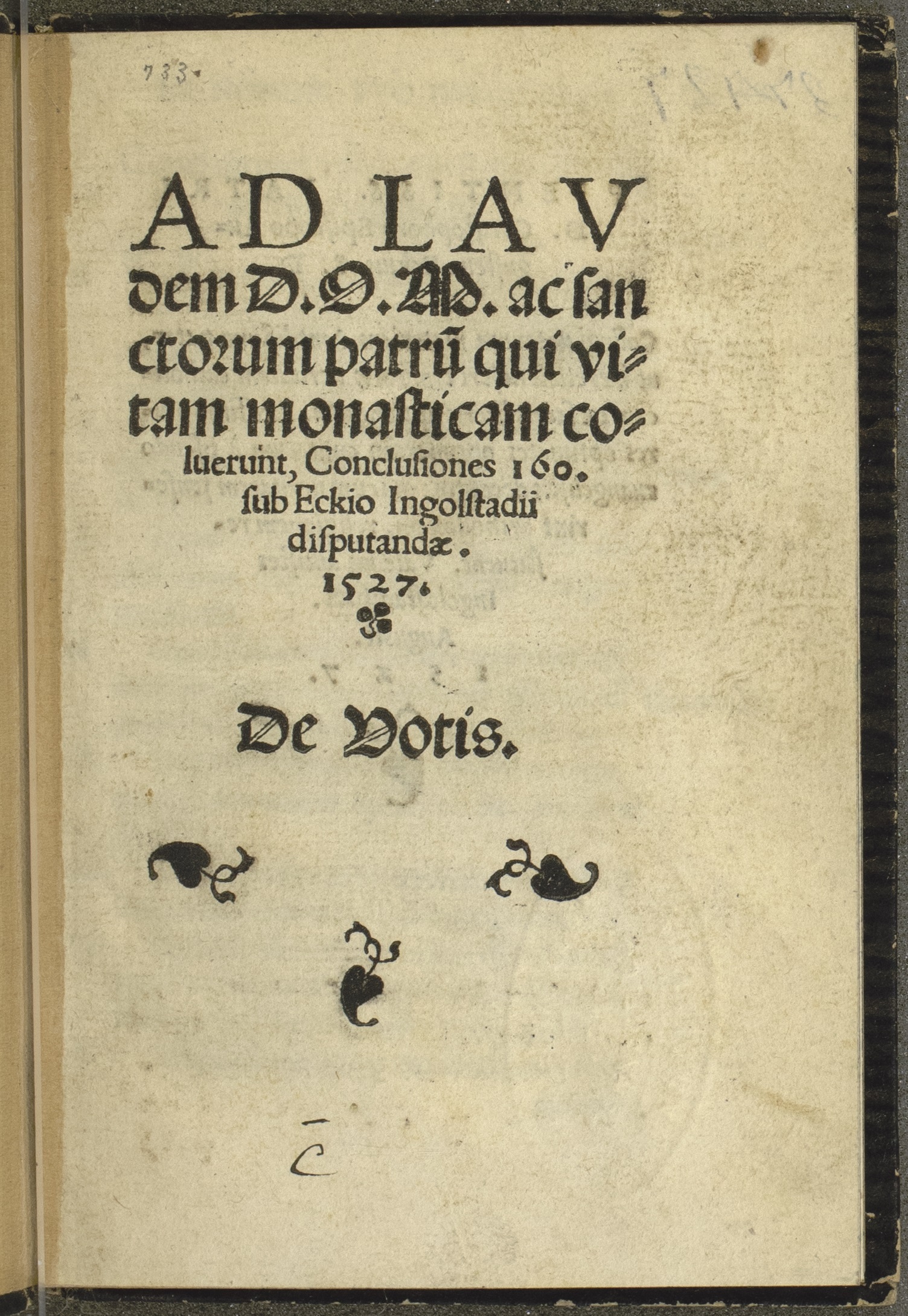 Text
TextAd laudem D.O.M. ac sanctorum patru[m] qui vitam monasticam coluerunt, conclusiones 160
Eck, Johann, 1486-1543Summary: This is another academic disputation by Eck at Ingolstadt on monastic vows including 160 theses "in praise of those men who practice the monastic life."Summary: This is another academic disputation by Eck at Ingolstadt on monastic vows including 160 theses "in praise of those men who practice the monastic life." -
 Still image
Adam and Eve after eating from the Tree of Knowledge
Baldung, Hans, -1545A woodcut decorating the title page of Johan Geiler von Kayersberg's Seelen Paradiss. The woodcut depicts Adam and Eve in the Garden of Eden just after having eaten the fruit of the Tree of Knowledge of Good and Evil. They are shown covering themselves, each holding an apple while God looks on. In the bottom right of the scene, an angel carrying a sword guards the gate to the garden.A woodcut decorating the title page of Johan Geiler von Kayersberg's Seelen Paradiss. The woodcut depicts Adam and Eve in the Garden of Eden just after having eaten the fruit of the Tree of Knowledge of Good and Evil. They are shown covering themselves, each holding an apple while God looks on. In the bottom right of the scene, an angel carrying a sword guards the gate to the garden. -
 Still image
Adam and Eve after eating from the Tree of Knowledge
A woodcut depicting Adam and Eve eating from the Tree of Knowledge as God looks on from Heaven. To the right, they are expelled from Eden by an angel wielding a sword. A set of four decorative woodcuts create a border around the main image and depict plants and birds.A woodcut depicting Adam and Eve eating from the Tree of Knowledge as God looks on from Heaven. To the right, they are expelled from Eden by an angel wielding a sword. A set of four decorative woodcuts create a border around the main image and depict plants and birds. -
 Text
TextAdami Siberi Psalterii, seu, Carminum Dauidicorum libri V
Summary: Poetic paraphrases of the Psalms by the humanist and reformer Adam Siber.Summary: Poetic paraphrases of the Psalms by the humanist and reformer Adam Siber. -
 Still image
Agnus Dei
A medallion featuring the Agnus Dei (Lamb of God) with a cross banner.A medallion featuring the Agnus Dei (Lamb of God) with a cross banner. -
 Text
TextAin Beweysung, das der war Messias kom[m]en sey, des die Juden noch on Vrsach zůkünfftig sein, warte[n]
Samuel, MarochitanusSummary: German translation by Ludwig Hätzer of Epistola contra Judaeorum, thought to be written in Arabic by Samuel of Marocco, an apostate Jew at the beginning of the 11th century and translated into Latin by the Spanish Dominican Alphonsus Bonihominis in the 14th century and widely disseminated. Bonihominis is likely the real author of the work.Summary: German translation by Ludwig Hätzer of Epistola contra Judaeorum, thought to be written in Arabic by Samuel of Marocco, an apostate Jew at the beginning of the 11th century and translated into Latin by the Spanish Dominican Alphonsus Bonihominis in the 14th century and widely disseminated. Bonihominis is likely the real author of the work. -
 Text
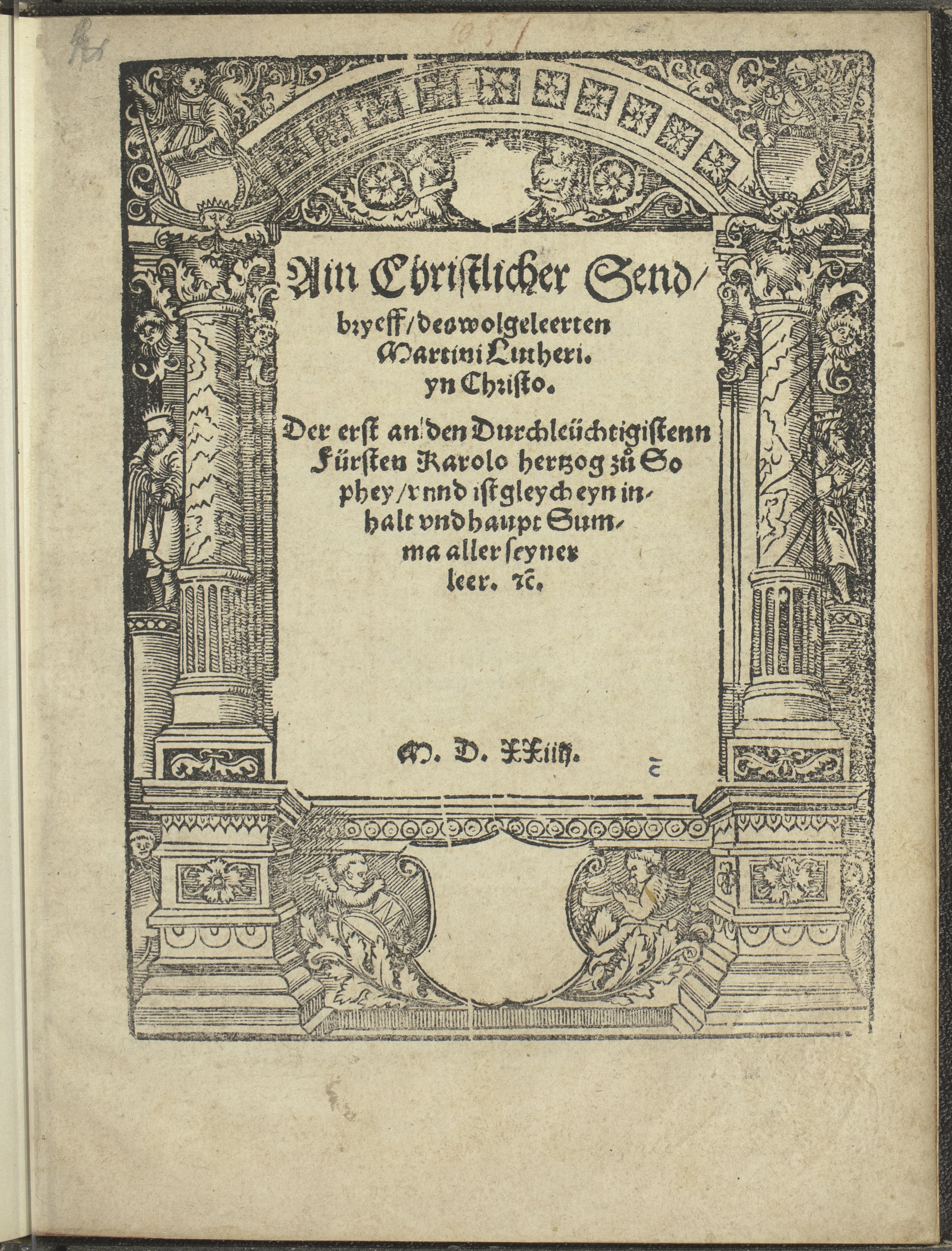
TextAin Christlicher Sendbryeff
Luther, Martin, 1483-1546Summary: This work is an anonymous translation to German from Latin of Luther's letter (Ad inlustrissimum principem Carolum Sabaudiae ducem Epistola) to Duke Charles III of Savoy, dated September 7, 1523.Summary: This work is an anonymous translation to German from Latin of Luther's letter (Ad inlustrissimum principem Carolum Sabaudiae ducem Epistola) to Duke Charles III of Savoy, dated September 7, 1523. -
 Text
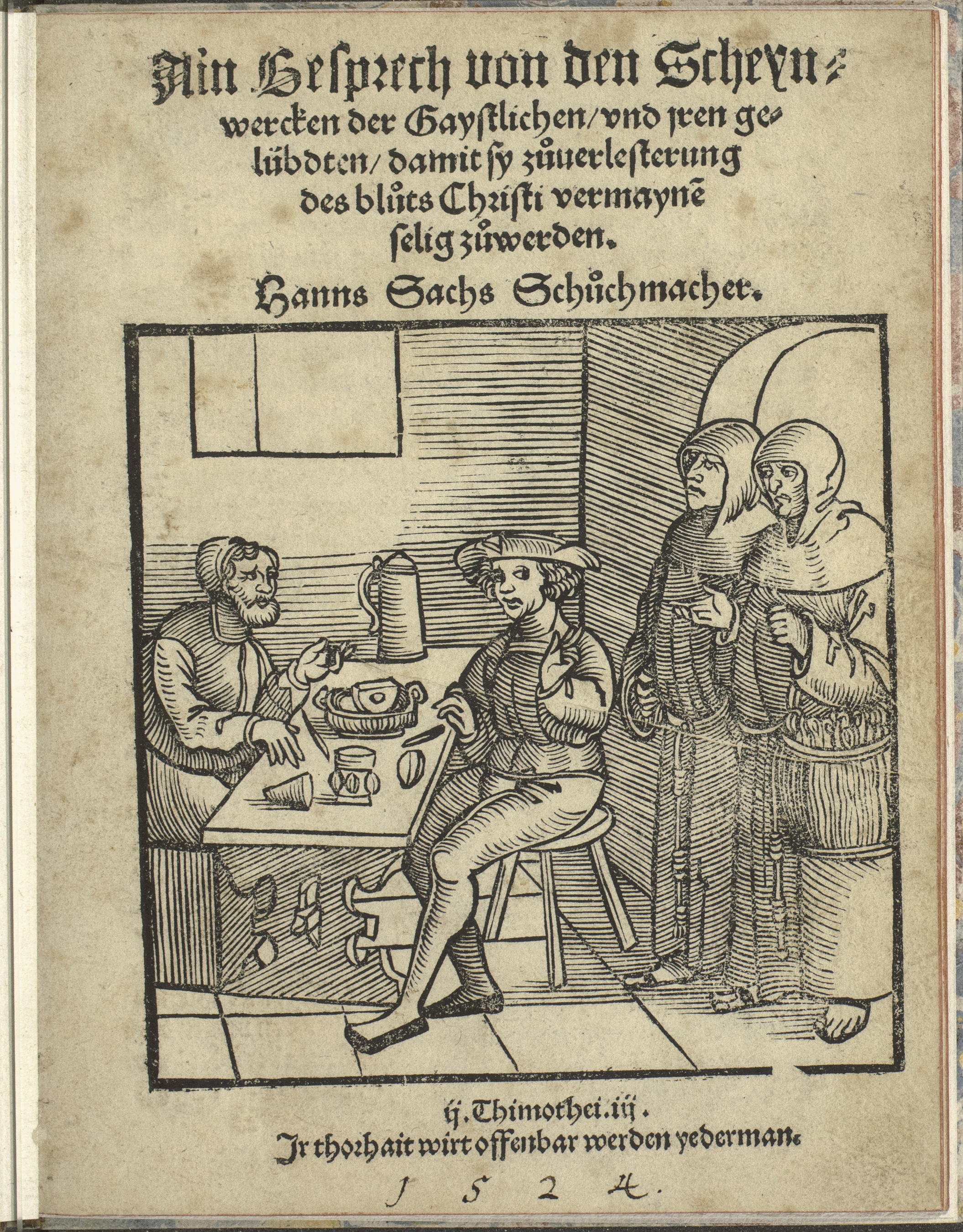
TextAin Gesprech von den Scheynwercken der Gaystlichen, vnd jren gelübdten, : damit sy zuouerlesterung des blouts Christi vermayne[n] selig zuowerden
Sachs, Hans, 1494-1576Summary: H. Sachs the Nuremberg "Master-Singer" and shoemaker became an early and ardent supporter of Luther and the Protestant cause. In this "trio-logue" a baker named Peter, a monk named Heinrich, and a shoemaker named Hans discuss questions relating to monastic life and monastic vows. The work is in prose, a change from Sachs' usual rhymed couplet format. This printing is from the same year as the first printing and re-uses the woodcut from the title page of the first printing.Summary: H. Sachs the Nuremberg "Master-Singer" and shoemaker became an early and ardent supporter of Luther and the Protestant cause. In this "trio-logue" a baker named Peter, a monk named Heinrich, and a shoemaker named Hans discuss questions relating to monastic life and monastic vows. The work is in prose, a change from Sachs' usual rhymed couplet format. This printing is from the same year as the first printing and re-uses the woodcut from the title page of the first printing. -
 Text
TextAin Sermo[n] am fPingstmontag [sic] das Ewangelium Joan iij, Also hat Got die Welt lieb gehabt, [et]c.
Luther, Martin, 1483-1546Summary: Sermon preached June 9, 1522, on John III, 16, "For God so loved the world ..."Summary: Sermon preached June 9, 1522, on John III, 16, "For God so loved the world ..." -
 Text
TextAin Sermon
Luther, Martin, 1483-1546Summary: Sermon preached August 10, 1522, on Matthew 7:15-23 (Beware of False Prophets).Summary: Sermon preached August 10, 1522, on Matthew 7:15-23 (Beware of False Prophets).