Search
741 resources
741 items
Collection
Richard C. Kessler Reformation Collection
-
 Still image
Mendicant Monks
A woodcut depicting a pair of mendicant monks standing beneath an archway as a pair of men sit at a table and wave them away.A woodcut depicting a pair of mendicant monks standing beneath an archway as a pair of men sit at a table and wave them away. -
 Still image
Mendicant Monks
A woodcut depicting a pair of mendicant monks standing beneath an archway as a pair of men sit at a table and wave them away.A woodcut depicting a pair of mendicant monks standing beneath an archway as a pair of men sit at a table and wave them away. -
 Still image
Mendicant Monks
A woodcut depicting a pair of mendicant monks standing beneath an archway as a pair of men sit at a table and wave them away.A woodcut depicting a pair of mendicant monks standing beneath an archway as a pair of men sit at a table and wave them away. -
 Still image
Mendicant Monks
A woodcut depicting a pair of mendicant monks standing beneath an archway as a pair of men sit at a table and wave them away.A woodcut depicting a pair of mendicant monks standing beneath an archway as a pair of men sit at a table and wave them away. -
 Still image
Monstrance
A woodcut depicting an elaborate monstrance, or an ostensorium, somewhat in the shape of a cathedral with a crucefix on top.A woodcut depicting an elaborate monstrance, or an ostensorium, somewhat in the shape of a cathedral with a crucefix on top. -
 Text
TextMultiloquus de co[n]citata ex dictis Lutheri seditio[n]e, : ad Inuictissimu[m] & optimu[m] Imperatore[m] ac multo[rum] regno[rum] Rege[m] inclitu[m] etc[etera]. Carolu[m] S.
Dungersheim, Hieronymus, 1465-1540Summary: H. Dungersheim had had a long academic career before the Reformation started. He proved to be a determined foe of Luther. In this rare book he presents "over a hundred" citations from Luther's books written before the Peasants' War (1525) to prove that Luther was a teacher of sedition and tumult.Summary: H. Dungersheim had had a long academic career before the Reformation started. He proved to be a determined foe of Luther. In this rare book he presents "over a hundred" citations from Luther's books written before the Peasants' War (1525) to prove that Luther was a teacher of sedition and tumult. -
 Text
TextNew deudsch Psalter
Summary: Luther's first major revision of his translation of the Hebrew book of Psalms. Luther and his translation committee worked diligently on the German Bible throughout Luther's life. Every word came under repeated scrutiny; the translators never felt completely satisfied. The Psalter was revised repeatedly, always with the aim of seeking clarity of expression. This is the first revision of the work. This copy is annotated, dated 5 February, 1541, by A. Blarer, a Swabian reformer who was deeply influenced by Luther.Summary: Luther's first major revision of his translation of the Hebrew book of Psalms. Luther and his translation committee worked diligently on the German Bible throughout Luther's life. Every word came under repeated scrutiny; the translators never felt completely satisfied. The Psalter was revised repeatedly, always with the aim of seeking clarity of expression. This is the first revision of the work. This copy is annotated, dated 5 February, 1541, by A. Blarer, a Swabian reformer who was deeply influenced by Luther. -
 Still image
Noah's Ark surviving the flood
Cranach, Lucas, 1472-1553A woodcut depicting Noah's Ark (Der Kaste Noe) safe and afloat amidst the torential rains (center). At the bottom of the image there is a field of fallen trees and dead people and animals left behind by the receeding waters. in the top left of the image there is a dove carrying an olive branch, signalling the receeding of the waters.A woodcut depicting Noah's Ark (Der Kaste Noe) safe and afloat amidst the torential rains (center). At the bottom of the image there is a field of fallen trees and dead people and animals left behind by the receeding waters. in the top left of the image there is a dove carrying an olive branch, signalling the receeding of the waters. -
 Text
TextNote on Old Testament Chronology
Luther, Martin, 1483-1546A manuscript in Martin Luther's own hand, "Notes on Two Chronological Difficulties in the Old Testament" (see Weimar Edition of The Works of Martin Luther, Volume 60, page 163). The document is a seven line author's note written in 1541, in which Luther discussed the accuracy of the computations in his 1541 work, Computation of the Years of the World. (Weimar Edition of The Works of Martin Luther, Volume 53, pages 177-182).A manuscript in Martin Luther's own hand, "Notes on Two Chronological Difficulties in the Old Testament" (see Weimar Edition of The Works of Martin Luther, Volume 60, page 163). The document is a seven line author's note written in 1541, in which Luther discussed the accuracy of the computations in his 1541 work, Computation of the Years of the World. (Weimar Edition of The Works of Martin Luther, Volume 53, pages 177-182). -
 Text
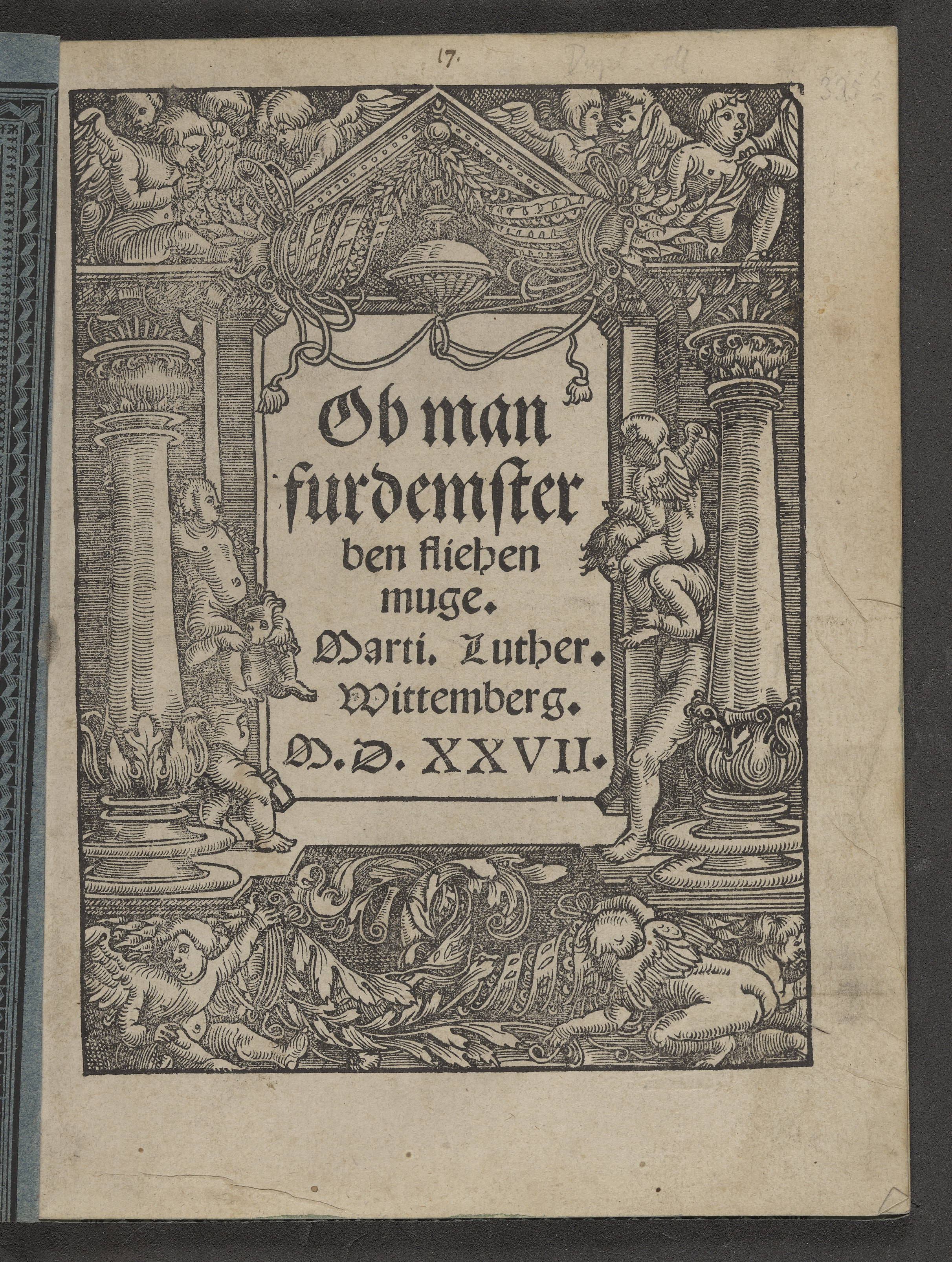
TextOb man fur dem Sterben fliehen muge
Luther, Martin, 1483-1546Summary: The Black Death ravaged Europe from the fourteenth century onward. Dr. Johann Hess, a pastor from Breslau, asked Luther in 1527 whether it was permissible for a person to flee from plague-infested areas. Luther replied that it was, and then added some public health advice for town and city government officials in plague-ravaged areas. He advocated fumigation of this, the seventh printing of the work.Summary: The Black Death ravaged Europe from the fourteenth century onward. Dr. Johann Hess, a pastor from Breslau, asked Luther in 1527 whether it was permissible for a person to flee from plague-infested areas. Luther replied that it was, and then added some public health advice for town and city government officials in plague-ravaged areas. He advocated fumigation of this, the seventh printing of the work. -
 Text
TextOb man fur dem sterben fliehen muge
Luther, Martin, 1483-1546Summary: The Black Death ravaged Europe from the fourteenth century onward. Dr. Johann Hess, a pastor from Breslau, asked Luther in 1527 whether it was permissible for a person to flee from plague-infested areas. Luther replied that it was, and then added some public health advice for town and city government officials in plague-ravaged areas.Summary: The Black Death ravaged Europe from the fourteenth century onward. Dr. Johann Hess, a pastor from Breslau, asked Luther in 1527 whether it was permissible for a person to flee from plague-infested areas. Luther replied that it was, and then added some public health advice for town and city government officials in plague-ravaged areas. -
 Still image
Obadiah Receives a Vision from an Angel
A woodcut depicting Obadiah receiving his vision from an angel. The text of the first verse of Obadiah is printed above.A woodcut depicting Obadiah receiving his vision from an angel. The text of the first verse of Obadiah is printed above. -
 Text
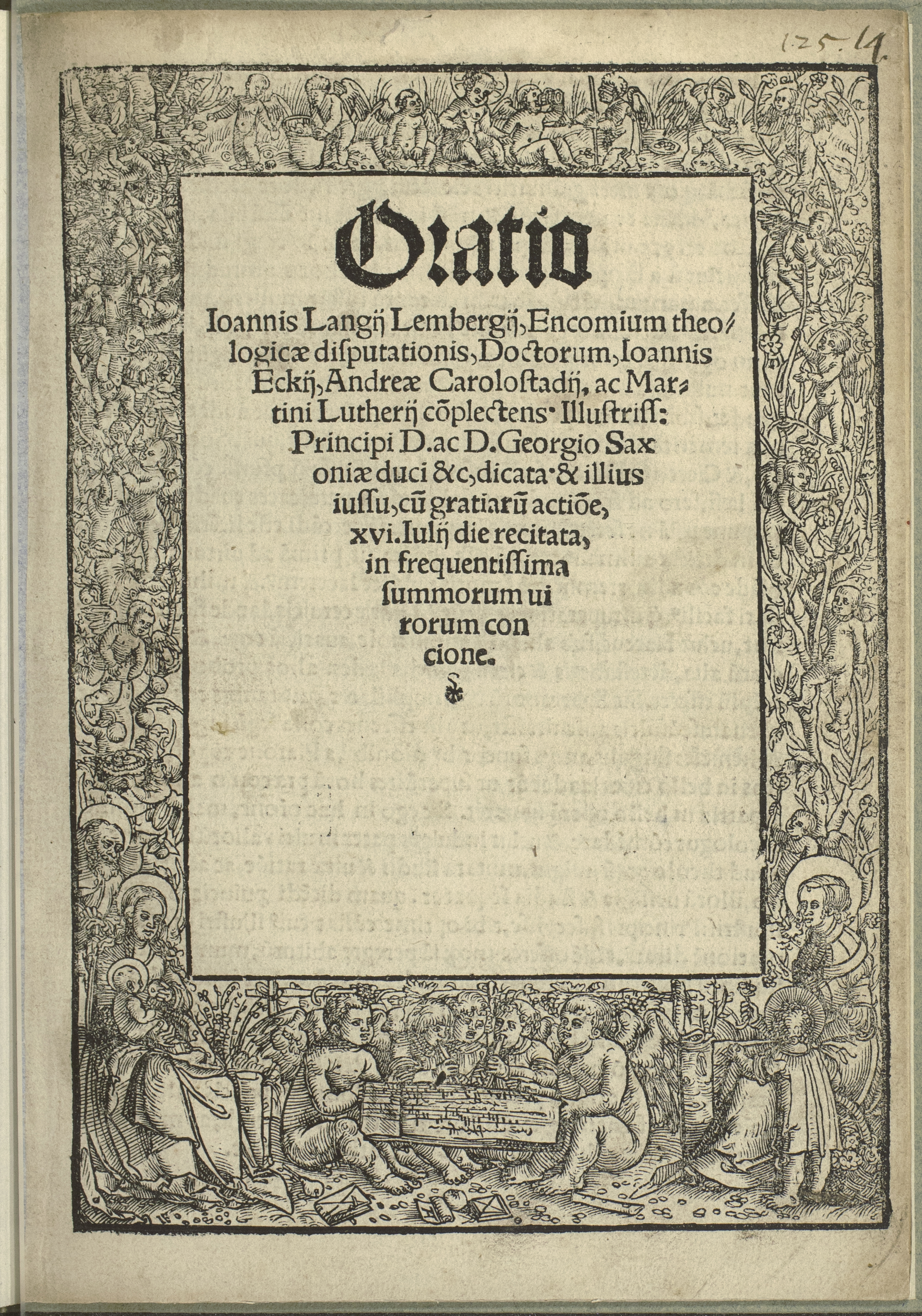
TextOratio
Lange, Johann, 1485-1565Summary: This is the speech by J. Lange von Lemberg, Rector of the University of Leipzig, given at the end of the Leipzig Disputation. Lange von Lemberg takes no sides in the Disputation but praises all the contestants, especially Luther. This is the only printing of the work.Summary: This is the speech by J. Lange von Lemberg, Rector of the University of Leipzig, given at the end of the Leipzig Disputation. Lange von Lemberg takes no sides in the Disputation but praises all the contestants, especially Luther. This is the only printing of the work. -
 Text
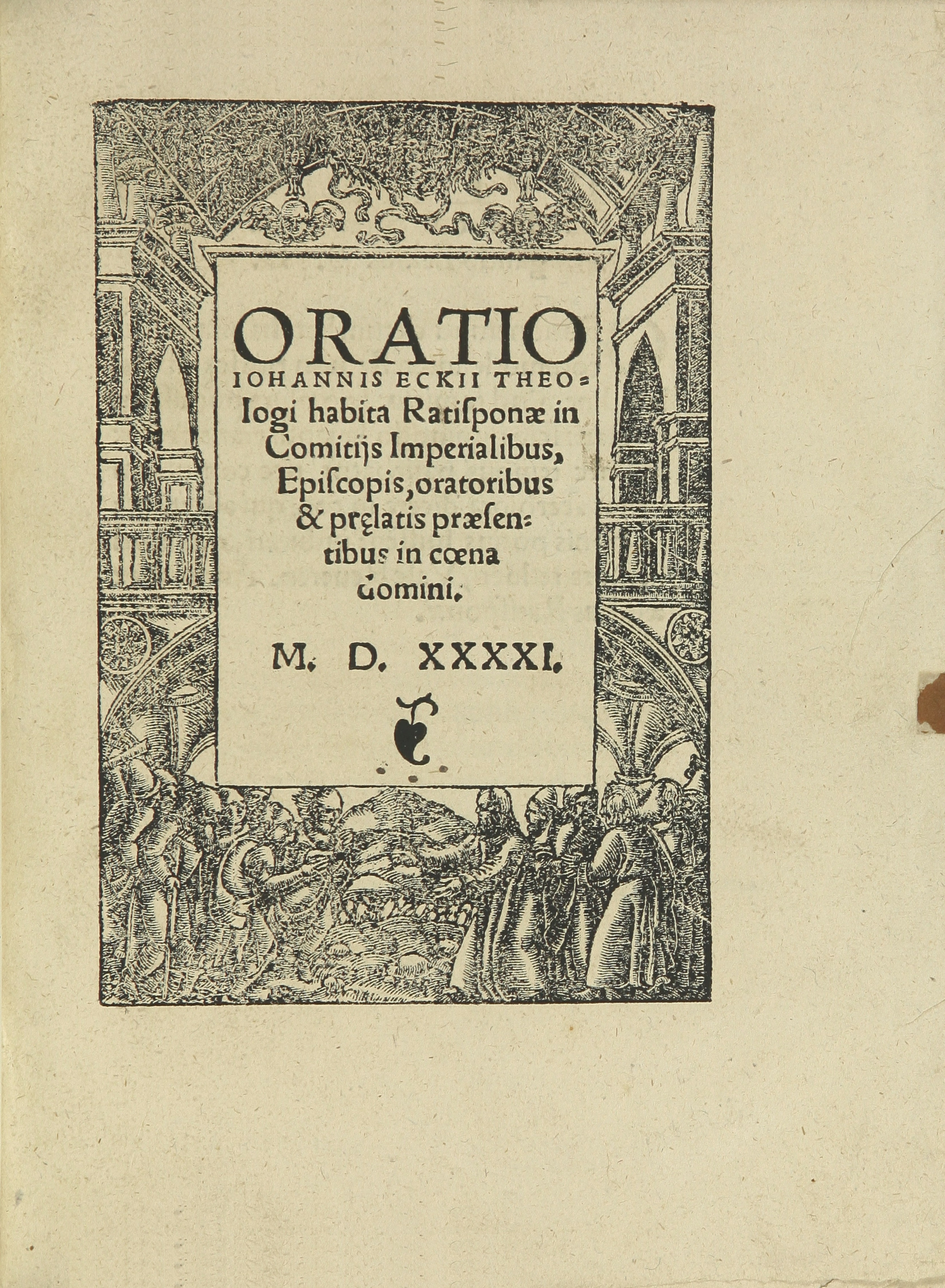
TextOratio
Eck, Johann, 1486-1543Summary: This is the first printing of Eck's speech to the Diet of Regensburg on April 5, 1541, defining the Catholic understanding of the Lord's Supper. The Diet of Regensburg proved to be Eck's last appearance as a major theological political leader, for his health declined and he could no longer bear the weight of these grueling encounters.Summary: This is the first printing of Eck's speech to the Diet of Regensburg on April 5, 1541, defining the Catholic understanding of the Lord's Supper. The Diet of Regensburg proved to be Eck's last appearance as a major theological political leader, for his health declined and he could no longer bear the weight of these grueling encounters. -
 Text
TextOratio in funere Reverendi viri D. Martini Lutheri
Melanchthon, Philipp, 1497-1560Summary: This is the original Latin version of Melanchthon's funeral oration for Luther, preached in Wittenberg, February 22, 1546. The friendship between Luther and Melanchthon was almost legendary, even in their own lifetimes, and this deeply moving oration is an eloquent testimony to the depth of Melanchthon's feelings for his friend of twenty-eight years.Summary: This is the original Latin version of Melanchthon's funeral oration for Luther, preached in Wittenberg, February 22, 1546. The friendship between Luther and Melanchthon was almost legendary, even in their own lifetimes, and this deeply moving oration is an eloquent testimony to the depth of Melanchthon's feelings for his friend of twenty-eight years. -
 Text
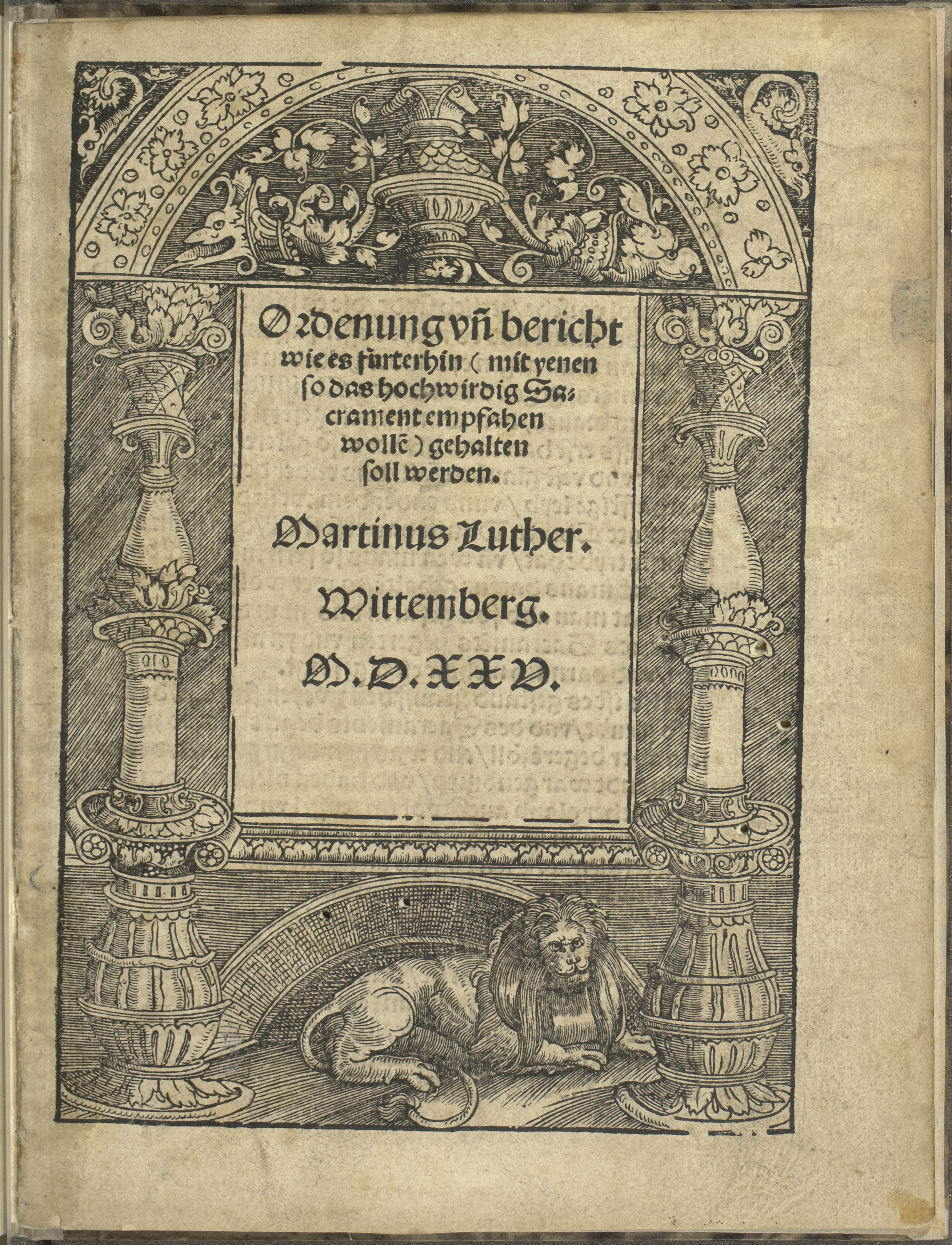
TextOrdenung vn[d] bericht wie es furterhin (mit yenen so das hochwirdig Sacrament empfahen wolle[n]) gehalten soll werden
Luther, Martin, 1483-1546Summary: Early guidance by Luther on how a Christian ought to approach and receive the Lord's Supper. Includes the Words of Institution, the Aaronic Benediction, and a series of questions that ought to be put to everyone wishing to receive the Sacrament, with appropriate answers.Summary: Early guidance by Luther on how a Christian ought to approach and receive the Lord's Supper. Includes the Words of Institution, the Aaronic Benediction, and a series of questions that ought to be put to everyone wishing to receive the Sacrament, with appropriate answers. -
 Text
TextOrdnu[n]g wie man tauffet, bissher im Latein gehalten, verteütscht : Hierin ist, auss etlichen Ursachen, was die andern, als uberflüssig, veracht haben, nicht aussgelassen
Catholic ChurchSummary: Osiander provides a fuller translation of the traditional Catholic rite of baptism than Münzer or Luther, who had both published baptism liturgies one year earlier, and who had eliminated certain ritual elements.Summary: Osiander provides a fuller translation of the traditional Catholic rite of baptism than Münzer or Luther, who had both published baptism liturgies one year earlier, and who had eliminated certain ritual elements. -
 Still image
Ornamental woodcut
An ornamental woodcut depicting a pair of capped figures riding hippocampi and holding shields, flanking a cherub's head.An ornamental woodcut depicting a pair of capped figures riding hippocampi and holding shields, flanking a cherub's head. -
 Still image
Ornamental woodcut
An ornamental woodcut depicting a pair of cherubs amongst some vines. The cherub on the left is riding a stick horse and holding an item similar to a pinwheel. On the right of the image, there is an arm holding an arrow which might be part of another cherub.An ornamental woodcut depicting a pair of cherubs amongst some vines. The cherub on the left is riding a stick horse and holding an item similar to a pinwheel. On the right of the image, there is an arm holding an arrow which might be part of another cherub. -
 Still image
Papal Arms of Leo X
The title page of a printed version of the papal bull against Martin Luther featuring the papal arms of Leo X which incorporates the Medici family crest.The title page of a printed version of the papal bull against Martin Luther featuring the papal arms of Leo X which incorporates the Medici family crest. -
 Text
TextParuus catechismus pro pueris in schola
Luther, Martin, 1483-1546Summary: Latin version of Martin Luther's Small Catechism, translated by Johannes SauermannSummary: Latin version of Martin Luther's Small Catechism, translated by Johannes Sauermann