Search
32 resources
32 items
Publisher
Lotter, Melchior, approximately 1470-1549
-
 Text
TextActa f. Martini Luther august. apud D. legatu[m] apostolicu[m] Augustae recognitum
Luther, Martin, 1483-1546Summary: In 1518 Luther was summoned to Rome. He appealed to Frederick, Elector of Saxony who was attending the imperial Diet in Augsburg. Frederick negotiated with the Papal Legate Cajetan who finally agreed to a hearing in Augsburg. Luther went there with an imperial escort and then returned safely to Wittenberg. This is Luther's report of what took place in Augsburg. It is the fifth printing of the "Acta Augustana."Summary: In 1518 Luther was summoned to Rome. He appealed to Frederick, Elector of Saxony who was attending the imperial Diet in Augsburg. Frederick negotiated with the Papal Legate Cajetan who finally agreed to a hearing in Augsburg. Luther went there with an imperial escort and then returned safely to Wittenberg. This is Luther's report of what took place in Augsburg. It is the fifth printing of the "Acta Augustana." -
 Text
TextAd Dialoguz [i.e. Dialogum] Syluestri Prieratis M[a]g[ist]ri Palatii de potestate Pape Respo[n]sio
Luther, Martin, 1483-1546Summary: When Luther received S. Mazzolini's Dialogue on the 95 Theses, he put it into print at once to show just how weak a piece Mazzolini had written. He followed it up with the present work which includes Mazzolini's text and Luther's reply to it. Even the Pope is said to have been embarrassed by Mazzolini's poor performance in this work. The Dominicans are reported to have bought up the first edition, presumably to prevent its further circulation.Summary: When Luther received S. Mazzolini's Dialogue on the 95 Theses, he put it into print at once to show just how weak a piece Mazzolini had written. He followed it up with the present work which includes Mazzolini's text and Luther's reply to it. Even the Pope is said to have been embarrassed by Mazzolini's poor performance in this work. The Dominicans are reported to have bought up the first edition, presumably to prevent its further circulation. -
 Text
TextAn den Stier zu Uuittenberg
Emser, Hieronymus, 1478-1527Summary: A reply to Martin Luther's "An den Bock zu Leipzig."Summary: A reply to Martin Luther's "An den Bock zu Leipzig." -
 Text
TextAusslegung des hundert vnd neundte[n] psalme[n], Dixit d[omin]us domi[n]o meo
Luther, Martin, 1483-1546Summary: The third of three printings of an exposition of Psalm 109 by Luther to be issued in 1518, interpreting the Psalm of the Kingdom and Priesthood of Jesus Christ.Summary: The third of three printings of an exposition of Psalm 109 by Luther to be issued in 1518, interpreting the Psalm of the Kingdom and Priesthood of Jesus Christ. -
 Text
TextAuszlegung vnnd Lewterung etzlicher heyligenn Geschrifften : So dem Menschen dienstlich vnd erschieszlich seint zu Christlichem Lebe[n] : kurtzlich berurth vnd angetzeich[n]et in den Figurn vnd Schrifften der Wagen : In Sonderheit, des Creutzes, tzu welchem vnser Goth vnd Herr, den Menschen berufft. Bediengung vnd Vorwort...
Karlstadt, Andreas Rudolff-Bodenstein von, 1486-1541Summary: Only edition of an early work by Karlstadt addressing questions of what constitutes a Christian life.Summary: Only edition of an early work by Karlstadt addressing questions of what constitutes a Christian life. -
 Still image
Coat of Arms of Johann "The Constant", Elector of Saxony
Cranach, Lucas, 1472-1553A woodcut depicting the coat of arm sof Johann "the Constant" (or "Steadfast"), Elector of Saxony, who was a supporter of Luther and his movement. The coat of arms features a pair of crossed swords at the center, surrounded by ten fields with varying iconography, including lions, eagles, and a rose. Three helmets with different crests sit above the coat of arms and the entire composition is surrounded by a host of cherubs and a pair of trees.A woodcut depicting the coat of arm sof Johann "the Constant" (or "Steadfast"), Elector of Saxony, who was a supporter of Luther and his movement. The coat of arms features a pair of crossed swords at the center, surrounded by ten fields with varying iconography, including lions, eagles, and a rose. Three helmets with different crests sit above the coat of arms and the entire composition is surrounded by a host of cherubs and a pair of trees. -
 Text
TextDe disputatio[n]e Lipsicensi : quantum ad Boemos obiter deflexa est
Emser, Hieronymus, 1478-1527Summary: A letter by Hieronymus Emser, early opponent of Luther concerning the Leipzig Disputation of 1519, describing Luther's debate with Johann Eck, and Luther's admitting that councils could err.Summary: A letter by Hieronymus Emser, early opponent of Luther concerning the Leipzig Disputation of 1519, describing Luther's debate with Johann Eck, and Luther's admitting that councils could err. -
 Text
TextDoctor Martinus Luthers antwort auff die tzedel : szo vnter des Officials tzu Stolpen sigel ist ausgangen
Luther, Martin, 1483-1546Summary: The first of five printings in 1520 of an answer to an attack on Luther issued under the seal and authority of Albert, Archbishop of Mainz.Summary: The first of five printings in 1520 of an answer to an attack on Luther issued under the seal and authority of Albert, Archbishop of Mainz. -
 Text
TextEyn Sermon von dem sacrament der pusz
Luther, Martin, 1483-1546Summary: Fifth (and first outside Wittenberg) printing of an early sermon on the Sacrament of Penance by Luther.Summary: Fifth (and first outside Wittenberg) printing of an early sermon on the Sacrament of Penance by Luther. -
 Still image
Hieronymus Emser's Coat of Arms
A woodcut depicting Hieronymus Emser's coat of arms which features a shield emblazoned with a goat's head and a helmet crowned with a goat's head. A label to the side of the crest reads "ARMA HIERONYMI EMSER".A woodcut depicting Hieronymus Emser's coat of arms which features a shield emblazoned with a goat's head and a helmet crowned with a goat's head. A label to the side of the crest reads "ARMA HIERONYMI EMSER". -
 Still image
Hieronymus Emser's Coat of Arms
A woodcut depicting Hieronymus Emser's coat of arms which features a shield emblazoned with a goat's head and a helmet crowned with a goat's head. A label to the side of the crest reads "ARMA HIERONYMI EMSER".A woodcut depicting Hieronymus Emser's coat of arms which features a shield emblazoned with a goat's head and a helmet crowned with a goat's head. A label to the side of the crest reads "ARMA HIERONYMI EMSER". -
 Still image
Historiated title page of Luther's Ad dialogum Syluestri Prieratis Magistri Palatii de potestate Pape Responsio
A woodcut border on the title page of Luther's Ad dialogum Syluestri Prieratis Magistri Palatii de potestate Pape Responsio printed in 1518. Along the bottom margin, the border features three portraits, one of the Virgin Mary holding Jesus, one of a saint holding a spear and a book (possibly Saint Longinus), and one of a pope. Along both side margins are a series of decorative elements, including a cherub, two men chasing each other around a column, a pair of cats, a goose, and a trio of women.A woodcut border on the title page of Luther's Ad dialogum Syluestri Prieratis Magistri Palatii de potestate Pape Responsio printed in 1518. Along the bottom margin, the border features three portraits, one of the Virgin Mary holding Jesus, one of a saint holding a spear and a book (possibly Saint Longinus), and one of a pope. Along both side margins are a series of decorative elements, including a cherub, two men chasing each other around a column, a pair of cats, a goose, and a trio of women. -
 Still image
Historiated title page of Luther's De captivitate babylonica ecclesiae
Cranach, Hans, -1537A woodcut border on the title page of Luther's De captivitate babylonica ecclesiae printed in 1520. The border is comprised of a single woodcut. At the bottom, there is a crest with the Brazen Serpent coiled around a cross with two men pulling it from either side. On the sides, there are two plinths, cherubs, and riders atop a pair of centaur-like figures. At the top, there is another crest featuring two towers and a striped shield.A woodcut border on the title page of Luther's De captivitate babylonica ecclesiae printed in 1520. The border is comprised of a single woodcut. At the bottom, there is a crest with the Brazen Serpent coiled around a cross with two men pulling it from either side. On the sides, there are two plinths, cherubs, and riders atop a pair of centaur-like figures. At the top, there is another crest featuring two towers and a striped shield. -
 Still image
Historiated title page of Luther's Sermo de penitentia
A woodcut border on the title page of Luther's Sermo de penitentia printed in 1519. Along the bottom margin, the border features three portraits, one of the Virgin Mary holding Jesus, one of a saint holding a spear and a book (possibly Saint Longinus), and one of a pope. Along both side margins are a series of decorative elements, including a cherub, two men chasing each other around a column, a pair of cats, a goose, and a trio of women. At the top of the page, there is a scene of two women with fish tails for legs (possibly a reference to Scylla) flanking a running boy and bird.A woodcut border on the title page of Luther's Sermo de penitentia printed in 1519. Along the bottom margin, the border features three portraits, one of the Virgin Mary holding Jesus, one of a saint holding a spear and a book (possibly Saint Longinus), and one of a pope. Along both side margins are a series of decorative elements, including a cherub, two men chasing each other around a column, a pair of cats, a goose, and a trio of women. At the top of the page, there is a scene of two women with fish tails for legs (possibly a reference to Scylla) flanking a running boy and bird. -
 Still image
Historiated title page of Luther's defense of his thirteenth proposition on the power of the Pope
Cranach, Lucas, 1472-1553A woodcut border on the title page of Luther's defense of his thirteenth proposition on the power of the Pope printed in 1519. The border depicts philosophers gathered around the Castalian spring, where historically the Delphi priestesses bathed before announcing their oracles, with the twin peaks of Mount Parnassus in the background. Along the sides and top of the border are a series of musicians playing flutes, harps, bagpipes, lutes, horns, and violins.A woodcut border on the title page of Luther's defense of his thirteenth proposition on the power of the Pope printed in 1519. The border depicts philosophers gathered around the Castalian spring, where historically the Delphi priestesses bathed before announcing their oracles, with the twin peaks of Mount Parnassus in the background. Along the sides and top of the border are a series of musicians playing flutes, harps, bagpipes, lutes, horns, and violins. -
 Still image
Historiated title page to Johann Lange's Oratio
A woodcut border on the title page of Johann Lange's Oratio published in 1519. The border is comprised of one complete woodcut and depicts a group of angels playing music as the Virgin Mary, Jesus, and several other saints watch. Additional scenes of cherubs picking fruit and climbing trees appear in the left and right border sections.A woodcut border on the title page of Johann Lange's Oratio published in 1519. The border is comprised of one complete woodcut and depicts a group of angels playing music as the Virgin Mary, Jesus, and several other saints watch. Additional scenes of cherubs picking fruit and climbing trees appear in the left and right border sections. -
 Still image
Historiated title page to Luther's In epistolam Pauli ad Galatas commentarius
Cranach, Lucas, 1472-1553A woodcut border on the title page of Luther's In epistolam Pauli ad Galatas commentarius printed in 1519. The border depicts philosophers gathered around the Castalian spring, where historically the Delphi priestesses bathed before announcing their oracles, with the twin peaks of Mount Parnassus in the background. Along the sides and top of the border are a series of musicians playing flutes, harps, bagpipes, lutes, horns, and violins.A woodcut border on the title page of Luther's In epistolam Pauli ad Galatas commentarius printed in 1519. The border depicts philosophers gathered around the Castalian spring, where historically the Delphi priestesses bathed before announcing their oracles, with the twin peaks of Mount Parnassus in the background. Along the sides and top of the border are a series of musicians playing flutes, harps, bagpipes, lutes, horns, and violins. -
 Still image
Historiated title page to Luther's In epistolam Pauli ad Galatas commentarius
Cranach, Lucas, 1472-1553A woodcut border on the title page of Luther's In epistolam Pauli ad Galatas commentarius printed in 1519. The border depicts philosophers gathered around the Castalian spring, where historically the Delphi priestesses bathed before announcing their oracles, with the twin peaks of Mount Parnassus in the background. Along the sides and top of the border are a series of musicians playing flutes, harps, bagpipes, lutes, horns, and violins.A woodcut border on the title page of Luther's In epistolam Pauli ad Galatas commentarius printed in 1519. The border depicts philosophers gathered around the Castalian spring, where historically the Delphi priestesses bathed before announcing their oracles, with the twin peaks of Mount Parnassus in the background. Along the sides and top of the border are a series of musicians playing flutes, harps, bagpipes, lutes, horns, and violins. -
 Still image
Historiated title page to Luther's exposition of Psalm 109
A woodcut border on the title page of Luther's exposition of Psalm 109 printed in 1518. Along the bottom margin, the border features three portraits, one of the Virgin Mary holding Jesus, one of a saint holding a spear and a book (possibly Saint Longinus), and one of a pope. Along both side margins are a series of decorative elements, including a cherub, two men chasing each other around a column, a pair of cats, a goose, and a trio of women. At the top of the page, there is a scene of two women with fish tails for legs (possibly a reference to Scylla) flanking a running boy and bird.A woodcut border on the title page of Luther's exposition of Psalm 109 printed in 1518. Along the bottom margin, the border features three portraits, one of the Virgin Mary holding Jesus, one of a saint holding a spear and a book (possibly Saint Longinus), and one of a pope. Along both side margins are a series of decorative elements, including a cherub, two men chasing each other around a column, a pair of cats, a goose, and a trio of women. At the top of the page, there is a scene of two women with fish tails for legs (possibly a reference to Scylla) flanking a running boy and bird. -
 Still image
Historiated title page to Luther's sermon on the Sacrament of Penance
Cranach, Lucas, 1472-1553A woodcut border on the title page of the fifth printing of Luther's sermon on the sacrament of penance. The border depicts philosophers gathered around the Castalian spring, where historically the Delphi priestesses bathed before announcing their oracles, with the twin peaks of Mount Parnassus in the background. Along the sides and top of the border are a series of musicians playing flutes, harps, bagpipes, lutes, horns, and violins.A woodcut border on the title page of the fifth printing of Luther's sermon on the sacrament of penance. The border depicts philosophers gathered around the Castalian spring, where historically the Delphi priestesses bathed before announcing their oracles, with the twin peaks of Mount Parnassus in the background. Along the sides and top of the border are a series of musicians playing flutes, harps, bagpipes, lutes, horns, and violins. -
 Still image
Historiated title page to Silvestro da Prierio Mazzolini's refutation of Luther's 95 Theses
A woodcut border on the title page of Silvestro da Prierio Mazzolini's refutation of Luther's 95 Theses printed in 1518. Along the bottom margin, the border features three portraits, one of the Virgin Mary holding Jesus, one of a saint holding a spear and a book (possibly Saint Longinus), and one of a pope. Along both side margins are a series of decorative elements, including a cherub, two men chasing each other around a column, a pair of cats, a goose, and a trio of women.A woodcut border on the title page of Silvestro da Prierio Mazzolini's refutation of Luther's 95 Theses printed in 1518. Along the bottom margin, the border features three portraits, one of the Virgin Mary holding Jesus, one of a saint holding a spear and a book (possibly Saint Longinus), and one of a pope. Along both side margins are a series of decorative elements, including a cherub, two men chasing each other around a column, a pair of cats, a goose, and a trio of women. -
 Text
TextIn Epistolam Pauli ad Galatas, F. Martini Lutheri Augustiniani, commentarius ..
Luther, Martin, 1483-1546Summary: One of six 1519 printings of Luther's lectures on Paul's letter to the Galatians, first held in 1516. Galatians was Luther's favorite biblical book, which had a profound infulence on the formation of his theological thought and his understanding of law and grace.Summary: One of six 1519 printings of Luther's lectures on Paul's letter to the Galatians, first held in 1516. Galatians was Luther's favorite biblical book, which had a profound infulence on the formation of his theological thought and his understanding of law and grace. -
 Text
TextOratio
Lange, Johann, 1485-1565Summary: This is the speech by J. Lange von Lemberg, Rector of the University of Leipzig, given at the end of the Leipzig Disputation. Lange von Lemberg takes no sides in the Disputation but praises all the contestants, especially Luther. This is the only printing of the work.Summary: This is the speech by J. Lange von Lemberg, Rector of the University of Leipzig, given at the end of the Leipzig Disputation. Lange von Lemberg takes no sides in the Disputation but praises all the contestants, especially Luther. This is the only printing of the work. -
 Text
TextR.P. Fratris Siluestri Prieratis ordinis praedicatorum et sacre Theologie p[ro]fessoris celeberrimi sacriq[ue] palatij apostolici magistri: in p[re]sumptuosas Martini Luther co[n]clusio[n]es de p[otes]tate pape dialog[us]
Mazzolini, Silvestro, da Prierio, 1456?-1527?Summary: S. Mazzolini was Master of the Sacred Palace (Vatican) in Rome, censor of books, and one of the first Catholic literary opponents of Luther. This is an early printing of the first work issued in opposition to Luther. Where the printing fits in bibliographically is still a matter of dispute. The work is in dialogue form and contains a refutation of Luther's 95 theses.Summary: S. Mazzolini was Master of the Sacred Palace (Vatican) in Rome, censor of books, and one of the first Catholic literary opponents of Luther. This is an early printing of the first work issued in opposition to Luther. Where the printing fits in bibliographically is still a matter of dispute. The work is in dialogue form and contains a refutation of Luther's 95 theses. -
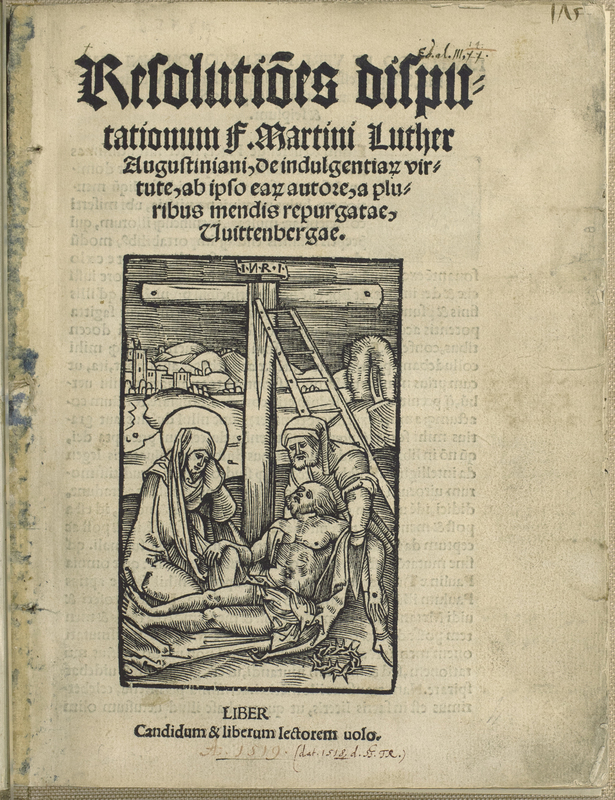 Still image
Removal of Jesus from the Cross
A woodcut depicting Mary and Joseph of Arimathea taking the body of Jesus down from the cross. The crown of thorns lies on the ground beside Jesus and the inscription "INRI" appears above the cross.A woodcut depicting Mary and Joseph of Arimathea taking the body of Jesus down from the cross. The crown of thorns lies on the ground beside Jesus and the inscription "INRI" appears above the cross. -
 Text
TextReplica F. Sylvestri Prieriat[is] : sacri Palatii Apostolici Magistri, ad F. Martinum Luther Ordinis Eremitaru[m] ; Martinus Luther, optimo lectori salutem ...
Mazzolini, Silvestro, da Prierio, 1456?-1527?Summary: When Luther received the replies of S. Mazzolini, the first man to take up the cudgels against Luther, he found the best course of reply to be a reprinting with notes of Mazzolini's inept rejoinders. Even the Catholics had to admit that Mazzolini's answers simply did not meet Luther's objections. This is the second printing of the work.Summary: When Luther received the replies of S. Mazzolini, the first man to take up the cudgels against Luther, he found the best course of reply to be a reprinting with notes of Mazzolini's inept rejoinders. Even the Catholics had to admit that Mazzolini's answers simply did not meet Luther's objections. This is the second printing of the work. -
 Text
TextResolutio lutheriana [sic] super propositione deci[m]a tertia: de potestate pape
Luther, Martin, 1483-1546Summary: One of the thorniest issues raised in the Leipzig Disputation was the historical precedence of papal authority. Eck argued that from earliest times, the authority of the bishop of Rome was accepted by the other bishops. Luther's thirteenth proposition argued that only much later did the church in Rome claim precedence over the other churches.Summary: One of the thorniest issues raised in the Leipzig Disputation was the historical precedence of papal authority. Eck argued that from earliest times, the authority of the bishop of Rome was accepted by the other bishops. Luther's thirteenth proposition argued that only much later did the church in Rome claim precedence over the other churches. -
 Text
TextResolutio[n]es disputationum
Luther, Martin, 1483-1546Summary: This is Luther's final authorized edition of his Ninety-five Theses in book form with his own commentaries. The edition published by Rhau-Grunemberg had been so full of errors, that Luther gave the printing of this edition to Melchior Lotter in Leipzig.Summary: This is Luther's final authorized edition of his Ninety-five Theses in book form with his own commentaries. The edition published by Rhau-Grunemberg had been so full of errors, that Luther gave the printing of this edition to Melchior Lotter in Leipzig. -
 Text
TextSermo de penitentia
Luther, Martin, 1483-1546Summary: This sermon on penance was written and preached before Easter, 1518. It is a natural sequel to the sermon on Indulgences and grace, although this sermon was preached first. This is the seventh printing of the sermon.Summary: This sermon on penance was written and preached before Easter, 1518. It is a natural sequel to the sermon on Indulgences and grace, although this sermon was preached first. This is the seventh printing of the sermon. -
 Text
TextStella clericorum cuilib[et] clerico summe necessaria
Summary: "Star of the Clergy" is an anonymous handbook on pastoral care. This manual was widely printed and copied. Lotter, the Leipzig printer who produced this edition, also published Luther's first work.Summary: "Star of the Clergy" is an anonymous handbook on pastoral care. This manual was widely printed and copied. Lotter, the Leipzig printer who produced this edition, also published Luther's first work. -
 Text
TextVerba dei : quanto candore & [que] syncere praedicari, quanta[que] solicitudine uniuersi debeant addiscere
Karlstadt, Andreas Rudolff-Bodenstein von,1486-1541.Summary: Only printing of a pamphlet by Karlstadt attacking Johann Eck on issues that emerged during their disputation at Leipzig 1519, in particular the interpretation of scripture and the question of free will and its relation to the grace of God.Summary: Only printing of a pamphlet by Karlstadt attacking Johann Eck on issues that emerged during their disputation at Leipzig 1519, in particular the interpretation of scripture and the question of free will and its relation to the grace of God. -
 Text
TextVorlegung gemacht von Bruder Johan Tetzel Prediger Orde[n]s Ketzermeister : wyder eynen vormessen Sermon von tzwentzig irrige[n] Artickeln Bebstlichen Ablas vn[d] Gnade belange[n]de allen cristglaubige[n] Mensche[n] tzuwissen von Notten
Tetzel, Johann, 1460-1519Summary: First attack on Luther's "Sermon von dem Ablass und Gnade" (Sermon on indulgences and grace) by Johan Tetzel, a refutation of Luther's position.Summary: First attack on Luther's "Sermon von dem Ablass und Gnade" (Sermon on indulgences and grace) by Johan Tetzel, a refutation of Luther's position.