Search
35 resources
35 items
Subject
Doctrines
-
 Text
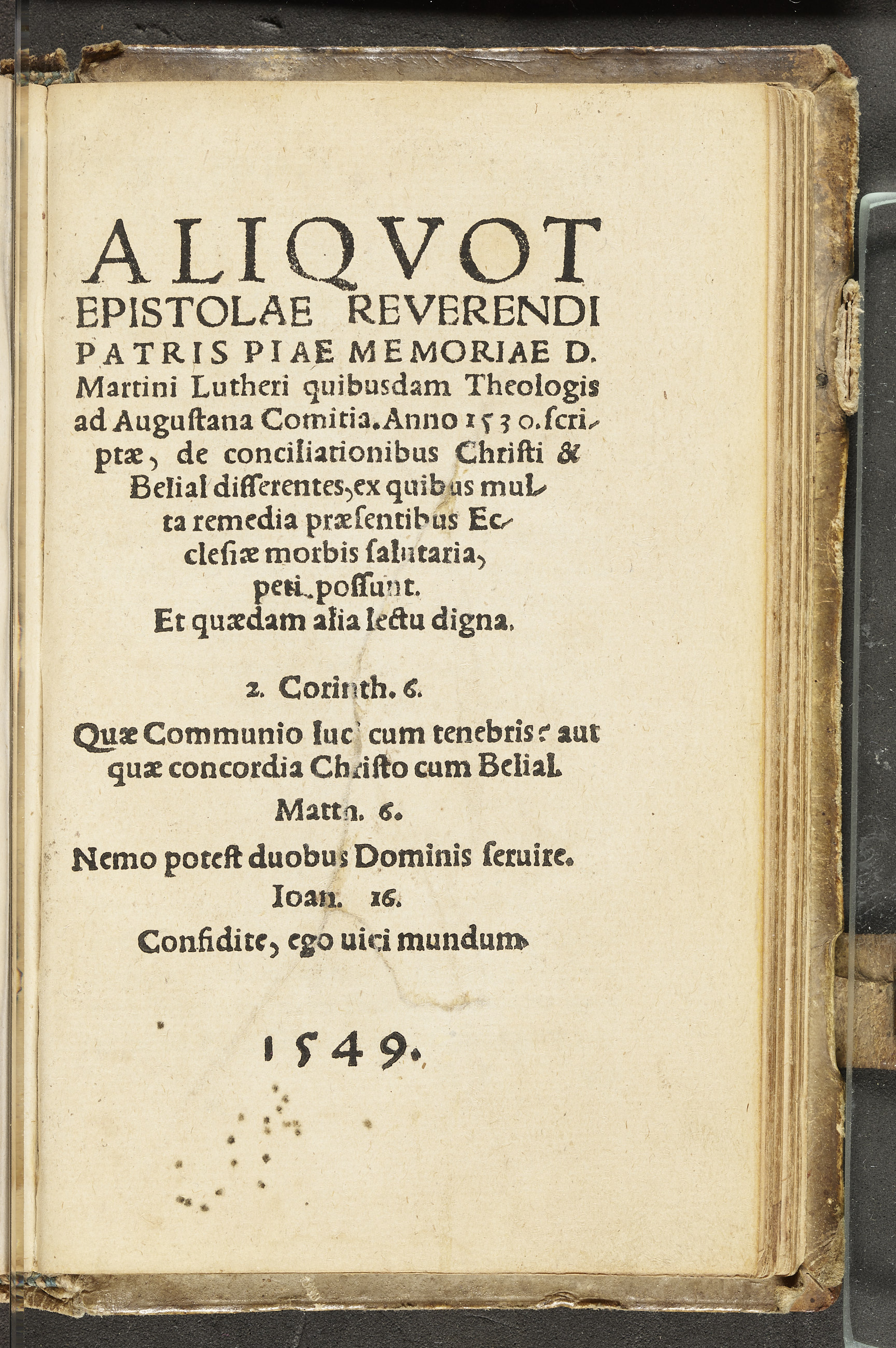
TextAliquot epistolae
Luther, Martin, 1483-1546Summary: M. Flacius Illyricus issued this edition of Luther's letters from Coburg Castle to the theologians at the Diet of Augsburg in an attempt to strengthen the Protestant resolve during the Interim. Intended for the widest possible distribution, both German and Latin versions were provided.Summary: M. Flacius Illyricus issued this edition of Luther's letters from Coburg Castle to the theologians at the Diet of Augsburg in an attempt to strengthen the Protestant resolve during the Interim. Intended for the widest possible distribution, both German and Latin versions were provided. -
 Text
TextAmbrosii Catharini olim La[n]cinoti co[n]tra Martinu[m] Lutherum super his verbis, Tu es Petrus [et cetera], Et tibi dabo claues regni celorum [et cetera], Mathei xvi. : Dialogus [i?]n minus disertus qua[m] elegans et festiuus : Roffensis Episcopi loca qu[a]edam quibus predicta[m] auctoritate[m] cu[m] duabus alijs Matthei scz xviij. & Ioa[n]nis xx. eiusdem monet[a]e, sed no[n] eiusdem valoris comparat, & discrimen earu[m] euidenti scripturaru[m] testimonio declarat.
Ambrosius Catharinus, Archbishop of Conza, 1484-1553Summary: A selection of criticisms of Luther's views on the spiritual origins of the Papacy by one of his early opponents, Ambrosius Catharinus, edited by another of his early opponents, Hieronymus Emser, and dedicated by Emser to a third Luther opponent, Paul Bachmann, Abbot of Altenzelle.Summary: A selection of criticisms of Luther's views on the spiritual origins of the Papacy by one of his early opponents, Ambrosius Catharinus, edited by another of his early opponents, Hieronymus Emser, and dedicated by Emser to a third Luther opponent, Paul Bachmann, Abbot of Altenzelle. -
 Text
TextAn answer to every man that asketh a reason of thehope that is in us. By way of question and answer
Whitefield, George, 1714-1770Summary:Summary: -
 Text
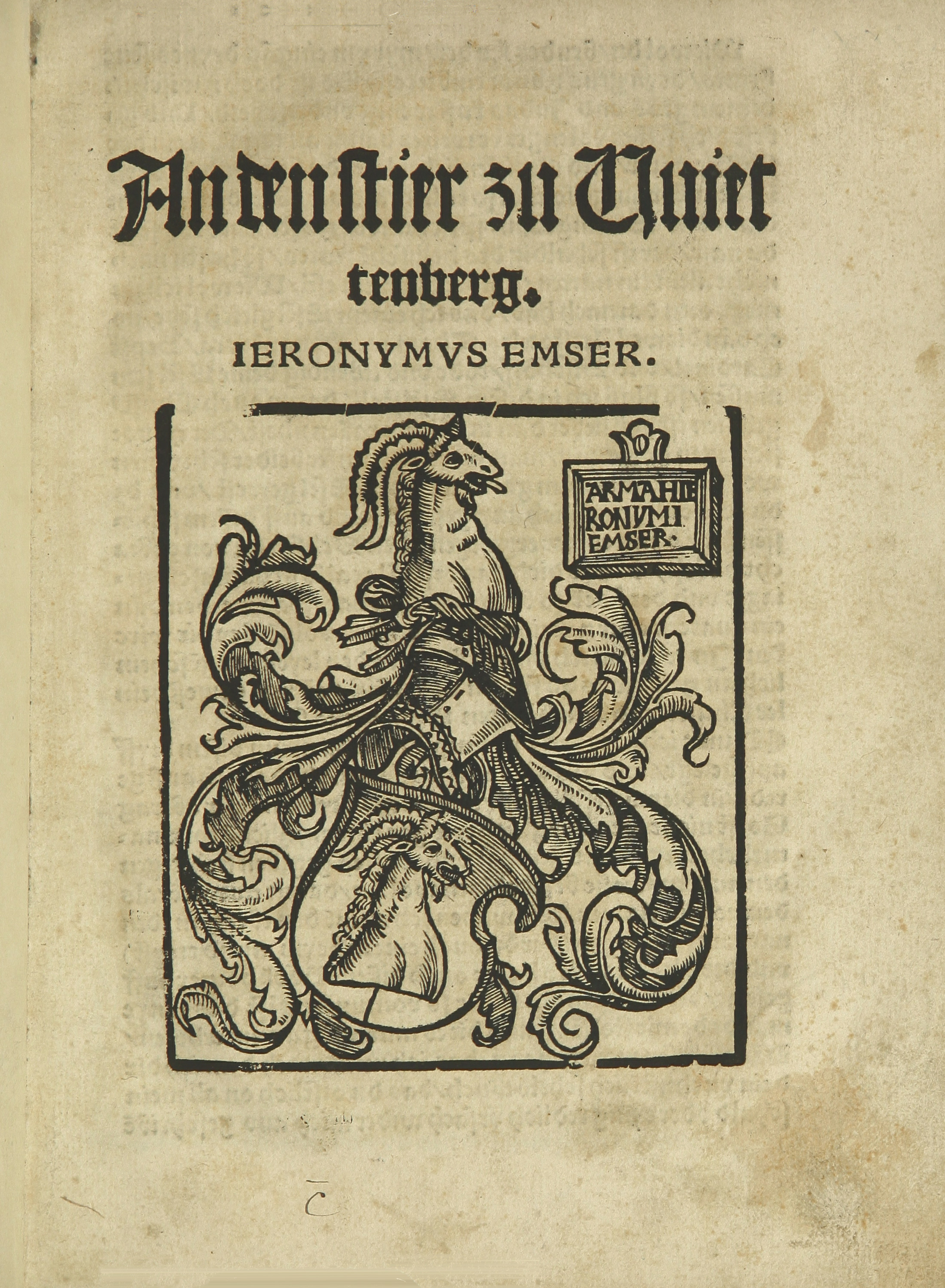
TextAn den Stier zu Uuittenberg
Emser, Hieronymus, 1478-1527Summary: A reply to Martin Luther's "An den Bock zu Leipzig."Summary: A reply to Martin Luther's "An den Bock zu Leipzig." -
 Text
TextAnalectus siue libellus collectaneorum, continens tres tractatus de praecipuis capitibus doctrinae Christianae, quae à Papistis corrumpuntur, & oppugnantur
Selneccer, Nicolaus, 1530-1592Summary: Compilation of three anti-Catholic tracts by the Lutheran theologians and composer of hymns Nicolaus Selneccer.Summary: Compilation of three anti-Catholic tracts by the Lutheran theologians and composer of hymns Nicolaus Selneccer. -
 Text
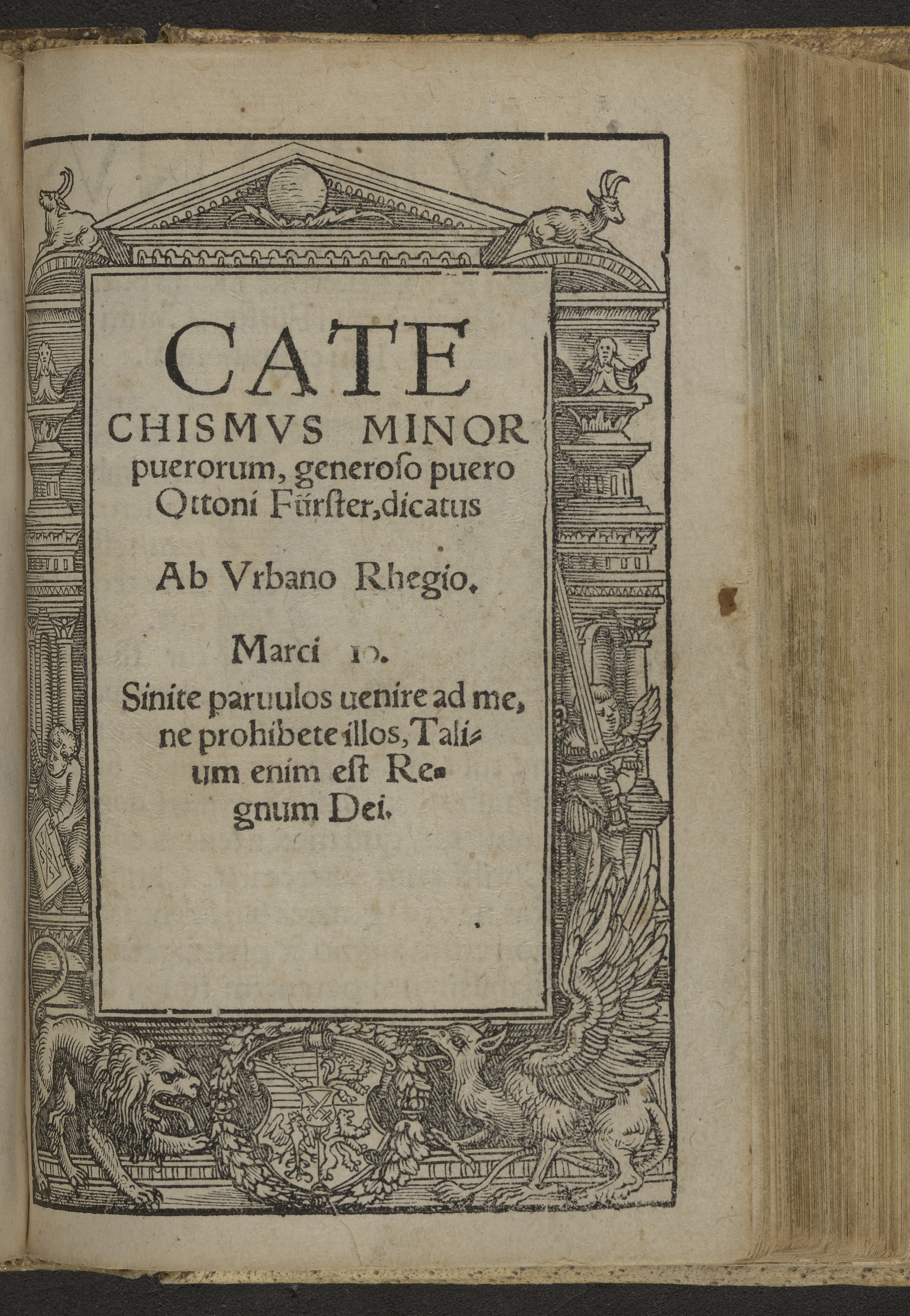
TextCatechismus minor puerorum, generoso puero Ottoni Fürster
Rhegius, Urbanus, 1489-1541Summary: Rhegius was a Reformer, active throughout Germany promoting Lutheran unity in the Holy Roman Empire. In 1530 at the Diet of Augsburg he was befriended by Ernest I, Duke of Brunswick-Luneburg, under whose patronage he returned to Brunswick where he wrote the present work for Ernest's son, Francis Otto (1530-1559). Like many 16th c. catechisms, Rhegius' is in the form of a dialogue, in this instance between the teacher and the pupil (paedagogus et discipulus).Summary: Rhegius was a Reformer, active throughout Germany promoting Lutheran unity in the Holy Roman Empire. In 1530 at the Diet of Augsburg he was befriended by Ernest I, Duke of Brunswick-Luneburg, under whose patronage he returned to Brunswick where he wrote the present work for Ernest's son, Francis Otto (1530-1559). Like many 16th c. catechisms, Rhegius' is in the form of a dialogue, in this instance between the teacher and the pupil (paedagogus et discipulus). -
 Text
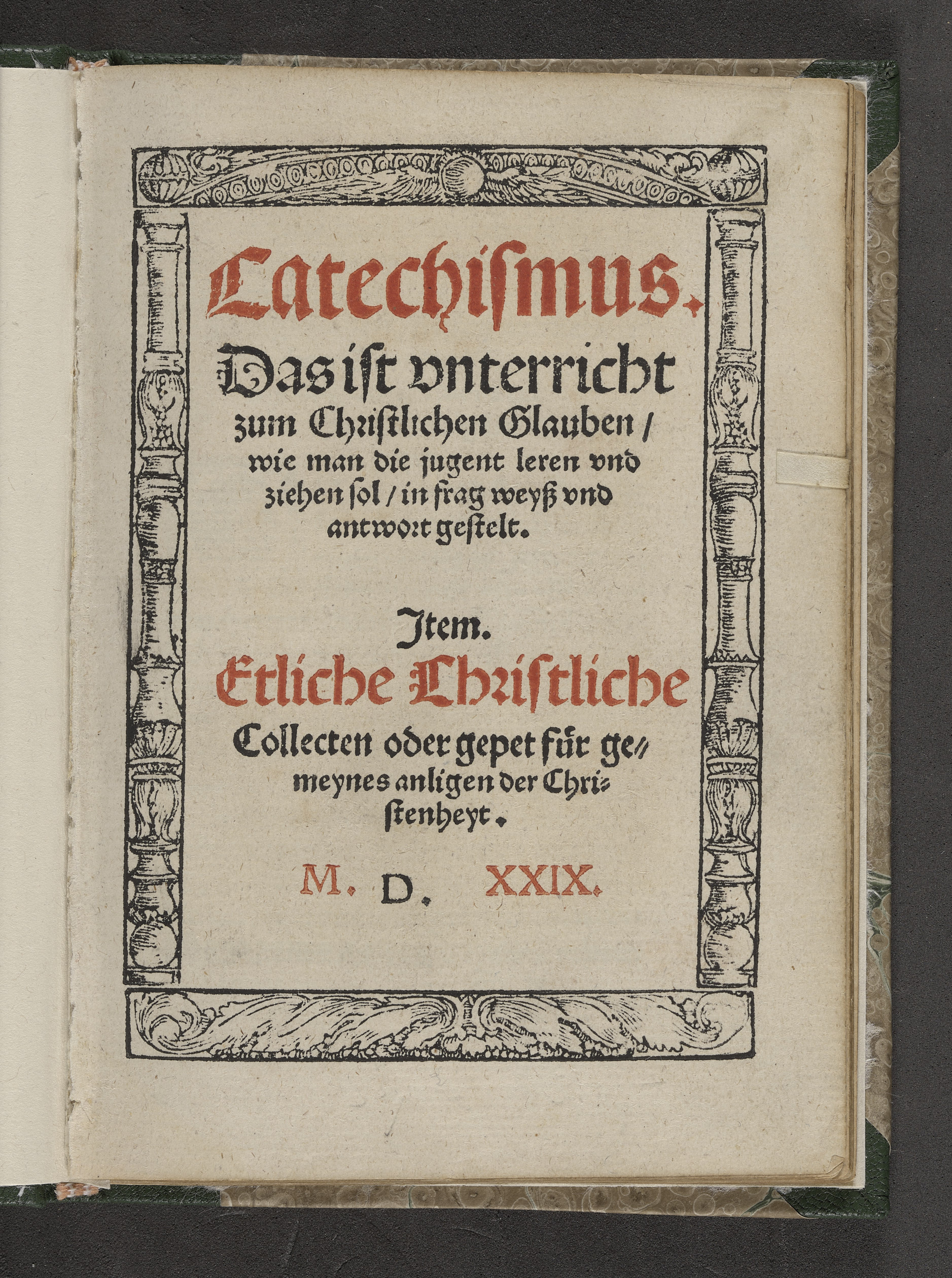
TextCatechismus. Das ist Vnterricht zum christlichen Glauben wie man die Jugent leren vnd ziehen sol, in Frag Weyss vnd Antwort gestelt : Jtem etliche christliche Collecten oder Gepet für gemeynes Anligen der Christenheyt
Althamer, Andreas, approximately 1500-1539Summary: Third printing of the Ansbach Catechism by Andreas Althamer and Johannes Rurer, commissioned by Margrave Georg of Brandenburg. It has been called the first regional catechism of the Protestant movement. It contains 92 questions and answers as well as an appendix with 18 prayers.Summary: Third printing of the Ansbach Catechism by Andreas Althamer and Johannes Rurer, commissioned by Margrave Georg of Brandenburg. It has been called the first regional catechism of the Protestant movement. It contains 92 questions and answers as well as an appendix with 18 prayers. -
 Text
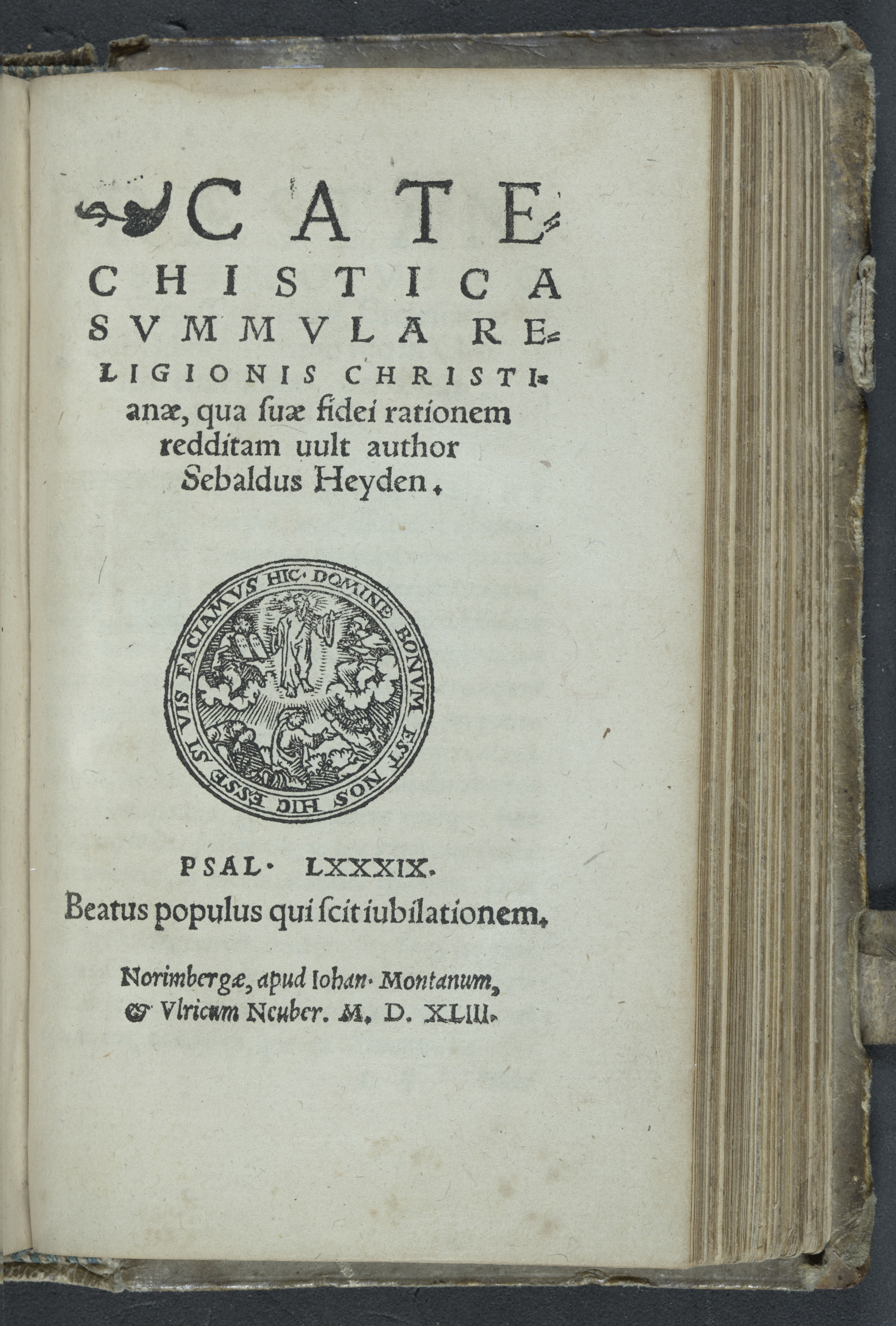
TextCatechistica summula religionis Christianae
Heyden, Sebald, -1561Summary: Summary-style Lutheran catechism by Sebald Heyden, a humanist scholar and educator in Nuremberg. He was well known as a poet and composer of hymns and his book "De arte candendi" (On the art of singing) had a significant impact on the study and teaching of music.Summary: Summary-style Lutheran catechism by Sebald Heyden, a humanist scholar and educator in Nuremberg. He was well known as a poet and composer of hymns and his book "De arte candendi" (On the art of singing) had a significant impact on the study and teaching of music. -
 Text
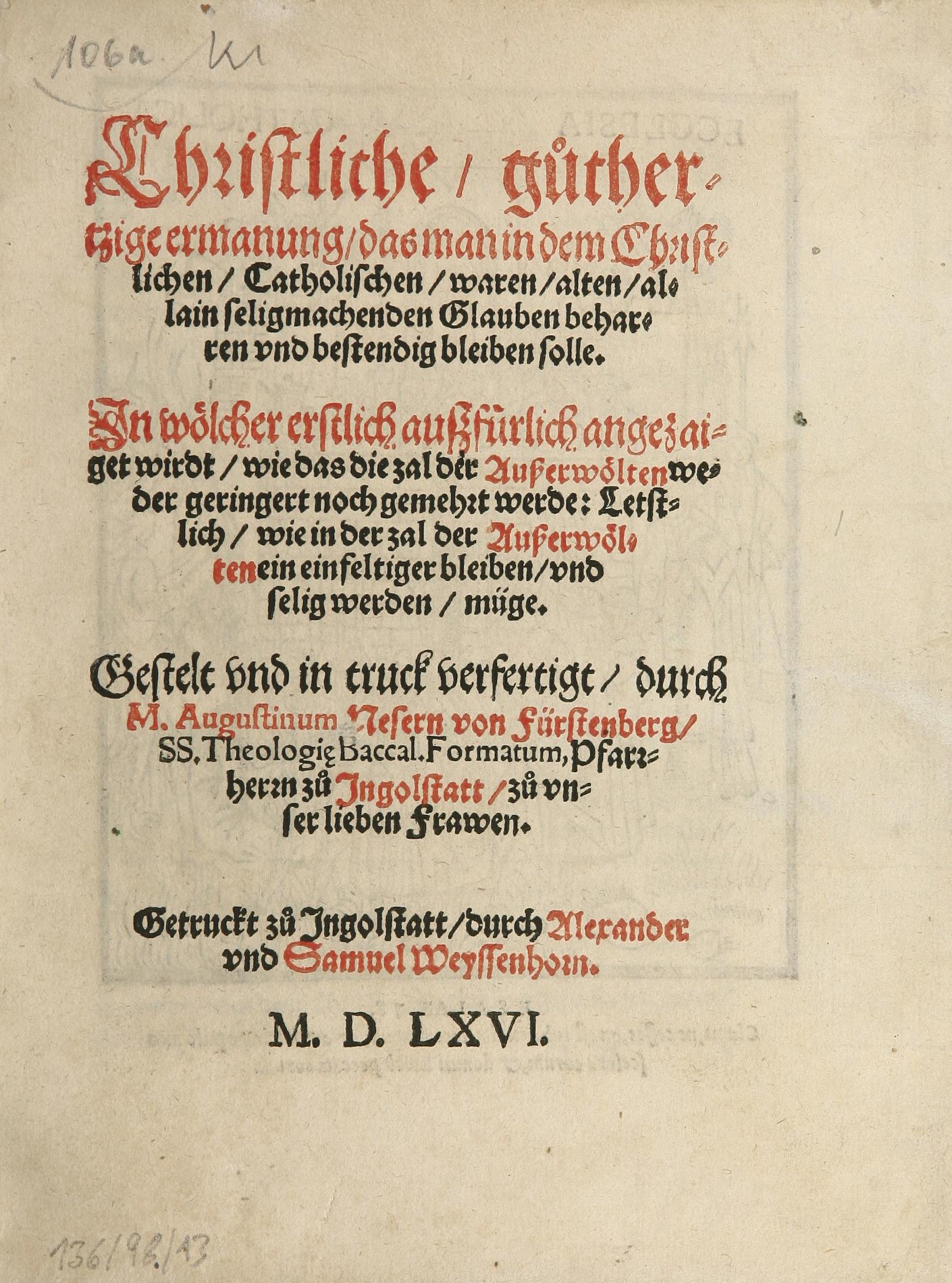
TextChristliche güthertzige Ermanung, das Man in dem Christlichen, Catholischen, waren, alten, allain seligmachenden Glauben beharren vnd bestendig bleiben solle : In wölcher erstlich auszfürlich angezaiget wirdt, wie das die Zal der Ausserwölten weder geringert noch gemehrt werde: letstlich, wie in der Zal der Ausserwölten ein einfeltiger bleiben, vnd selig werden, müge
Neser, AugustinusSummary: Augustinus Neser was a pastor in Ingolstadt. In this hortatory tract he discusses the importance of staying within the Catholic fold.Summary: Augustinus Neser was a pastor in Ingolstadt. In this hortatory tract he discusses the importance of staying within the Catholic fold. -
 Text
TextCommonefactio De periculis horum temporum : proposita scholasticis Academiae Vuitebergensis, XII. Cal. IXbris, Anno M.D.LXV. Rectore Micaelo Teubero , I.V. doctore
Peucer, Kaspar, 1525-1602Summary: Lecture delivered to the faculty and students of the University of Wittenberg on "the perils of these times" by Kaspar Peucer, Philipp Melanchthon's son-in-law. The perils to which he refers are the military threat of the Turks to the east, and the plague.Summary: Lecture delivered to the faculty and students of the University of Wittenberg on "the perils of these times" by Kaspar Peucer, Philipp Melanchthon's son-in-law. The perils to which he refers are the military threat of the Turks to the east, and the plague. -
 Text
TextContra haereticum dikaeusistam de dicto Ioannis: Spiritus arguet munde iustitia uado ad Patrem
Flacius Illyricus, Matthias, 1520-1575Summary: Response by Mathias Flacius Illyricus, among the strictest of the Lutheran theologians of his time, to the views of the early Reformer of Nürnberg, Andreas Osiander, on Justification. Osiander emphasized the believer's being made righteous, as opposed to being declared righteous through Christ. Flacius reports on the title page that he had shared his views on this issue privately in writing with friends, but that they had been published without his permission and in a form unacceptable to him. This edition represents the official response by Flacius.Summary: Response by Mathias Flacius Illyricus, among the strictest of the Lutheran theologians of his time, to the views of the early Reformer of Nürnberg, Andreas Osiander, on Justification. Osiander emphasized the believer's being made righteous, as opposed to being declared righteous through Christ. Flacius reports on the title page that he had shared his views on this issue privately in writing with friends, but that they had been published without his permission and in a form unacceptable to him. This edition represents the official response by Flacius. -
 Text
TextDe Petro et Roma adversus Velenu[m] Lutheranum, libri quatuor
Cochlaeus, Johannes, 1479-1552Summary: Oldrich Velensky, Latinized as Ulrich Velenus, was a Bohemian Protestant who opposed the papal claims to power based on St. Peter's residence and martyrdom in Rome. Cochlaeus upholds the traditional Catholic view that St. Peter was martyred in Rome in the reign of Nero in this volume against Velensky's criticism.Summary: Oldrich Velensky, Latinized as Ulrich Velenus, was a Bohemian Protestant who opposed the papal claims to power based on St. Peter's residence and martyrdom in Rome. Cochlaeus upholds the traditional Catholic view that St. Peter was martyred in Rome in the reign of Nero in this volume against Velensky's criticism. -
 Text
TextDecem praecepta Witte[n]berge[n]si praedicata populo
Luther, Martin, 1483-1546Summary: The sermons on which this commentary on the Ten Commandments is based were delivered in Wittenberg in 1516-1517. This is the first work of Luther's to be translated into a modern European language. This is the first printing of the work.Summary: The sermons on which this commentary on the Ten Commandments is based were delivered in Wittenberg in 1516-1517. This is the first work of Luther's to be translated into a modern European language. This is the first printing of the work. -
 Text
TextDialogus ad Martinu[m] Lutherum : pro responsione ad impertinentem quanda[m] ipsius epistolam super posita[m] veluti collocutoris vice intermixtam
Dungersheim, Hieronymus, 1465-1540Summary: H. Dungersheim had exchanged several letters with Luther before he wrote this dialogue. It was his first formal controversialist tract, written in 1520, but not published until 1531. Luther burned a manuscript copy of this work when he burned the bull Exsurge Domine on December 10, 1520.Summary: H. Dungersheim had exchanged several letters with Luther before he wrote this dialogue. It was his first formal controversialist tract, written in 1520, but not published until 1531. Luther burned a manuscript copy of this work when he burned the bull Exsurge Domine on December 10, 1520. -
 Text
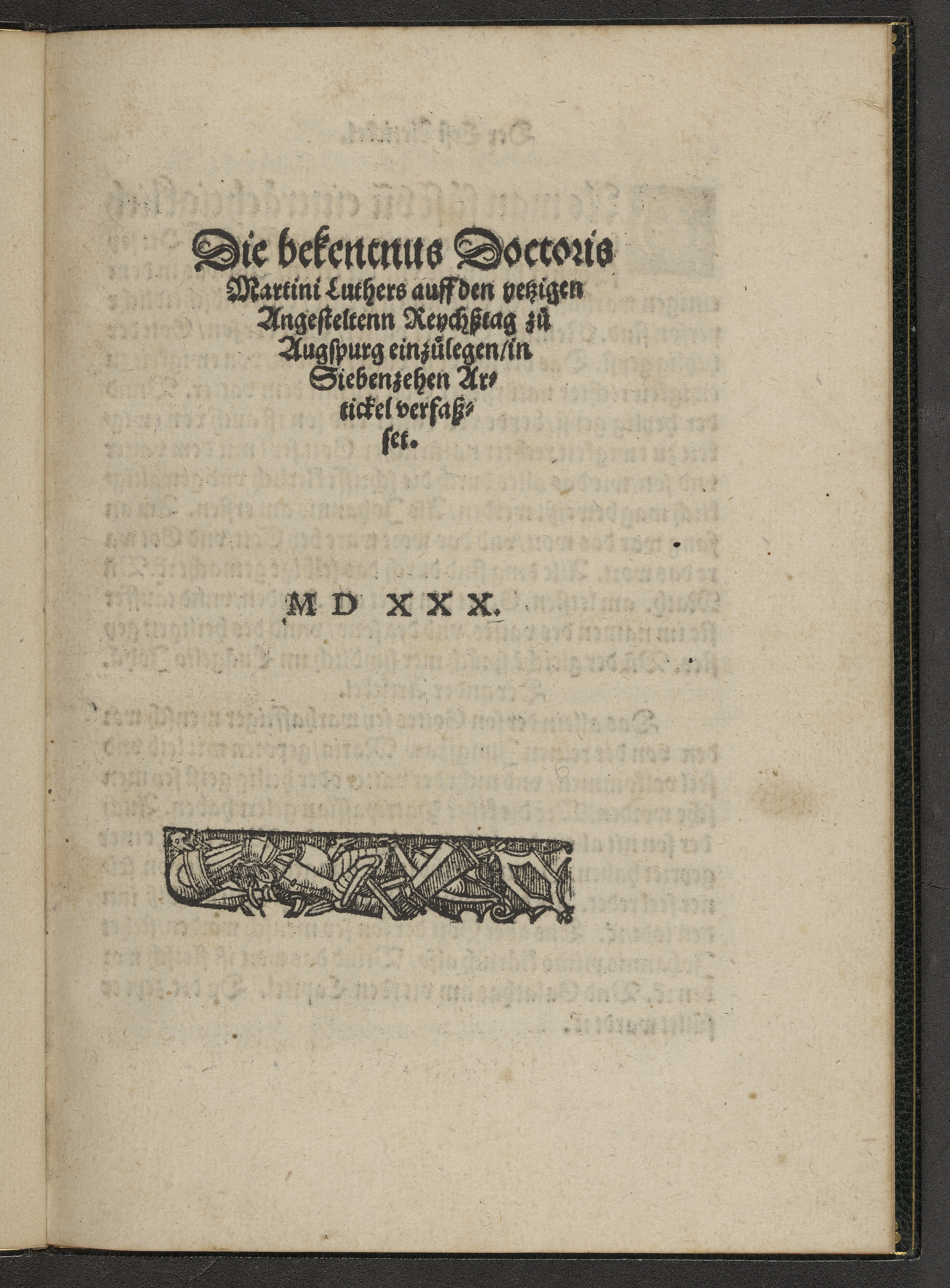
TextDie bekentnus Doctoris Martini Luthers auff den yetzigen Angesteltenn Reychstag zu Augspurg einzuolegen : in Siebenzehen Artickel verfasset
Luther, Martin, 1483-1546Summary: One of at least 11 printings produced in 1530 of the Schwabach Articles, 17 articles of faith composed by Luther 1529 in Schwabach. It became one of the foundational documents for the Augsburg Confession.Bound in modern dark green morocco, bordered, blind- and gilt-tooled, with inside dentelles, gold spine title, and gilt edges. Upper board scratched.Summary: One of at least 11 printings produced in 1530 of the Schwabach Articles, 17 articles of faith composed by Luther 1529 in Schwabach. It became one of the foundational documents for the Augsburg Confession.Bound in modern dark green morocco, bordered, blind- and gilt-tooled, with inside dentelles, gold spine title, and gilt edges. Upper board scratched. -
 Text
TextDoctor Johan. dietenberger. [sic] Widerlegung des Lutherischen büchlins, da er schreibt von menschen leren zü meiden rc.
Dietenberger, Johann, approximately 1475-1537Summary: Johannes Dietenberger was a preaching monk who later became the grand inquisitor in the dioceses of Mainz and Cologne. He is best known for his German translation of the Bible, published in 1534. This work is an answer to Luther's writings on human doctrines and traditions in the Church.Summary: Johannes Dietenberger was a preaching monk who later became the grand inquisitor in the dioceses of Mainz and Cologne. He is best known for his German translation of the Bible, published in 1534. This work is an answer to Luther's writings on human doctrines and traditions in the Church. -
 Text
TextEin Worhafft geschicht wie es kürtzlich einem prediger Münch zuo Nürmberg mit seinen Ordens brüdern von wegen seiner Eua[n]gelischen predig ergangen ist
Korn, GallusSummary: The tribulation of monks-turned Protestant, and then turned out of their monasteries, made fascinating reading for the newly-converted Protestants. In style, it is analogous to martyrologies, such as Foxe's "Book of Martyrs." G. Korn here relates his sufferings on account of the Gospel as one such monk in Nuremberg.Summary: The tribulation of monks-turned Protestant, and then turned out of their monasteries, made fascinating reading for the newly-converted Protestants. In style, it is analogous to martyrologies, such as Foxe's "Book of Martyrs." G. Korn here relates his sufferings on account of the Gospel as one such monk in Nuremberg. -
 Text
TextEnchiridion locorum communium aduersus Lutheranos
Eck, Johann, 1486-1543Summary: In 1521, Melanchthon wrote the first Protestant dogmatics, the "Loci Communes." Eck countered in 1525 with his "handbook on Theological Topics". Possibly the most widely reprinted Catholic critique of Lutheran doctrine (Metzler lists 91 contemporary editions). Eck uses the same topical procedure and cites the Bible, Church Fathers, Councils, and Popes heavily in the presentation of his arguments.Summary: In 1521, Melanchthon wrote the first Protestant dogmatics, the "Loci Communes." Eck countered in 1525 with his "handbook on Theological Topics". Possibly the most widely reprinted Catholic critique of Lutheran doctrine (Metzler lists 91 contemporary editions). Eck uses the same topical procedure and cites the Bible, Church Fathers, Councils, and Popes heavily in the presentation of his arguments. -
 Text
TextEpitome colloquij inter illustrissimorum Principum D. Friderici Palantini Electoris, & D. Christophori Ducis Wirtengergensis theologos, de maiestate hominis Christi, de[ni]q[ue] vera eius in eucharistia praesentia, Maulbrunnae instituti
Colloquy of Maulbronn (1564)Summary: Summary of the transactions of teh Colloquy of Maulbronn, a council involving theologians from Lutheran Würtemberg and the Reformed (Zwinglian) Palatinate. The main point of debate was the presence of Christ in the Eucharist.Summary: Summary of the transactions of teh Colloquy of Maulbronn, a council involving theologians from Lutheran Würtemberg and the Reformed (Zwinglian) Palatinate. The main point of debate was the presence of Christ in the Eucharist. -
 Text
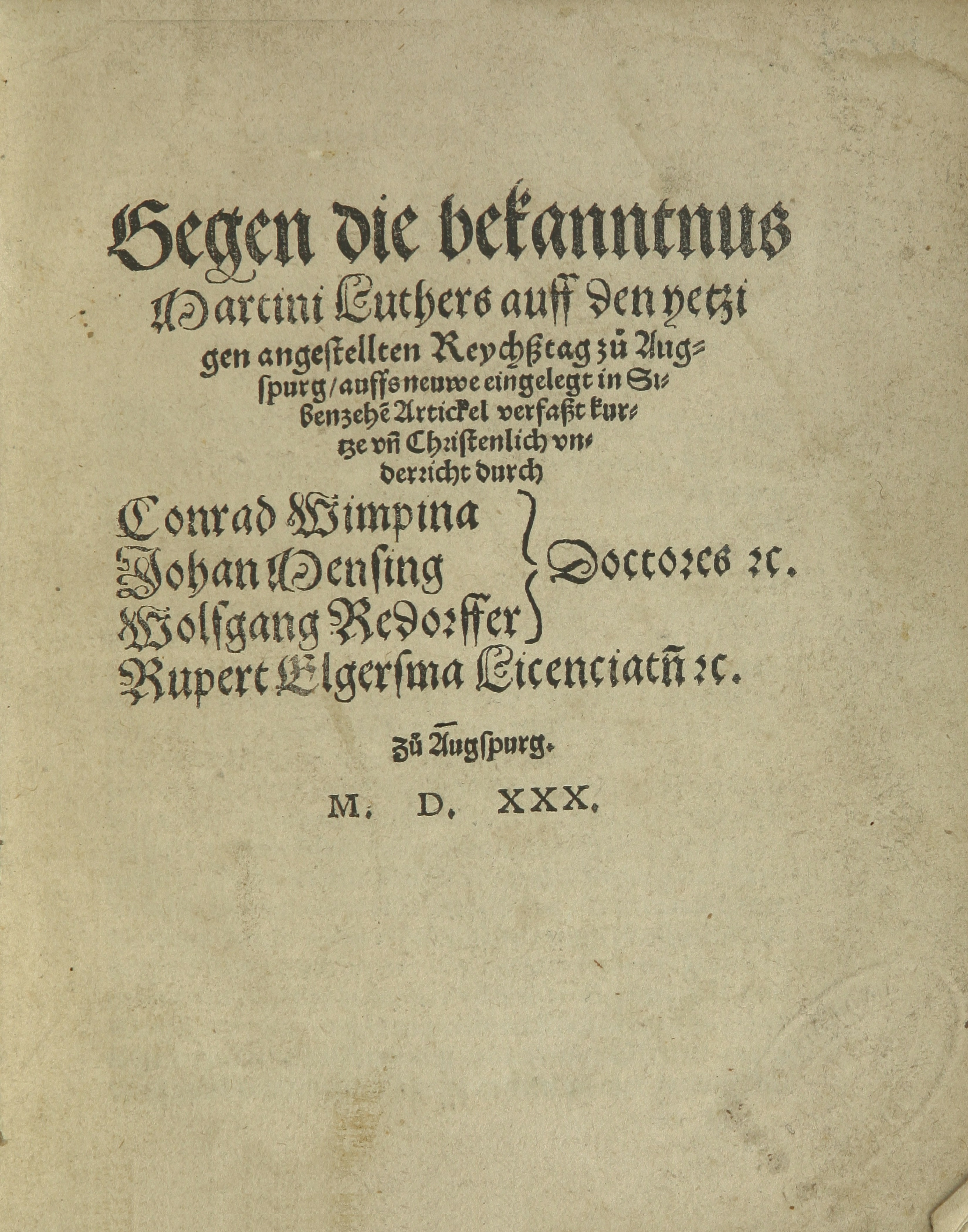
TextGegen die bekanntnus Martini Luthers auff den yetzigen angestellten Reychsstag zuo Augsburg, auff neuwe eingelegt in sibenzehe[n] Artickel verfasst. Kurtze vn[d] Christenlich vnderricht
Wimpina, Konrad, 1460-1531Summary: This pamphlet contains the Catholic response to the first, unauthorized edition of the Schwabach Articles, published in Coburg in 1530. Among the authors of this tract, Konrad Wimpina and Johannes Mensing helped draft the Catholic Confutation of the Augsburg Confession.Summary: This pamphlet contains the Catholic response to the first, unauthorized edition of the Schwabach Articles, published in Coburg in 1530. Among the authors of this tract, Konrad Wimpina and Johannes Mensing helped draft the Catholic Confutation of the Augsburg Confession. -
 Text
TextLoci communes seu hypotyposes theologicae
Melanchthon, Philipp, 1497-1560Summary: A 1525 printing of this most famous of all Melanchthon's theological works, first published in Wittenberg in 1521. The Loci Communes represent the most comrehensive systematic theology of the Lutheran reformation. Melanchthon continued to revise this work throughout his life.Summary: A 1525 printing of this most famous of all Melanchthon's theological works, first published in Wittenberg in 1521. The Loci Communes represent the most comrehensive systematic theology of the Lutheran reformation. Melanchthon continued to revise this work throughout his life. -
 Text
TextMargarita theologica, continens praecipuos locos doctrinae Christianae, per quaestiones breuiter & ordine explicatos : Omnibus pastoribus, verbi praeconibus, & ecclesiae ministris summè utilis & necessaria
Spangenberg, JohannSummary: Popular doctrinal theology by the Lutheran reformer Johann Spangenberg, based on Melanchthon's Loci Communes, and written for use by pastors and ministers. The work was first published in 1540 and was re-issued and translated numerous times.Summary: Popular doctrinal theology by the Lutheran reformer Johann Spangenberg, based on Melanchthon's Loci Communes, and written for use by pastors and ministers. The work was first published in 1540 and was re-issued and translated numerous times. -
 Text
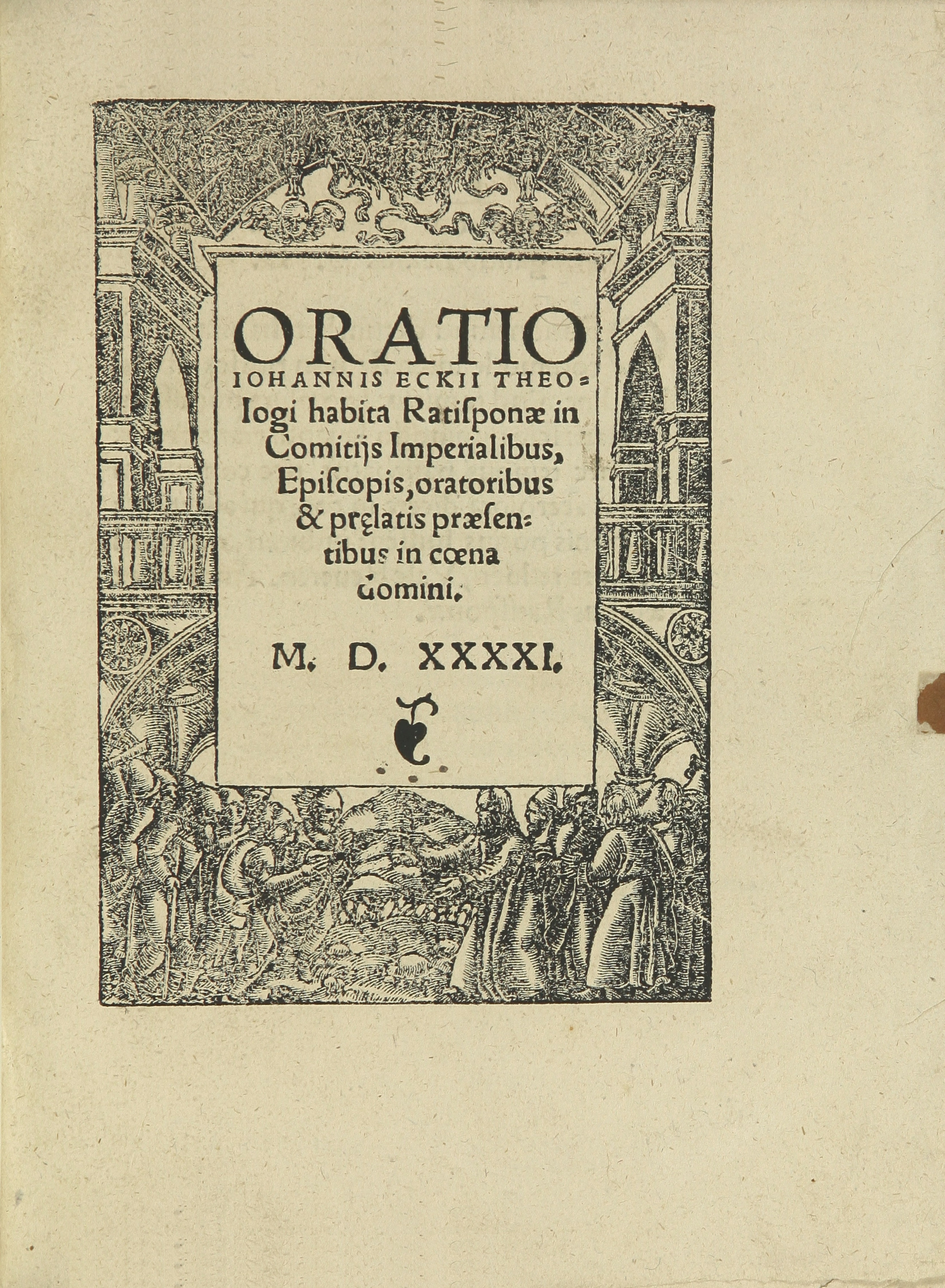
TextOratio
Eck, Johann, 1486-1543Summary: This is the first printing of Eck's speech to the Diet of Regensburg on April 5, 1541, defining the Catholic understanding of the Lord's Supper. The Diet of Regensburg proved to be Eck's last appearance as a major theological political leader, for his health declined and he could no longer bear the weight of these grueling encounters.Summary: This is the first printing of Eck's speech to the Diet of Regensburg on April 5, 1541, defining the Catholic understanding of the Lord's Supper. The Diet of Regensburg proved to be Eck's last appearance as a major theological political leader, for his health declined and he could no longer bear the weight of these grueling encounters. -
 Text
TextQuaedam scripta theologorum VVirtembergicorum & Victorini Strigelij unde liquet, quid illi de ipsius papistica synergia sentiant
Strigel, Victorinus, 1524-1569Summary: Collection of documents issued by theologians in the Duchy of Württemberg and Victorinus Strigel concerning Strigel's Psalms commentary and his position in the synergistic controversy. Strigel supported the Philippist position that human will contributes to salvation, an idea that was rejected by the gnesio-Lutherans and by most of the theologians in Württemberg.Summary: Collection of documents issued by theologians in the Duchy of Württemberg and Victorinus Strigel concerning Strigel's Psalms commentary and his position in the synergistic controversy. Strigel supported the Philippist position that human will contributes to salvation, an idea that was rejected by the gnesio-Lutherans and by most of the theologians in Württemberg. -
 Text
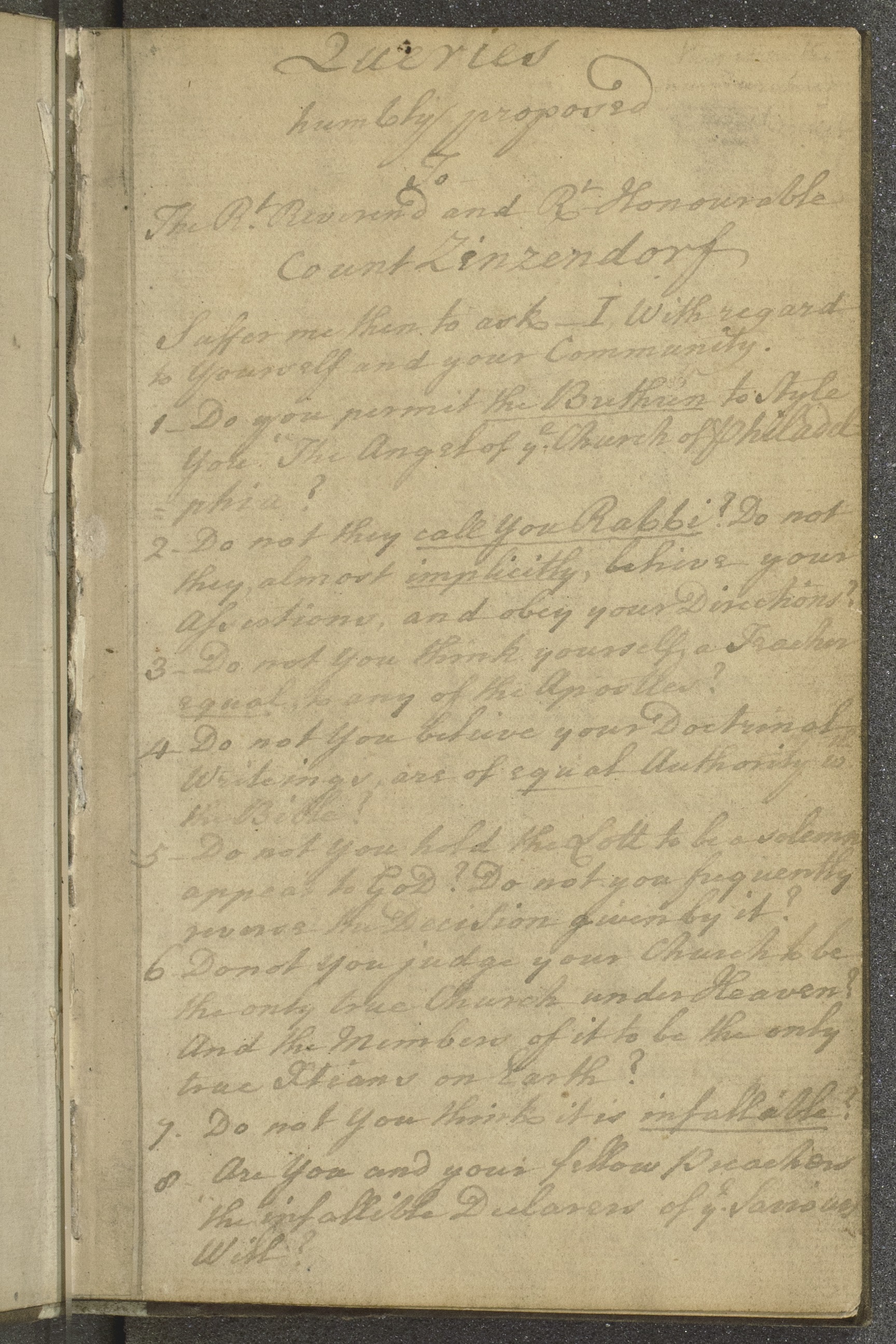
TextQueries humbly proposed to the Rt. Reverend and Rt. Honourable Count Zinzendorf
Bennet, John, 1714-1759Summary: A set of questions written by Bennet, here referred to as queries, posed to Count Niclaus Ludwig graf von Zinzendorf, the founder of the Moravian Church.Summary: A set of questions written by Bennet, here referred to as queries, posed to Count Niclaus Ludwig graf von Zinzendorf, the founder of the Moravian Church. -
 Text
TextReplica F. Sylvestri Prieriat[is] : sacri Palatii Apostolici Magistri, ad F. Martinum Luther Ordinis Eremitaru[m] ; Martinus Luther, optimo lectori salutem ...
Mazzolini, Silvestro, da Prierio, 1456?-1527?Summary: When Luther received the replies of S. Mazzolini, the first man to take up the cudgels against Luther, he found the best course of reply to be a reprinting with notes of Mazzolini's inept rejoinders. Even the Catholics had to admit that Mazzolini's answers simply did not meet Luther's objections. This is the second printing of the work.Summary: When Luther received the replies of S. Mazzolini, the first man to take up the cudgels against Luther, he found the best course of reply to be a reprinting with notes of Mazzolini's inept rejoinders. Even the Catholics had to admit that Mazzolini's answers simply did not meet Luther's objections. This is the second printing of the work. -
 Text
TextReplica contra periculosa scripta post Scrutinium diuine scripture iam pride[m] emissum emanata. ...
Schatzgeyer, Kaspar, 1463 or 1464-1527Summary: Casper Schatzgeyer, or Sasgerus, was a Franciscan friar who became provincial of the Province of Strasbourg in 1517. He wrote about 23 books on theological topics and against members of other orders and sects, notably J. von Staupitz and A. Osiander. This book, however, criticizes two of Luther's tracts: On Monastic Vows and On the Abolition of the Private Mass. Luther persuaded Johann Briessmann to reply, and Schatzgeyer replied to Briessmann. This is the work's first printing.Summary: Casper Schatzgeyer, or Sasgerus, was a Franciscan friar who became provincial of the Province of Strasbourg in 1517. He wrote about 23 books on theological topics and against members of other orders and sects, notably J. von Staupitz and A. Osiander. This book, however, criticizes two of Luther's tracts: On Monastic Vows and On the Abolition of the Private Mass. Luther persuaded Johann Briessmann to reply, and Schatzgeyer replied to Briessmann. This is the work's first printing. -
 Text
TextResolutio[n]es disputationum
Luther, Martin, 1483-1546Summary: This is Luther's final authorized edition of his Ninety-five Theses in book form with his own commentaries. The edition published by Rhau-Grunemberg had been so full of errors, that Luther gave the printing of this edition to Melchior Lotter in Leipzig.Summary: This is Luther's final authorized edition of his Ninety-five Theses in book form with his own commentaries. The edition published by Rhau-Grunemberg had been so full of errors, that Luther gave the printing of this edition to Melchior Lotter in Leipzig. -
 Text
TextResponsio Exulum Turingicorum Ad Inuectiuam D. Iohannis Stosselii : Quam Mense Octobri M.D.LXV. Emisit
Summary: Response singed by 30 gnesio-Luther theologians, who had been expelled from the city of Jena.Summary: Response singed by 30 gnesio-Luther theologians, who had been expelled from the city of Jena. -
 Text
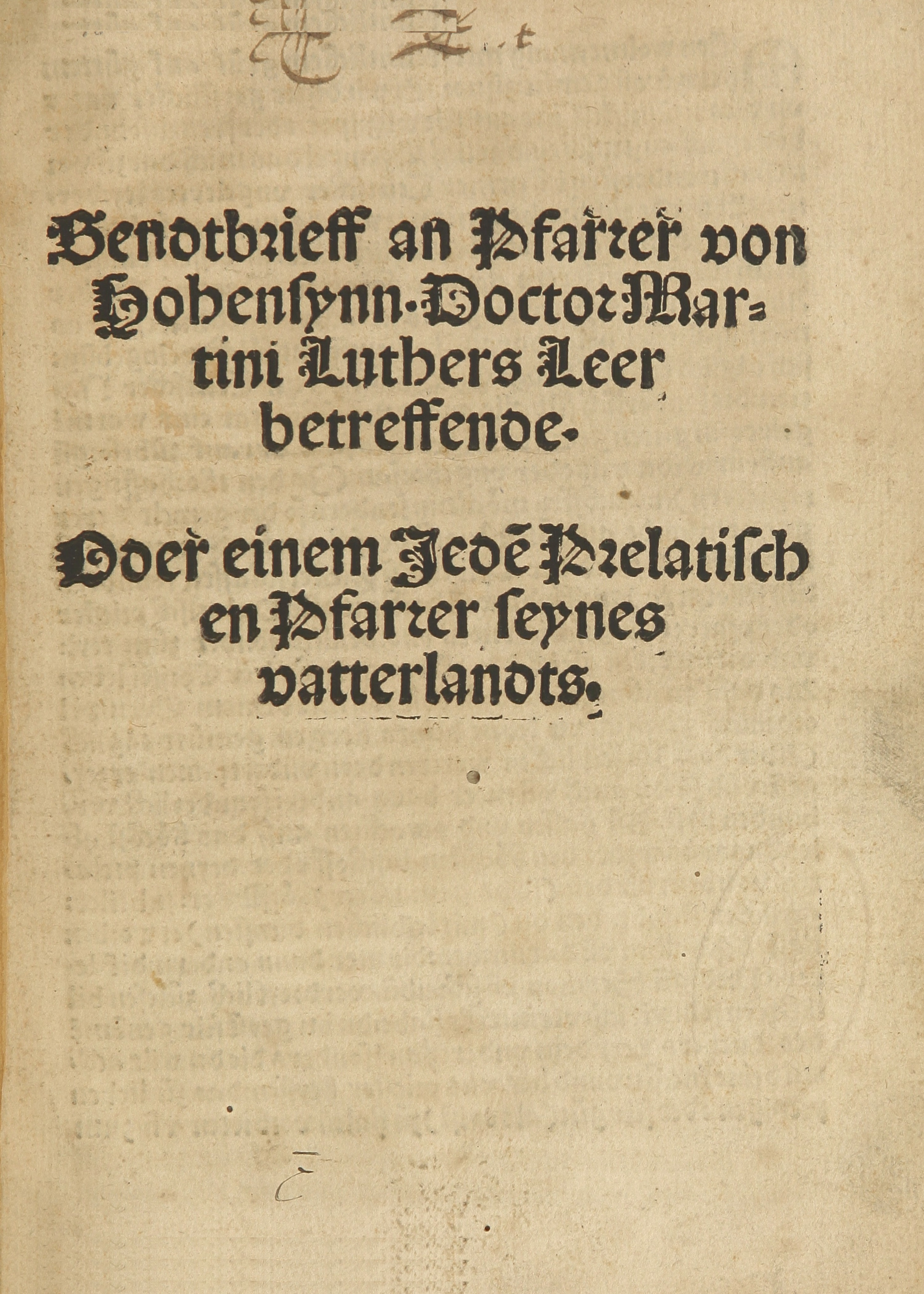
TextSendtbrieff an Pfarrer von Hohensynn. Doctor Martini Luthers Leer betreffende. Oder einem Jede[n] Prelatischen Pfarrer Seynes vaterlandes.
Summary: This is a Catholic pamphlet warning against Luther's errors. "Pastor Highmind" may be pseudonym or the name of a real Pastor von Hohensynn.Summary: This is a Catholic pamphlet warning against Luther's errors. "Pastor Highmind" may be pseudonym or the name of a real Pastor von Hohensynn. -
-
 Text
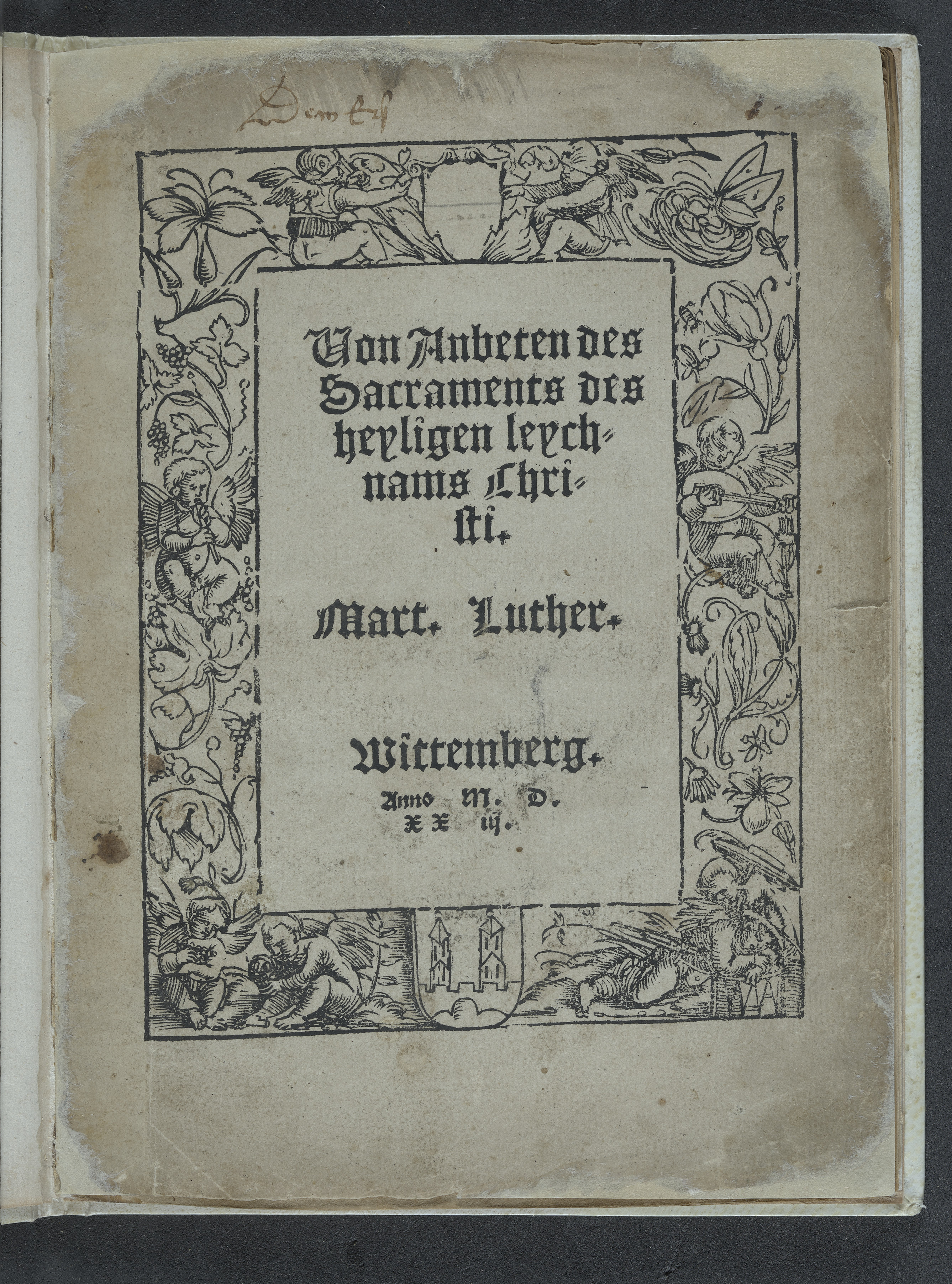
TextUon Anbeten des Sacraments des heyligen leychnams Christi
Luther, Martin, 1483-1546Summary: Second printing of Luther's response to a catechism of the Bohemian Brethren, with special attention to the Adoration of the Host, and to the Real Presence.Summary: Second printing of Luther's response to a catechism of the Bohemian Brethren, with special attention to the Adoration of the Host, and to the Real Presence. -
 Text
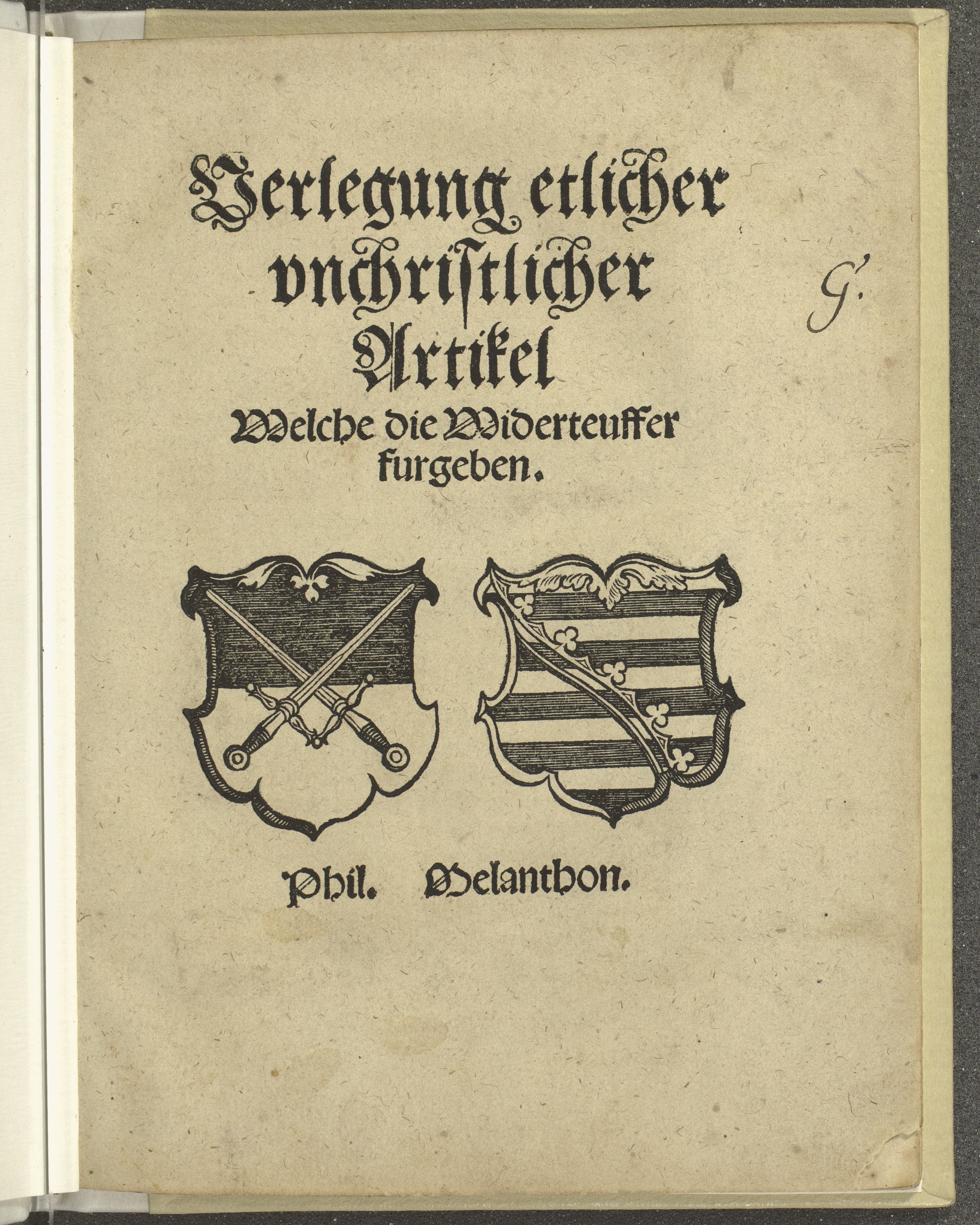
TextVerlegung etlicher vnchristlicher Artikel : Welche die widerteuffer furgeben
Melanchthon, Philipp, 1497-1560Summary: In this piece, Melanchthon sharply attacks the major Anabaptist theological points. This is the second printing of the tract.Summary: In this piece, Melanchthon sharply attacks the major Anabaptist theological points. This is the second printing of the tract. -
 Text
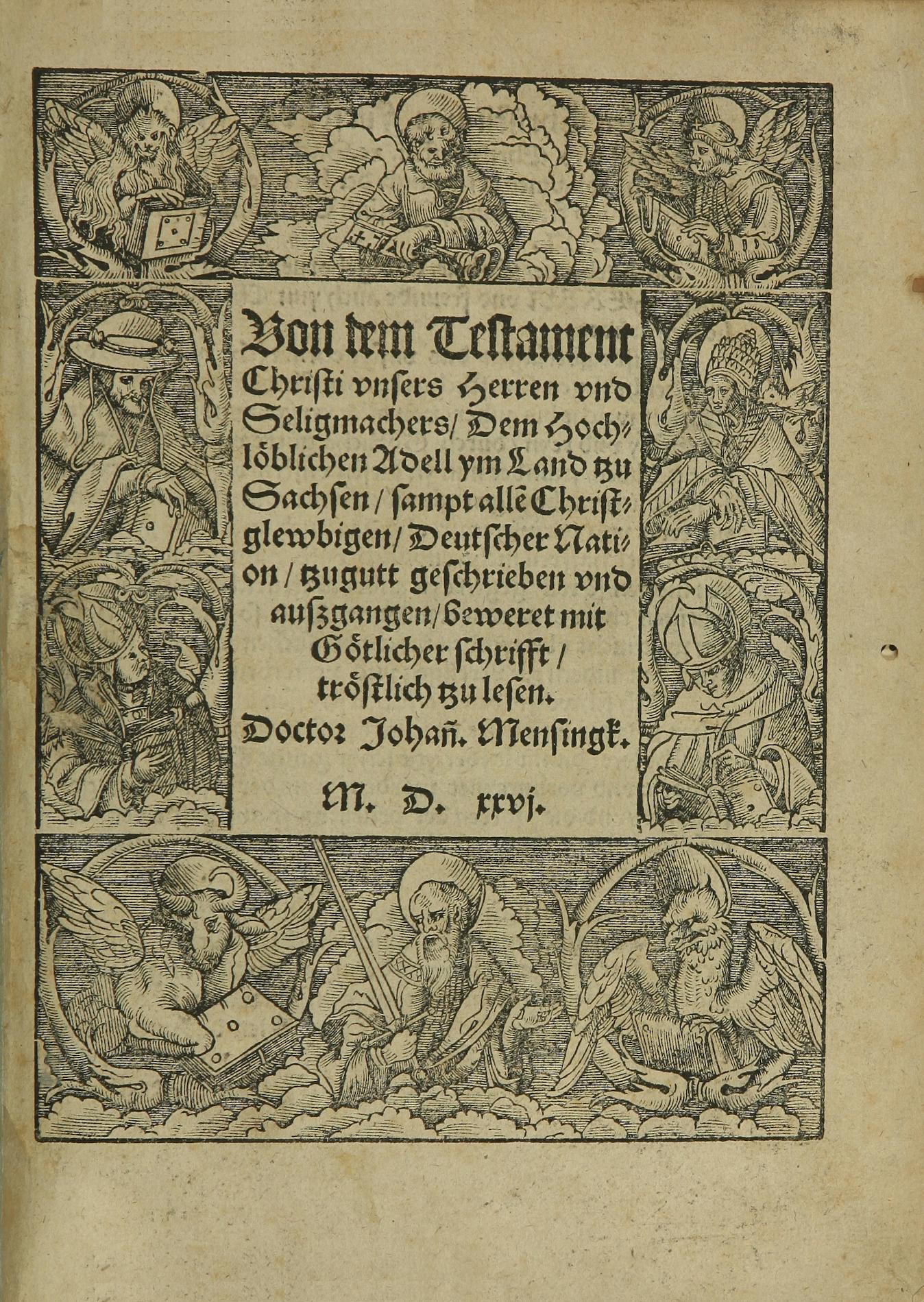
TextVon dem Testament Christi vnsers Herren vnd Seligmachers : Dem Hochlöblichen Adell ym landt zu Sachsen, sampt alle[n] Christglewbigen, Deutscher Nation, tzugutt geschriben vnd auszgangen, beweret mit Götlicher schrifft, tröstlich zu lesen
Mensing, Johannes, active 1495-1541Summary: J. Mensing was a Dominican opponent of Luther. Born in either Mageburg or Zutphen, Holland, he studied in Wittenberg and Frankfurt an der Oder, where he took his doctorate. He preached at Mageburg Cathedral 1522-1524 against the Reformers. In 1530, he was one of the Confutators of the Augsburg Confession. In 1534, he became provincial of the Dominicans, and in 1539, suffragan-bishop of Halberstedt. In this tract, Mensing defends Catholic interpretation of the Lord's Supper through references to scripture.Summary: J. Mensing was a Dominican opponent of Luther. Born in either Mageburg or Zutphen, Holland, he studied in Wittenberg and Frankfurt an der Oder, where he took his doctorate. He preached at Mageburg Cathedral 1522-1524 against the Reformers. In 1530, he was one of the Confutators of the Augsburg Confession. In 1534, he became provincial of the Dominicans, and in 1539, suffragan-bishop of Halberstedt. In this tract, Mensing defends Catholic interpretation of the Lord's Supper through references to scripture. -
 Text
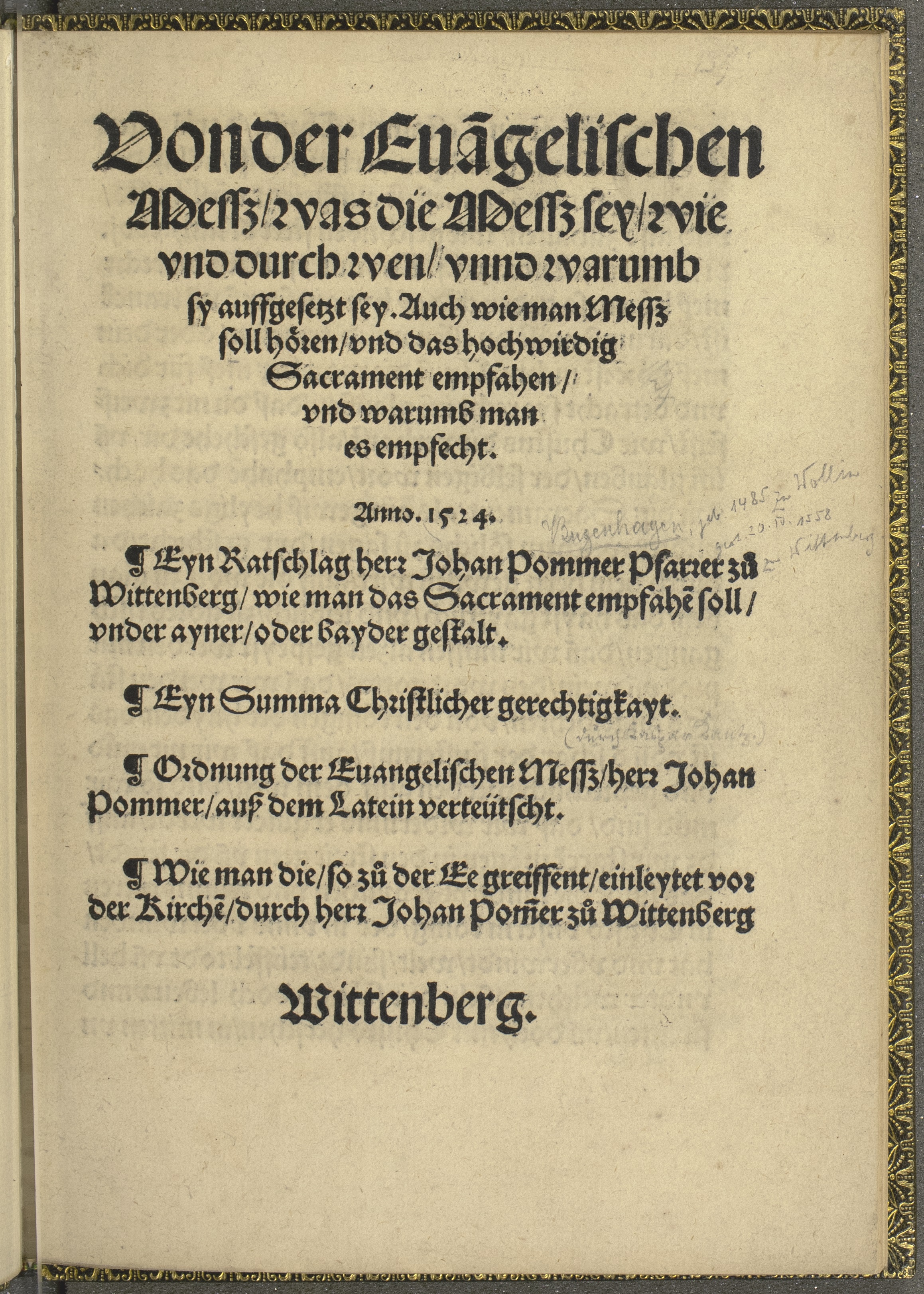
TextVon der Eua[n]gelischen Messz : was die Messz sey, wie vnd durch wen, vnnd warumb sy auffgesetzt sey. : Auch wie man Messz sol hören, vnd das hochwirdig sacrament empfahen, vnd warumb man es empfecht. Anno 1524
Bugenhagen, Johann, 1485-1558Summary: The term "Evangelical Mass" was coined by the Lutherans as their attempt to shop that it was they and not the Catholics who were the preservers of the true tradition of the Lord's Supper. Bugenhagen was, next to Melanchthon, Luther's closest ally in the Protestant struggle. This tract indicates which attributes the Lutherans believed to be necessary for worthy reception of the Lord's Supper.Summary: The term "Evangelical Mass" was coined by the Lutherans as their attempt to shop that it was they and not the Catholics who were the preservers of the true tradition of the Lord's Supper. Bugenhagen was, next to Melanchthon, Luther's closest ally in the Protestant struggle. This tract indicates which attributes the Lutherans believed to be necessary for worthy reception of the Lord's Supper.