Search
430 resources
430 items
Quarto
-
 Text
TextThe Passionate remonstrance made by his Holinesse in the conclave at Rome: upon the late proceedings, and great Covenant of Scotland, &c. : With a reply Of Cardinall De Barbarini in the name of the Roman clergy. Together with a letter of intelligence from the Apostolicke Nuntio (now residing in London) to Pope Vrban the 8
Summary: A satire.Summary: A satire. -
 Text
TextThe Prince of Orange his declaration: shewing the reasons why he invades England. : With a short preface, and some modest remarks on it.
William III, King of England, 1650-1702Summary: "The declaration of His Highnes William Henry, by the grace of God, Prince of Orange, &c. of the reasons inducing him, to appear in armes in the kingdome of England, for preserving of the Protestant religion, and for restoring the lawes and liberties of England, Scotland and Ireland": p. 4-14. "His Highnesses additional declaration": p. 16-17. "Animadversions upon the Declaration of His Highness the Prince of Orange": p. 19-32.Summary: "The declaration of His Highnes William Henry, by the grace of God, Prince of Orange, &c. of the reasons inducing him, to appear in armes in the kingdome of England, for preserving of the Protestant religion, and for restoring the lawes and liberties of England, Scotland and Ireland": p. 4-14. "His Highnesses additional declaration": p. 16-17. "Animadversions upon the Declaration of His Highness the Prince of Orange": p. 19-32. -
 Still image
The Ten Commandments and the Golden Calf
A woodcut depicting Moses receiving the Ten Commandments from God (upper right) as the the people of Israel worship the Golden Calf (lower left). On the right, Mount Sinai and Mount Horeb are labeled, as well as the figures of Moses and Joshua.A woodcut depicting Moses receiving the Ten Commandments from God (upper right) as the the people of Israel worship the Golden Calf (lower left). On the right, Mount Sinai and Mount Horeb are labeled, as well as the figures of Moses and Joshua. -
 Still image
The Whore of Babylon
The Whore of Babylon riding atop a seven-headed beast and holding a chalice aloft. She is depicted wearing the papal crown.The Whore of Babylon riding atop a seven-headed beast and holding a chalice aloft. She is depicted wearing the papal crown. -
 Still image
The crucifixion of Christ
A woodcut depicting the crucifixion of Jesus Christ, including a crowd of onlookers surrounding the Virgin Mary.A woodcut depicting the crucifixion of Jesus Christ, including a crowd of onlookers surrounding the Virgin Mary. -
 Text
TextThe duty of honouring the King and the obligations we have thereto : delivered in a sermon preached at Richmond in York-shire, on the 6th of February, 1685/6 being the day on which His Majesty began His happy reign : at a general assembly of the loyal gentry of those parts, held there on purpose to celebrate the King's quiet and peaceable succession to the throne of his ancestors
Wyvill, Christopher, 1651?-1711Summary: A sermon preached in honor of the king's succession and reign.Summary: A sermon preached in honor of the king's succession and reign. -
 Text
TextThe hind and the panther : a poem in three parts
Prior, Matthew, 1664-1721Summary: A burlesque of Dryden's poem, by Matthew Prior and Charles Montague afterwards earl of Halifax.Summary: A burlesque of Dryden's poem, by Matthew Prior and Charles Montague afterwards earl of Halifax. -
 Still image
Three Weddings
A woodcut depicting the wedding ceremonies of three clergy members with musicians (top) playing accompaniment.A woodcut depicting the wedding ceremonies of three clergy members with musicians (top) playing accompaniment. -
 Still image
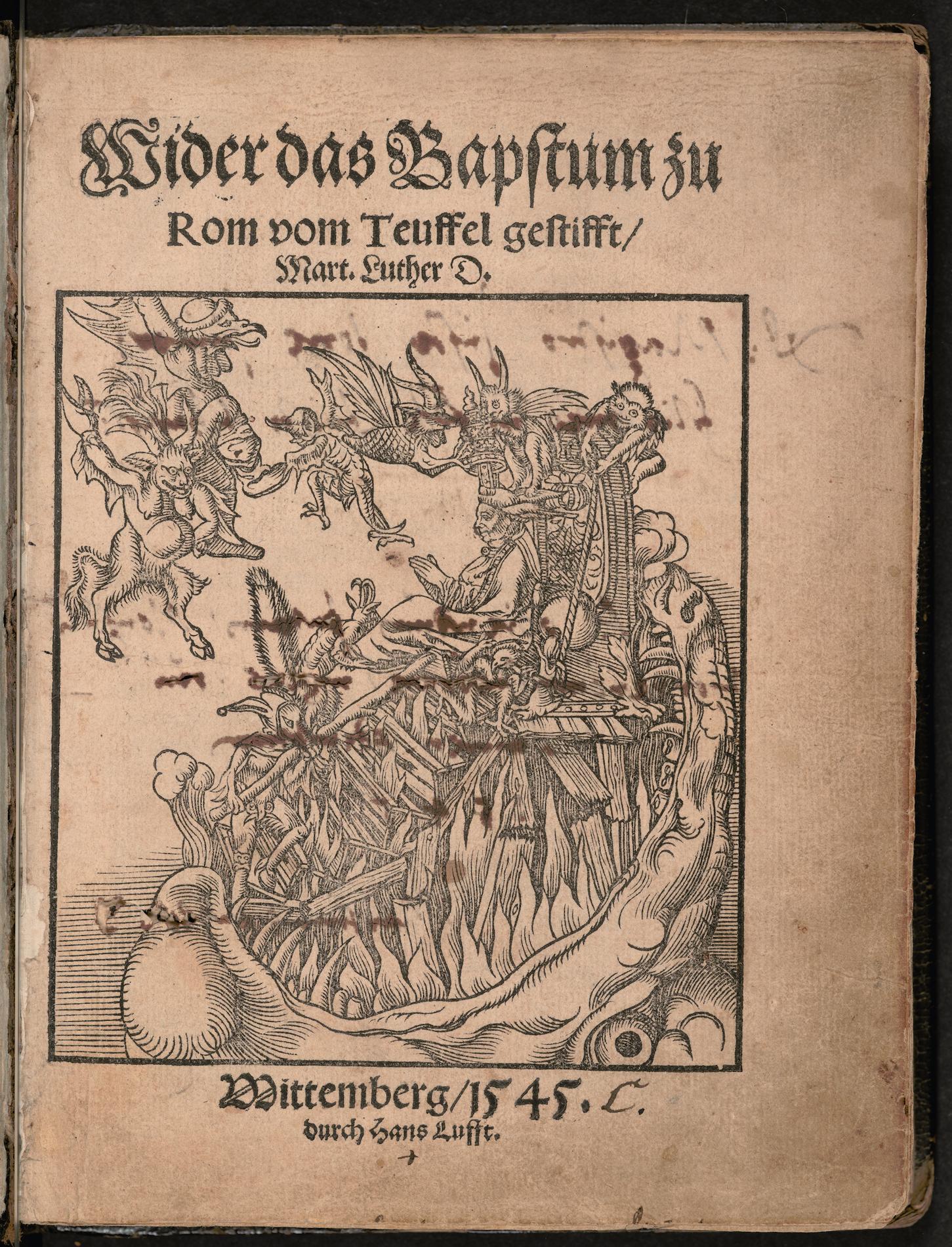
Title page of Wider das Bapstum zu Rom vom Teuffel gestifft
Satirical wood-engraving from the workshop of Lucas Cranach, depicting the pope, with ears of an ass, sitting on a wooden throne at the mouth of hell, on the title page.Satirical wood-engraving from the workshop of Lucas Cranach, depicting the pope, with ears of an ass, sitting on a wooden throne at the mouth of hell, on the title page. -
 Text
TextTo the Most Reverend Fathers in God, William Lord Archbishop of Canterbury, Primate of all England and metropolitan, and John Lord Archbishop of York, Primate of England and metropolitan.
James II, King of England, 1633-1701Summary: An address to the Archbishop of Canterbury by James II.Summary: An address to the Archbishop of Canterbury by James II. -
 Text
TextTractatus de sensu et auctoritate decretorum Constantiensis concilii : sessione quarta et quinta circa potestatem ecclesiasticam ...
Schelstrate, Emmanuel, 1645-1692Summary:Summary: -
 Text
TextUom Missbrauch der Messen
Luther, Martin, 1483-1546Summary: Written in Latin in the fall of 1521 under the title De abroganda missa privata, this is the third printing of the first German edition of Martin Luther's important tract on the celebration of private masses. Luther opposed any celebration of the Eucharist that was not accessible to or provided for the congregation at large and felt so strongly about this material that he translated it into German himself.Summary: Written in Latin in the fall of 1521 under the title De abroganda missa privata, this is the third printing of the first German edition of Martin Luther's important tract on the celebration of private masses. Luther opposed any celebration of the Eucharist that was not accessible to or provided for the congregation at large and felt so strongly about this material that he translated it into German himself. -
 Text
TextUom eelichen Leben
Luther, Martin, 1483-1546Summary: This sermon on marriage is an elaboration of an earlier work no longer extant. In its present form there is no set Bible text, nor is the sermon designed for a particular place in the Church year.Summary: This sermon on marriage is an elaboration of an earlier work no longer extant. In its present form there is no set Bible text, nor is the sermon designed for a particular place in the Church year. -
 Text
TextUom eelichen Leben
Luther, Martin, 1483-1546Summary: This sermon on marriage is an elaboration of an earlier work no longer extant. In its present form there is no set Bible text, nor is the sermon designed for a particular place in the Church year.Summary: This sermon on marriage is an elaboration of an earlier work no longer extant. In its present form there is no set Bible text, nor is the sermon designed for a particular place in the Church year. -
 Text
TextUom miszbrauch der Messen
Luther, Martin, 1483-1546Summary: Luther always felt a special fondness for this work. Nearly two decades after writing it, he remembered it as being especially powerful. It elicited response from Catholic opponents five years hence. Luther felt so strongly about this material that he translated it into German himself. The abuse of the title refers to the masses sung by chantry priests for individuals. Luther opposed any celebration of the Eucharist that was not accessible to or provided for the congregation at large.Summary: Luther always felt a special fondness for this work. Nearly two decades after writing it, he remembered it as being especially powerful. It elicited response from Catholic opponents five years hence. Luther felt so strongly about this material that he translated it into German himself. The abuse of the title refers to the masses sung by chantry priests for individuals. Luther opposed any celebration of the Eucharist that was not accessible to or provided for the congregation at large. -
 Text
TextUon Anbeten des Sacraments des heyligen leychnams Christi
Luther, Martin, 1483-1546Summary: Second printing of Luther's response to a catechism of the Bohemian Brethren, with special attention to the Adoration of the Host, and to the Real Presence.Summary: Second printing of Luther's response to a catechism of the Bohemian Brethren, with special attention to the Adoration of the Host, and to the Real Presence. -
 Text
TextUon Menschen leeren zu meyden
Luther, Martin, 1483-1546Summary: First published earlier the same year, Luther's pamphlet Defense of the doctrines of men was one of Luther's most widely read writings with approximately twenty editions appearing in the years 1522 and 1523. Written in honor of Hans von Belepsch who had hosted Luther at the Wartburg as the reformer translated the New Testament. Luther argues that church teachings that have no basis in the Bible, in particular fasting and celibacy, are illegitimate and are to be avoided.Summary: First published earlier the same year, Luther's pamphlet Defense of the doctrines of men was one of Luther's most widely read writings with approximately twenty editions appearing in the years 1522 and 1523. Written in honor of Hans von Belepsch who had hosted Luther at the Wartburg as the reformer translated the New Testament. Luther argues that church teachings that have no basis in the Bible, in particular fasting and celibacy, are illegitimate and are to be avoided. -
 Text
TextUon Menschenn Lere zu meyden
Luther, Martin, 1483-1546Summary: A treatise by Luther on the relationship of belief and practice, intended for those "poor consciences, that lie captive to human laws in cloisters and monastic foundations", as he puts it in his preface. It is also noteworthy that Luther assumes his audience includes both those who could read his writings directly, and those who heard them read by others, when he dedicates his pamphlet "to all who read or hear this little book".Summary: A treatise by Luther on the relationship of belief and practice, intended for those "poor consciences, that lie captive to human laws in cloisters and monastic foundations", as he puts it in his preface. It is also noteworthy that Luther assumes his audience includes both those who could read his writings directly, and those who heard them read by others, when he dedicates his pamphlet "to all who read or hear this little book". -
 Text
TextUon beyder gestalt des Sacraments zu nehmen vnd ander newerung
Luther, Martin, 1483-1546Summary: After Luther published his "Eight Sermons" of 1522, he decided that there was needed a shorter, more concise statement of these sermons' arguments. This is the third printing of the resulting précis.Summary: After Luther published his "Eight Sermons" of 1522, he decided that there was needed a shorter, more concise statement of these sermons' arguments. This is the third printing of the resulting précis. -
 Text
TextUon denn geystlichen vnd kloster gelubden
Luther, Martin, 1483-1546Summary: One of three 1522 printings of an essay on monastic vows written by Luther during his stay at the Wartburg Castle after the Diet of Worms. It is addressed to monks, whose conscience is troubled by the conflict between their vows and their desire to leave the monastic life. Luther frequently referred to this piece throughout his career, and it became one of his most influential works.Summary: One of three 1522 printings of an essay on monastic vows written by Luther during his stay at the Wartburg Castle after the Diet of Worms. It is addressed to monks, whose conscience is troubled by the conflict between their vows and their desire to leave the monastic life. Luther frequently referred to this piece throughout his career, and it became one of his most influential works. -
 Text
TextUon der beycht ob die der Bapst macht hab zugepieten
Luther, Martin, 1483-1546Summary: This is Luther's tract on auricular confession. The sacrament of penance was the focus of Luther's most vehement criticisms. Not only was the sacrament the course of numerous abuses, indulgence selling among them, but attacks on the efficacy of priestly absolution called into question the sacramental authority of all priests, the pope included.Summary: This is Luther's tract on auricular confession. The sacrament of penance was the focus of Luther's most vehement criticisms. Not only was the sacrament the course of numerous abuses, indulgence selling among them, but attacks on the efficacy of priestly absolution called into question the sacramental authority of all priests, the pope included.