Search
578 resources
578 items
Language
German
-
 Still image
Massacre dans la Ville de Tiran, par l'Evêque de Chur, pres l'an 1606
Luiken, Jan, 1649-1712An engraving depicting the massacre of Anabaptists under the orders of the Bishop of Chur. The image shows two men shooting a third with rifles while standing over two bodies (foreground), people being thrown from windows (background, center), and people being hanged (background left).An engraving depicting the massacre of Anabaptists under the orders of the Bishop of Chur. The image shows two men shooting a third with rifles while standing over two bodies (foreground), people being thrown from windows (background, center), and people being hanged (background left). -
 Still image
Massacre de Tilly à Magdebourg, l'an 1631
Luiken, Jan, 1649-1712An engraving depicting the Siege of Magdeburg during the Thirty Years' War. The image shows the invading forces murdering civilians and burning the city.An engraving depicting the Siege of Magdeburg during the Thirty Years' War. The image shows the invading forces murdering civilians and burning the city. -
 Still image
Matthieu Mair, noyé à Wier, A. 1592
Luiken, Jan, 1649-1712An engraving depicting the execution of Mattheus Mair. The image shows Mair, bound, being lowered into a river as a crowd watches.An engraving depicting the execution of Mattheus Mair. The image shows Mair, bound, being lowered into a river as a crowd watches. -
 Still image
Matthieu Servaas, decapité à Cologne, A. 1565
Luiken, Jan, 1649-1712An engraving depicting the execution of Matthias Servaes. The image shows Servaes being led towards the execution site with hands held in prayer (right) while a young man (left) and woman (right) who had wished to speak with him and were apprehended are ordered to be releasted by a nobleman (right, on horse).An engraving depicting the execution of Matthias Servaes. The image shows Servaes being led towards the execution site with hands held in prayer (right) while a young man (left) and woman (right) who had wished to speak with him and were apprehended are ordered to be releasted by a nobleman (right, on horse). -
 Still image
Mendicant Monks
A woodcut depicting a pair of mendicant monks standing beneath an archway as a pair of men sit at a table and wave them away.A woodcut depicting a pair of mendicant monks standing beneath an archway as a pair of men sit at a table and wave them away. -
 Still image
Mendicant Monks
A woodcut depicting a pair of mendicant monks standing beneath an archway as a pair of men sit at a table and wave them away.A woodcut depicting a pair of mendicant monks standing beneath an archway as a pair of men sit at a table and wave them away. -
 Still image
Mendicant Monks
A woodcut depicting a pair of mendicant monks standing beneath an archway as a pair of men sit at a table and wave them away.A woodcut depicting a pair of mendicant monks standing beneath an archway as a pair of men sit at a table and wave them away. -
 Still image
Mendicant Monks
A woodcut depicting a pair of mendicant monks standing beneath an archway as a pair of men sit at a table and wave them away.A woodcut depicting a pair of mendicant monks standing beneath an archway as a pair of men sit at a table and wave them away. -
 Still image
Miseres fait aux Ministres Protestans en Hongrie en l'an 1674
Luiken, Jan, 1649-1712An engraving depicting the torture and forced labor of Protestant priests in Hungary. The image shows the priests digging and hauling dirt in work parties under the watch of overseers.An engraving depicting the torture and forced labor of Protestant priests in Hungary. The image shows the priests digging and hauling dirt in work parties under the watch of overseers. -
 Text
TextNew deudsch Psalter
Summary: Luther's first major revision of his translation of the Hebrew book of Psalms. Luther and his translation committee worked diligently on the German Bible throughout Luther's life. Every word came under repeated scrutiny; the translators never felt completely satisfied. The Psalter was revised repeatedly, always with the aim of seeking clarity of expression. This is the first revision of the work. This copy is annotated, dated 5 February, 1541, by A. Blarer, a Swabian reformer who was deeply influenced by Luther.Summary: Luther's first major revision of his translation of the Hebrew book of Psalms. Luther and his translation committee worked diligently on the German Bible throughout Luther's life. Every word came under repeated scrutiny; the translators never felt completely satisfied. The Psalter was revised repeatedly, always with the aim of seeking clarity of expression. This is the first revision of the work. This copy is annotated, dated 5 February, 1541, by A. Blarer, a Swabian reformer who was deeply influenced by Luther. -
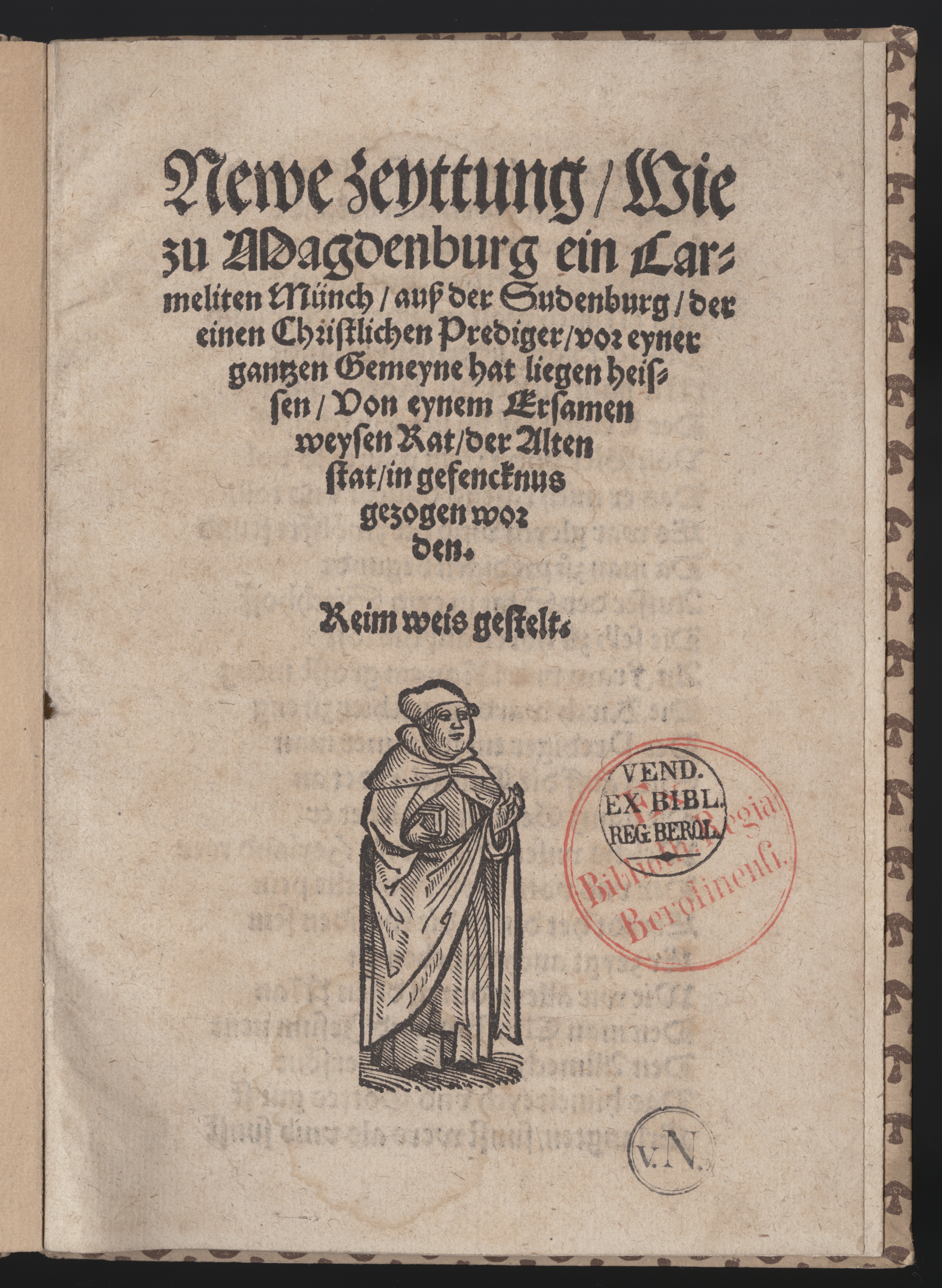 Text
TextNewe zeyttung, Wie zu Magdenburg ein Carmeliten Münch, auss der Sudenburg, der einen Christlichen Prediger, vor eyner gantzen Gemeyne hat liegen heissen, Von eynem Ersamen weysen Rat, der Alten stat, in gefencknus gezogen worden. : Reim weis gestelt.
Summary: Polemic ballad with a total of 142 rhymed lines, relating the story of a drunk Carmelite monk who attends a sermon preached outside the city by a righteous (Lutheran) pastor and who interrupts the preacher, accusing him of lying and misrepresenting Scripture. The people in response rise up and begin to beat him, almost killing him, but the monk is taken away and brought before the city council and the mayor who calls for calm and instructs that the monk should be locked up to await the executioner and thus be placed under God's justice rather than the mob's anger.Summary: Polemic ballad with a total of 142 rhymed lines, relating the story of a drunk Carmelite monk who attends a sermon preached outside the city by a righteous (Lutheran) pastor and who interrupts the preacher, accusing him of lying and misrepresenting Scripture. The people in response rise up and begin to beat him, almost killing him, but the monk is taken away and brought before the city council and the mayor who calls for calm and instructs that the monk should be locked up to await the executioner and thus be placed under God's justice rather than the mob's anger. -
 Text
TextOb man fur dem Sterben fliehen muge
Luther, Martin, 1483-1546Summary: The Black Death ravaged Europe from the fourteenth century onward. Dr. Johann Hess, a pastor from Breslau, asked Luther in 1527 whether it was permissible for a person to flee from plague-infested areas. Luther replied that it was, and then added some public health advice for town and city government officials in plague-ravaged areas. He advocated fumigation of this, the seventh printing of the work.Summary: The Black Death ravaged Europe from the fourteenth century onward. Dr. Johann Hess, a pastor from Breslau, asked Luther in 1527 whether it was permissible for a person to flee from plague-infested areas. Luther replied that it was, and then added some public health advice for town and city government officials in plague-ravaged areas. He advocated fumigation of this, the seventh printing of the work. -
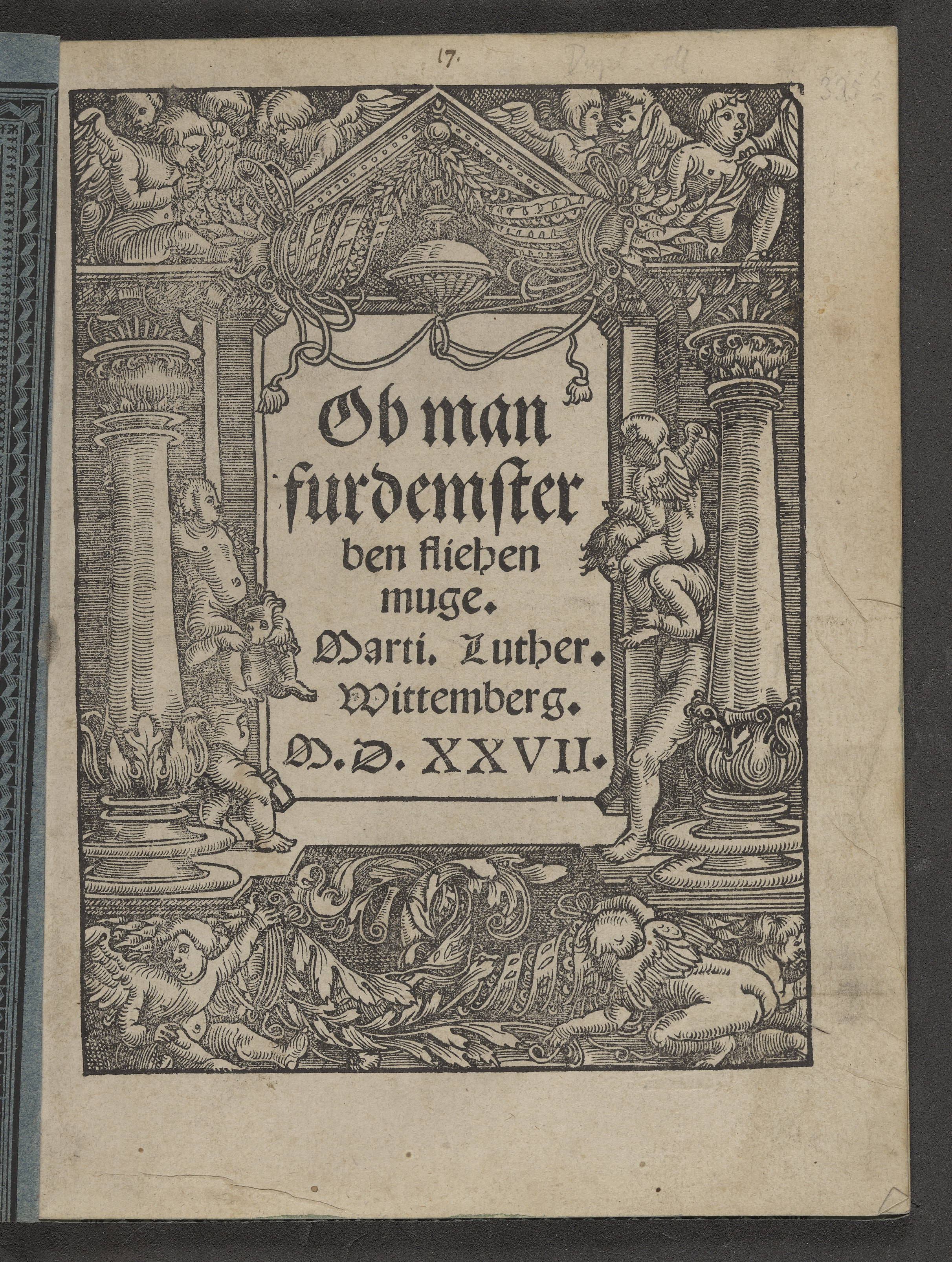 Text
TextOb man fur dem sterben fliehen muge
Luther, Martin, 1483-1546Summary: The Black Death ravaged Europe from the fourteenth century onward. Dr. Johann Hess, a pastor from Breslau, asked Luther in 1527 whether it was permissible for a person to flee from plague-infested areas. Luther replied that it was, and then added some public health advice for town and city government officials in plague-ravaged areas.Summary: The Black Death ravaged Europe from the fourteenth century onward. Dr. Johann Hess, a pastor from Breslau, asked Luther in 1527 whether it was permissible for a person to flee from plague-infested areas. Luther replied that it was, and then added some public health advice for town and city government officials in plague-ravaged areas. -
 Still image
Obadiah
An engraving depicting the prophet Obadiah standing barefoot as he glances left and up towards heaven. Behind him is a landscape featuring a cliffside with two groups of buildings.An engraving depicting the prophet Obadiah standing barefoot as he glances left and up towards heaven. Behind him is a landscape featuring a cliffside with two groups of buildings. -
 Still image
Obadiah Receives a Vision from an Angel
A woodcut depicting Obadiah receiving his vision from an angel. The text of the first verse of Obadiah is printed above.A woodcut depicting Obadiah receiving his vision from an angel. The text of the first verse of Obadiah is printed above. -
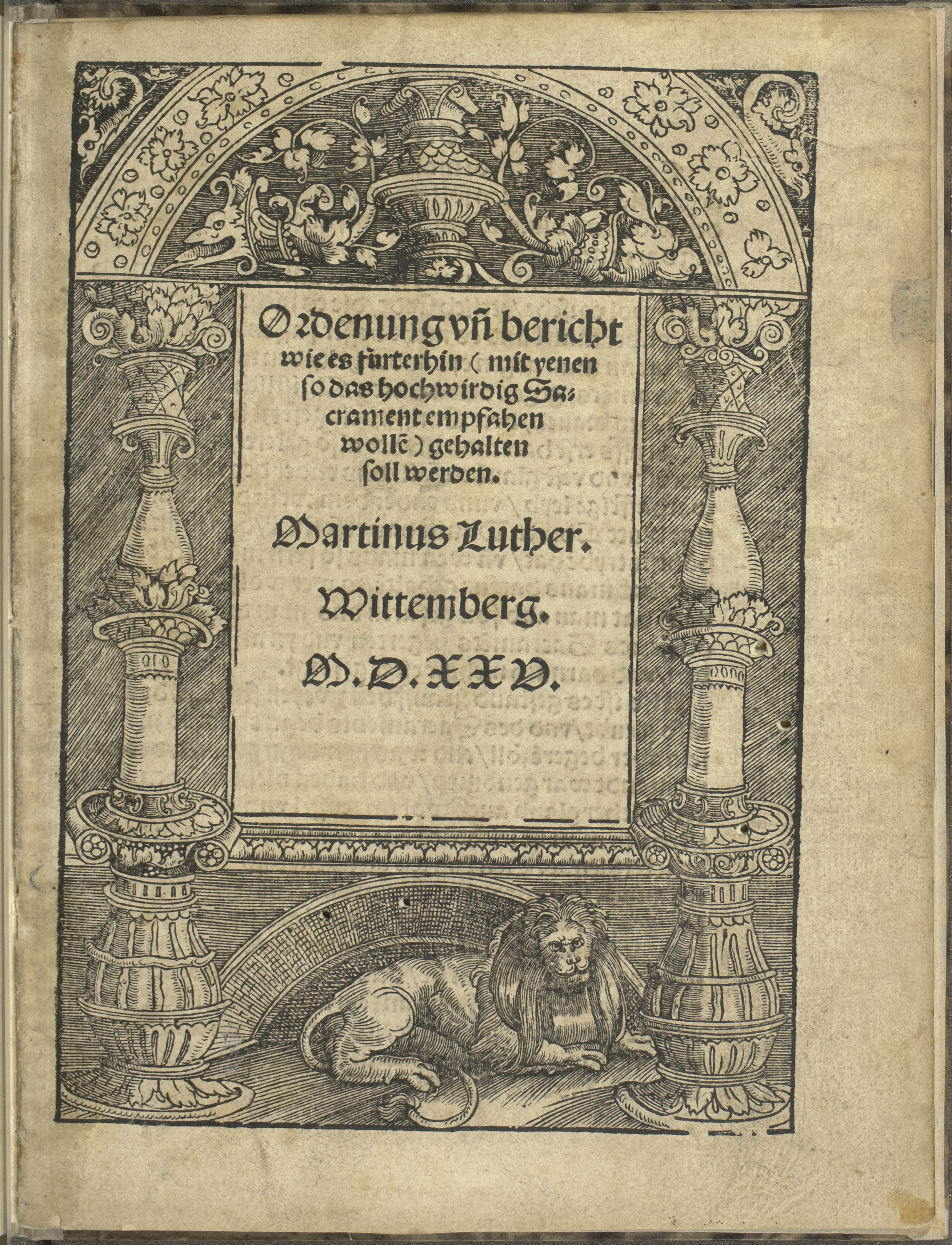 Text
TextOrdenung vn[d] bericht wie es furterhin (mit yenen so das hochwirdig Sacrament empfahen wolle[n]) gehalten soll werden
Luther, Martin, 1483-1546Summary: Early guidance by Luther on how a Christian ought to approach and receive the Lord's Supper. Includes the Words of Institution, the Aaronic Benediction, and a series of questions that ought to be put to everyone wishing to receive the Sacrament, with appropriate answers.Summary: Early guidance by Luther on how a Christian ought to approach and receive the Lord's Supper. Includes the Words of Institution, the Aaronic Benediction, and a series of questions that ought to be put to everyone wishing to receive the Sacrament, with appropriate answers. -
 Text
TextOrdnu[n]g wie man tauffet, bissher im Latein gehalten, verteütscht : Hierin ist, auss etlichen Ursachen, was die andern, als uberflüssig, veracht haben, nicht aussgelassen
Catholic ChurchSummary: Osiander provides a fuller translation of the traditional Catholic rite of baptism than Münzer or Luther, who had both published baptism liturgies one year earlier, and who had eliminated certain ritual elements.Summary: Osiander provides a fuller translation of the traditional Catholic rite of baptism than Münzer or Luther, who had both published baptism liturgies one year earlier, and who had eliminated certain ritual elements. -
 Still image
Orïgene, mis à la torture à Alexandrie, et ensuite envoyé en exil, environ l'An 254
Luiken, Jan, 1649-1712An engraving depicting the torture of Origen. The image shows Origen chained to a prison wall by his neck, his hands clasped in prayer and feet locked in a stocks, while torturers head coals and hold burning straw towards him.An engraving depicting the torture of Origen. The image shows Origen chained to a prison wall by his neck, his hands clasped in prayer and feet locked in a stocks, while torturers head coals and hold burning straw towards him. -
 Text
TextPassional Christi vnnd Antichristi
Luther, Martin, 1483-1546Summary: A polemic in the form of thirteen pairs of woodcuts (with captions) depicting scenes from the life of Christ contrasted with scenes from the life of the Pope. The text for the Latin edition was by P. Melanchthon and J. Schwertfeger, while that for the German edition was by M. Luther. The text consists of quotations from the Gospels and the canon law. This collaborative effort between Lukas Cranach and Luther is among the more famous pieces of popular propaganda provided during the reformation. Luther wrote the German texts to accompany Cranach's woodcuts.Summary: A polemic in the form of thirteen pairs of woodcuts (with captions) depicting scenes from the life of Christ contrasted with scenes from the life of the Pope. The text for the Latin edition was by P. Melanchthon and J. Schwertfeger, while that for the German edition was by M. Luther. The text consists of quotations from the Gospels and the canon law. This collaborative effort between Lukas Cranach and Luther is among the more famous pieces of popular propaganda provided during the reformation. Luther wrote the German texts to accompany Cranach's woodcuts. -
 Text
TextPassional Christi vnnd Antichristi, an annotated digital edition
Luther, Martin, 1483-1546The digital edition of the 1521 Erfurt printing of Passional Christi und Antichristi, held by the Richard C. Kessler Reformation Collection at Emory University. The digitized pamphlet has been overlayed with a searchable transcription of the printed text. In addition, annotations have been added that provide transcriptions and translations of all manuscript marginalia, as well as commentaries by subject matter experts.The digital edition of the 1521 Erfurt printing of Passional Christi und Antichristi, held by the Richard C. Kessler Reformation Collection at Emory University. The digitized pamphlet has been overlayed with a searchable transcription of the printed text. In addition, annotations have been added that provide transcriptions and translations of all manuscript marginalia, as well as commentaries by subject matter experts. -
 Text
TextPaulus Spricht zu den Colossern
Melanchthon, Philipp, 1497-1560An unpublished manuscript signed and dated (1551) by Philipp Melanchthon. Written on three sides of two sheets, it is a meditation on the Third Chapter of Paul's Letter to the Colossians. The two leaves on which the meditation is written (19 x 29 cm.) show signs of insect damage and have been repaired with Japanese paper. The verso of the title page holds the inscription "C. S. V. R. mit Galt" near the top with a less readable second line. Near the bottom is the inscription "1551 mit Galt". For their protection, both pieces were encapsulated in mylar.An unpublished manuscript signed and dated (1551) by Philipp Melanchthon. Written on three sides of two sheets, it is a meditation on the Third Chapter of Paul's Letter to the Colossians. The two leaves on which the meditation is written (19 x 29 cm.) show signs of insect damage and have been repaired with Japanese paper. The verso of the title page holds the inscription "C. S. V. R. mit Galt" near the top with a less readable second line. Near the bottom is the inscription "1551 mit Galt". For their protection, both pieces were encapsulated in mylar.