Search
178 resources
178 items
Subject
Catholic Church
-
 Text
TextContra Henricum regem Angliae
Luther, Martin, 1483-1546Summary: This is the second and much expanded edition of Luther's reply to Henry VIII's Assertion of the Seven Sacraments. Luther replies quite moderately (for him) to what he feels to be the King's unwarranted assertions on the Catholic Sacraments. This is the second printing of this edition.Summary: This is the second and much expanded edition of Luther's reply to Henry VIII's Assertion of the Seven Sacraments. Luther replies quite moderately (for him) to what he feels to be the King's unwarranted assertions on the Catholic Sacraments. This is the second printing of this edition. -
 Still image
Cupola di San Pietro fatta da Sesto et Libraria Vaticana
A pair of engravings depicting the dome atop St. Peter's Basilica and the Vatican Library, both of which were parts of Pope Sixtus V's urban reform program.A pair of engravings depicting the dome atop St. Peter's Basilica and the Vatican Library, both of which were parts of Pope Sixtus V's urban reform program. -
 Still image
Das Munchkalb zu Freyberg
A woodcut depicting the Monk-Calf of Freyberg, which was born with a tonsure-like irregularity on its head, resembling the common hairstyle of a Catholic monk.A woodcut depicting the Monk-Calf of Freyberg, which was born with a tonsure-like irregularity on its head, resembling the common hairstyle of a Catholic monk. -
 Text
TextDas Tauff Buchlin
Luther, Martin, 1483-1546Summary: Luther's German translation of the Wittenberg usage of the Catholic rite of Baptism (Ordo baptizandi). The work was reprinted fifteen times between 1523 and 1526, when Luther issued a revised edition.Summary: Luther's German translation of the Wittenberg usage of the Catholic rite of Baptism (Ordo baptizandi). The work was reprinted fifteen times between 1523 and 1526, when Luther issued a revised edition. -
 Text
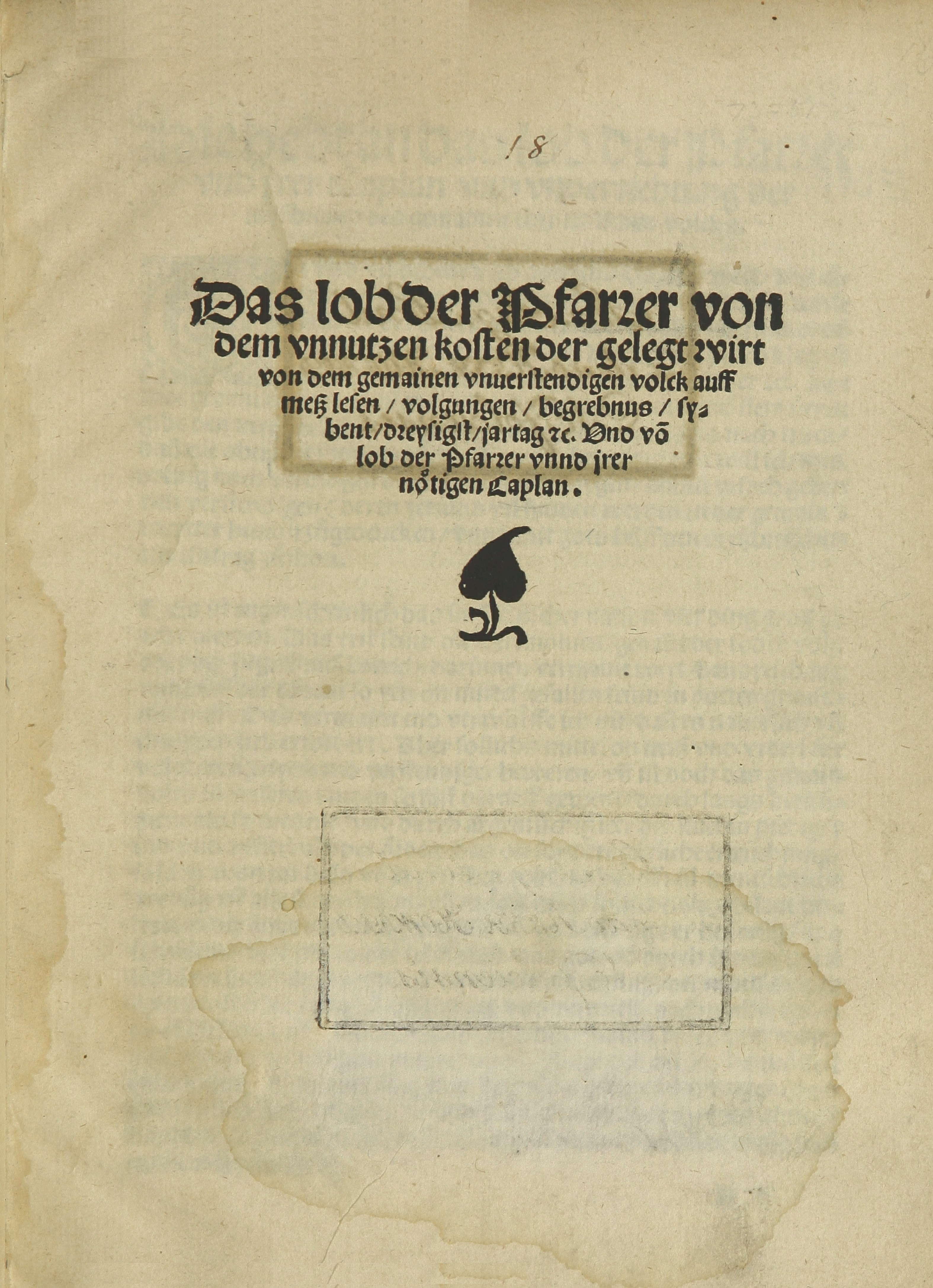
TextDas lob der Pfarrer von dem vnnutzen kosten der gelegt wirt von dem gemainen vnuerstendigen volck auff mess lesen, volgungen, begrebnus, sybent, dreysigst, jartag, rc. : Vnd vo[m] lob der Pfarrer vnnd irer nötigen Caplan.
Eberlin von Günzburg, Johann, approximately 1470-1533Summary: One of the problems that led to the Reformation was the sad state of ecclesiastical finance that forced many priests to change fees for the sacraments and other services. Von Gunzburg subjects such practices to sharp sanitization in the form of "praise of priests."Summary: One of the problems that led to the Reformation was the sad state of ecclesiastical finance that forced many priests to change fees for the sacraments and other services. Von Gunzburg subjects such practices to sharp sanitization in the form of "praise of priests." -
 Text
TextDe Petro et Roma adversus Velenu[m] Lutheranum, libri quatuor
Cochlaeus, Johannes, 1479-1552Summary: Oldrich Velensky, Latinized as Ulrich Velenus, was a Bohemian Protestant who opposed the papal claims to power based on St. Peter's residence and martyrdom in Rome. Cochlaeus upholds the traditional Catholic view that St. Peter was martyred in Rome in the reign of Nero in this volume against Velensky's criticism.Summary: Oldrich Velensky, Latinized as Ulrich Velenus, was a Bohemian Protestant who opposed the papal claims to power based on St. Peter's residence and martyrdom in Rome. Cochlaeus upholds the traditional Catholic view that St. Peter was martyred in Rome in the reign of Nero in this volume against Velensky's criticism. -

-
 Text
TextDe disputatione lipsicensi quantum ad Boemos obiter deflexa est Epistola
Emser, Hieronymus, 1478-1527Summary: This volume includes both Emser's letter on the Leipzig Disputation, and Luther's sharp reply. Luther and Emser became lifelong enemies, a situation only exacerbated by Emser's use of Luther's New Testament as a basis for his own German translation in which he attacks Luther and Lutheranism. The woodcut on the title page shows Emser's coat-of-arms with the prominent goat, which gave Luther the title of his work, "To the Goat in Leipzig." The manuscript note on the title page says the book was purchased in 1520.Summary: This volume includes both Emser's letter on the Leipzig Disputation, and Luther's sharp reply. Luther and Emser became lifelong enemies, a situation only exacerbated by Emser's use of Luther's New Testament as a basis for his own German translation in which he attacks Luther and Lutheranism. The woodcut on the title page shows Emser's coat-of-arms with the prominent goat, which gave Luther the title of his work, "To the Goat in Leipzig." The manuscript note on the title page says the book was purchased in 1520. -
 Still image
Der Bapstesel zu Rom
A woodcut depicting the "Papal Ass," a monster purported to have been pulled from the Tiber in Rome as a portent of the corruption of the Roman Catholic Church.A woodcut depicting the "Papal Ass," a monster purported to have been pulled from the Tiber in Rome as a portent of the corruption of the Roman Catholic Church. -
 Still image
Des Ehrwirdigen Herrn Doctoris Martini Lutheri, gottseligen, Triumph, und Verantwortung, wider die gottlosen Schmehschrifft, der newen Münch, der Jesuiter, welche sie vnter dem Titel, Anatomia Lutheri, ausgesprenget haben
Single sheet woodcut depicting Pope Leo X on a throne that is about to topple. Behind him are priests and monks and below them a group of Jesuits, who are trying to support the toppling throne. Leo's key, the symbol of the Petrine office is crumbling in the pope's hands. Facing Leo is Martin Luther holding an open Bible. Below him is a group of reformers led by Philipp Melanchthon, each holding a book (Bible). In the center below Leo is Friedrich Staphylus depicted as Judas Iscariot. Staphylus was a student of Philipp Melanchthon's, who rejoined the Catholic Church in 1553.Single sheet woodcut depicting Pope Leo X on a throne that is about to topple. Behind him are priests and monks and below them a group of Jesuits, who are trying to support the toppling throne. Leo's key, the symbol of the Petrine office is crumbling in the pope's hands. Facing Leo is Martin Luther holding an open Bible. Below him is a group of reformers led by Philipp Melanchthon, each holding a book (Bible). In the center below Leo is Friedrich Staphylus depicted as Judas Iscariot. Staphylus was a student of Philipp Melanchthon's, who rejoined the Catholic Church in 1553. -
 Text
TextDialogus ad Martinu[m] Lutherum : pro responsione ad impertinentem quanda[m] ipsius epistolam super posita[m] veluti collocutoris vice intermixtam
Dungersheim, Hieronymus, 1465-1540Summary: H. Dungersheim had exchanged several letters with Luther before he wrote this dialogue. It was his first formal controversialist tract, written in 1520, but not published until 1531. Luther burned a manuscript copy of this work when he burned the bull Exsurge Domine on December 10, 1520.Summary: H. Dungersheim had exchanged several letters with Luther before he wrote this dialogue. It was his first formal controversialist tract, written in 1520, but not published until 1531. Luther burned a manuscript copy of this work when he burned the bull Exsurge Domine on December 10, 1520. -
 Text
TextDoctor Johan. dietenberger. [sic] Widerlegung des Lutherischen büchlins, da er schreibt von menschen leren zü meiden rc.
Dietenberger, Johann, approximately 1475-1537Summary: Johannes Dietenberger was a preaching monk who later became the grand inquisitor in the dioceses of Mainz and Cologne. He is best known for his German translation of the Bible, published in 1534. This work is an answer to Luther's writings on human doctrines and traditions in the Church.Summary: Johannes Dietenberger was a preaching monk who later became the grand inquisitor in the dioceses of Mainz and Cologne. He is best known for his German translation of the Bible, published in 1534. This work is an answer to Luther's writings on human doctrines and traditions in the Church. -
 Text
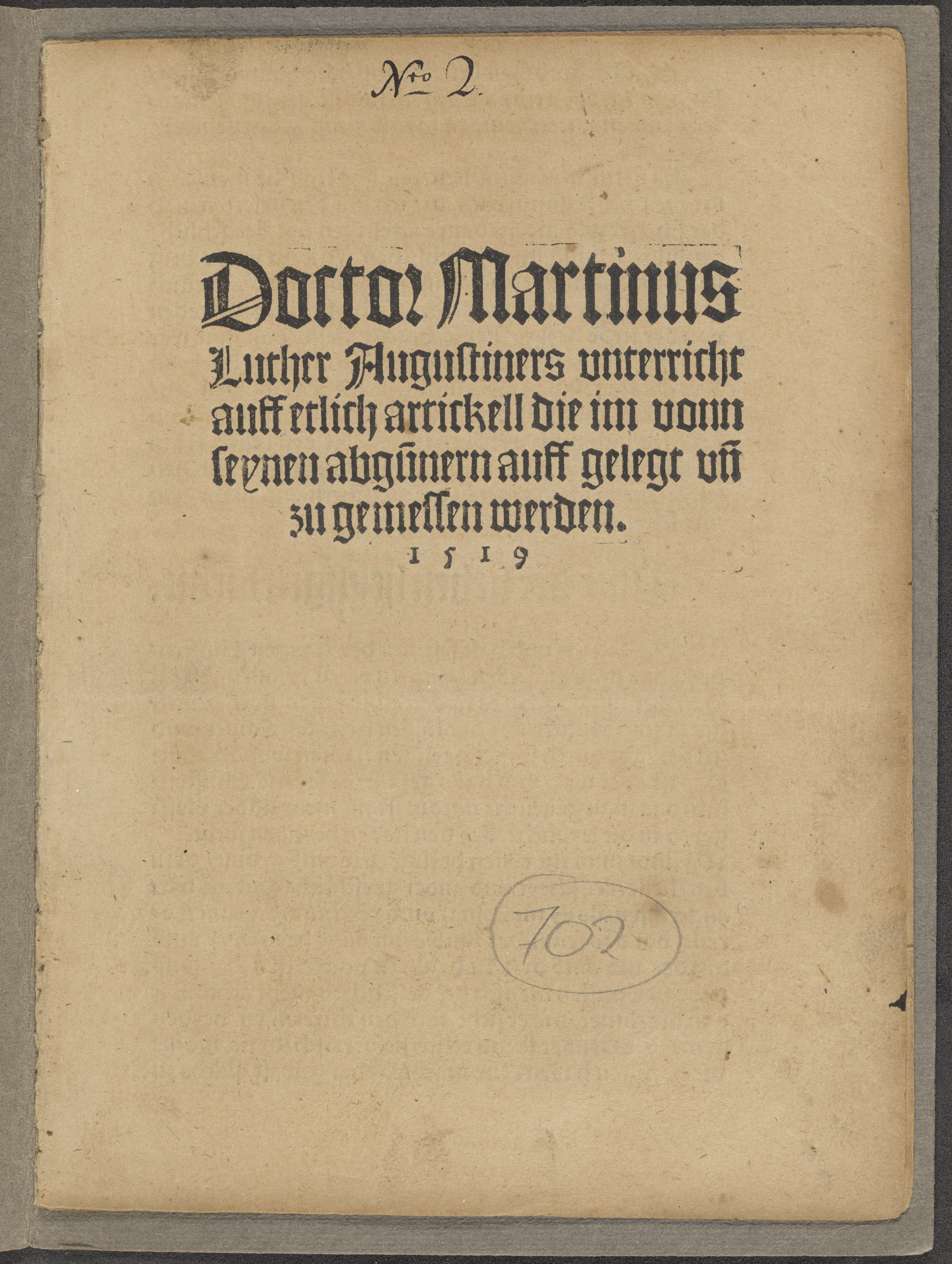
TextDoctor Martinus Luther Augustiners Vnterricht auff etlich Artickell die im vonn seynen Abgūrnern auff gelegt vn[d] zu gemessen werden
Luther, Martin, 1483-1546Summary: Luther was persuaded by Karl von Miltitz to write this public statement as a response to certain charges brought against him by his opponents, in particular Mazzolini da Prierio. In this tract, Luther still supports the invocation of the saints, an idea which he abandoned only shortly after.Summary: Luther was persuaded by Karl von Miltitz to write this public statement as a response to certain charges brought against him by his opponents, in particular Mazzolini da Prierio. In this tract, Luther still supports the invocation of the saints, an idea which he abandoned only shortly after. -
 Text
TextEin Christliche lere : zu gründtlichem vnd bestendigem vnderricht des rechten Glaubens vnd eines Gotseligen wandels
Johann VIII, Bishop of Meissen, 1492 or 1493-1549Summary: A Catholic catechism text.Summary: A Catholic catechism text. -
 Text
TextEine Schrifft, wie die Pfarherrn an den Örtern, da man die Papisterey widerumb auffricht, die Euangelisch Lehr, welche sie Lutherisch nennen, verloben vnd verschweren müssen
Summary: An anonymous pamphlet, containing an oath German pastors had to swear to renounce the "Evangelical doctrine, which is called Lutheran" in order to be readmitted to the Roman Catholic Church. The copy of the oath is preceded by two satirical poems regarding the oath, the first one representing the opinion of a wise man, the second one the answer of an unwise man. On the titlepage are two verses from Matthew 10 against the taking of oaths. The work is published by Christian Rödinger, a printer who put his press in service of the Reformation.Summary: An anonymous pamphlet, containing an oath German pastors had to swear to renounce the "Evangelical doctrine, which is called Lutheran" in order to be readmitted to the Roman Catholic Church. The copy of the oath is preceded by two satirical poems regarding the oath, the first one representing the opinion of a wise man, the second one the answer of an unwise man. On the titlepage are two verses from Matthew 10 against the taking of oaths. The work is published by Christian Rödinger, a printer who put his press in service of the Reformation. -
 Text
TextEnchiridion locorum communium aduersus Lutheranos
Eck, Johann, 1486-1543Summary: In 1521, Melanchthon wrote the first Protestant dogmatics, the "Loci Communes." Eck countered in 1525 with his "handbook on Theological Topics". Possibly the most widely reprinted Catholic critique of Lutheran doctrine (Metzler lists 91 contemporary editions). Eck uses the same topical procedure and cites the Bible, Church Fathers, Councils, and Popes heavily in the presentation of his arguments.Summary: In 1521, Melanchthon wrote the first Protestant dogmatics, the "Loci Communes." Eck countered in 1525 with his "handbook on Theological Topics". Possibly the most widely reprinted Catholic critique of Lutheran doctrine (Metzler lists 91 contemporary editions). Eck uses the same topical procedure and cites the Bible, Church Fathers, Councils, and Popes heavily in the presentation of his arguments. -
 Still image
Environ 80 Vaudois brulez à Strasbourg, A. 1215
Luiken, Jan, 1649-1712An engraving depicting the burning of eighty Waldensians in Strasbourg. The image shows a number of individuals already tied to stakes (right) while others are being prepared to be led to the pyres (left).An engraving depicting the burning of eighty Waldensians in Strasbourg. The image shows a number of individuals already tied to stakes (right) while others are being prepared to be led to the pyres (left). -
 Text
TextExcusatio eckij : ad ea que falso sibi Philippus Melanchton gra[m]maticus Vuittenbergen[sis] super theologica disputatione lipsica adscripsit.
Eck, Johann, 1486-1543Summary: The participants in the Leipzig Disputation promised not to print their positions before the faculties of Paris and Louvain had issued their verdicts in the case. Both sides broke their promise. Melanchthon apparently got into print first, for this is Eck's reply to Melanchthon. This is the second printing of the work.Summary: The participants in the Leipzig Disputation promised not to print their positions before the faculties of Paris and Louvain had issued their verdicts in the case. Both sides broke their promise. Melanchthon apparently got into print first, for this is Eck's reply to Melanchthon. This is the second printing of the work. -
 Text
TextEyn Widerruff vom Fegefeur
Luther, Martin, 1483-1546Summary: Refutation, by Luther, of the teaching of Purgatory.Summary: Refutation, by Luther, of the teaching of Purgatory. -
 Text
TextEyn Wyderrueff vom Fegfewr
Luther, Martin, 1483-1546Summary: One of several 1530 editions of a tract in which Luther rejects the Catholic doctrine of purgatory, a topic not addressed in the Augsburg Confessions.Summary: One of several 1530 editions of a tract in which Luther rejects the Catholic doctrine of purgatory, a topic not addressed in the Augsburg Confessions. -
 Still image
Fall and Restoration in the Catholic Church
Picart, Bernard, 1673-1733A set of six engravings depicting various examples of separation and reconciliation in the Catholic Church. The upper engravings show the degradation and restoration of a bishop. The middle engravings show the extinguishing of a candle, symbolizing excommunication, and the restoration of the excommunicated person to the church . The lower engravings show a heretic seeking reconciliation and being led to the altar by a bishop.A set of six engravings depicting various examples of separation and reconciliation in the Catholic Church. The upper engravings show the degradation and restoration of a bishop. The middle engravings show the extinguishing of a candle, symbolizing excommunication, and the restoration of the excommunicated person to the church . The lower engravings show a heretic seeking reconciliation and being led to the altar by a bishop.