Search
741 resources
741 items
Collection
Richard C. Kessler Reformation Collection
-
 Text
TextEnchiridion locorum communium aduersus Lutheranos
Eck, Johann, 1486-1543Summary: In 1521, Melanchthon wrote the first Protestant dogmatics, the "Loci Communes." Eck countered in 1525 with his "handbook on Theological Topics". Possibly the most widely reprinted Catholic critique of Lutheran doctrine (Metzler lists 91 contemporary editions). Eck uses the same topical procedure and cites the Bible, Church Fathers, Councils, and Popes heavily in the presentation of his arguments.Summary: In 1521, Melanchthon wrote the first Protestant dogmatics, the "Loci Communes." Eck countered in 1525 with his "handbook on Theological Topics". Possibly the most widely reprinted Catholic critique of Lutheran doctrine (Metzler lists 91 contemporary editions). Eck uses the same topical procedure and cites the Bible, Church Fathers, Councils, and Popes heavily in the presentation of his arguments. -
 Text
TextEncomiu[m] Rubij Longipolii apud Lipsim : in errores quos pueriliter co[m]misit adversus Vuittenbergen[ses] : Nemo potest quicquid toto gestatur in orbe rumpere liuores omnia Nemo potest
Montanus, Jacobus, active 1486-1534Summary: It is not certain who wrote this tract on the Leipzig Disputation but J. Montanus or J. Cellarius appear to be the most likely candidates. Montanus became the first Protestant preacher in Westphalia, while Cellarius or Kellner, became the first Protestant Superintendent of Dresden.Summary: It is not certain who wrote this tract on the Leipzig Disputation but J. Montanus or J. Cellarius appear to be the most likely candidates. Montanus became the first Protestant preacher in Westphalia, while Cellarius or Kellner, became the first Protestant Superintendent of Dresden. -
 Text
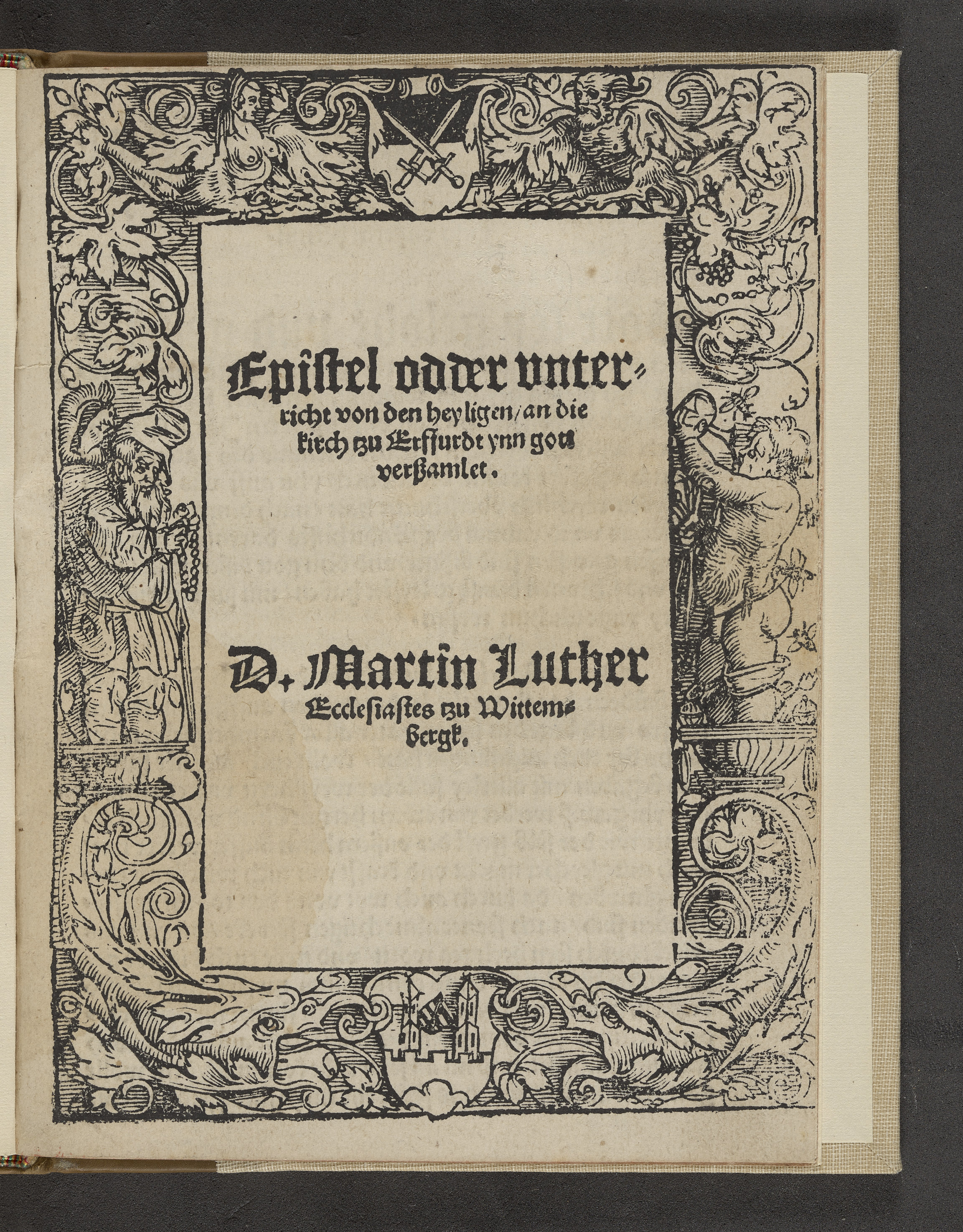
TextEpistel odder vnterricht von den heyligen : an die kirch zu Erfurdt ynn gott verszamelt
Luther, Martin, 1483-1546Summary: First printing of an open letter by Luther to the church of Erfurt on the subject of prayers to the saints.Summary: First printing of an open letter by Luther to the church of Erfurt on the subject of prayers to the saints. -
 Text
TextEpistola D. Martini Luther ad Georgium Spalatinum &c. de disputatione sua : Eiusdem super Tredecim Proposit[i]o[n]ibus Lipsi[a]e disputatis resolutiones
Luther, Martin, 1483-1546Summary: The Leipzig disputation was a debate between Martin Luther and Andreas Karlstadt on the one hand and Johann Eck on the other. While Karlstadt and Eck found some grounds for agreement on the question of free will, Luther and Eck disagreed vehemently over the question of the pope's authority to establish new articles of faith. This work publishes a letter Luther wrote to his friend Georg Spalatin, as well as 13 theses by Luther refuting Eck's position on the primacy of the pope and the authority of councils.Summary: The Leipzig disputation was a debate between Martin Luther and Andreas Karlstadt on the one hand and Johann Eck on the other. While Karlstadt and Eck found some grounds for agreement on the question of free will, Luther and Eck disagreed vehemently over the question of the pope's authority to establish new articles of faith. This work publishes a letter Luther wrote to his friend Georg Spalatin, as well as 13 theses by Luther refuting Eck's position on the primacy of the pope and the authority of councils. -
 Text
TextEpistola apologetica Matthiae Flacij Illyrici ad quendam Pastorem : Item Duo Somnia Philippi
Flacius Illyricus, Matthias, 1520-1575Summary: Open letter to an anonymous pastor justifying Matthias Flacius' opposition to the Leipzig interim, and Melanchthon's willingness to compromise with the Catholic Church on matters of liturgy.Summary: Open letter to an anonymous pastor justifying Matthias Flacius' opposition to the Leipzig interim, and Melanchthon's willingness to compromise with the Catholic Church on matters of liturgy. -
 Text
TextEpistola de Lipsica disputatione
Melanchthon, Philipp, 1497-1560Summary: A report on the Leipzig Disputation of 1519, ostensibly between Karlstadt and Johann Eck, but with the active participation of Luther both in preparation and in delivery. It was at this formal disputation that Eck was successful in pushing Luther to admit that not only popes, but councils, as well, had erred. This was an important point in Eck's favor, since Luther had, up to this point, appealed from the authority of the Pope to that of an ecumenical council.Summary: A report on the Leipzig Disputation of 1519, ostensibly between Karlstadt and Johann Eck, but with the active participation of Luther both in preparation and in delivery. It was at this formal disputation that Eck was successful in pushing Luther to admit that not only popes, but councils, as well, had erred. This was an important point in Eck's favor, since Luther had, up to this point, appealed from the authority of the Pope to that of an ecumenical council. -
 Text
TextEpistolae duae
Haner, Johannes, active 1524-1544Summary: This pamphlet contains two letters on Lutheranism by converts to Catholicism. Witzel's publication of Haner's letter led to the latter's expulsion from the city of Nuremberg.Summary: This pamphlet contains two letters on Lutheranism by converts to Catholicism. Witzel's publication of Haner's letter led to the latter's expulsion from the city of Nuremberg. -
 Text
TextEpitome colloquij inter illustrissimorum Principum D. Friderici Palantini Electoris, & D. Christophori Ducis Wirtengergensis theologos, de maiestate hominis Christi, de[ni]q[ue] vera eius in eucharistia praesentia, Maulbrunnae instituti
Colloquy of Maulbronn (1564)Summary: Summary of the transactions of teh Colloquy of Maulbronn, a council involving theologians from Lutheran Würtemberg and the Reformed (Zwinglian) Palatinate. The main point of debate was the presence of Christ in the Eucharist.Summary: Summary of the transactions of teh Colloquy of Maulbronn, a council involving theologians from Lutheran Würtemberg and the Reformed (Zwinglian) Palatinate. The main point of debate was the presence of Christ in the Eucharist. -
 Text
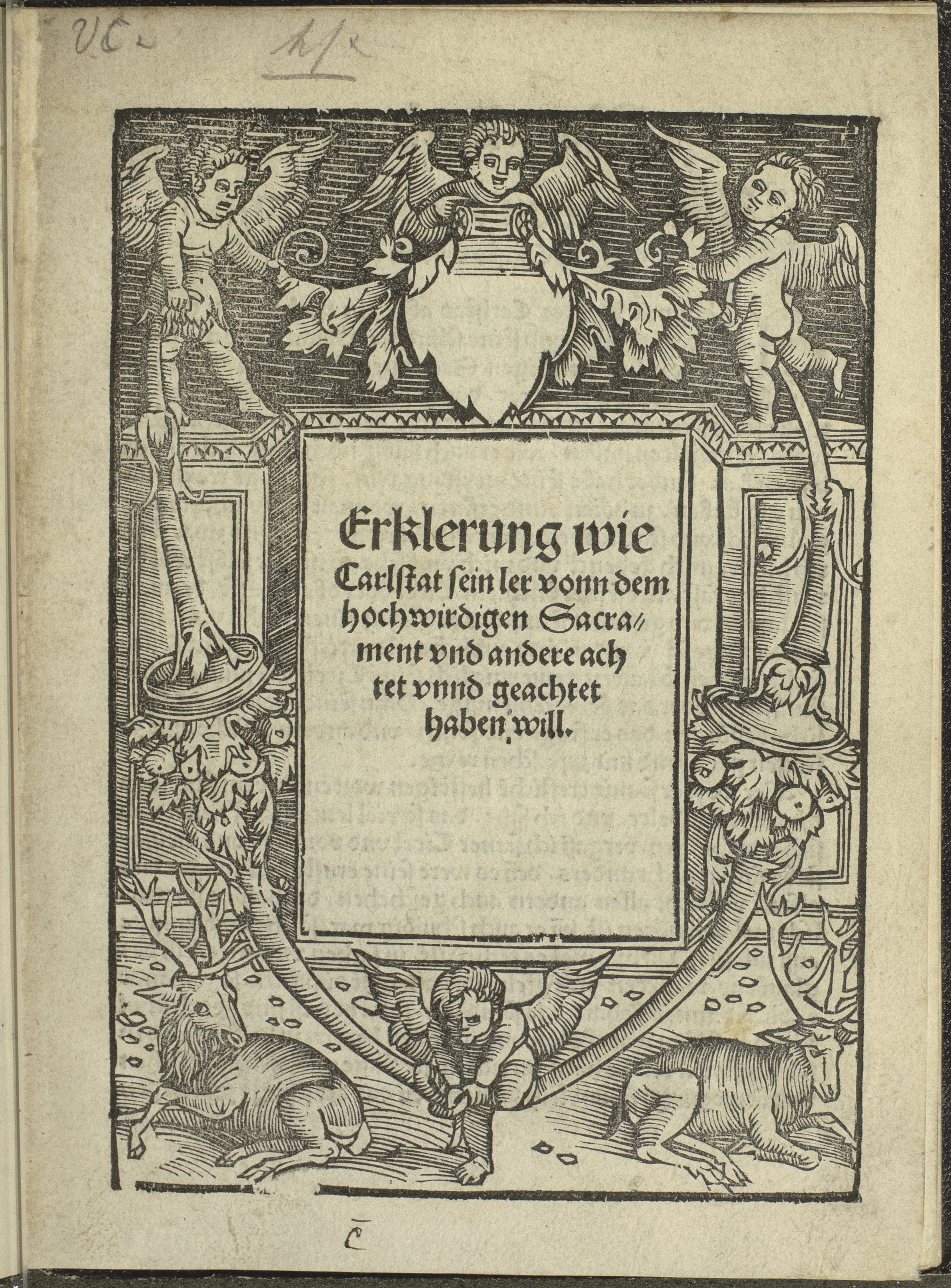
TextErklerung wie Carlstat sein ler vonn dem hochwirdigen Sacrament : vnd andere achtet vnnd geachtet haben will
Karlstadt, Andreas Rudolff-Bodenstein von, 1486-1541Summary: After Karlstadt had been driven out of Saxony, he sought refuge in South Germany. When this proved impossible, he returned to Wittenberg. Karlstadt publish a retraction of his former opinions and then publish nothing else without prior approval. This is the retraction with Luther's preface. Needless to say, Karlstadt did not find these conditions at all acceptable and he was soon on the move again. He came to settle in Switzerland, first in Zurich and finally in Basel, where he died on Christmas Eve, 1541.Summary: After Karlstadt had been driven out of Saxony, he sought refuge in South Germany. When this proved impossible, he returned to Wittenberg. Karlstadt publish a retraction of his former opinions and then publish nothing else without prior approval. This is the retraction with Luther's preface. Needless to say, Karlstadt did not find these conditions at all acceptable and he was soon on the move again. He came to settle in Switzerland, first in Zurich and finally in Basel, where he died on Christmas Eve, 1541. -
 Text
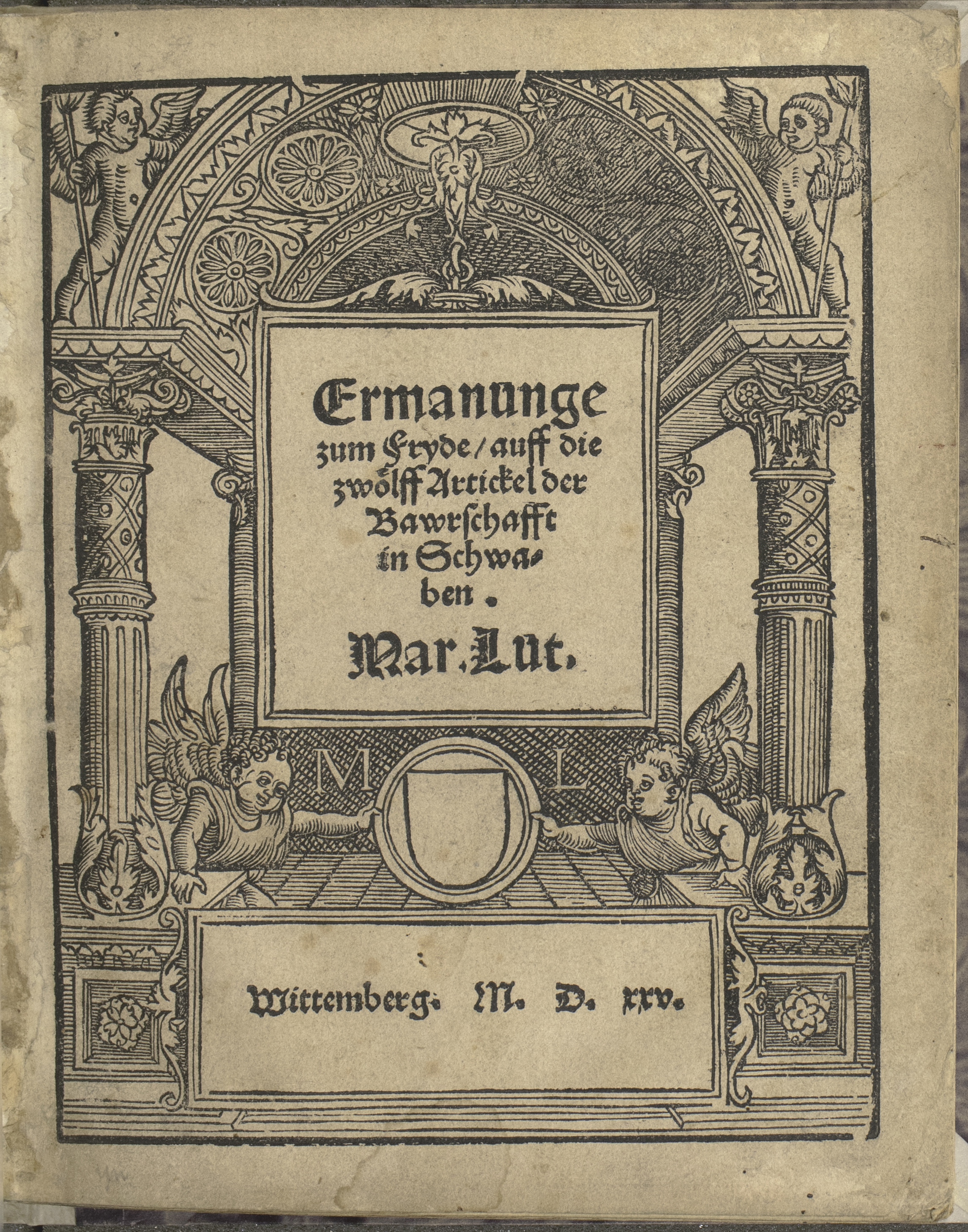
TextErmanunge zum Fryde auff die zwölff Artickel der Bawrshafft in Schwaben
Luther, Martin, 1483-1546Summary: Martin Luther's response to the Twelve Arcticles, a list of demands issued by the leaders of the peasant's revolt to the Swabian League and often seen as the first list of human rights in Europe.Summary: Martin Luther's response to the Twelve Arcticles, a list of demands issued by the leaders of the peasant's revolt to the Swabian League and often seen as the first list of human rights in Europe. -
 Text
TextErmanunge zum fride auff die zwelff artickel der Bawerschafft yn Schwaben
Luther, Martin, 1483-1546Summary: When Luther wrote this reply to the Swabian peasant' "Twelve Articles and Institution of the Peasants, he was still in hopes that reason might prevail and that bloodshed might be avoided.Summary: When Luther wrote this reply to the Swabian peasant' "Twelve Articles and Institution of the Peasants, he was still in hopes that reason might prevail and that bloodshed might be avoided. -
 Text
TextErotemata dialectices : continentia ferè integram artem : ita scripta, ut iuuentuti utiliter proponi possint
Melanchthon, Philipp, 1497-1560Summary: First printing of Melanchthon's third and final textbook of dialectic.Summary: First printing of Melanchthon's third and final textbook of dialectic. -
 Text
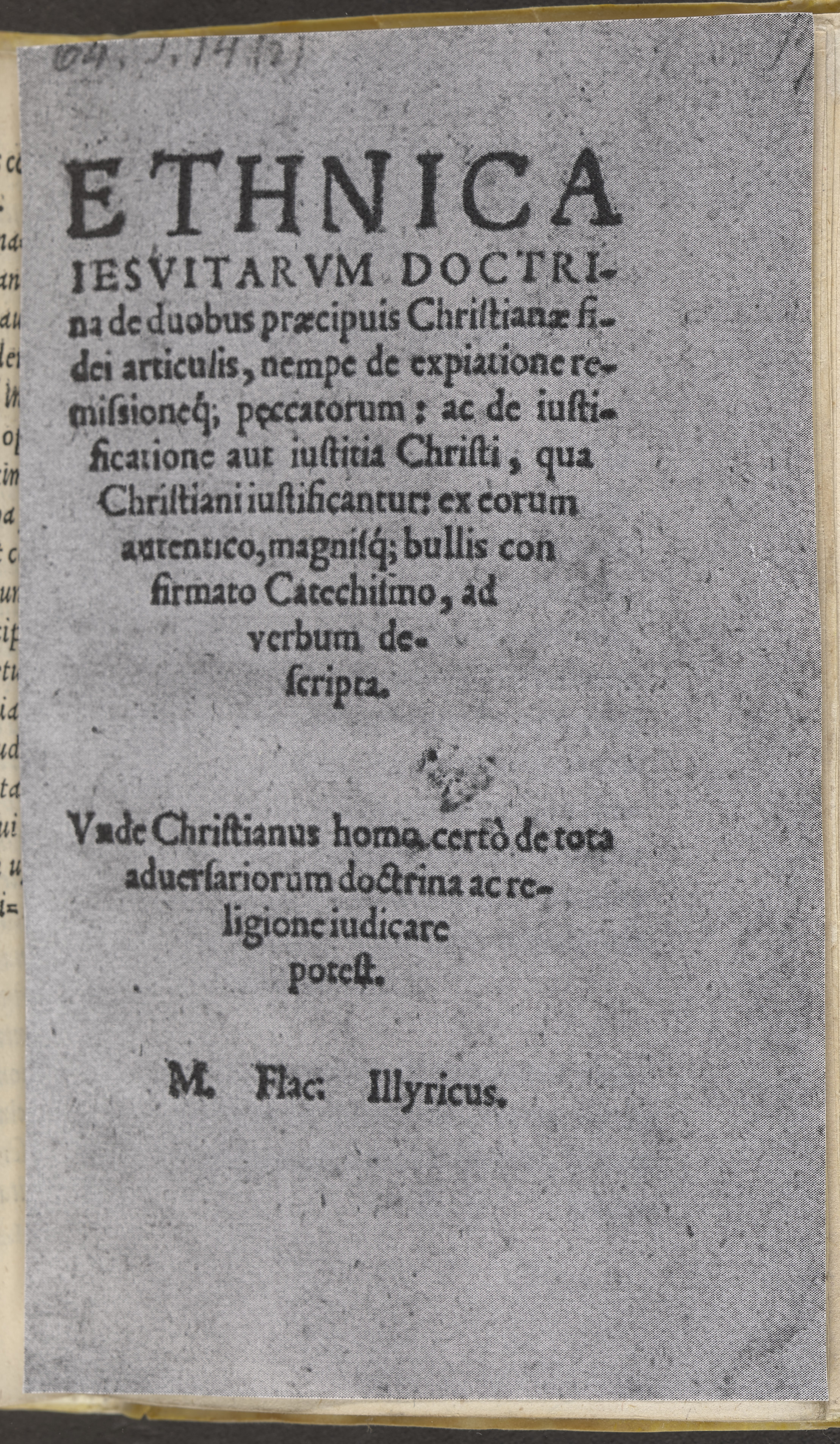
TextEthnica Iesvitarum doctrina de duobus praecipuis Christianae fidei articulis, : nempe de expiatione remissioneq[ue] peccatorum: ac de iustificatione aut iustitia Christi, qua Christiani iustificantur: ex eorum autentico, magnisq[ue] bullis confirmato Catechismo, ad verbum descripta ...
Flacius Illyricus, Matthias, 1520-1575Summary: Peter Canisius was a Dutch Jesuit working to restore the Catholic church in Germany during the Reformation. Matthias Flacius criticized Canisius's catechism, first published in 1555. In this tract, he specifically attacks the Jesuit's views on the expiation of sin and the justification in Christ.Summary: Peter Canisius was a Dutch Jesuit working to restore the Catholic church in Germany during the Reformation. Matthias Flacius criticized Canisius's catechism, first published in 1555. In this tract, he specifically attacks the Jesuit's views on the expiation of sin and the justification in Christ. -
 Text
TextException of Royal Powers in the Church from Infringement
Spain. Sovereign (1556-1598: Philip II)A contemporary official text, in Spanish, of the famous royal cedula by which the reluctant King Philip II at last promulgated the Catholic Church's reply to the Protestant revolt from the church. This ratifies for the Spanish dominions, the profound reforms of the great Council meeting at Trent from 1545 to 1552 and finally in 1562-1563.A contemporary official text, in Spanish, of the famous royal cedula by which the reluctant King Philip II at last promulgated the Catholic Church's reply to the Protestant revolt from the church. This ratifies for the Spanish dominions, the profound reforms of the great Council meeting at Trent from 1545 to 1552 and finally in 1562-1563. -
 Text
TextExcusatio eckij : ad ea que falso sibi Philippus Melanchton gra[m]maticus Vuittenbergen[sis] super theologica disputatione lipsica adscripsit.
Eck, Johann, 1486-1543Summary: The participants in the Leipzig Disputation promised not to print their positions before the faculties of Paris and Louvain had issued their verdicts in the case. Both sides broke their promise. Melanchthon apparently got into print first, for this is Eck's reply to Melanchthon. This is the second printing of the work.Summary: The participants in the Leipzig Disputation promised not to print their positions before the faculties of Paris and Louvain had issued their verdicts in the case. Both sides broke their promise. Melanchthon apparently got into print first, for this is Eck's reply to Melanchthon. This is the second printing of the work. -
 Text
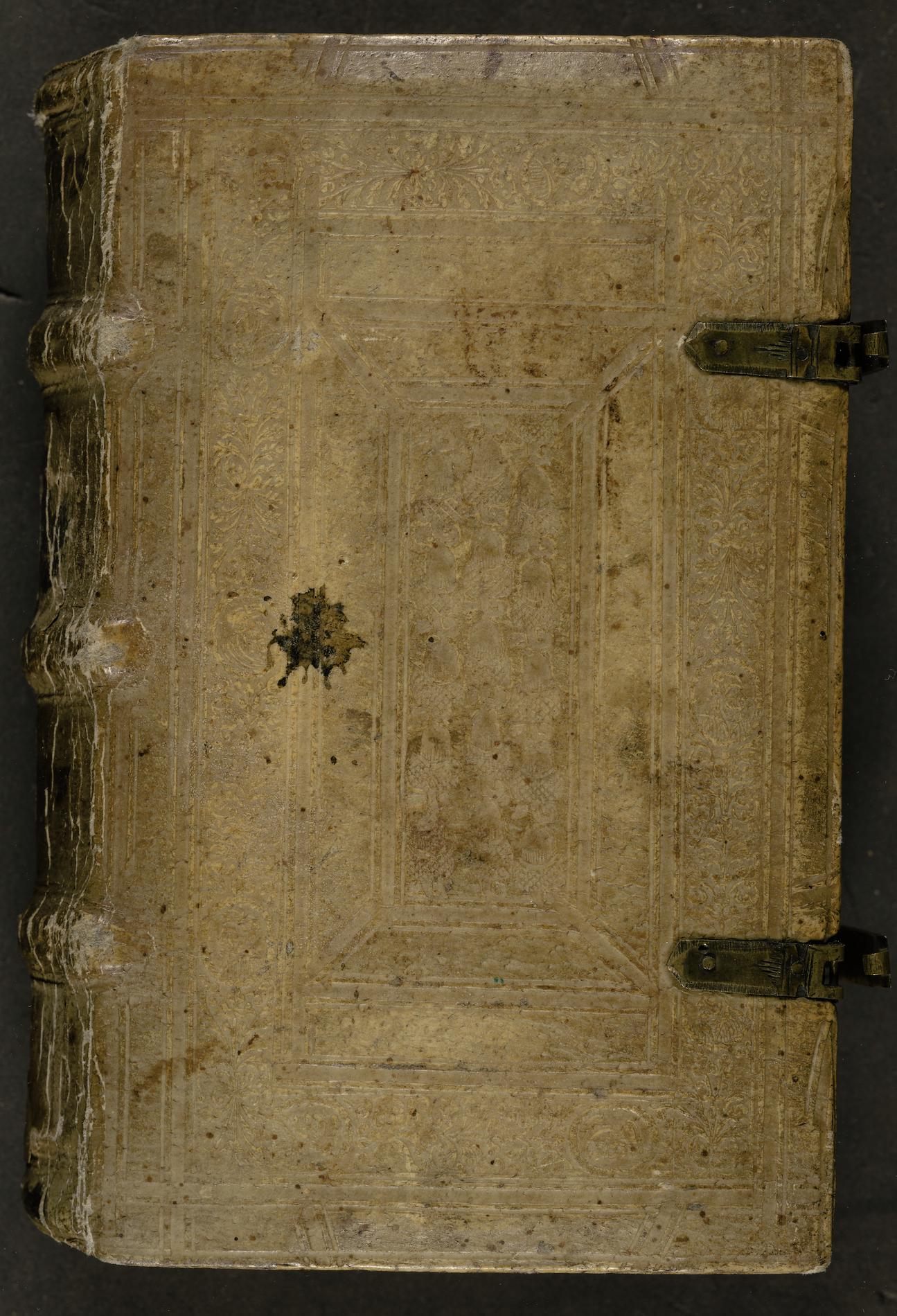
TextExplicatio Epistolae D. Pauli ad Galatos
Brenz, Johannes, 1499-1570Summary: Johannes Brenz's commentary on Galatians, first published in 1546/47 and reprinted numerous times.Summary: Johannes Brenz's commentary on Galatians, first published in 1546/47 and reprinted numerous times. -
 Still image
Expulsion from the Garden of Eden
Holbein, Hans, 1497-1543A woodcut depicting Adam and Eve being driven from the garden of Eden by an angel. The woodcut is accompanied by a verse from Genesis 3 translated into French (top) and then reformatted into verse (bottom).A woodcut depicting Adam and Eve being driven from the garden of Eden by an angel. The woodcut is accompanied by a verse from Genesis 3 translated into French (top) and then reformatted into verse (bottom). -
 Text
TextEyn Brieff an die Fürsten zu Sachsen von dem auffrurischen Geyst
Luther, Martin, 1483-1546Summary: Fourth printing of an open letter by Martin Luther to the princes of Saxony, in which he calls on them to monitor the actions of Thomas Müntzer in order to prevent the outbreak of violence. When war did break out the following year, Luther was one of the harshest critics of the rebelling peasants.Summary: Fourth printing of an open letter by Martin Luther to the princes of Saxony, in which he calls on them to monitor the actions of Thomas Müntzer in order to prevent the outbreak of violence. When war did break out the following year, Luther was one of the harshest critics of the rebelling peasants. -
 Text
TextEyn Gesprech vo[n] de[n] Scheinwercke[n] der Gaistlichen, und yhren gelubde[n] : damit sie zuverlesterung des bluts Christi vermaynen selig zu werden
Sachs, Hans, 1494-1576Summary: One of nine 1524 printings of this short anti-monastic tract by the Nuremberg cobbler and playright Hans Sachs.Summary: One of nine 1524 printings of this short anti-monastic tract by the Nuremberg cobbler and playright Hans Sachs. -
 Text
TextEyn Gesprech vo[n] den Scheinwercke[n] der Gaystlichen, vnd jren gelübdten : damit sy zuouerlesterung des bluots Christi vermaynen selig zuowerden
Sachs, Hans, 1494-1576Summary: One of nine 1524 printings of this short anti-monastic tract by the Nuremberg cobbler and playright Hans Sachs.Summary: One of nine 1524 printings of this short anti-monastic tract by the Nuremberg cobbler and playright Hans Sachs. -
 Text
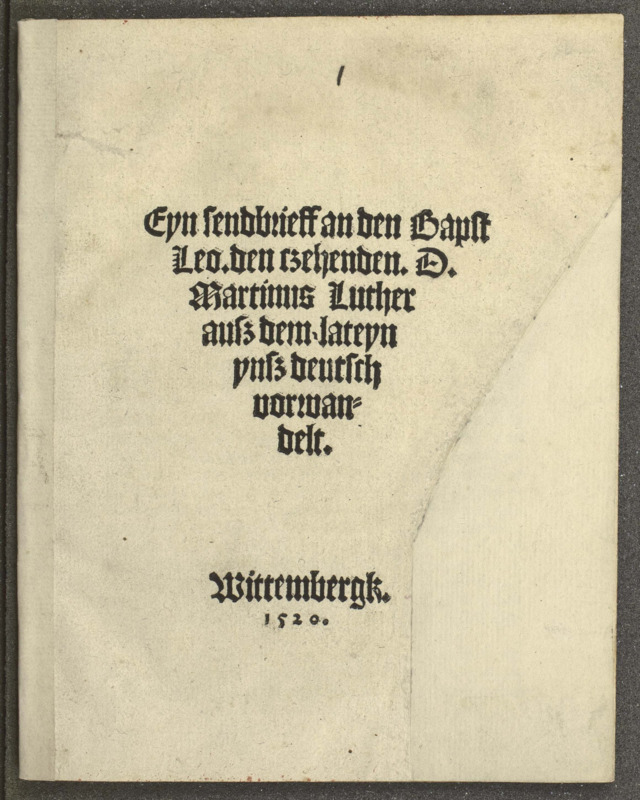
TextEyn Sendbrieff an den Bapst Leo den Czehenden
Luther, Martin, 1483-1546Summary: A letter by Luther to Pope Leo X. Leo had issued his famous bull 'Exsurge Domine' on June 15 1520, demanding that Luther recant his teachings of face excommunication. Luther responded with this letter in September, seeking to explain his position, calling for the church to reform, while emphasizing that his critiques have been directed against abuses within the church, not against the person or office of the pope.Summary: A letter by Luther to Pope Leo X. Leo had issued his famous bull 'Exsurge Domine' on June 15 1520, demanding that Luther recant his teachings of face excommunication. Luther responded with this letter in September, seeking to explain his position, calling for the church to reform, while emphasizing that his critiques have been directed against abuses within the church, not against the person or office of the pope.