Search
55 resources
55 items
Spatial coverage
Germany
-
 Text
TextAcht sermon
Luther, Martin, 1483-1546Summary: Second printing of the eight sermons Luther preached on his return from Wartburg Castle, March 9-16, 1522. They dealt with the mass, the Lord's Supper, images, fating, auricular confession, and other topics. These sermons allowed Luther to restore order in Wittenberg and put and end to the Tumults that had griped the city during his absence.Summary: Second printing of the eight sermons Luther preached on his return from Wartburg Castle, March 9-16, 1522. They dealt with the mass, the Lord's Supper, images, fating, auricular confession, and other topics. These sermons allowed Luther to restore order in Wittenberg and put and end to the Tumults that had griped the city during his absence. -
 Text
TextAd criminatricem Martini Luders Uitte[n]bergen[sis] offensione[m] super iudicio iustissimo facto : ad articulos quosdam per minoritas de obserua[n]tia Reuere[n]dissimo Episcopo Brandenburgen[si] oblatos Eckiana responsio; Quia hactenus abusus est Mar. Luderus modestia Eckiana : tande[m] extorsit, vt mordaci, mordaciter quo[que] responderem ...
Eck, Johann, 1486-1543Summary: Johann Eck responds in this early work to Luther's pamphlet "Contra malignum Iohannis Eccii iudicium."Summary: Johann Eck responds in this early work to Luther's pamphlet "Contra malignum Iohannis Eccii iudicium." -
 Text
TextAin Sermon von den Hayltumben vnnd gezierd mit vberfluss, Vom hailigen Creutz in den kirchen
Luther, Martin, 1483-1546Summary: A sermon by Luther admonishing the directing of one's attentions not to the wealth of the church and its relics, but to the needs of the poor.Summary: A sermon by Luther admonishing the directing of one's attentions not to the wealth of the church and its relics, but to the needs of the poor. -
 Text
TextAin schöner Dialogus wie ain Bawr mit aim Frawe[n] Brůder Münch redt : das er die Kutten von jm würfft, und dem Münch Arbayt zůgeben, lustbarlich und lieblich zů lesen
Summary: Polemical dialogue between a peasant and a monk, who had lost his livelihood after the dissolution of his monastery. The peasant advises the monk to try his hand at "real work".Summary: Polemical dialogue between a peasant and a monk, who had lost his livelihood after the dissolution of his monastery. The peasant advises the monk to try his hand at "real work". -
 Text
TextAin schrifft Philippi Melanchthon wider die artickel der Baurschafft
Melanchthon, Philipp, 1497-1560Summary: Treatise by Melanchthon against the peasants' revolt of the mid 1520's.Summary: Treatise by Melanchthon against the peasants' revolt of the mid 1520's. -
 Text
TextAinn Sermon oder Predigt von der Aufferstehung Christi
Alber, Matthäus, 1495-1570Summary: First and possibly only edition of a sermon by Mathäus Alber on the resurrection of Christ. Alber was an active reformer in Swabia, particularly in Reutlingen and Esslingen.Summary: First and possibly only edition of a sermon by Mathäus Alber on the resurrection of Christ. Alber was an active reformer in Swabia, particularly in Reutlingen and Esslingen. -
 Text
TextAmbrosii Catharini olim La[n]cinoti co[n]tra Martinu[m] Lutherum super his verbis, Tu es Petrus [et cetera], Et tibi dabo claues regni celorum [et cetera], Mathei xvi. : Dialogus [i?]n minus disertus qua[m] elegans et festiuus : Roffensis Episcopi loca qu[a]edam quibus predicta[m] auctoritate[m] cu[m] duabus alijs Matthei scz xviij. & Ioa[n]nis xx. eiusdem monet[a]e, sed no[n] eiusdem valoris comparat, & discrimen earu[m] euidenti scripturaru[m] testimonio declarat.
Ambrosius Catharinus, Archbishop of Conza, 1484-1553Summary: A selection of criticisms of Luther's views on the spiritual origins of the Papacy by one of his early opponents, Ambrosius Catharinus, edited by another of his early opponents, Hieronymus Emser, and dedicated by Emser to a third Luther opponent, Paul Bachmann, Abbot of Altenzelle.Summary: A selection of criticisms of Luther's views on the spiritual origins of the Papacy by one of his early opponents, Ambrosius Catharinus, edited by another of his early opponents, Hieronymus Emser, and dedicated by Emser to a third Luther opponent, Paul Bachmann, Abbot of Altenzelle. -
 Text
TextAn den Christlichen Adel deutscher Nation : von des Christlichen Standes Besserung
Luther, Martin, 1483-1546Summary: Fourth edition of the "Address to the Christian Nobility of the German Nation," one of Luther's most important pamphlets, in which he develops some of the central ideas of his theology, including the principle of universal priesthood. He also discusses the possibility of a German national church.Summary: Fourth edition of the "Address to the Christian Nobility of the German Nation," one of Luther's most important pamphlets, in which he develops some of the central ideas of his theology, including the principle of universal priesthood. He also discusses the possibility of a German national church. -
 Text
TextAn den Durchleüchtigen Hochgepornen Fürsten vnd Herrn, Herrn Albrechten, Marggraffen zuo Brandenburg, inn Preussen [et]c. Hertzogen [et]c. Ein Sendbrief Doct. Mart. Luth. Wider ettliche Rottengeyster : Wittemberg, M.D.XXXII
Luther, Martin, 1483-1546Summary: Luther's reply to a letter from Duke Albrecht of Brandenburg, concerning the interpretation of John VI with reference to the Lord's Supper.Summary: Luther's reply to a letter from Duke Albrecht of Brandenburg, concerning the interpretation of John VI with reference to the Lord's Supper. -
 Text
TextAn die Herren deütschs Ordens : das sye falsche Keüscheit meyden, und zuor rechten eelichen Keuscheit greiffen, Ermanung
Luther, Martin, 1483-1546Summary: Sixth printing of a letter addressed to Albrecht von Brandenburg (later Albert, Duke of Prussia) the new General of the Teutonic Knights. In response to a question by the general, Luther applies his critique of monastic celibacy to military orders, stressing that it is pleasing to God to have families and to raise children.Summary: Sixth printing of a letter addressed to Albrecht von Brandenburg (later Albert, Duke of Prussia) the new General of the Teutonic Knights. In response to a question by the general, Luther applies his critique of monastic celibacy to military orders, stressing that it is pleasing to God to have families and to raise children. -
 Text
TextAn die Radherrn aller stedte deutsches lands : das sie Christliche schulen auffrichten vnd halten sollen
Luther, Martin, 1483-1546Summary: Radical reformers such as Karlstadt believed that education was unnecessary for faith. Luther argued against such a position, asking all cities to set up schools to teach correct doctrine. He also emphasized the need for teaching Latin and Greek as part of Christian education. This is the first printing of this important tract.Summary: Radical reformers such as Karlstadt believed that education was unnecessary for faith. Luther argued against such a position, asking all cities to set up schools to teach correct doctrine. He also emphasized the need for teaching Latin and Greek as part of Christian education. This is the first printing of this important tract. -
 Text
TextAn die Radtherren aller Stette teutsches lands : Das sy Christliche schuolen auffrichten vnd hallten sollen
Luther, Martin, 1483-1546Summary: This is the ninth printing of Luther's treatise addressed top the councilmen of Germany that they should promote the building of schools.Summary: This is the ninth printing of Luther's treatise addressed top the councilmen of Germany that they should promote the building of schools. -
 Text
TextAuszlegung vnnd Lewterung etzlicher heyligenn Geschrifften : So dem Menschen dienstlich vnd erschieszlich seint zu Christlichem Lebe[n] : kurtzlich berurth vnd angetzeich[n]et in den Figurn vnd Schrifften der Wagen : In Sonderheit, des Creutzes, tzu welchem vnser Goth vnd Herr, den Menschen berufft. Bediengung vnd Vorwort...
Karlstadt, Andreas Rudolff-Bodenstein von, 1486-1541Summary: Only edition of an early work by Karlstadt addressing questions of what constitutes a Christian life.Summary: Only edition of an early work by Karlstadt addressing questions of what constitutes a Christian life. -
 Still image
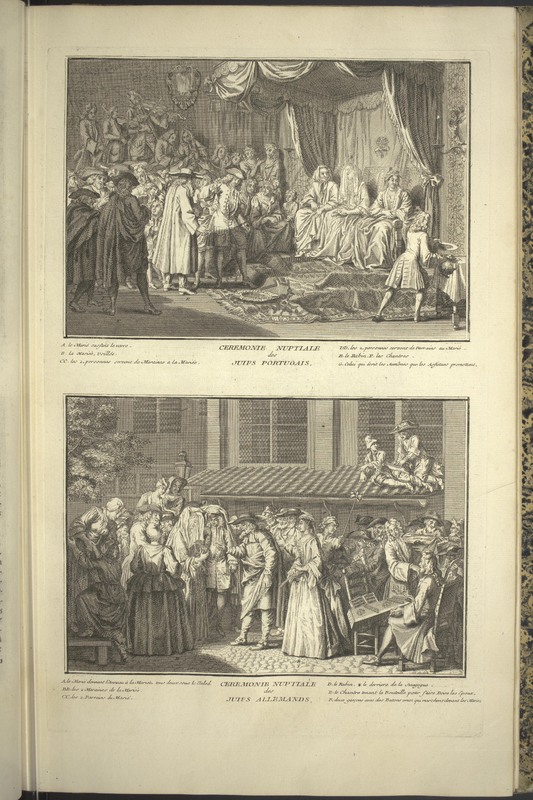
Ceremonie Nuptiale des Juifs Portugais [et] Juifs Allemands
Picart, Bernard, 1673-1733A pair of engravings depicting Jewish weddings in Portugal (top) and Germany (bottom). The Portugese wedding shows a gathering indoors, the bride sitting beneath a canopy on a dais as the groom raises a glass to toss it down and break. The German wedding shows a gathering outdoors, the bride and groom trading rings beneath a tallit as the rabbi guides them.A pair of engravings depicting Jewish weddings in Portugal (top) and Germany (bottom). The Portugese wedding shows a gathering indoors, the bride sitting beneath a canopy on a dais as the groom raises a glass to toss it down and break. The German wedding shows a gathering outdoors, the bride and groom trading rings beneath a tallit as the rabbi guides them. -
 Still image
Christ enthroned, surrounded by the Apostles : a leaf from the Nuremberg chronicle of 1493
Wolgemut, Michael, 1434-1519Leaf CI of the German Nuremberg Chronicle, with a large woodcut, colorized by hand, depicting Christ enthroned, surrounded by the Apostles.Leaf CI of the German Nuremberg Chronicle, with a large woodcut, colorized by hand, depicting Christ enthroned, surrounded by the Apostles. -
 Text
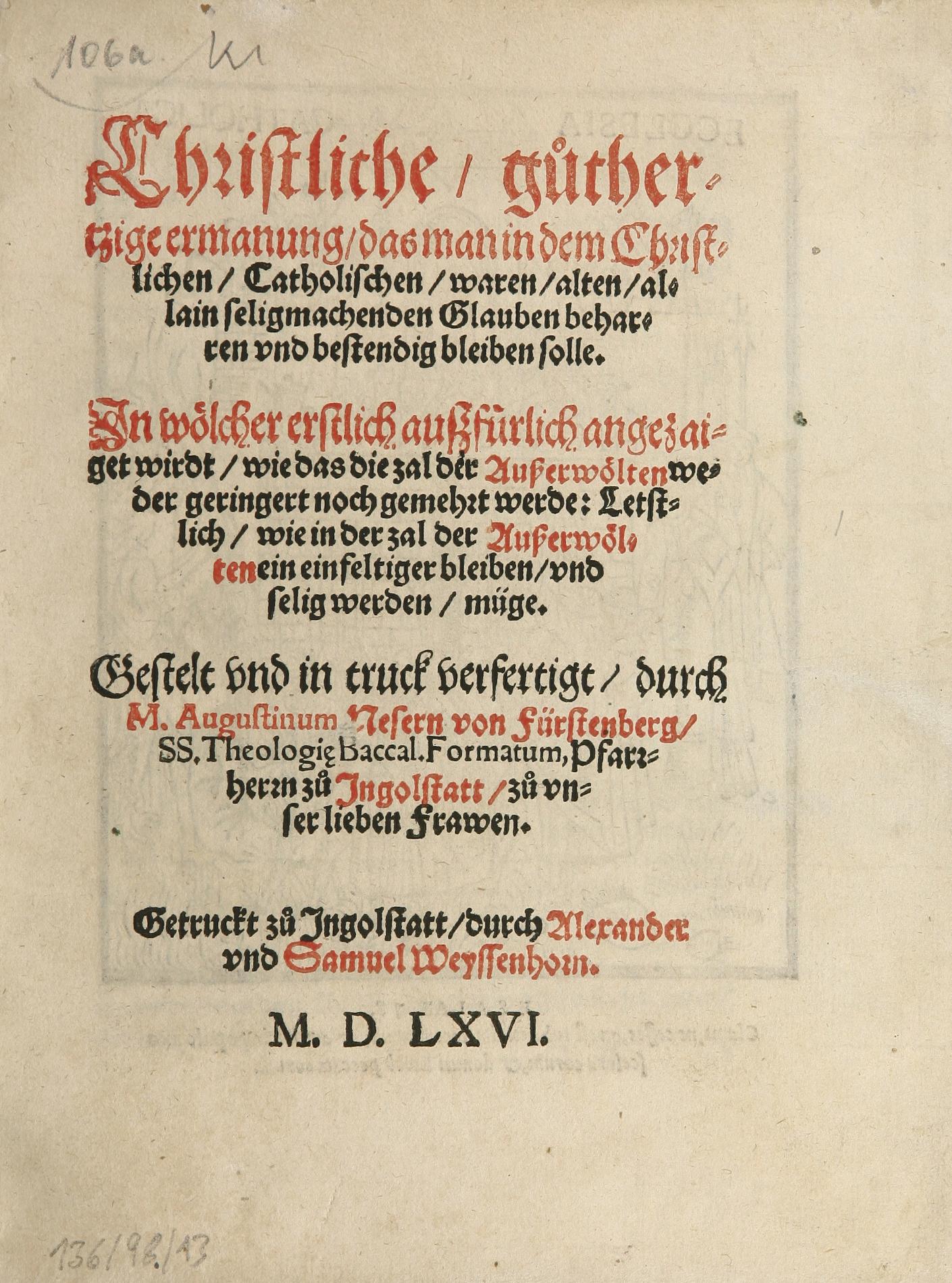
TextChristliche güthertzige Ermanung, das Man in dem Christlichen, Catholischen, waren, alten, allain seligmachenden Glauben beharren vnd bestendig bleiben solle : In wölcher erstlich auszfürlich angezaiget wirdt, wie das die Zal der Ausserwölten weder geringert noch gemehrt werde: letstlich, wie in der Zal der Ausserwölten ein einfeltiger bleiben, vnd selig werden, müge
Neser, AugustinusSummary: Augustinus Neser was a pastor in Ingolstadt. In this hortatory tract he discusses the importance of staying within the Catholic fold.Summary: Augustinus Neser was a pastor in Ingolstadt. In this hortatory tract he discusses the importance of staying within the Catholic fold. -
 Text
TextDe disputatio[n]e Lipsicensi : quantum ad Boemos obiter deflexa est
Emser, Hieronymus, 1478-1527Summary: A letter by Hieronymus Emser, early opponent of Luther concerning the Leipzig Disputation of 1519, describing Luther's debate with Johann Eck, and Luther's admitting that councils could err.Summary: A letter by Hieronymus Emser, early opponent of Luther concerning the Leipzig Disputation of 1519, describing Luther's debate with Johann Eck, and Luther's admitting that councils could err. -
 Text
TextDisputatio et excusatio
Luther, Martin, 1483-1546Summary: A response by Luther to the accusations leveled at him at the Leipzig Disputation by his opponent, Johann Eck.Summary: A response by Luther to the accusations leveled at him at the Leipzig Disputation by his opponent, Johann Eck. -
 Text
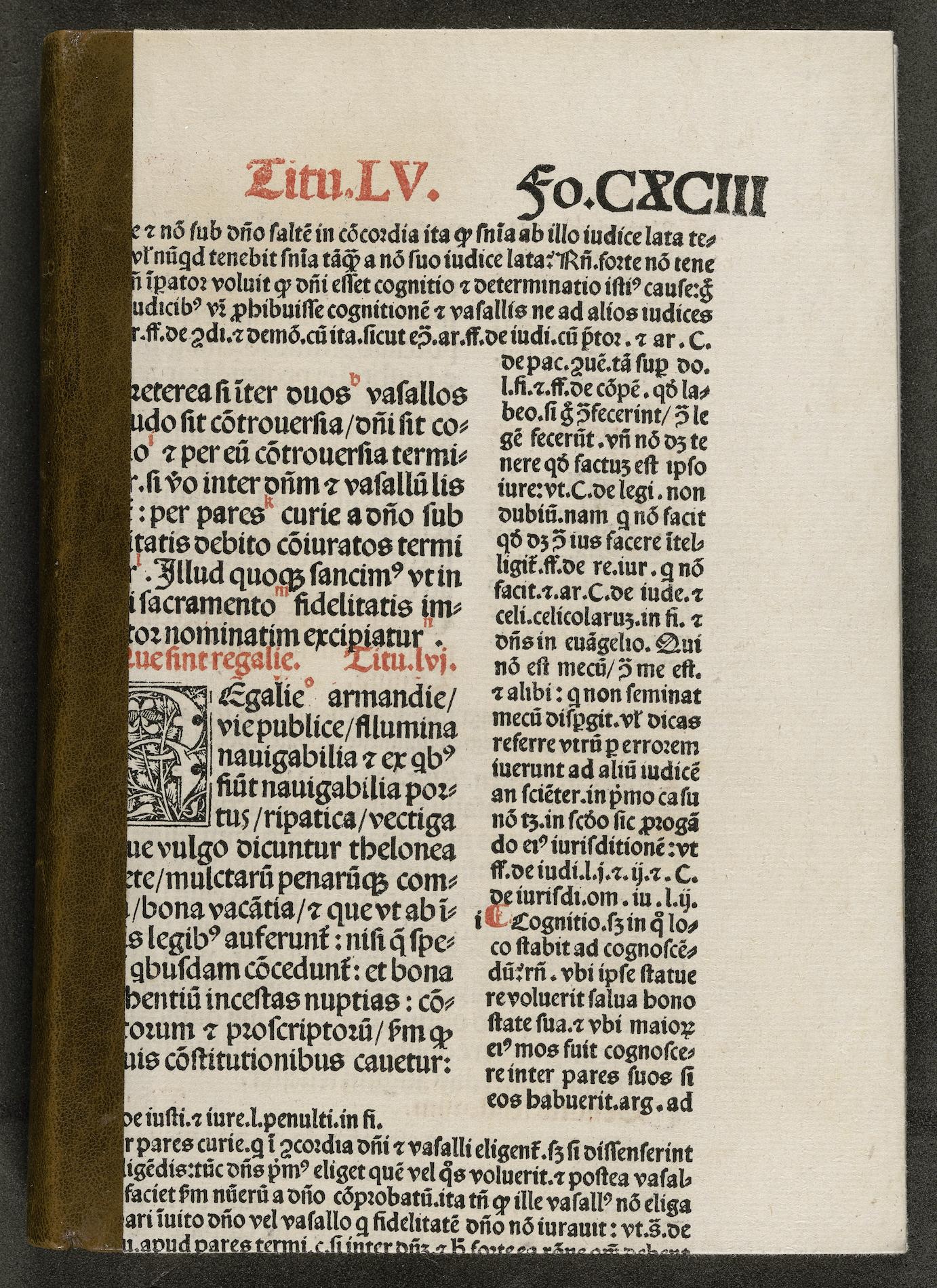
TextDisputatio inter Egregios & praelatus virus ac doctores, Joannem Ecci[um] & Martinum Lutherum in p[rae]sentia notariorum habita
Luther, Martin, 1483-1546Summary: Unique printing of the original notarial protocol of the Leipzig Disputation between Andreas Karlstadt and Martin Luther on the one hand, and Johann Eck, on the other. Includes fully two thirds of the several day debate, and all of the famous "duel" between Luther and Eck on authority in the church. The debates were copied by two notaries, and, at the end of each day's sessions, were verified by two witnesses.Summary: Unique printing of the original notarial protocol of the Leipzig Disputation between Andreas Karlstadt and Martin Luther on the one hand, and Johann Eck, on the other. Includes fully two thirds of the several day debate, and all of the famous "duel" between Luther and Eck on authority in the church. The debates were copied by two notaries, and, at the end of each day's sessions, were verified by two witnesses. -
 Text
TextDoctor Martinus Luther Augustiners Vnterricht auff etlich Artickell die im vonn seynen Abgūrnern auff gelegt vn[d] zu gemessen werden
Luther, Martin, 1483-1546Summary: Luther was persuaded by Karl von Miltitz to write this public statement as a response to certain charges brought against him by his opponents, in particular Mazzolini da Prierio. In this tract, Luther still supports the invocation of the saints, an idea which he abandoned only shortly after.Summary: Luther was persuaded by Karl von Miltitz to write this public statement as a response to certain charges brought against him by his opponents, in particular Mazzolini da Prierio. In this tract, Luther still supports the invocation of the saints, an idea which he abandoned only shortly after. -
 Text
TextDoctor Martinus Luthers antwort auff die tzedel : szo vnter des Officials tzu Stolpen sigel ist ausgangen
Luther, Martin, 1483-1546Summary: The first of five printings in 1520 of an answer to an attack on Luther issued under the seal and authority of Albert, Archbishop of Mainz.Summary: The first of five printings in 1520 of an answer to an attack on Luther issued under the seal and authority of Albert, Archbishop of Mainz. -
 Text
TextEin Sentbreiue an ein frum Eidgnossschafft : betreffendt die ketzerische Disputation Frantz Kolben des aussgeloffen Münchs, vnnd B. Hallers des verlognen Predicanten zu[o] Bern; Ein annderer brieue an Vlrich Zwingli; Der drit brieue an Cunrat Rotenacker zu Vlm; Soli Deo gloria.
Eck, Johann, 1486-1543Summary: First edition of three public letters by Johann Eck. The letters refer to an invitation sent to Eck by Zwingli, Haller and Kolbe, all of them evangelical preachers, to participate in a religious disputation scheduled to take place in Bern. The first letter, addressed to the confederation, explains courteously enough that he, Eck, does not intend to follow the call of the three proven heretics individually, a call not issued by the civic authorities. Not that he is afraid of their arguments; but he insists on an authoritative invitation and presence.Summary: First edition of three public letters by Johann Eck. The letters refer to an invitation sent to Eck by Zwingli, Haller and Kolbe, all of them evangelical preachers, to participate in a religious disputation scheduled to take place in Bern. The first letter, addressed to the confederation, explains courteously enough that he, Eck, does not intend to follow the call of the three proven heretics individually, a call not issued by the civic authorities. Not that he is afraid of their arguments; but he insists on an authoritative invitation and presence. -
 Text
TextEin Worhafft geschicht wie es kürtzlich einem prediger Münch zuo Nürmberg mit seinen Ordens brüdern von wegen seiner Eua[n]gelischen predig ergangen ist
Korn, GallusSummary: The tribulation of monks-turned Protestant, and then turned out of their monasteries, made fascinating reading for the newly-converted Protestants. In style, it is analogous to martyrologies, such as Foxe's "Book of Martyrs." G. Korn here relates his sufferings on account of the Gospel as one such monk in Nuremberg.Summary: The tribulation of monks-turned Protestant, and then turned out of their monasteries, made fascinating reading for the newly-converted Protestants. In style, it is analogous to martyrologies, such as Foxe's "Book of Martyrs." G. Korn here relates his sufferings on account of the Gospel as one such monk in Nuremberg. -
 Text
TextEin gar kurtz aber sehr artlich vnd zů diser zeit vast nutzlich Gesprech, darinn der grund vnnd die vrsach angezeigt wirdt waran es bissher gemangelt dass die Papisten nit all Euangelisch seind worden.
Walasser, Adam, -1581Summary: A fictitious dialogue between a Catholic and a Protestant, written by the Catholic theologian Adam Walasser. The discussion includes topics like the authority of tradition outside of Scripture or prayer to the Saints and the Protestant position is presented as reasonable, albeit incorrect by Walasser.Summary: A fictitious dialogue between a Catholic and a Protestant, written by the Catholic theologian Adam Walasser. The discussion includes topics like the authority of tradition outside of Scripture or prayer to the Saints and the Protestant position is presented as reasonable, albeit incorrect by Walasser. -
 Text
TextEin schöner spruch darinn deren von Costantz seltzame Renckh und Abentheür, damit Sy vmbgon begriffen syen.
Treger, Konrad, approximately 1480-1542Summary: Anti-Reformation poem directed at the city of Konstanz. Tregor, an Augustinian Prior, was a leading defender of Catholicism in Switzerland.Summary: Anti-Reformation poem directed at the city of Konstanz. Tregor, an Augustinian Prior, was a leading defender of Catholicism in Switzerland. -
 Text
TextEine Heer predigt wider den Turcken
Luther, Martin, 1483-1546Summary: This is the third printing, second state, of Luther's sermon against the Turks.Summary: This is the third printing, second state, of Luther's sermon against the Turks. -
 Text
TextEine Schrifft, wie die Pfarherrn an den Örtern, da man die Papisterey widerumb auffricht, die Euangelisch Lehr, welche sie Lutherisch nennen, verloben vnd verschweren müssen
Summary: An anonymous pamphlet, containing an oath German pastors had to swear to renounce the "Evangelical doctrine, which is called Lutheran" in order to be readmitted to the Roman Catholic Church. The copy of the oath is preceded by two satirical poems regarding the oath, the first one representing the opinion of a wise man, the second one the answer of an unwise man. On the titlepage are two verses from Matthew 10 against the taking of oaths. The work is published by Christian Rödinger, a printer who put his press in service of the Reformation.Summary: An anonymous pamphlet, containing an oath German pastors had to swear to renounce the "Evangelical doctrine, which is called Lutheran" in order to be readmitted to the Roman Catholic Church. The copy of the oath is preceded by two satirical poems regarding the oath, the first one representing the opinion of a wise man, the second one the answer of an unwise man. On the titlepage are two verses from Matthew 10 against the taking of oaths. The work is published by Christian Rödinger, a printer who put his press in service of the Reformation. -
 Text
TextEncomiu[m] Rubij Longipolii apud Lipsim : in errores quos pueriliter co[m]misit adversus Vuittenbergen[ses] : Nemo potest quicquid toto gestatur in orbe rumpere liuores omnia Nemo potest
Montanus, Jacobus, active 1486-1534Summary: It is not certain who wrote this tract on the Leipzig Disputation but J. Montanus or J. Cellarius appear to be the most likely candidates. Montanus became the first Protestant preacher in Westphalia, while Cellarius or Kellner, became the first Protestant Superintendent of Dresden.Summary: It is not certain who wrote this tract on the Leipzig Disputation but J. Montanus or J. Cellarius appear to be the most likely candidates. Montanus became the first Protestant preacher in Westphalia, while Cellarius or Kellner, became the first Protestant Superintendent of Dresden. -
 Text
TextEpistola D. Martini Luther ad Georgium Spalatinum &c. de disputatione sua : Eiusdem super Tredecim Proposit[i]o[n]ibus Lipsi[a]e disputatis resolutiones
Luther, Martin, 1483-1546Summary: The Leipzig disputation was a debate between Martin Luther and Andreas Karlstadt on the one hand and Johann Eck on the other. While Karlstadt and Eck found some grounds for agreement on the question of free will, Luther and Eck disagreed vehemently over the question of the pope's authority to establish new articles of faith. This work publishes a letter Luther wrote to his friend Georg Spalatin, as well as 13 theses by Luther refuting Eck's position on the primacy of the pope and the authority of councils.Summary: The Leipzig disputation was a debate between Martin Luther and Andreas Karlstadt on the one hand and Johann Eck on the other. While Karlstadt and Eck found some grounds for agreement on the question of free will, Luther and Eck disagreed vehemently over the question of the pope's authority to establish new articles of faith. This work publishes a letter Luther wrote to his friend Georg Spalatin, as well as 13 theses by Luther refuting Eck's position on the primacy of the pope and the authority of councils. -
 Text
TextEyn deutsch Theologia : das ist Eyn edles Buchleyn, von rechtem vorstand, was Adam vnd Christus sey, vnd wie Adam yn vns sterben, vnd Christus ersteen sall
FranckforterSummary: First printing of Luther's second publication of the "Theologia Deutsch", or "German Theology" of an unknown disciple of the Medieval German mystic, Johannes Tauler (ca. 1300-1361). Luther says in his preface that he has learned more from it than from any other book, the Bible and the works of St. Augustine, excepted, "as to what God, Christ, the human being, and all things are".Summary: First printing of Luther's second publication of the "Theologia Deutsch", or "German Theology" of an unknown disciple of the Medieval German mystic, Johannes Tauler (ca. 1300-1361). Luther says in his preface that he has learned more from it than from any other book, the Bible and the works of St. Augustine, excepted, "as to what God, Christ, the human being, and all things are". -
 Still image
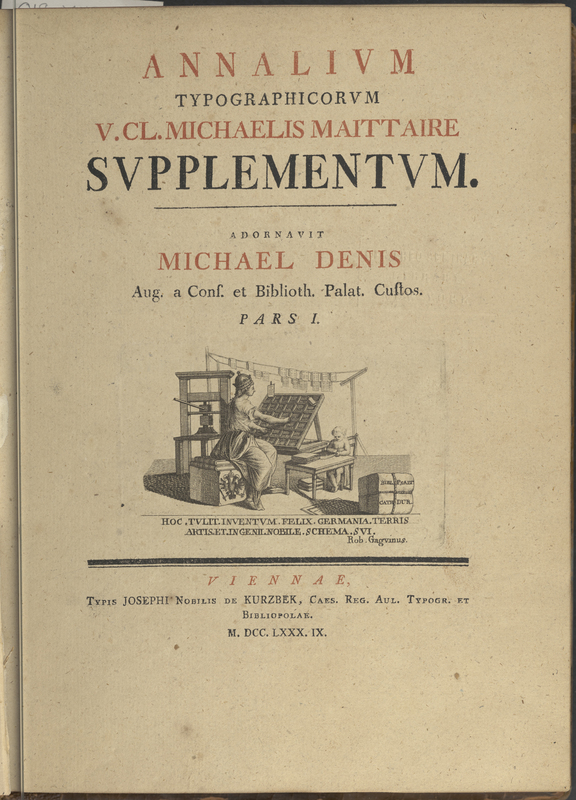
Historiated title page of Annalium typographicorum v. cl. Michaelis Maittaire supplementum
The title page of Michael Denis' Annalium typographicorum v. cl. Michaelis Maittaire supplementum featuring an image of a crowned woman sitting on a block bearing the two-headed eagle of the Holy Roman Empire as she arranges a board of movable type. A printing press sits to the woman's left, a line of drying pages in the background, and a child (possibly a cherub) sitting at a small table to her right.The title page of Michael Denis' Annalium typographicorum v. cl. Michaelis Maittaire supplementum featuring an image of a crowned woman sitting on a block bearing the two-headed eagle of the Holy Roman Empire as she arranges a board of movable type. A printing press sits to the woman's left, a line of drying pages in the background, and a child (possibly a cherub) sitting at a small table to her right. -
 Text
TextIudicium Martini Lutheri de votis : scriptum ad episcopos & diaconos Vuittembergen[sis] ecclesiae
Luther, Martin, 1483-1546Summary: First edition of a short tract written by Luther at Wartburg castle and addressed to the bishop and religious leaders in Wittenberg. In 139 brief statements, Luther warns that religious vows and monastic life do not by themselves bring about the forgiveness of sins.Summary: First edition of a short tract written by Luther at Wartburg castle and addressed to the bishop and religious leaders in Wittenberg. In 139 brief statements, Luther warns that religious vows and monastic life do not by themselves bring about the forgiveness of sins. -
![The digital edition of an introduction to and translation of Johan Tetzel's "Vorlegung gemacht von Bruder Johan Tetzel Prediger Orde[n]s Ketzermeister : wyder eynen vormessen Sermon von tzwentzig irrige[n] Artickeln Bebstlichen Ablas vn[d] Gnade belange[n]de allen cristglaubige[n] Mensche[n] tzuwissen von Notten," originally published by Melchior Lotter in Leipzig, Germany, in 1518, including facsimile reproductions. The original text is the first attack on Luther's "Sermon von dem Ablass und Gnade" (Sermon on indulgences and grace) by Johan Tetzel, a refutation of Luther's position.](https://s3.us-west-2.amazonaws.com/omekacloud-main/large/P_CSTA005_BD002_300000422352/P_CSTA005_BD002_2012_300000422352_KRAMER.jpg) Text
TextJohann Tetzel's Rebuttal against Luther's Sermon on Indulgences and Grace
Tetzel, Johann, 1460-1519The digital edition of an introduction to and translation of Johan Tetzel's "Vorlegung gemacht von Bruder Johan Tetzel Prediger Orde[n]s Ketzermeister : wyder eynen vormessen Sermon von tzwentzig irrige[n] Artickeln Bebstlichen Ablas vn[d] Gnade belange[n]de allen cristglaubige[n] Mensche[n] tzuwissen von Notten," originally published by Melchior Lotter in Leipzig, Germany, in 1518, including facsimile reproductions.The digital edition of an introduction to and translation of Johan Tetzel's "Vorlegung gemacht von Bruder Johan Tetzel Prediger Orde[n]s Ketzermeister : wyder eynen vormessen Sermon von tzwentzig irrige[n] Artickeln Bebstlichen Ablas vn[d] Gnade belange[n]de allen cristglaubige[n] Mensche[n] tzuwissen von Notten," originally published by Melchior Lotter in Leipzig, Germany, in 1518, including facsimile reproductions. -
 Text
TextLetter from Georg Spalatin to Duke Magnus III of Mecklenburg, May 3, 1534
Spalatin, Georg, 1484-1545A cover letter, dated May 3, 1534, for a manuscript which Spalatin had promised to Duke Magnus III of Mecklenburg regarding the justification used by Henry VIII for his divorce from Catherine of Aragon, which was never recognized by Rome. Henry had married Anne Boleyn in January of 1533 and on May 23 1534, Pope Clement VII invalidated Henry's divorce and remarriage, which led to England's final break with Rome and the foundingn of the Anglican Church.A cover letter, dated May 3, 1534, for a manuscript which Spalatin had promised to Duke Magnus III of Mecklenburg regarding the justification used by Henry VIII for his divorce from Catherine of Aragon, which was never recognized by Rome. Henry had married Anne Boleyn in January of 1533 and on May 23 1534, Pope Clement VII invalidated Henry's divorce and remarriage, which led to England's final break with Rome and the foundingn of the Anglican Church. -
 Text
TextLetter from Georg Spalatin to Heinrich von Einsiedel, January 9, 1536
Spalatin, Georg, 1484-1545A letter written to Heinrich von Einsiedel and an enclosed with a copy of a sermon by Philipp Melanchthon. Within the body of the letter, Spalatin entreats Einsiedel to "exert your goodwill on the work's behalf". The letter is dated 1536.A letter written to Heinrich von Einsiedel and an enclosed with a copy of a sermon by Philipp Melanchthon. Within the body of the letter, Spalatin entreats Einsiedel to "exert your goodwill on the work's behalf". The letter is dated 1536. -
![A letter written to the "Noble and Right worthy Heinrich von Einsiedel" in Gnansteyn. The matter being addressed is the refusal of Brosius Berger to take an oath, thus hindering Katharina Gockritz from getting married. Mention of consultation with Doctor Martin [Luther] is in the letter. With the exception of the upper right corner which is missing, the paper is in good condition. The date "1528" appears in the upper left corner in a different ink.](https://s3.us-west-2.amazonaws.com/omekacloud-main/large/P-MSS122_B001_F001_I001/P-MSS122_B001_F001_I001_P001_PROD.jpg) Text
TextLetter from Georg Spalatin to Heinrich von Einsiedel, October 7, 1528
Spalatin, Georg, 1484-1545A letter written to the "Noble and Right worthy Heinrich von Einsiedel" in Gnansteyn. The matter being addressed is the refusal of Brosius Berger to take an oath, thus hindering Katharina Gockritz from getting married. Mention of consultation with Doctor Martin [Luther] is in the letter. With the exception of the upper right corner which is missing, the paper is in good condition. The date "1528" appears in the upper left corner in a different ink.A letter written to the "Noble and Right worthy Heinrich von Einsiedel" in Gnansteyn. The matter being addressed is the refusal of Brosius Berger to take an oath, thus hindering Katharina Gockritz from getting married. Mention of consultation with Doctor Martin [Luther] is in the letter. With the exception of the upper right corner which is missing, the paper is in good condition. The date "1528" appears in the upper left corner in a different ink. -
 Text
TextLetter from John Wesley to Susanna (Annesley) Wesley, July 6, 1738
Wesley, John, 1703-1791A letter from John Wesley to his mother relating a visit to Count Zinzendorf near Frankfort.A letter from John Wesley to his mother relating a visit to Count Zinzendorf near Frankfort. -
 Text
TextResolutiones Lutheriane super propositio[n]ibus suis Lipsie disputatis
Luther, Martin, 1483-1546Summary: An analysis by Luther of the propositions debated by him, his colleague, Andreas Karlstadt, and Johann Eck at the Leipzig Debate of 1519.Summary: An analysis by Luther of the propositions debated by him, his colleague, Andreas Karlstadt, and Johann Eck at the Leipzig Debate of 1519. -
 Still image
Three-headed portent of Marcomirus
A woodcut depicting a being with three heads: a frog representing France, an eagle representing Rome, and a lion representing Germany. This creature preceeded the arrival of Marcomirus, a Sicambrian king who took control of a region of Gaul after moving from the Danube region into the low countries (Gelders and Holland).A woodcut depicting a being with three heads: a frog representing France, an eagle representing Rome, and a lion representing Germany. This creature preceeded the arrival of Marcomirus, a Sicambrian king who took control of a region of Gaul after moving from the Danube region into the low countries (Gelders and Holland). -
 Text
TextTürkenkriege -- Verzeichnis der personen vnd knechte, so zu widerstandt des Türcken : auff bewilligung der stende des Reichs von dem Churfürsten zu Sachsen etc. zu Zwickau gemustertt (...), 1542 May 10
This manuscript is handwritten in German and dated May 10, 1542. It lists people from Zwickau, Saxony (Germany) who enlisted or were paid to participate in the field campaign against the Turkish invasion of Marseille.This manuscript is handwritten in German and dated May 10, 1542. It lists people from Zwickau, Saxony (Germany) who enlisted or were paid to participate in the field campaign against the Turkish invasion of Marseille. -
 Text
TextUrsach vnd anttwortt das iungkfrawe[n] kloster gottlich v[er]lassen muge[n]
Luther, Martin, 1483-1546Summary: The catalyst for this famous Luther letter was the removal by stealth of nine nuns from the cloister of Nimbschen bei Grimma at Easter in the year 1523. Luther names the nine, which include a sister of Johann Staupitz, Luther's father confessor, and Katharina von Bora, who was to become Luther's wife.Summary: The catalyst for this famous Luther letter was the removal by stealth of nine nuns from the cloister of Nimbschen bei Grimma at Easter in the year 1523. Luther names the nine, which include a sister of Johann Staupitz, Luther's father confessor, and Katharina von Bora, who was to become Luther's wife. -
 Text
TextVonn dem Ampt der Fürsten : vnd welcher Gestalt inen das auss Gottes Befelch aufflegen thüe die Abstellung der Missbräuch in den Kirchen
Melanchthon, Philipp, 1497-1560Summary: Tract on the duties and responsibilties of civic leaders, and on the relationship between church and state, first published in Latin a year earlier.Summary: Tract on the duties and responsibilties of civic leaders, and on the relationship between church and state, first published in Latin a year earlier. -
 Text
TextWarnung : Erinnerung vnd Christliche Ermanung sampt gruntliche[m] bericht von itziger Kriegsvbung in Deutzscher Nation
Treulinger, Johann, active 1546Summary: Response by an otherwise unknown author to the in 1546 developing Schmalkald War. The author leans more towards the position of the Holy Roman Emperor, rather than to that of the Lutheran princes.Summary: Response by an otherwise unknown author to the in 1546 developing Schmalkald War. The author leans more towards the position of the Holy Roman Emperor, rather than to that of the Lutheran princes. -
 Text
TextWid' die unselige Auffrure Merten Luders von Wolffgango Wulffer un[d] andern Christgleubige[n] euch zw Wittenberg tzugeschribenn.
Wulffer, Wolfgang, -1538Summary: First printing of a rare pamphlet directed against Martin Luther. Wulffer calls Luther a false prophet and claims that his teachings contain no love, but only self-aggrandizement.Summary: First printing of a rare pamphlet directed against Martin Luther. Wulffer calls Luther a false prophet and claims that his teachings contain no love, but only self-aggrandizement. -
 Text
TextWidder Luthers trostung ann die Christen zu Hall : vber er Georgen yhres Predigers todt, szo viel die entpfahung des hochwirdigen Sacraments belangt
Alveldt, Augustin von, active 16th centurySummary: Luther's Consolation to the Protestants of Halle, published in 1527, provoked this reply from Agustin von Alveld, garuden of the Franciscan Monastery in Halle from 1524-29. Alveld condemns Luther's tract as "Hussisch," in particular with respect to his teachings on the sacrament. Alveld dedicated the work to Albert of Brandenburg, Archbishop of Mainz.Summary: Luther's Consolation to the Protestants of Halle, published in 1527, provoked this reply from Agustin von Alveld, garuden of the Franciscan Monastery in Halle from 1524-29. Alveld condemns Luther's tract as "Hussisch," in particular with respect to his teachings on the sacrament. Alveld dedicated the work to Albert of Brandenburg, Archbishop of Mainz. -
 Text
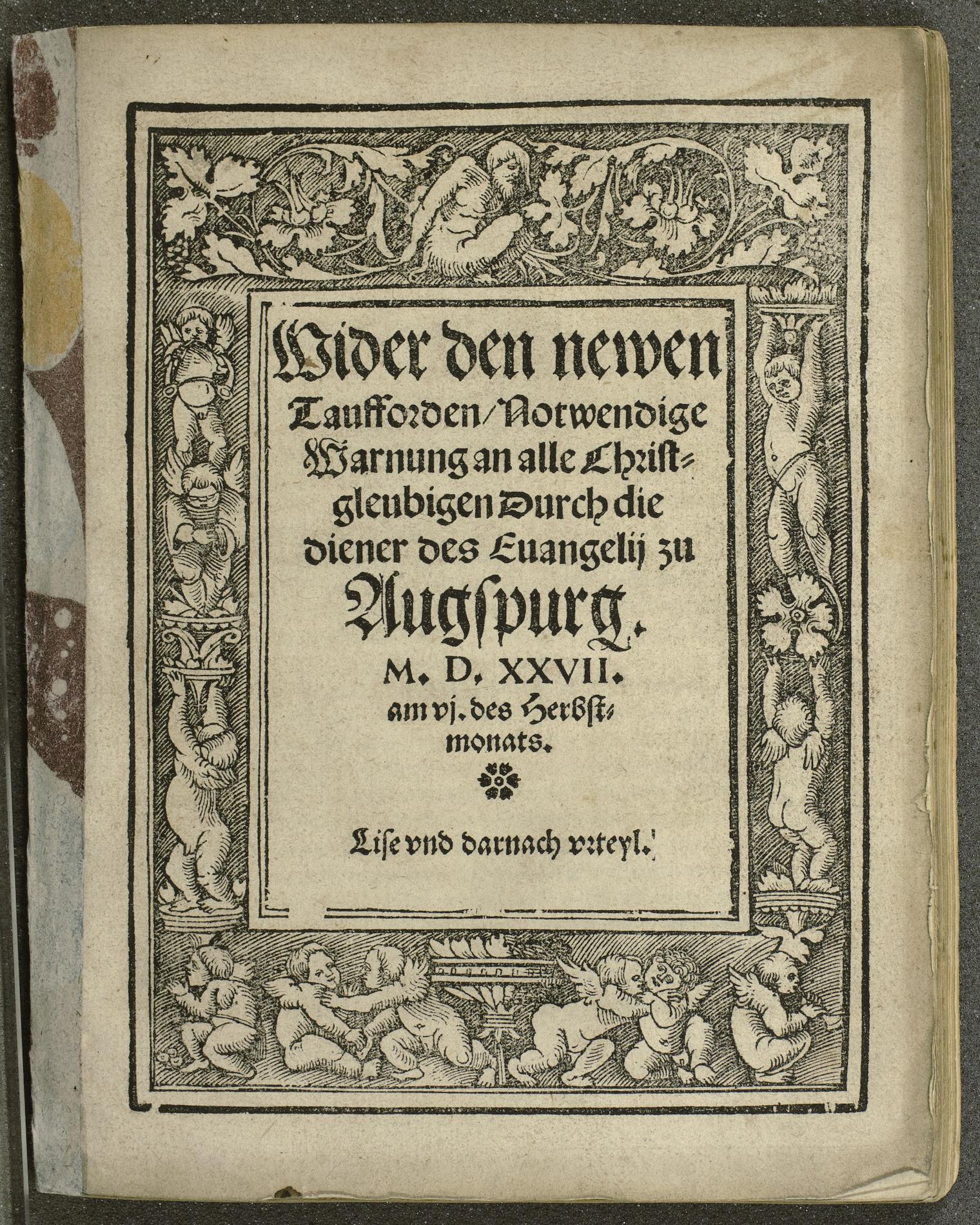
TextWider den newen Taufforden : notwendige Warnung an alle Christgleubigen
Rhegius, Urbanus, 1489-1541Summary: First and only edition of an important source about the early relations between the Lutheran and Anabaptist movements.Summary: First and only edition of an important source about the early relations between the Lutheran and Anabaptist movements. -
 Text
TextWie gar geferlich sey. So ein Priester kein Eeweyb hat : Wie unchristlich, und schedlich eim Gemeynenn nutz die menschenn seind, weliche hindern die Pfaffẽ am Eelichen stand.
Eberlin von Günzburg, Johann, approximately 1470-1533Summary: Johann Eberlin von Günzburg was a former Franciscan who had left the order and joined the Lutheran Reformation in 1521. This is the second edition of his tract on the dangers of priestly celibacy. He himself was married in 1524 and had four children. The title page woodcut shows the wedding of three different priests, including one to a nun.Summary: Johann Eberlin von Günzburg was a former Franciscan who had left the order and joined the Lutheran Reformation in 1521. This is the second edition of his tract on the dangers of priestly celibacy. He himself was married in 1524 and had four children. The title page woodcut shows the wedding of three different priests, including one to a nun. -
 Text
TextWie syben Weyber vber jhre vngeratene Menner klagen
Sachs, Hans, 1494-1576Satirical poem by the Nuremberg Meistersinger and cobbler about seven women complaining about their wayward husbands. The piece was originally published as a broadside in 1531 (cf. Erdmann) and is the counterpart to another poem by Sachs about seven men complaining about their wives.Satirical poem by the Nuremberg Meistersinger and cobbler about seven women complaining about their wayward husbands. The piece was originally published as a broadside in 1531 (cf. Erdmann) and is the counterpart to another poem by Sachs about seven men complaining about their wives. -
 Still image
Wittenberg in Obern Sachsen
A woodcut containing a view of Wittenberg in Saxony-Anhalt. The woodcut was excerpted from from the German edition of Sebastian Münster's Cosmographia (Basel: Heinrich Petri, 1572). The reverse side depicts a jousting battle scene.A woodcut containing a view of Wittenberg in Saxony-Anhalt. The woodcut was excerpted from from the German edition of Sebastian Münster's Cosmographia (Basel: Heinrich Petri, 1572). The reverse side depicts a jousting battle scene. -
 Text
TextWyder den Wittenbergischen Abtgot Martin Luther
Alveldt, Augustin von, active 16th centurySummary: The Franciscan Augustine of Alveldt wrote this polemical tract in response to Luther's pamphlet "Widder den newen Abgott und alten Teuffel" which criticized the recent canonization of Bishop Benno of Mainz.Summary: The Franciscan Augustine of Alveldt wrote this polemical tract in response to Luther's pamphlet "Widder den newen Abgott und alten Teuffel" which criticized the recent canonization of Bishop Benno of Mainz. -
 Text
TextYoungsters from the German Highways: a picture survey on constructive aid for Refugee youth
Hoffman, Bengt Runo, 1913-1997This item is a scrapbook produced while Hoffman was serving as Secretary for Germany and Austria for the World Council of Churches. It contains sixty black-and-white photographs depicting the lives of young refugees in West Germany after World War II. In English, the captions and narrative describe church relief work among the refugees. Much of this document is an appeal for more funds and resources to help Protestant churches continue their relief efforts in the boarding houses and schools for refugees, who were mainly from West Germany although some were from East Germany.This item is a scrapbook produced while Hoffman was serving as Secretary for Germany and Austria for the World Council of Churches. It contains sixty black-and-white photographs depicting the lives of young refugees in West Germany after World War II. In English, the captions and narrative describe church relief work among the refugees. Much of this document is an appeal for more funds and resources to help Protestant churches continue their relief efforts in the boarding houses and schools for refugees, who were mainly from West Germany although some were from East Germany. -
 Text
TextZeitungen aus Welschlanden : daraus ein jder klar vorstehen kan, das der Babst vnd seine geistlichen den Keyser zu dem jtzigen Kriege bewegt ...
Summary: Early "newspaper/editorial" accusing the Pope and the Roman clergy of being the true instigators of the Schmalkald War.Summary: Early "newspaper/editorial" accusing the Pope and the Roman clergy of being the true instigators of the Schmalkald War. -
 Text
TextZwey keiserliche vneynige vn[d] widerwertige gepot den Luther betreffendt.
Holy Roman Empire. Emperor (1519-1556 : Charles V)Summary: The diet of Nuremberg in 1524 reaffirmed the imperial ban of Luther's person expressed in the edict of Worms, but not the condemnation of his teachings, which were to be addressed at the diet of Speyer. Luther issued both the edict of Worms and the resolutions of the diet of Nuremberg along with his own foreward and comments, in which he calls the emperor a "mad, irrational, senseless, raving and insane fool".Summary: The diet of Nuremberg in 1524 reaffirmed the imperial ban of Luther's person expressed in the edict of Worms, but not the condemnation of his teachings, which were to be addressed at the diet of Speyer. Luther issued both the edict of Worms and the resolutions of the diet of Nuremberg along with his own foreward and comments, in which he calls the emperor a "mad, irrational, senseless, raving and insane fool".

