Search
182 resources
182 items
Creator
Luther, Martin, 1483-1546
-
 Text
TextSermo de penitentia
Luther, Martin, 1483-1546Summary: This sermon on penance was written and preached before Easter, 1518. It is a natural sequel to the sermon on Indulgences and grace, although this sermon was preached first. This is the seventh printing of the sermon.Summary: This sermon on penance was written and preached before Easter, 1518. It is a natural sequel to the sermon on Indulgences and grace, although this sermon was preached first. This is the seventh printing of the sermon. -
 Text
TextSermon an dem xiii. [sic] Sontag nach Pfingsten
Luther, Martin, 1483-1546Summary: Sermon preached November 1, 1523, on Matthew 18:23-35 (the parable of the forgiven debtor who was unforgiving).Summary: Sermon preached November 1, 1523, on Matthew 18:23-35 (the parable of the forgiven debtor who was unforgiving). -
 Text
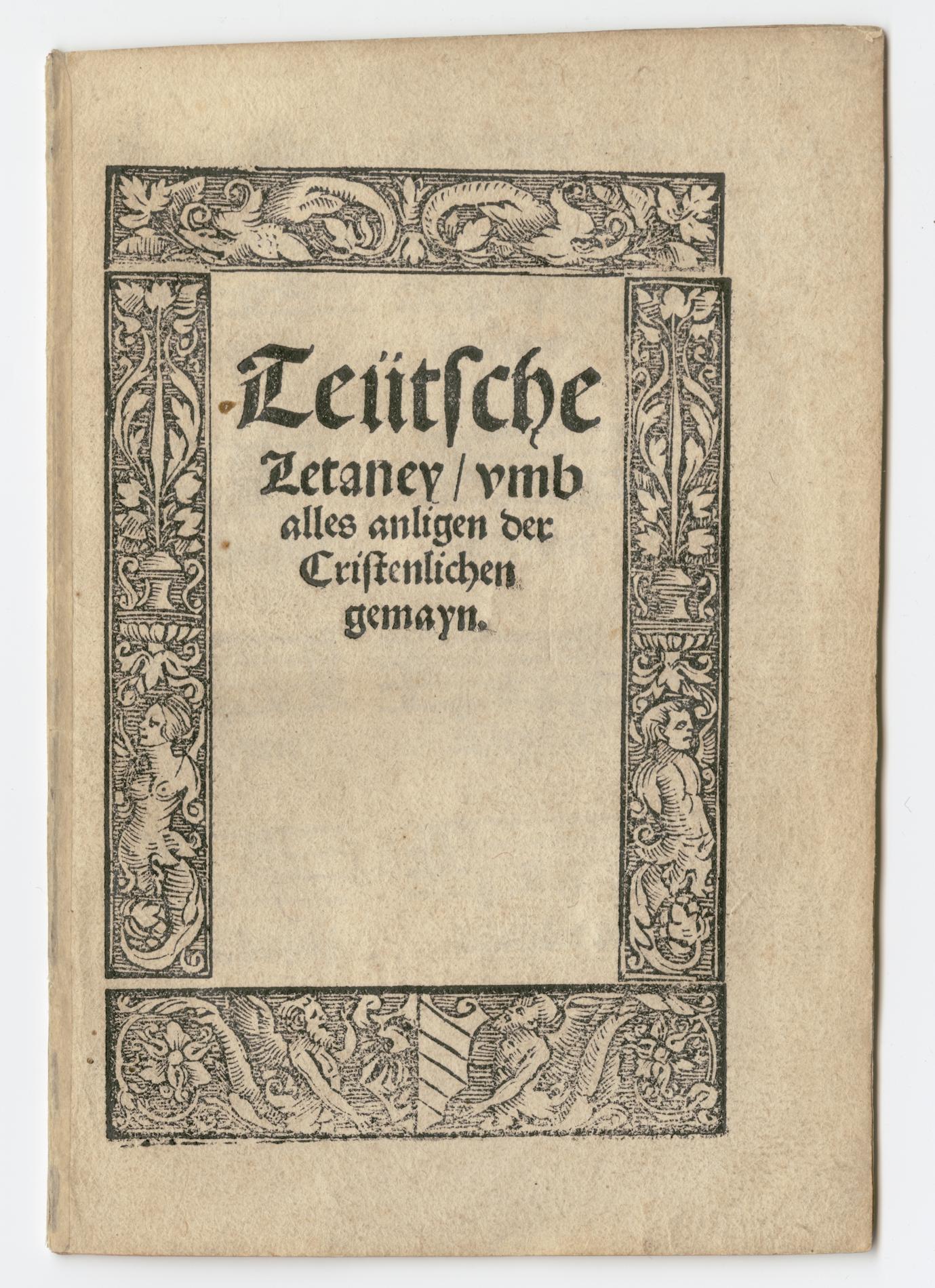
TextTeütsche Letaney, vmb alles anligen der Cristenlichen gemayn
Luther, Martin, 1483-1546Summary: This is Luther's reinstatement of the Litany of "All Saints", containing both the musical notation and German text of the antiphons.Summary: This is Luther's reinstatement of the Litany of "All Saints", containing both the musical notation and German text of the antiphons. -
 Text
TextUom Missbrauch der Messen
Luther, Martin, 1483-1546Summary: Written in Latin in the fall of 1521 under the title De abroganda missa privata, this is the third printing of the first German edition of Martin Luther's important tract on the celebration of private masses. Luther opposed any celebration of the Eucharist that was not accessible to or provided for the congregation at large and felt so strongly about this material that he translated it into German himself.Summary: Written in Latin in the fall of 1521 under the title De abroganda missa privata, this is the third printing of the first German edition of Martin Luther's important tract on the celebration of private masses. Luther opposed any celebration of the Eucharist that was not accessible to or provided for the congregation at large and felt so strongly about this material that he translated it into German himself. -
 Text
TextUom eelichen Leben
Luther, Martin, 1483-1546Summary: This sermon on marriage is an elaboration of an earlier work no longer extant. In its present form there is no set Bible text, nor is the sermon designed for a particular place in the Church year.Summary: This sermon on marriage is an elaboration of an earlier work no longer extant. In its present form there is no set Bible text, nor is the sermon designed for a particular place in the Church year. -
 Text
TextUom eelichen Leben
Luther, Martin, 1483-1546Summary: This sermon on marriage is an elaboration of an earlier work no longer extant. In its present form there is no set Bible text, nor is the sermon designed for a particular place in the Church year.Summary: This sermon on marriage is an elaboration of an earlier work no longer extant. In its present form there is no set Bible text, nor is the sermon designed for a particular place in the Church year. -
 Text
TextUom miszbrauch der Messen
Luther, Martin, 1483-1546Summary: Luther always felt a special fondness for this work. Nearly two decades after writing it, he remembered it as being especially powerful. It elicited response from Catholic opponents five years hence. Luther felt so strongly about this material that he translated it into German himself. The abuse of the title refers to the masses sung by chantry priests for individuals. Luther opposed any celebration of the Eucharist that was not accessible to or provided for the congregation at large.Summary: Luther always felt a special fondness for this work. Nearly two decades after writing it, he remembered it as being especially powerful. It elicited response from Catholic opponents five years hence. Luther felt so strongly about this material that he translated it into German himself. The abuse of the title refers to the masses sung by chantry priests for individuals. Luther opposed any celebration of the Eucharist that was not accessible to or provided for the congregation at large. -
 Text
TextUon Anbeten des Sacraments des heyligen leychnams Christi
Luther, Martin, 1483-1546Summary: Second printing of Luther's response to a catechism of the Bohemian Brethren, with special attention to the Adoration of the Host, and to the Real Presence.Summary: Second printing of Luther's response to a catechism of the Bohemian Brethren, with special attention to the Adoration of the Host, and to the Real Presence. -
 Text
TextUon Menschen leeren zu meyden
Luther, Martin, 1483-1546Summary: First published earlier the same year, Luther's pamphlet Defense of the doctrines of men was one of Luther's most widely read writings with approximately twenty editions appearing in the years 1522 and 1523. Written in honor of Hans von Belepsch who had hosted Luther at the Wartburg as the reformer translated the New Testament. Luther argues that church teachings that have no basis in the Bible, in particular fasting and celibacy, are illegitimate and are to be avoided.Summary: First published earlier the same year, Luther's pamphlet Defense of the doctrines of men was one of Luther's most widely read writings with approximately twenty editions appearing in the years 1522 and 1523. Written in honor of Hans von Belepsch who had hosted Luther at the Wartburg as the reformer translated the New Testament. Luther argues that church teachings that have no basis in the Bible, in particular fasting and celibacy, are illegitimate and are to be avoided. -
 Text
TextUon Menschenn Lere zu meyden
Luther, Martin, 1483-1546Summary: A treatise by Luther on the relationship of belief and practice, intended for those "poor consciences, that lie captive to human laws in cloisters and monastic foundations", as he puts it in his preface. It is also noteworthy that Luther assumes his audience includes both those who could read his writings directly, and those who heard them read by others, when he dedicates his pamphlet "to all who read or hear this little book".Summary: A treatise by Luther on the relationship of belief and practice, intended for those "poor consciences, that lie captive to human laws in cloisters and monastic foundations", as he puts it in his preface. It is also noteworthy that Luther assumes his audience includes both those who could read his writings directly, and those who heard them read by others, when he dedicates his pamphlet "to all who read or hear this little book". -
 Text
TextUon beyder gestalt des Sacraments zu nehmen vnd ander newerung
Luther, Martin, 1483-1546Summary: After Luther published his "Eight Sermons" of 1522, he decided that there was needed a shorter, more concise statement of these sermons' arguments. This is the third printing of the resulting précis.Summary: After Luther published his "Eight Sermons" of 1522, he decided that there was needed a shorter, more concise statement of these sermons' arguments. This is the third printing of the resulting précis. -
 Text
TextUon denn geystlichen vnd kloster gelubden
Luther, Martin, 1483-1546Summary: One of three 1522 printings of an essay on monastic vows written by Luther during his stay at the Wartburg Castle after the Diet of Worms. It is addressed to monks, whose conscience is troubled by the conflict between their vows and their desire to leave the monastic life. Luther frequently referred to this piece throughout his career, and it became one of his most influential works.Summary: One of three 1522 printings of an essay on monastic vows written by Luther during his stay at the Wartburg Castle after the Diet of Worms. It is addressed to monks, whose conscience is troubled by the conflict between their vows and their desire to leave the monastic life. Luther frequently referred to this piece throughout his career, and it became one of his most influential works. -
 Text
TextUon der beycht ob die der Bapst macht hab zugepieten
Luther, Martin, 1483-1546Summary: This is Luther's tract on auricular confession. The sacrament of penance was the focus of Luther's most vehement criticisms. Not only was the sacrament the course of numerous abuses, indulgence selling among them, but attacks on the efficacy of priestly absolution called into question the sacramental authority of all priests, the pope included.Summary: This is Luther's tract on auricular confession. The sacrament of penance was the focus of Luther's most vehement criticisms. Not only was the sacrament the course of numerous abuses, indulgence selling among them, but attacks on the efficacy of priestly absolution called into question the sacramental authority of all priests, the pope included. -
-
 Text
TextUrsach vnd anttwortt das iungkfrawe[n] kloster gottlich v[er]lassen muge[n]
Luther, Martin, 1483-1546Summary: The catalyst for this famous Luther letter was the removal by stealth of nine nuns from the cloister of Nimbschen bei Grimma at Easter in the year 1523. Luther names the nine, which include a sister of Johann Staupitz, Luther's father confessor, and Katharina von Bora, who was to become Luther's wife.Summary: The catalyst for this famous Luther letter was the removal by stealth of nine nuns from the cloister of Nimbschen bei Grimma at Easter in the year 1523. Luther names the nine, which include a sister of Johann Staupitz, Luther's father confessor, and Katharina von Bora, who was to become Luther's wife. -
 Text
TextVermanung zum Sacrament des leybs vnd bluots vnsers Herren
Luther, Martin, 1483-1546Summary: Luther wrote this "Exhortation to the sacraments" during his stay at Coburg Castle in 1530, during the Diet of Augsburg.Summary: Luther wrote this "Exhortation to the sacraments" during his stay at Coburg Castle in 1530, during the Diet of Augsburg. -
 Text
TextVier trostliche Psalmen, an die Königin zu Hungern
Luther, Martin, 1483-1546Summary: An interpretation on 4 Consolation Psalms (Ps. 37, 62, 94, 109), written by Luther for Queen Mary of Hungary, sister of the Emperor Charles V, after the death of her husband Louis in the battle of Mohács.Summary: An interpretation on 4 Consolation Psalms (Ps. 37, 62, 94, 109), written by Luther for Queen Mary of Hungary, sister of the Emperor Charles V, after the death of her husband Louis in the battle of Mohács. -
 Text
TextVon Ehesachen
Luther, Martin, 1483-1546Summary: Second edition of the last of Luther's four tracts on marriage and married life. Luther addresses in particular the issue of secret or private engagements and their status in cases in which one of the parties enters into a public engagement.Summary: Second edition of the last of Luther's four tracts on marriage and married life. Luther addresses in particular the issue of secret or private engagements and their status in cases in which one of the parties enters into a public engagement. -
 Text
TextVon Mensche[n] Leren zu[o] meiden
Luther, Martin, 1483-1546Summary: Luther addresses the monastic rules of fasting, obedience and celibacy, arguing that they have no foundation in scripture and that a transgression of these rules is therefore no sin. At the same time, Luther warns that a transgression of monastic rules in itself is by no means a sign of faith or internalized piety.Summary: Luther addresses the monastic rules of fasting, obedience and celibacy, arguing that they have no foundation in scripture and that a transgression of these rules is therefore no sin. At the same time, Luther warns that a transgression of monastic rules in itself is by no means a sign of faith or internalized piety. -
 Text
TextVon beyder gestalt des Sacraments zü nem[m]en : vnd ander nüwerung
Luther, Martin, 1483-1546When Luther returned from Wartburg Castle, he preached a series of Eight Sermons in an attempt to restore order in Wittenberg. This tract epitomizes the contents of these sermons.When Luther returned from Wartburg Castle, he preached a series of Eight Sermons in an attempt to restore order in Wittenberg. This tract epitomizes the contents of these sermons. -
 Text
TextVon der Beycht, ob die der Bapst macht habe zuo gebieten
Luther, Martin, 1483-1546Summary: Second Basel printing of an early Luther treatise on Penance, together with a translation and exposition of Psalm 118.Summary: Second Basel printing of an early Luther treatise on Penance, together with a translation and exposition of Psalm 118.