Search
65 resources
65 items
Subject
Luther, Martin, 1483-1546
-
![Artist Statement: "In the background of the painting appears the 1938 edition of the Korean Bible--especially, Romans 1:17 ("the righteous will live by faith"). The cross of Jesus Christ stands in the middle between Martin Luther [(1483-1546)] on the left and Philipp Melanchton [sic][(1497-1560)] on the right. The cross and the three persons beneath it--John the Baptist, Chranach [sic], and Luther-- originally appeared in the alter painting entitled Law and Grace. It is supposed that Lucas Cranach [the Elder (1472-1553)] drew the first draft of the painting and then his son Lucas Cranach the Younger ([1515]-1586) completed it in 1555. Interestingly, a Korean woman next to them is overhearing the gospel. The building beneath Luther is Jangdaehyeon Church, where the revival movement of the Korean church startedin 1907. Meanwhile, the other building beneath Melanchton [sic] is Wittenberg Castle Church. Luther is portrayed as translating the Bible on the right of the bottom. On the left of the bottom the image of children studying in a Korean traditional schoolhouse was borrowed from Hong-do Kim's Seondang, as if they were studying the Bible. This painting portrays the historical process in which the gospel that Luther rediscovered was appreciated by native Koreans." (from the guide for Min's exhibition, "500 jähriges Reformationsjubiläum, Korea," which ran from July 5-10, 2017, at the Gasthaus Ökumene in Wittenberg and from July 12-August 1, 2017 at the Kreuzkirche Alte Bibliothek in Dresden)](https://digital.pitts.emory.edu/files/large/2024-04-12_MIN_I003/2024-04-12_MIN_I003.jpg) Still image
Still image500 years of the Reformation, Korea (2016)
Min, Kyeong AhArtist Statement: "In the background of the painting appears the 1938 edition of the Korean Bible--especially, Romans 1:17 ("the righteous will live by faith"). The cross of Jesus Christ stands in the middle between Martin Luther [(1483-1546)] on the left and Philipp Melanchton [sic][(1497-1560)] on the right. The cross and the three persons beneath it--John the Baptist, Chranach [sic], and Luther-- originally appeared in the alter painting entitled Law and Grace.Artist Statement: "In the background of the painting appears the 1938 edition of the Korean Bible--especially, Romans 1:17 ("the righteous will live by faith"). The cross of Jesus Christ stands in the middle between Martin Luther [(1483-1546)] on the left and Philipp Melanchton [sic][(1497-1560)] on the right. The cross and the three persons beneath it--John the Baptist, Chranach [sic], and Luther-- originally appeared in the alter painting entitled Law and Grace. -
![Artist Statement: "Seongsan Bridge appears over the River Han. Across the bridge stands Lotte World Tower, a 123-floor skyscraper that officially opened in 2017. A cross is floating on the river. Martin Luther, while reminding us of his speech at the Diet of Worms, stands just next to Jesus, pointing to him. Several people surrounding them are watching the event of Jesus' crucufixion. All of them are figures borrowed from Yun-Bok Shin's genre paintings. There are also other figures borrowed from Hong-Do Kim's paintings. The blacksmith in Daejanggan (A Blacksmith's Worshop [sic]) is portrayed as nailing Jesus' hand on the cross; the bow in Whalsogi (Archery) is targeted at Jesus' heart; the indiscreet, crying childin Seodang (A Schoolhouse) is described as mourning over the crucifixion of Jesus; the man who hides himself and steals a glance in BBaleteo (A Washing Place) appears next to the crying child; thos who were enjoying boating and drinking in Deon-yudo (Painting of Boating) are represented as a group of people who are indifferent to, or have nothing to do with, the event of the cross." (from the guide for Min's exhibition, "500 jähriges Reformationsjubiläum, Korea," which ran from July 5-10, 2017, at the Gasthaus Ökumene in Wittenberg and from July 12-August 1, 2017 at the Kreuzkirche Alte Bibliothek in Dresden)](https://digital.pitts.emory.edu/files/large/2024-04-12_MIN_I004/2024-04-12_MIN_I004.jpg) Still image
Still image500 years of the Reformation, Korea (2017)
Min, Kyeong AhArtist Statement: "Seongsan Bridge appears over the River Han. Across the bridge stands Lotte World Tower, a 123-floor skyscraper that officially opened in 2017. A cross is floating on the river. Martin Luther, while reminding us of his speech at the Diet of Worms, stands just next to Jesus, pointing to him. Several people surrounding them are watching the event of Jesus' crucufixion. All of them are figures borrowed from Yun-Bok Shin's genre paintings. There are also other figures borrowed from Hong-Do Kim's paintings.Artist Statement: "Seongsan Bridge appears over the River Han. Across the bridge stands Lotte World Tower, a 123-floor skyscraper that officially opened in 2017. A cross is floating on the river. Martin Luther, while reminding us of his speech at the Diet of Worms, stands just next to Jesus, pointing to him. Several people surrounding them are watching the event of Jesus' crucufixion. All of them are figures borrowed from Yun-Bok Shin's genre paintings. There are also other figures borrowed from Hong-Do Kim's paintings. -
 Text
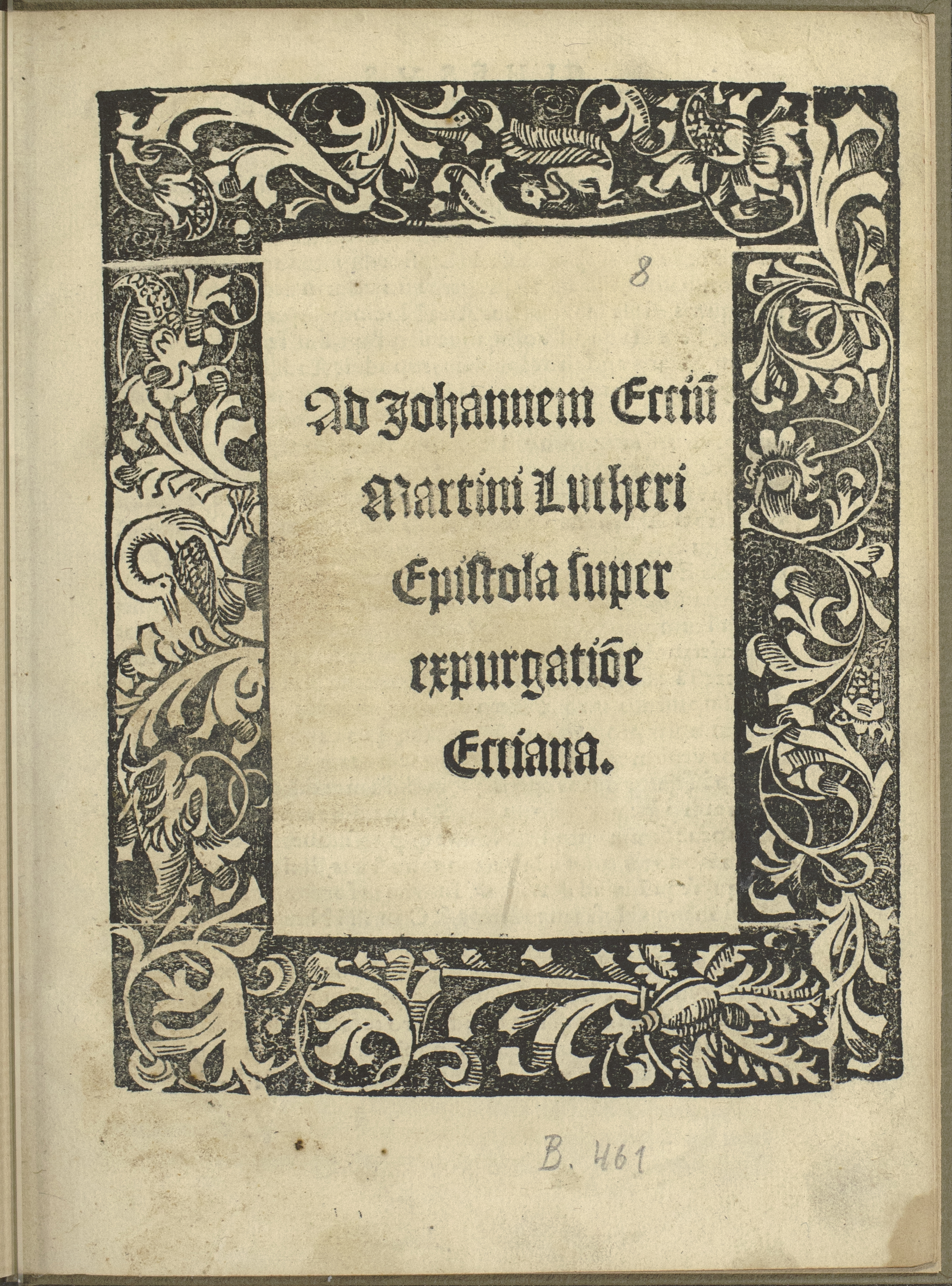
TextAd Johannem Ecciu[m]
Luther, Martin, 1483-1546Summary: A unique printing of an answer by Luther to the attacks of one his earliest opponents, Johann Eck.Summary: A unique printing of an answer by Luther to the attacks of one his earliest opponents, Johann Eck. -
 Text
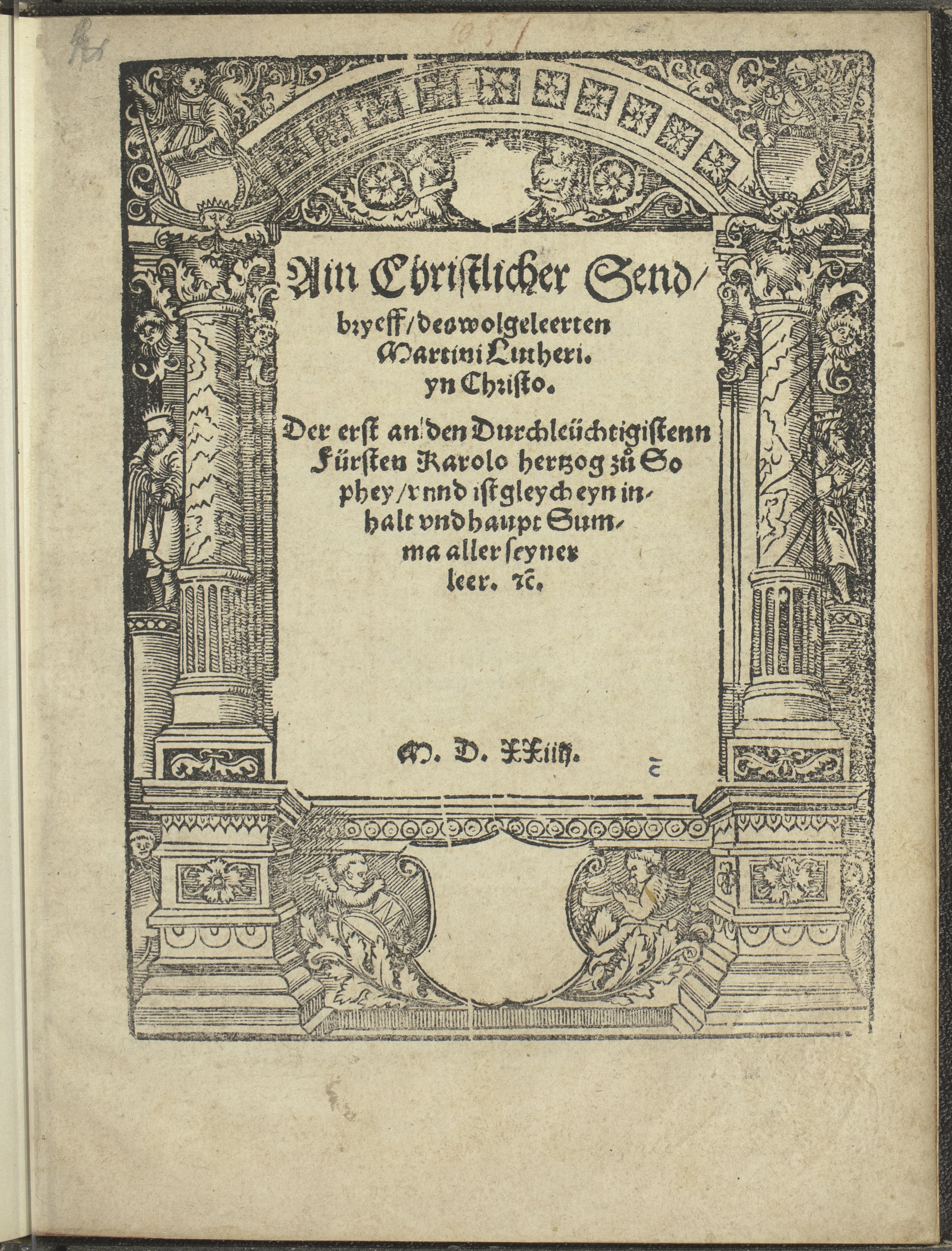
TextAin Christlicher Sendbryeff
Luther, Martin, 1483-1546Summary: This work is an anonymous translation to German from Latin of Luther's letter (Ad inlustrissimum principem Carolum Sabaudiae ducem Epistola) to Duke Charles III of Savoy, dated September 7, 1523.Summary: This work is an anonymous translation to German from Latin of Luther's letter (Ad inlustrissimum principem Carolum Sabaudiae ducem Epistola) to Duke Charles III of Savoy, dated September 7, 1523. -
 Text
TextAmbrosii Catharini olim La[n]cinoti co[n]tra Martinu[m] Lutherum super his verbis, Tu es Petrus [et cetera], Et tibi dabo claues regni celorum [et cetera], Mathei xvi. : Dialogus [i?]n minus disertus qua[m] elegans et festiuus : Roffensis Episcopi loca qu[a]edam quibus predicta[m] auctoritate[m] cu[m] duabus alijs Matthei scz xviij. & Ioa[n]nis xx. eiusdem monet[a]e, sed no[n] eiusdem valoris comparat, & discrimen earu[m] euidenti scripturaru[m] testimonio declarat.
Ambrosius Catharinus, Archbishop of Conza, 1484-1553Summary: A selection of criticisms of Luther's views on the spiritual origins of the Papacy by one of his early opponents, Ambrosius Catharinus, edited by another of his early opponents, Hieronymus Emser, and dedicated by Emser to a third Luther opponent, Paul Bachmann, Abbot of Altenzelle.Summary: A selection of criticisms of Luther's views on the spiritual origins of the Papacy by one of his early opponents, Ambrosius Catharinus, edited by another of his early opponents, Hieronymus Emser, and dedicated by Emser to a third Luther opponent, Paul Bachmann, Abbot of Altenzelle. -
 Text
TextAn den Durchleüchtigen Hochgepornen Fürsten vnd Herrn, Herrn Albrechten, Marggraffen zuo Brandenburg, inn Preussen [et]c. Hertzogen [et]c. Ein Sendbrief Doct. Mart. Luth. Wider ettliche Rottengeyster : Wittemberg, M.D.XXXII
Luther, Martin, 1483-1546Summary: Luther's reply to a letter from Duke Albrecht of Brandenburg, concerning the interpretation of John VI with reference to the Lord's Supper.Summary: Luther's reply to a letter from Duke Albrecht of Brandenburg, concerning the interpretation of John VI with reference to the Lord's Supper. -
 Still image
Architectural historiated title page of Deudsch Catechismus
An architectural historiated woodcut border on the title page of Luther's German Catechism. The border consists of a decorative arch, topped with a pair of cherubs supporting a roundel with the Luther rose on the left and a crest with the Lamb of God on the right. At the bottom of the page, the scene of the Crucifixion is depicted with Jesus in the center, flanked by the two thieves, however as the bottom right corner of the page is torn away, the second thief is missing.An architectural historiated woodcut border on the title page of Luther's German Catechism. The border consists of a decorative arch, topped with a pair of cherubs supporting a roundel with the Luther rose on the left and a crest with the Lamb of God on the right. At the bottom of the page, the scene of the Crucifixion is depicted with Jesus in the center, flanked by the two thieves, however as the bottom right corner of the page is torn away, the second thief is missing. -
 Still image
Augustinian Monk
A woodcut full-body portrait of either Martin Luther or Michael Stifel dressed in the garb of an Augustinian monk and holding a book.A woodcut full-body portrait of either Martin Luther or Michael Stifel dressed in the garb of an Augustinian monk and holding a book. -
 Still image
Augustinian Monk
A woodcut full-body portrait of a figure, possibly of Martin Luther, dressed in the garb of an Augustinian monk and holding a book.A woodcut full-body portrait of a figure, possibly of Martin Luther, dressed in the garb of an Augustinian monk and holding a book. -
 Still image
Augustinian Monk with decorative border
A woodcut full-body portrait of either Martin Luther or Michael Stifel dressed in the garb of an Augustinian monk and holding a book. Surrounding the monk is a separate woodcut border featuring cherubs and Wild Men in trees and the coat of arms of the Holy Roman Empire at the bottom.A woodcut full-body portrait of either Martin Luther or Michael Stifel dressed in the garb of an Augustinian monk and holding a book. Surrounding the monk is a separate woodcut border featuring cherubs and Wild Men in trees and the coat of arms of the Holy Roman Empire at the bottom. -
 Text
TextBvlla decimi Leonis, contra errores Martini Lutheri, & sequacium
Summary: First printing of the first edition of Hutten's edition of the papal bull Exsurge Domine, which condemns as heretical 41 statements by Martin Luther and offers Luther 60 days to recant. Hutten issued the bull with the papal coat of arms on the title page, and offers his own glosses, introduction, and call to Leo to keep his bulls to himself, and not to bother the German Protestants any longer.Summary: First printing of the first edition of Hutten's edition of the papal bull Exsurge Domine, which condemns as heretical 41 statements by Martin Luther and offers Luther 60 days to recant. Hutten issued the bull with the papal coat of arms on the title page, and offers his own glosses, introduction, and call to Leo to keep his bulls to himself, and not to bother the German Protestants any longer. -
 Text
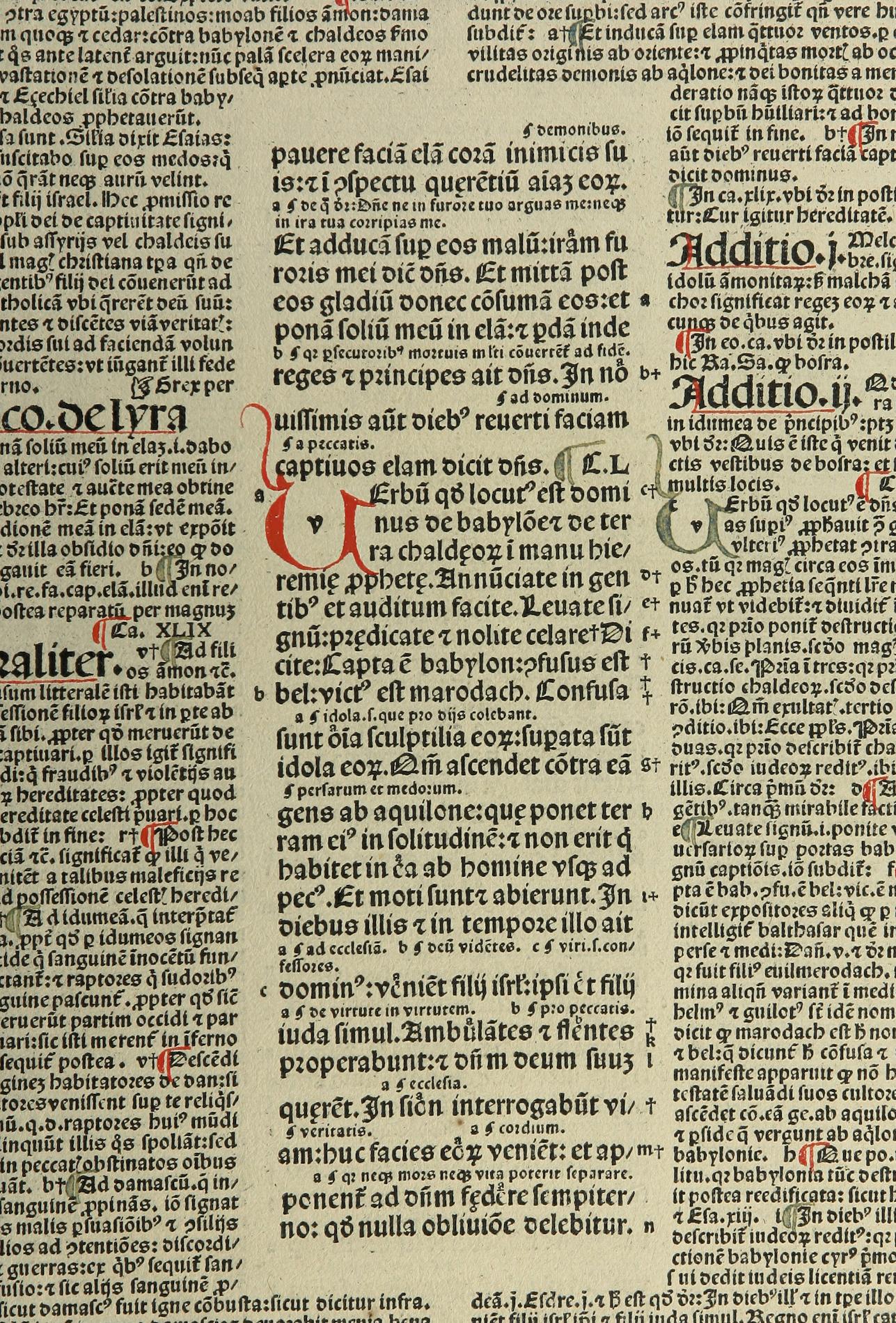
TextConfutatio XCI. articulorum e tribus Martini Lutheri Teuthonicis sermonibus excerptorum
Cochlaeus, Johannes, 1479-1552Summary: Second printing of the first edition of a tract listing 91 errors in three sermons by Martin Luther.Summary: Second printing of the first edition of a tract listing 91 errors in three sermons by Martin Luther. -
 Text
TextDe disputatio[n]e Lipsicensi : quantum ad Boemos obiter deflexa est
Emser, Hieronymus, 1478-1527Summary: A letter by Hieronymus Emser, early opponent of Luther concerning the Leipzig Disputation of 1519, describing Luther's debate with Johann Eck, and Luther's admitting that councils could err.Summary: A letter by Hieronymus Emser, early opponent of Luther concerning the Leipzig Disputation of 1519, describing Luther's debate with Johann Eck, and Luther's admitting that councils could err. -
 Still image
Des Ehrwirdigen Herrn Doctoris Martini Lutheri, gottseligen, Triumph, und Verantwortung, wider die gottlosen Schmehschrifft, der newen Münch, der Jesuiter, welche sie vnter dem Titel, Anatomia Lutheri, ausgesprenget haben
Single sheet woodcut depicting Pope Leo X on a throne that is about to topple. Behind him are priests and monks and below them a group of Jesuits, who are trying to support the toppling throne. Leo's key, the symbol of the Petrine office is crumbling in the pope's hands. Facing Leo is Martin Luther holding an open Bible. Below him is a group of reformers led by Philipp Melanchthon, each holding a book (Bible). In the center below Leo is Friedrich Staphylus depicted as Judas Iscariot. Staphylus was a student of Philipp Melanchthon's, who rejoined the Catholic Church in 1553.Single sheet woodcut depicting Pope Leo X on a throne that is about to topple. Behind him are priests and monks and below them a group of Jesuits, who are trying to support the toppling throne. Leo's key, the symbol of the Petrine office is crumbling in the pope's hands. Facing Leo is Martin Luther holding an open Bible. Below him is a group of reformers led by Philipp Melanchthon, each holding a book (Bible). In the center below Leo is Friedrich Staphylus depicted as Judas Iscariot. Staphylus was a student of Philipp Melanchthon's, who rejoined the Catholic Church in 1553. -
 Text
TextDialogus ad Martinu[m] Lutherum : pro responsione ad impertinentem quanda[m] ipsius epistolam super posita[m] veluti collocutoris vice intermixtam
Dungersheim, Hieronymus, 1465-1540Summary: H. Dungersheim had exchanged several letters with Luther before he wrote this dialogue. It was his first formal controversialist tract, written in 1520, but not published until 1531. Luther burned a manuscript copy of this work when he burned the bull Exsurge Domine on December 10, 1520.Summary: H. Dungersheim had exchanged several letters with Luther before he wrote this dialogue. It was his first formal controversialist tract, written in 1520, but not published until 1531. Luther burned a manuscript copy of this work when he burned the bull Exsurge Domine on December 10, 1520. -
 Text
TextDisputatio domini Johannis Eccij et P. Martini Luther in Studio Lipsiensi futura
Luther, Martin, 1483-1546Summary: This is Luther's first public attack on Johannes Eck. Included in this volume are Eck's letter of Dec. 24, 1518 in which he records his theological differences with Karlstadt, and Eck's own 12 theses with Luther's response.Summary: This is Luther's first public attack on Johannes Eck. Included in this volume are Eck's letter of Dec. 24, 1518 in which he records his theological differences with Karlstadt, and Eck's own 12 theses with Luther's response. -
 Text
TextDisputatio inter Egregios & praelatus virus ac doctores, Joannem Ecci[um] & Martinum Lutherum in p[rae]sentia notariorum habita
Luther, Martin, 1483-1546Summary: Unique printing of the original notarial protocol of the Leipzig Disputation between Andreas Karlstadt and Martin Luther on the one hand, and Johann Eck, on the other. Includes fully two thirds of the several day debate, and all of the famous "duel" between Luther and Eck on authority in the church. The debates were copied by two notaries, and, at the end of each day's sessions, were verified by two witnesses.Summary: Unique printing of the original notarial protocol of the Leipzig Disputation between Andreas Karlstadt and Martin Luther on the one hand, and Johann Eck, on the other. Includes fully two thirds of the several day debate, and all of the famous "duel" between Luther and Eck on authority in the church. The debates were copied by two notaries, and, at the end of each day's sessions, were verified by two witnesses. -
 Text
TextDisticha de uita et praecipuis rebus gestis uiri Dei et...
Stoltz, Johann, circa 1514-1556Twenty distichs (couplets) inspired by important events in the life of Martin Luther. The couplets, in Latin, were composed ca. 1550 and are written on paper. The author's name is found at the end of the piece as is his dedication of it to Johann Kestner. Pencil markings of a later owner are located in the upper left corner of the first page. Originally part of a signature, each of the two leaves has been encapsulated in Mylar for protection.Twenty distichs (couplets) inspired by important events in the life of Martin Luther. The couplets, in Latin, were composed ca. 1550 and are written on paper. The author's name is found at the end of the piece as is his dedication of it to Johann Kestner. Pencil markings of a later owner are located in the upper left corner of the first page. Originally part of a signature, each of the two leaves has been encapsulated in Mylar for protection. -
 Text
TextEegister [i.e. Register] aller Schrifften des Ehrwirdigen Herrn D. Martini Lutheri, : gerichtet zugleich auff die XIX. Wittenbergischen, vnd XII. Jhenischen Tomos, beyders [sic] des Alten vnd Newen Drucks, allen Liebhabern der Bücher Lutheri gantz nützlich zu gebrauchen
Suevus, Sigismundus, 1526-1596Summary: This is a very rare example of the index prepared to help students find specific works by Luther. Since Luther's writings had been collected in two different sets--the nineteen volume Wittenberg edition, and the twelve volume Jena edition--such an index was necessary.Summary: This is a very rare example of the index prepared to help students find specific works by Luther. Since Luther's writings had been collected in two different sets--the nineteen volume Wittenberg edition, and the twelve volume Jena edition--such an index was necessary. -
 Text
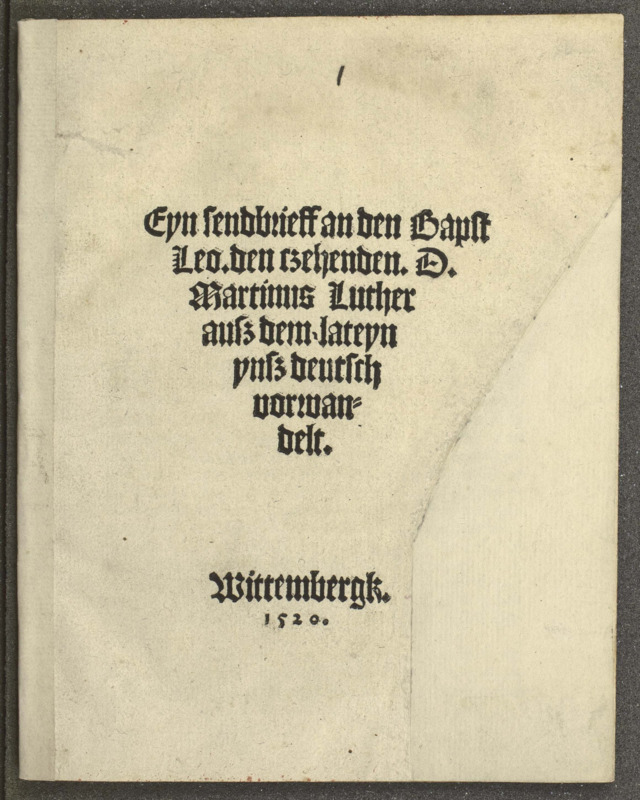
TextEyn Sendbrieff an den Bapst Leo den Czehenden
Luther, Martin, 1483-1546Summary: A letter by Luther to Pope Leo X. Leo had issued his famous bull 'Exsurge Domine' on June 15 1520, demanding that Luther recant his teachings of face excommunication. Luther responded with this letter in September, seeking to explain his position, calling for the church to reform, while emphasizing that his critiques have been directed against abuses within the church, not against the person or office of the pope.Summary: A letter by Luther to Pope Leo X. Leo had issued his famous bull 'Exsurge Domine' on June 15 1520, demanding that Luther recant his teachings of face excommunication. Luther responded with this letter in September, seeking to explain his position, calling for the church to reform, while emphasizing that his critiques have been directed against abuses within the church, not against the person or office of the pope.