Search
430 resources
430 items
Quarto
-
 Still image
Coat of Arms of Johann "The Constant", Elector of Saxony
Cranach, Lucas, 1472-1553A woodcut depicting the coat of arm sof Johann "the Constant" (or "Steadfast"), Elector of Saxony, who was a supporter of Luther and his movement. The coat of arms features a pair of crossed swords at the center, surrounded by ten fields with varying iconography, including lions, eagles, and a rose. Three helmets with different crests sit above the coat of arms and the entire composition is surrounded by a host of cherubs and a pair of trees.A woodcut depicting the coat of arm sof Johann "the Constant" (or "Steadfast"), Elector of Saxony, who was a supporter of Luther and his movement. The coat of arms features a pair of crossed swords at the center, surrounded by ten fields with varying iconography, including lions, eagles, and a rose. Three helmets with different crests sit above the coat of arms and the entire composition is surrounded by a host of cherubs and a pair of trees. -
 Text
TextConfutatio XCI. articulorum e tribus Martini Lutheri Teuthonicis sermonibus excerptorum
Cochlaeus, Johannes, 1479-1552Summary: Second printing of the first edition of a tract listing 91 errors in three sermons by Martin Luther.Summary: Second printing of the first edition of a tract listing 91 errors in three sermons by Martin Luther. -
 Text
TextContra Henricum regem Angliae
Luther, Martin, 1483-1546Summary: This is the second and much expanded edition of Luther's reply to Henry VIII's Assertion of the Seven Sacraments. Luther replies quite moderately (for him) to what he feels to be the King's unwarranted assertions on the Catholic Sacraments. This is the second printing of this edition.Summary: This is the second and much expanded edition of Luther's reply to Henry VIII's Assertion of the Seven Sacraments. Luther replies quite moderately (for him) to what he feels to be the King's unwarranted assertions on the Catholic Sacraments. This is the second printing of this edition. -
 Text
TextD. Andree Carolstatini doctoris et Archidiaconi VVittenburgensis : CCCLXX: et apologetic[a]e co[n]clusio[n]es p[er] sacris literis & Vuittenburgen[si] ita edit[a]e, vt & lectoribus p[er] futur[a]e sint
Karlstadt, Andreas Rudolff-Bodenstein von, 1486-1541Summary: After Luther had published the Ninety-five Theses, a broad academic debate spread across Germany on the question of the validity of indulgences. The debate was soon joined by Eck of Ingolstadt, representing the Catholic position. Karlstadt, a senior theologian at Wittenberg seems to have taken the lead in defending his colleague with his work, a series of disputations held at the University of Wittenberg beginning May 14, 1518, and continuing beyond July 7, 1518.Summary: After Luther had published the Ninety-five Theses, a broad academic debate spread across Germany on the question of the validity of indulgences. The debate was soon joined by Eck of Ingolstadt, representing the Catholic position. Karlstadt, a senior theologian at Wittenberg seems to have taken the lead in defending his colleague with his work, a series of disputations held at the University of Wittenberg beginning May 14, 1518, and continuing beyond July 7, 1518. -
 Text
TextD. Sebastian Meyers, etwan Predicanten zun Barfussern zu Strassburg, Widerrüffung an eyn löblich Freystat Strassburg. Anno M.D.XXiiij
Meyer, Sebastian, 1465-1545?Summary: Public renunciation of his monastic vows and earlier teachings by Sebastian Meyer, a preacher in the city of Strassburg and an early follower of Martin Luther.Summary: Public renunciation of his monastic vows and earlier teachings by Sebastian Meyer, a preacher in the city of Strassburg and an early follower of Martin Luther. -
 Text
TextDas Eltern die kinder zuo der Ehe nicht zwinge[n] noch hindern, : Vnd die kinder on der elltern willen sich nicht verloben solle[n]
Luther, Martin, 1483-1546Summary: Parental consent was an issue during the Reformation. Catholic orthodoxy demanded parental consent of the bridal couple as it impacted property. Luther saw value in both sides, arguing that while parents ought not to be able to compel children to marry or prevent weddings, the children ought to seek their parents' consent.Summary: Parental consent was an issue during the Reformation. Catholic orthodoxy demanded parental consent of the bridal couple as it impacted property. Luther saw value in both sides, arguing that while parents ought not to be able to compel children to marry or prevent weddings, the children ought to seek their parents' consent. -
 Text
TextDas Euangelium vom fischfang Petri
Luther, Martin, 1483-1546Summary: Sermon preached July 20, 1522, on Luke 5:1-11 (Peter's large catch of fish).Summary: Sermon preached July 20, 1522, on Luke 5:1-11 (Peter's large catch of fish). -
 Text
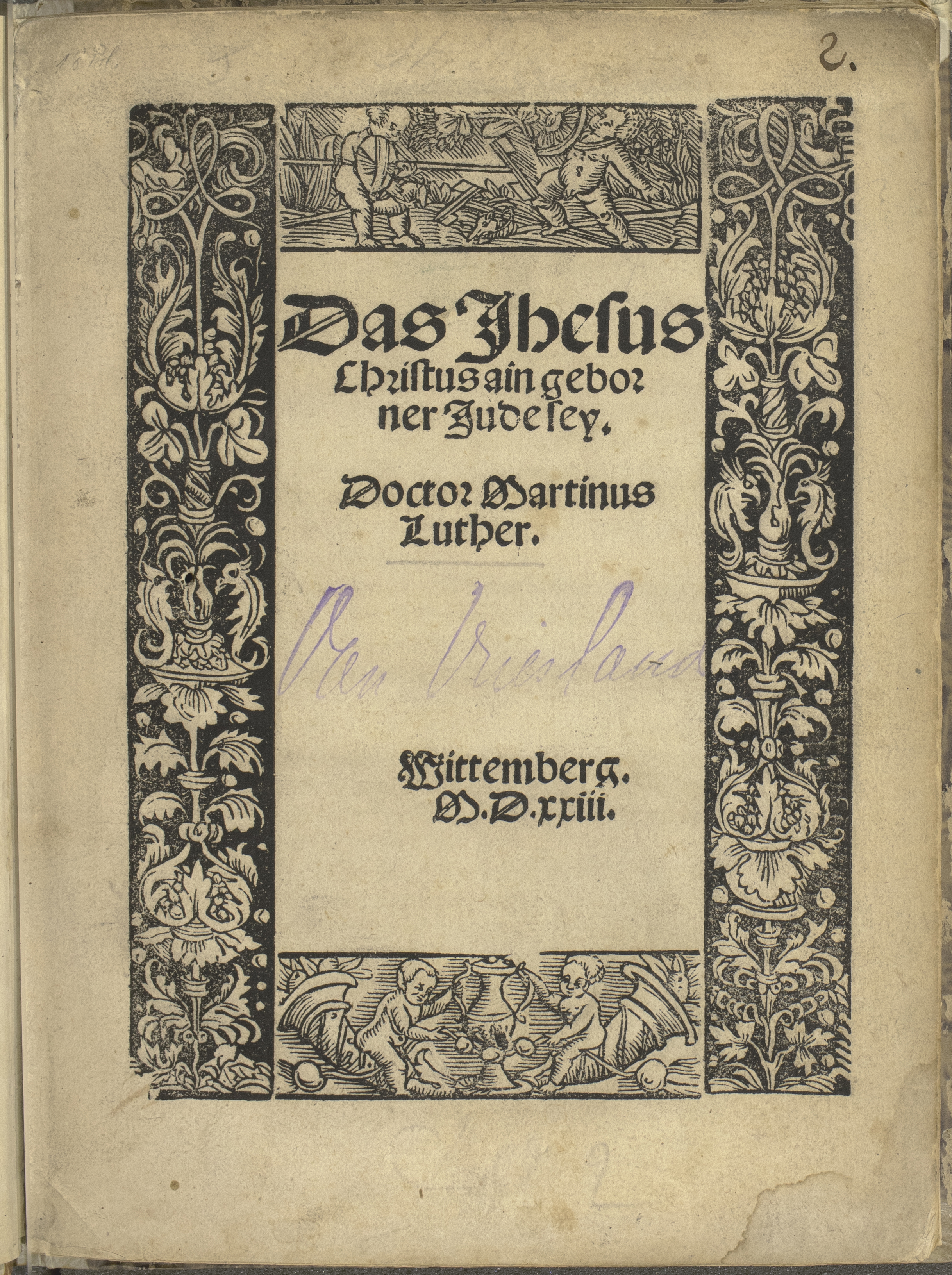
TextDas Ihesus Christus ain geborner Iude sey
Luther, Martin, 1483-1546Summary: The sixth printing (of ten in 1523) of Luther's early treatise, "That Jesus Christ was born a Jew", in which he denies the charges made against him that he did not believe in the Virgin Birth, but rather that Jesus was a naturally born child of Joseph and Mary. In this tract, Luther confesses that he believes that Jesus was born a Jew of the Virgin Mary. He also hopes that his teaching will bring more Jews to convert to Christianity.Summary: The sixth printing (of ten in 1523) of Luther's early treatise, "That Jesus Christ was born a Jew", in which he denies the charges made against him that he did not believe in the Virgin Birth, but rather that Jesus was a naturally born child of Joseph and Mary. In this tract, Luther confesses that he believes that Jesus was born a Jew of the Virgin Mary. He also hopes that his teaching will bring more Jews to convert to Christianity. -
 Text
TextDas Ihesus Christus ain geborner Iude sey
Luther, Martin, 1483-1546Summary: The fifth printing of Luther's early treatise, "That Jesus Christ was born a Jew", in which he denies the charges made against him that he did not believe in the Virgin Birth, but rather that Jesus was a naturally born child of Joseph and Mary. In this tract, Luther confesses that he believes that Jesus was born a Jew of the Virgin Mary. He also hopes that his teaching will bring more Jews to convert to Christianity.Summary: The fifth printing of Luther's early treatise, "That Jesus Christ was born a Jew", in which he denies the charges made against him that he did not believe in the Virgin Birth, but rather that Jesus was a naturally born child of Joseph and Mary. In this tract, Luther confesses that he believes that Jesus was born a Jew of the Virgin Mary. He also hopes that his teaching will bring more Jews to convert to Christianity. -
 Text
TextDas Jesus Christus ein geborner Jude sey
Luther, Martin, 1483-1546Summary: Luther was accused by Ferdinand (brother of Charles V) of teaching that Jesus was the seed of Abraham and that Mary was not a virgin either before or after the birth of Jesus. Luther replied with this booklet that demonstrated the human and divine natures of Jesus and showed sensitivity to Jesus' Jewish background. Luther hoped that books like this could be used to convert Jews from their erroneous beliefs.Summary: Luther was accused by Ferdinand (brother of Charles V) of teaching that Jesus was the seed of Abraham and that Mary was not a virgin either before or after the birth of Jesus. Luther replied with this booklet that demonstrated the human and divine natures of Jesus and showed sensitivity to Jesus' Jewish background. Luther hoped that books like this could be used to convert Jews from their erroneous beliefs. -
 Text
TextDas Jhesus Nazarenus der ware Messias sey : Derhalben die Juden auff kaynen andern warten dörffen
Samuel, MarochitanusSummary: German translation by Wenzeslaus Linck of Epistola contra Judaeorum, thought to be written in Arabic by Samuel of Marocco, an apostate Jew at the beginning of the 11th century and translated into Latin by the Spanish Dominican Alphonsus Bonihominis in the 14th century and widely disseminated. Bonihominis is likely the real author of the work.Summary: German translation by Wenzeslaus Linck of Epistola contra Judaeorum, thought to be written in Arabic by Samuel of Marocco, an apostate Jew at the beginning of the 11th century and translated into Latin by the Spanish Dominican Alphonsus Bonihominis in the 14th century and widely disseminated. Bonihominis is likely the real author of the work. -
 Text
TextDas Magnificat Vorteutschet vnd auszgelegt
Luther, Martin, 1483-1546Summary: Luther wrote this exposition of the Magnificent (Luke 1:46-55) in March 1521. He dedicated it to Duke Johann Frederich of Saxony as a token of his thanks to the Duke for his support and encouragement after Luther's condemnation by Pope Leo X. Text in German includes Luther's German translation of the Magnificat from the N.T. Greek of St. Luke's Gospel.Summary: Luther wrote this exposition of the Magnificent (Luke 1:46-55) in March 1521. He dedicated it to Duke Johann Frederich of Saxony as a token of his thanks to the Duke for his support and encouragement after Luther's condemnation by Pope Leo X. Text in German includes Luther's German translation of the Magnificat from the N.T. Greek of St. Luke's Gospel. -
 Text
TextDas Tauff Buchlin
Luther, Martin, 1483-1546Summary: Luther's German translation of the Wittenberg usage of the Catholic rite of Baptism (Ordo baptizandi). The work was reprinted fifteen times between 1523 and 1526, when Luther issued a revised edition.Summary: Luther's German translation of the Wittenberg usage of the Catholic rite of Baptism (Ordo baptizandi). The work was reprinted fifteen times between 1523 and 1526, when Luther issued a revised edition. -
 Text
TextDas ander teyl widder die hymlischen Propheten, vom Sacrament.
Luther, Martin, 1483-1546Summary: The Second printing of Luther's book, "Against the Heavenly Prophets addresses A. Karlstadt's doctrine of the Sacraments. This is the second printing of this work in its year of issue.Summary: The Second printing of Luther's book, "Against the Heavenly Prophets addresses A. Karlstadt's doctrine of the Sacraments. This is the second printing of this work in its year of issue. -
 Text
TextDas der frey will nichts sey : Anntwort D. Martini Luther ann Erasmum Rotherdam
Luther, Martin, 1483-1546Summary: German translation by Martin Luther's colleague, Justus Jonas, of "De servo arbitrio". "De servo arbitrio (Concerning the Enslaved Will)" is considered one of Luther's greatest literary productions, and among the most important writings of the Reformation. In it, he defends the idea of the complete inability of the human being to please God, apart from Divine grace.Summary: German translation by Martin Luther's colleague, Justus Jonas, of "De servo arbitrio". "De servo arbitrio (Concerning the Enslaved Will)" is considered one of Luther's greatest literary productions, and among the most important writings of the Reformation. In it, he defends the idea of the complete inability of the human being to please God, apart from Divine grace. -
 Text
TextDas lob der Pfarrer von dem vnnutzen kosten der gelegt wirt von dem gemainen vnuerstendigen volck auff mess lesen, volgungen, begrebnus, sybent, dreysigst, jartag, rc. : Vnd vo[m] lob der Pfarrer vnnd irer nötigen Caplan.
Eberlin von Günzburg, Johann, approximately 1470-1533Summary: One of the problems that led to the Reformation was the sad state of ecclesiastical finance that forced many priests to change fees for the sacraments and other services. Von Gunzburg subjects such practices to sharp sanitization in the form of "praise of priests."Summary: One of the problems that led to the Reformation was the sad state of ecclesiastical finance that forced many priests to change fees for the sacraments and other services. Von Gunzburg subjects such practices to sharp sanitization in the form of "praise of priests." -
 Text
TextDas schön Confitemini an der zal der CXVIII Psalm
Luther, Martin, 1483-1546Summary: Text in German includes Luther's German translation of Psalms CXVIII from the Hebrew O.T., and is Luther's expanded version of his earlier Latin work.Summary: Text in German includes Luther's German translation of Psalms CXVIII from the Hebrew O.T., and is Luther's expanded version of his earlier Latin work. -
 Text
TextDas schön Confitemini an der zal der cxviij. Psalm
Luther, Martin, 1483-1546Summary: This is the third printing of Luther's German translation of his notes on Psalm 118. An Earlier German translation version had been published by Wenzeslaus Linck. Luther's expanded edition, as reprinted here, differs from Linck's in that it uses Eobanus Hessus' verse translation of the psalm, prepared with Luther's advice, as the scriptural text. Text in German includes Luther's German translation of Psalms CXVIII from the Hebrew O.T., and is Luther's expanded version of his earlier Latin work.Summary: This is the third printing of Luther's German translation of his notes on Psalm 118. An Earlier German translation version had been published by Wenzeslaus Linck. Luther's expanded edition, as reprinted here, differs from Linck's in that it uses Eobanus Hessus' verse translation of the psalm, prepared with Luther's advice, as the scriptural text. Text in German includes Luther's German translation of Psalms CXVIII from the Hebrew O.T., and is Luther's expanded version of his earlier Latin work. -
 Text
TextDe Petro et Roma adversus Velenu[m] Lutheranum, libri quatuor
Cochlaeus, Johannes, 1479-1552Summary: Oldrich Velensky, Latinized as Ulrich Velenus, was a Bohemian Protestant who opposed the papal claims to power based on St. Peter's residence and martyrdom in Rome. Cochlaeus upholds the traditional Catholic view that St. Peter was martyred in Rome in the reign of Nero in this volume against Velensky's criticism.Summary: Oldrich Velensky, Latinized as Ulrich Velenus, was a Bohemian Protestant who opposed the papal claims to power based on St. Peter's residence and martyrdom in Rome. Cochlaeus upholds the traditional Catholic view that St. Peter was martyred in Rome in the reign of Nero in this volume against Velensky's criticism. -

-
 Text
TextDe disputatio[n]e Lipsicensi : quantum ad Boemos obiter deflexa est
Emser, Hieronymus, 1478-1527Summary: A letter by Hieronymus Emser, early opponent of Luther concerning the Leipzig Disputation of 1519, describing Luther's debate with Johann Eck, and Luther's admitting that councils could err.Summary: A letter by Hieronymus Emser, early opponent of Luther concerning the Leipzig Disputation of 1519, describing Luther's debate with Johann Eck, and Luther's admitting that councils could err.