Search
5912 resources
347 item sets
5912 items
-
 Text
An account of the experience of Hester Ann Rogers : and her funeral sermon
Rogers, Hester Ann, 1756-1794Summary:Summary: -
 Text
An alarm to unconverted sinners, in a serious treatise, shewing ... whereunto is annexed, Divers practical cases of conscience judiciously resolved
Alleine, Joseph, 1634-1668Summary: A treatise explaining what the process of conversion is, describing its necessity, and how to identify those who may be in need of conversion.Summary: A treatise explaining what the process of conversion is, describing its necessity, and how to identify those who may be in need of conversion. -
Text
An answer in defense of the truth against the Apology of private mass
Cooper, Thomas, 1517?-1594Summary:Summary: -
 Text
An answer to Aspasio vindicated in eleven letters : said to be wrote by the late Rev. Mr. James Hervey
Sellon, WalterSummary:Summary: -
Text
An answer to Sir Thomas More's Dialogue : The supper of the Lord after the true meaning of John VI. and 1 Cor. XI. And Wm. Tracy's Testament expounded
Tyndale, William, -1536Summary:Summary: -
 Text
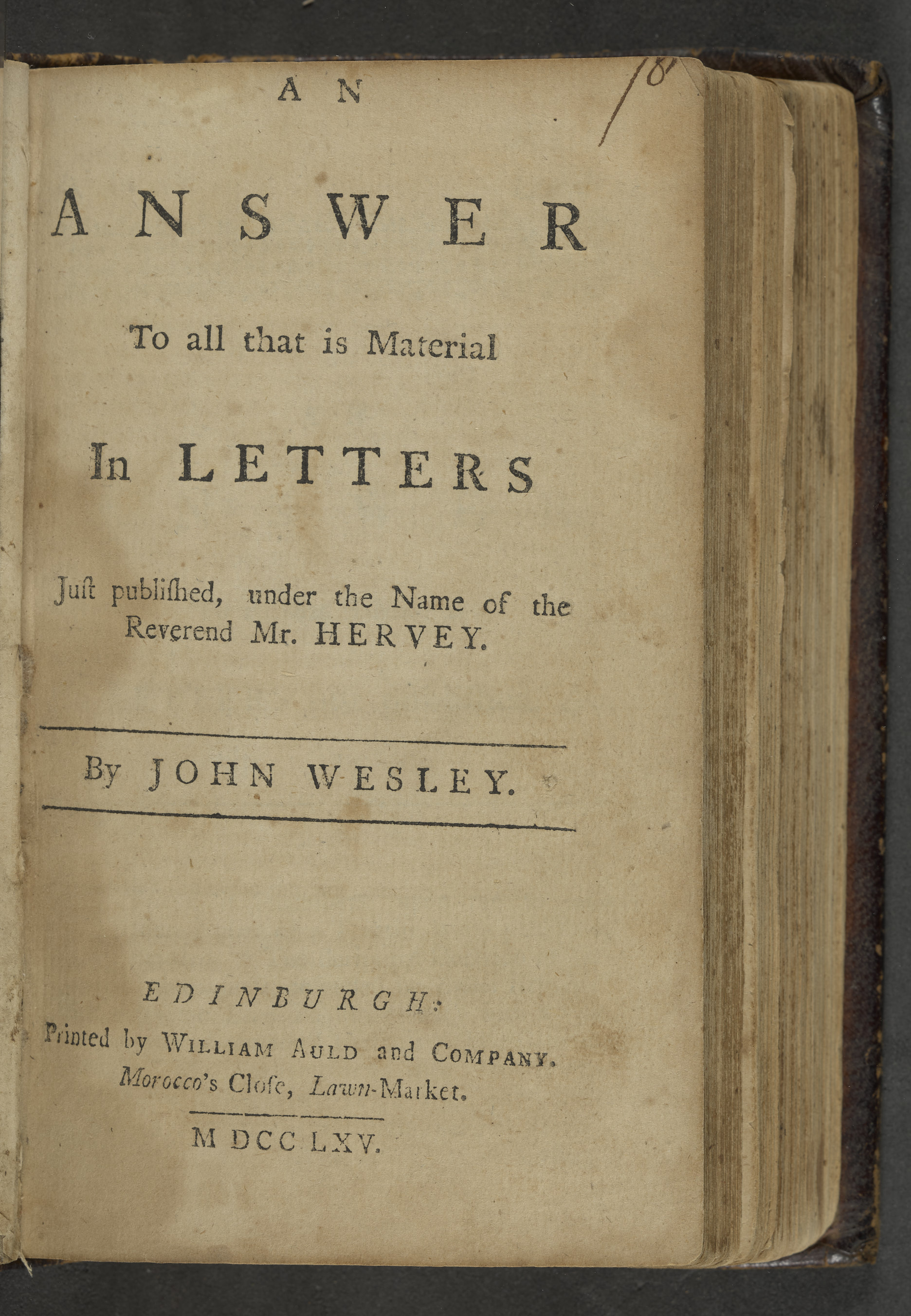
An answer to all that is material in letters just published, under the name of the Reverend Mr. Hervey
Wesley, John, 1703-1791Summary:Summary: -
 Text
An answer to every man that asketh a reason of thehope that is in us. By way of question and answer
Whitefield, George, 1714-1770Summary:Summary: -
 Text
An answer to the Request to Protestants : to produce plain Scriptures directly authorizing these tenets ...
Sherlock, William, 1641?-1707Summary: An itemized response to a set of tenets set forth by Protestants.Summary: An itemized response to a set of tenets set forth by Protestants. -
 Text
An appeal of the missionaries of the American Board of Commissioners for Foreign Missions : residing at Constantinople, to the friends and supporters of the mission in that city
Dwight, H. G. O. (Harrison Gray Otis), 1803-1862Summary: A call for assistance and support of mission work in Istanbul.Summary: A call for assistance and support of mission work in Istanbul. -
Text
An appeal to the records : a vindication of the Methodist Episcopal Church, in its policy and proceedings toward the South
Fuller, Erasmus Q. (Erasmus Quincy), 1828-1883Summary:Summary: -
 Text
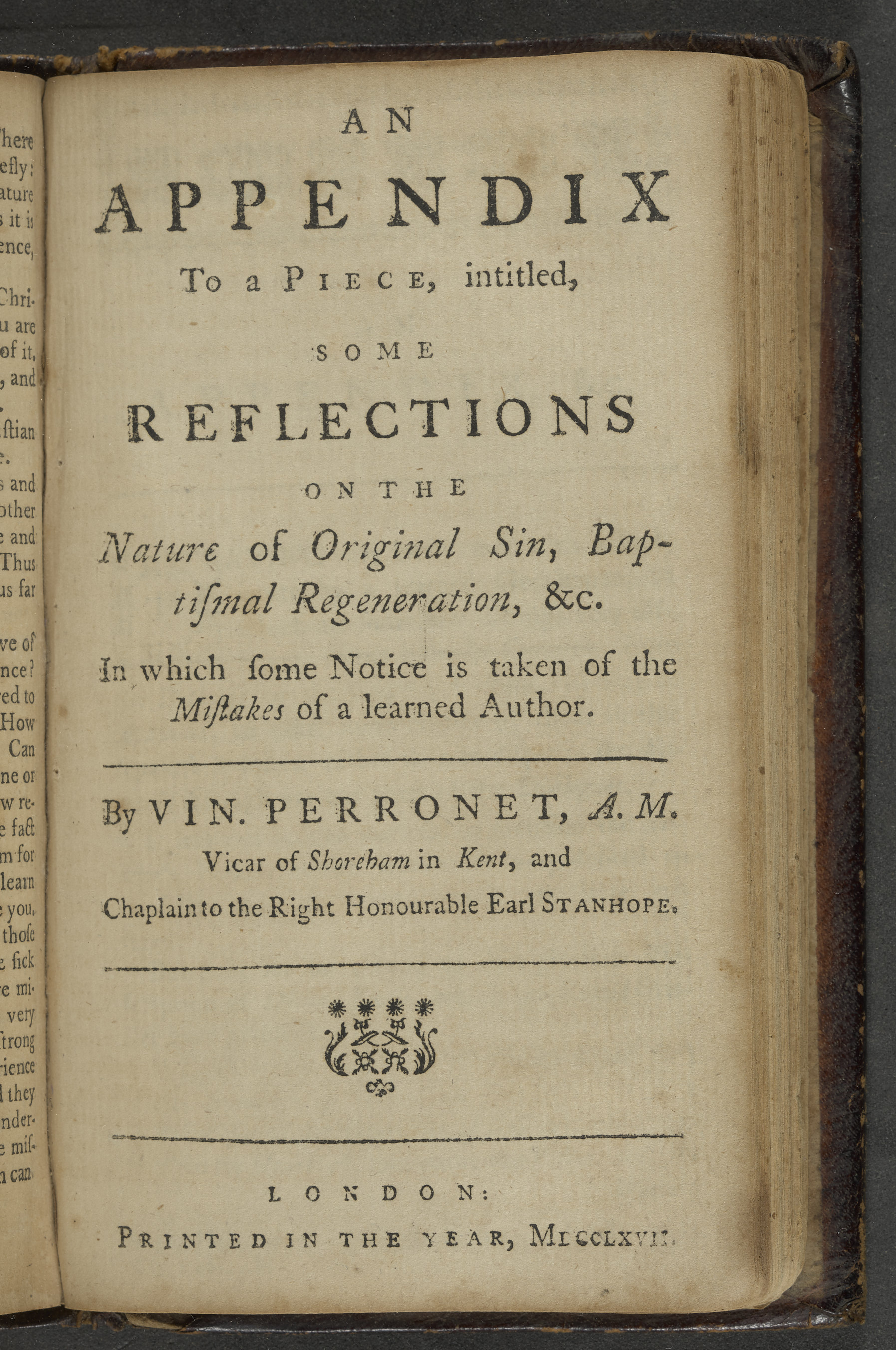
An appendix to a piece, intitled Some reflections on the nature of original sin, baptismal regeneration, &c. : in which some notice is taken of the mistakes of a learned author
Perronet, Vincent, 1693-1785Summary:Summary: -
 Text
An den Christlichen Adel deutscher Nation : von des Christlichen Standes Besserung
Luther, Martin, 1483-1546Summary: Fourth edition of the "Address to the Christian Nobility of the German Nation," one of Luther's most important pamphlets, in which he develops some of the central ideas of his theology, including the principle of universal priesthood. He also discusses the possibility of a German national church.Summary: Fourth edition of the "Address to the Christian Nobility of the German Nation," one of Luther's most important pamphlets, in which he develops some of the central ideas of his theology, including the principle of universal priesthood. He also discusses the possibility of a German national church. -
 Text
An den Christlichen Adel deutscher Nation : von des Christlichen standes besserung
Luther, Martin, 1483-1546Summary: First edition and first printing of Luther's address "To the Christian nobility of the German nation" is the first of three great Reformation booklets Luther wrote 1520. This piece was completed in August and divided into three parts: (1) an attack on the Papacy and denial of its claims, (2) a list of abuses by the papacy and curia, and (3) a list of necessary reforms.Summary: First edition and first printing of Luther's address "To the Christian nobility of the German nation" is the first of three great Reformation booklets Luther wrote 1520. This piece was completed in August and divided into three parts: (1) an attack on the Papacy and denial of its claims, (2) a list of abuses by the papacy and curia, and (3) a list of necessary reforms. -
 Text
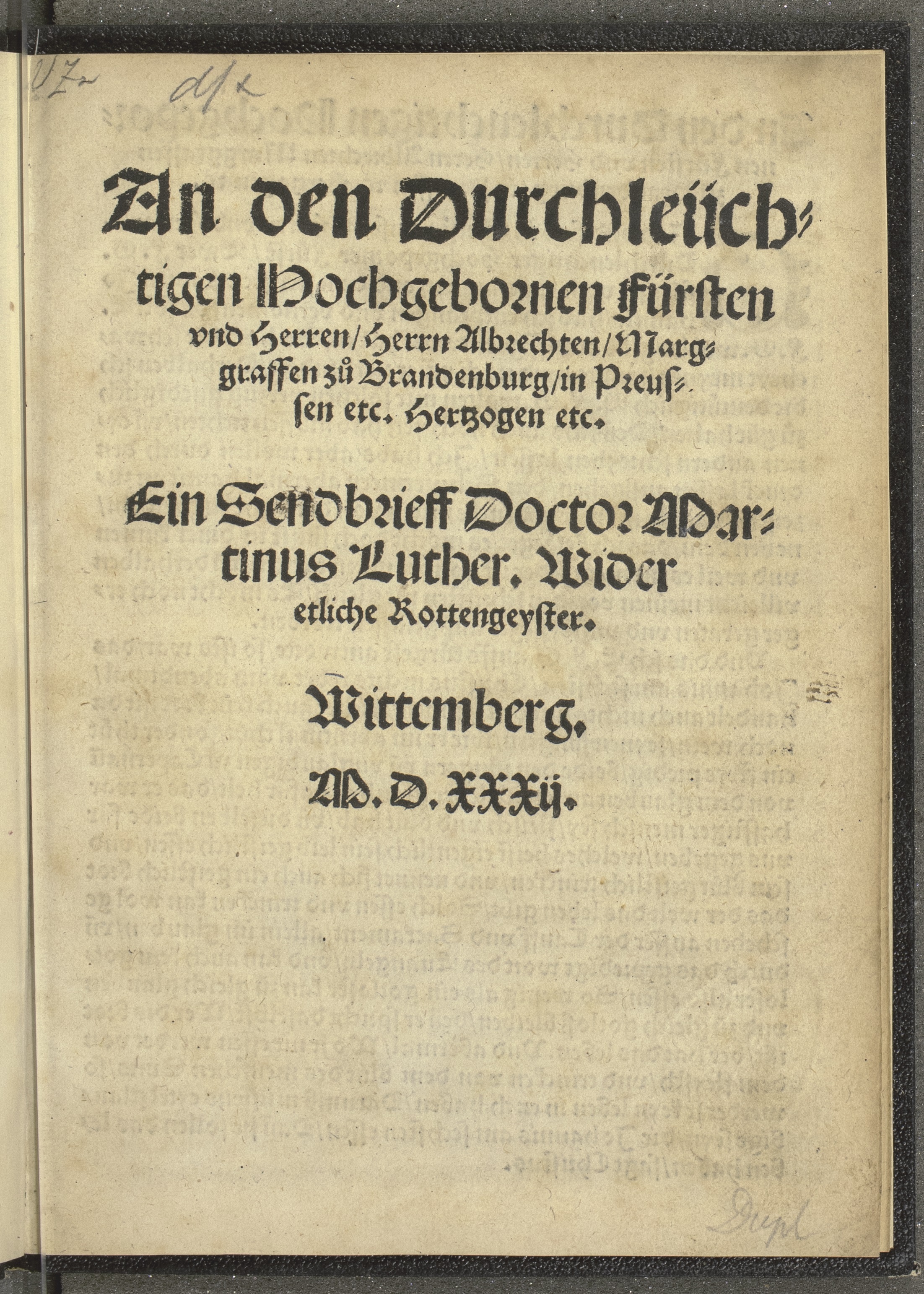
An den Durchleüchtigen Hochgebornen Fürsten vnd Herren. Herrn Albrechten, Marggraffen zuo Brandenburg, in Preussen etc. Hertzogen etc.
Luther, Martin, 1483-1546Summary: After Albrecht, Duke of Prussia and last of the Masters of the Teutonic Knights, became a Protestant, he sought out preachers to fill the pulpits in his territory. Some were Lutherans, others were followers of Schwenckfeld. Luther here warns Albrecht about the heretical tendencies of the Schwenckfelders. Albrecht came increasingly under the influence of F. Von Heideck (a Schwenckfelder) and was not especially impressed by Luther's arguments against the use of John 6 in the interpretation of the Lord's Supper.Summary: After Albrecht, Duke of Prussia and last of the Masters of the Teutonic Knights, became a Protestant, he sought out preachers to fill the pulpits in his territory. Some were Lutherans, others were followers of Schwenckfeld. Luther here warns Albrecht about the heretical tendencies of the Schwenckfelders. Albrecht came increasingly under the influence of F. Von Heideck (a Schwenckfelder) and was not especially impressed by Luther's arguments against the use of John 6 in the interpretation of the Lord's Supper. -
 Text
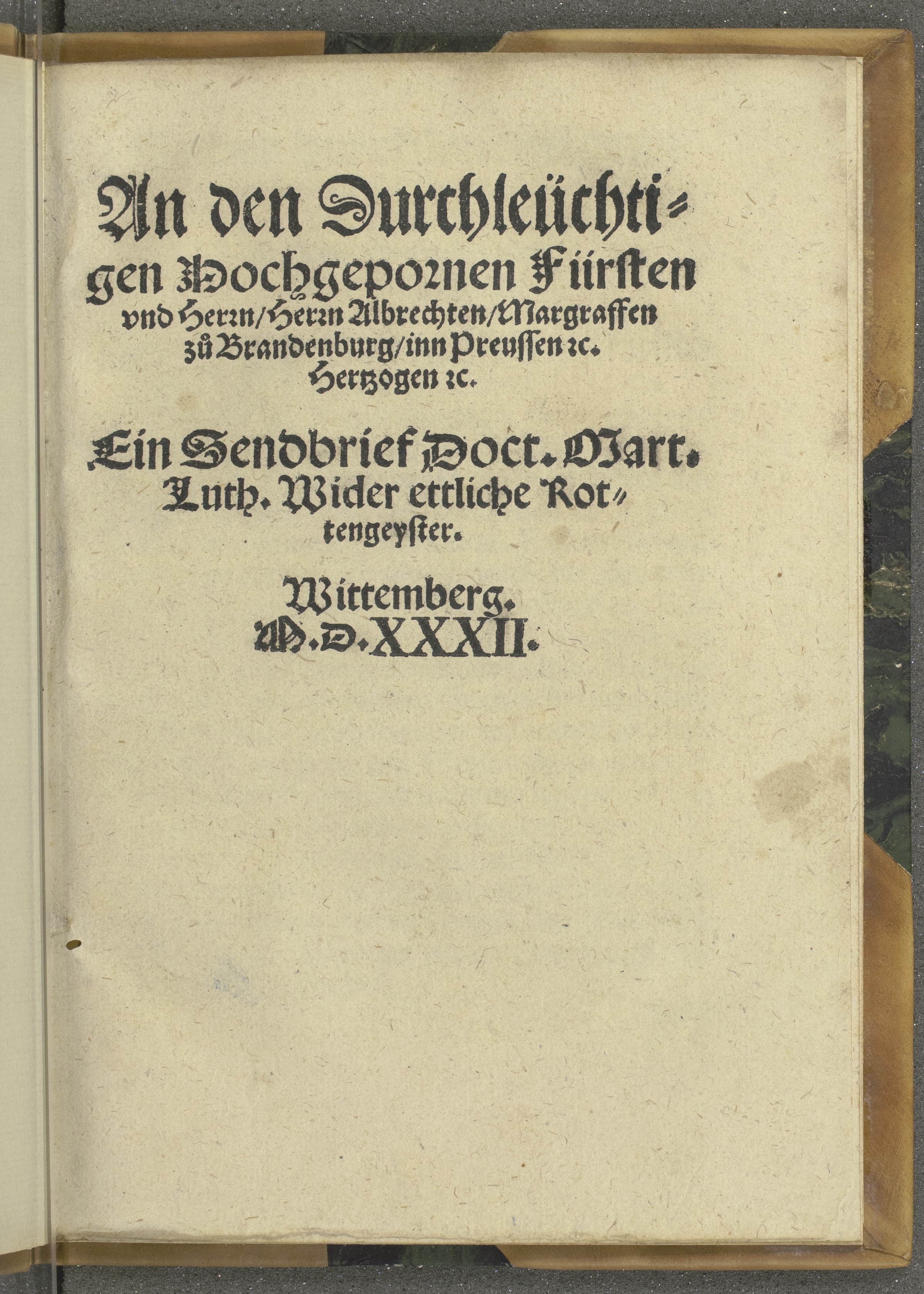
An den Durchleüchtigen Hochgepornen Fürsten vnd Herrn, Herrn Albrechten, Marggraffen zuo Brandenburg, inn Preussen [et]c. Hertzogen [et]c. Ein Sendbrief Doct. Mart. Luth. Wider ettliche Rottengeyster : Wittemberg, M.D.XXXII
Luther, Martin, 1483-1546Summary: Luther's reply to a letter from Duke Albrecht of Brandenburg, concerning the interpretation of John VI with reference to the Lord's Supper.Summary: Luther's reply to a letter from Duke Albrecht of Brandenburg, concerning the interpretation of John VI with reference to the Lord's Supper. -
 Text
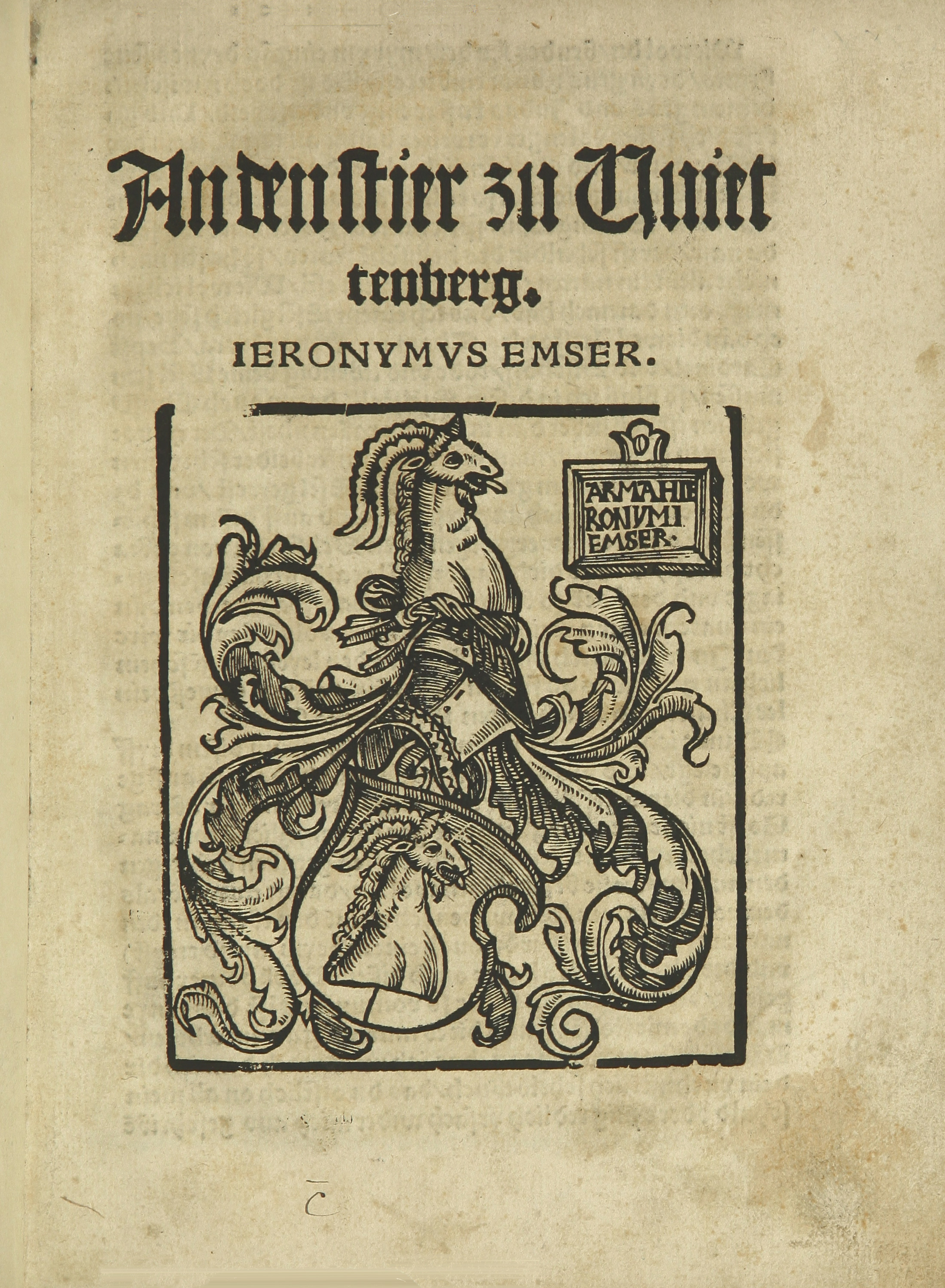
An den Stier zu Uuittenberg
Emser, Hieronymus, 1478-1527Summary: A reply to Martin Luther's "An den Bock zu Leipzig."Summary: A reply to Martin Luther's "An den Bock zu Leipzig." -
 Text
An die Herren deütschs Ordens : das sye falsche Keüscheit meyden, und zuor rechten eelichen Keuscheit greiffen, Ermanung
Luther, Martin, 1483-1546Summary: Sixth printing of a letter addressed to Albrecht von Brandenburg (later Albert, Duke of Prussia) the new General of the Teutonic Knights. In response to a question by the general, Luther applies his critique of monastic celibacy to military orders, stressing that it is pleasing to God to have families and to raise children.Summary: Sixth printing of a letter addressed to Albrecht von Brandenburg (later Albert, Duke of Prussia) the new General of the Teutonic Knights. In response to a question by the general, Luther applies his critique of monastic celibacy to military orders, stressing that it is pleasing to God to have families and to raise children. -
 Text
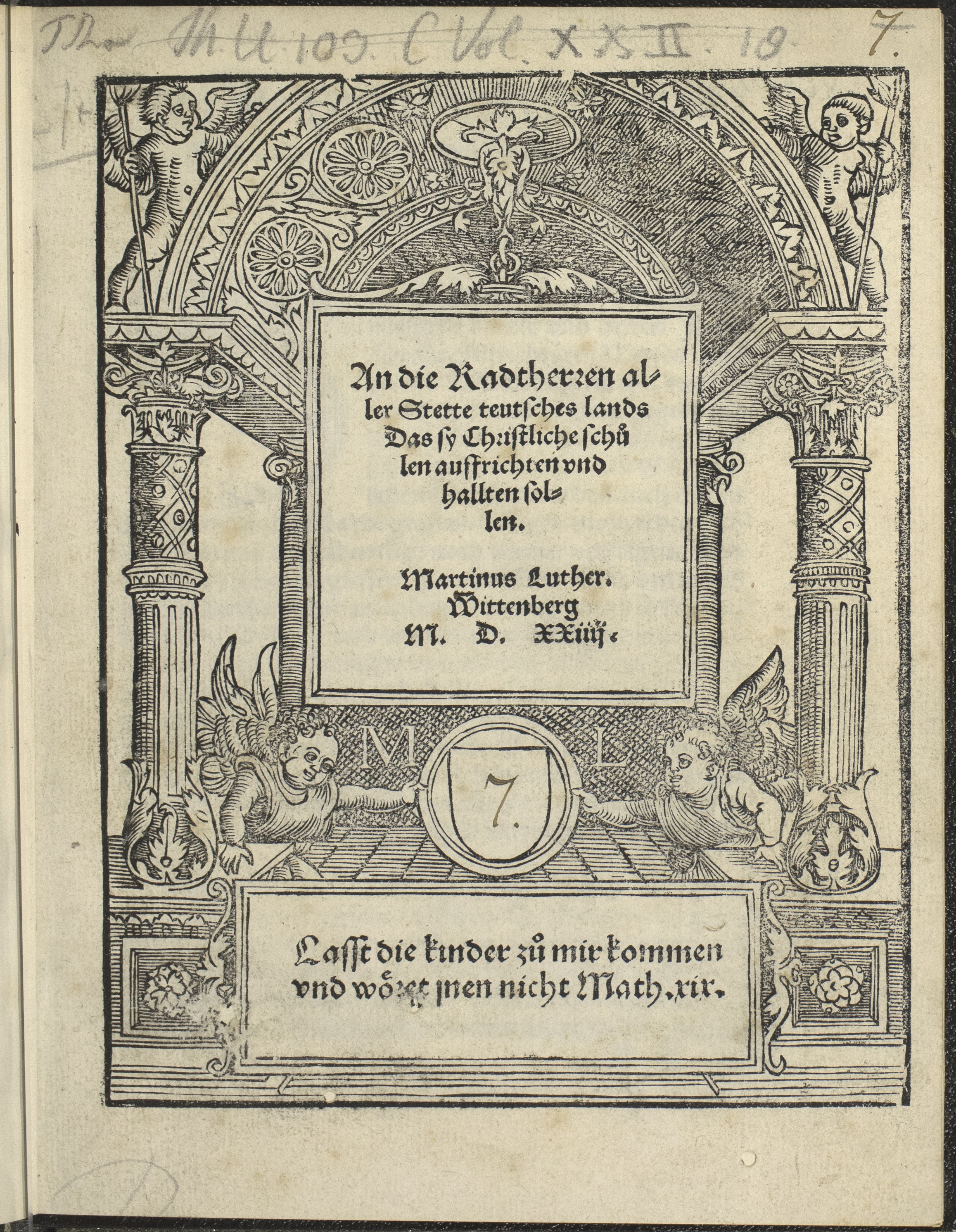
An die Radherrn aller stedte deutsches lands : das sie Christliche schulen auffrichten vnd halten sollen
Luther, Martin, 1483-1546Summary: Radical reformers such as Karlstadt believed that education was unnecessary for faith. Luther argued against such a position, asking all cities to set up schools to teach correct doctrine. He also emphasized the need for teaching Latin and Greek as part of Christian education. This is the first printing of this important tract.Summary: Radical reformers such as Karlstadt believed that education was unnecessary for faith. Luther argued against such a position, asking all cities to set up schools to teach correct doctrine. He also emphasized the need for teaching Latin and Greek as part of Christian education. This is the first printing of this important tract. -
 Text
An die Radtherren aller Stette teutsches lands : Das sy Christliche schuolen auffrichten vnd hallten sollen
Luther, Martin, 1483-1546Summary: This is the ninth printing of Luther's treatise addressed top the councilmen of Germany that they should promote the building of schools.Summary: This is the ninth printing of Luther's treatise addressed top the councilmen of Germany that they should promote the building of schools. -
 Text
An die durchtlüchtige[n] Fürsten Tütscher nation zuo Ougspurg versammlot ein Sendtbrieff Huldrych Zuinglis : die schelckwort Eggens so er wider die warheyt vszgossen betreffendt
Zwingli, Ulrich, 1484-1531Summary: Exemplar of a unique contemporary printing of Swiss Reformer Ulrich Zwingli's apology for his theological position, sent to the assembled princes at the Diet of Augsburg in 1530. Zwingli focusses especially on the Lord's Supper, in view of the criticisms of his position by Johann Eck.Summary: Exemplar of a unique contemporary printing of Swiss Reformer Ulrich Zwingli's apology for his theological position, sent to the assembled princes at the Diet of Augsburg in 1530. Zwingli focusses especially on the Lord's Supper, in view of the criticisms of his position by Johann Eck. -
 Text
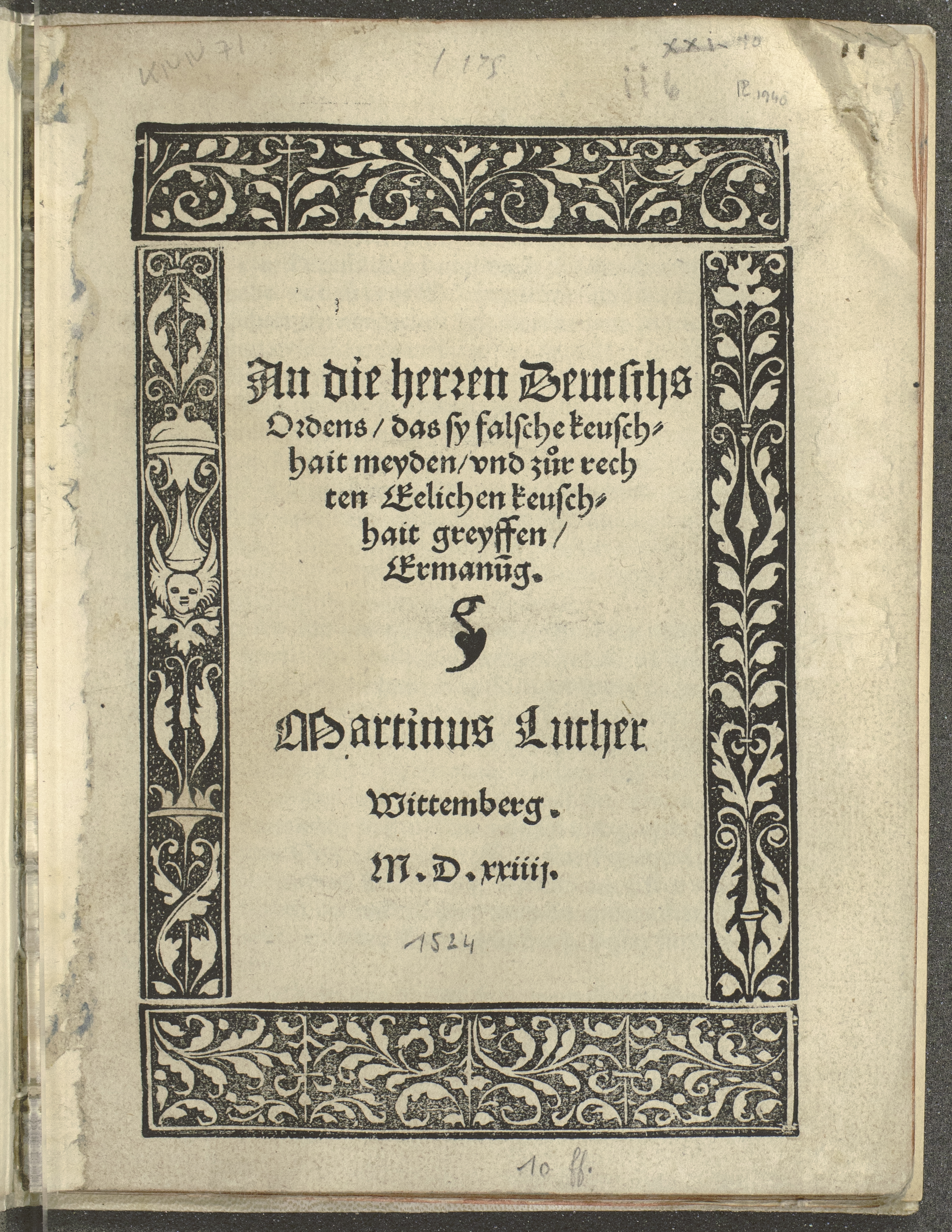
An die herren Deutschs Ordens, das sy falsche keuschhait meyden, : Vnd zuor rechten Eelichen Keuschhait greyffen, Ermanu[n]g
Luther, Martin, 1483-1546Summary: In 1523, Albert of Brandenburg-Ansbach, Grand Master of the Teutonic Knights formerly embraced Lutheranism and secularized the lands of the order in Prussia. Luther was named as his court preacher, and was one of Duke Albert's most trusted advisors. This is a letter to the members of the order, advising them to reject their vows of celibacy and marry.Summary: In 1523, Albert of Brandenburg-Ansbach, Grand Master of the Teutonic Knights formerly embraced Lutheranism and secularized the lands of the order in Prussia. Luther was named as his court preacher, and was one of Duke Albert's most trusted advisors. This is a letter to the members of the order, advising them to reject their vows of celibacy and marry.