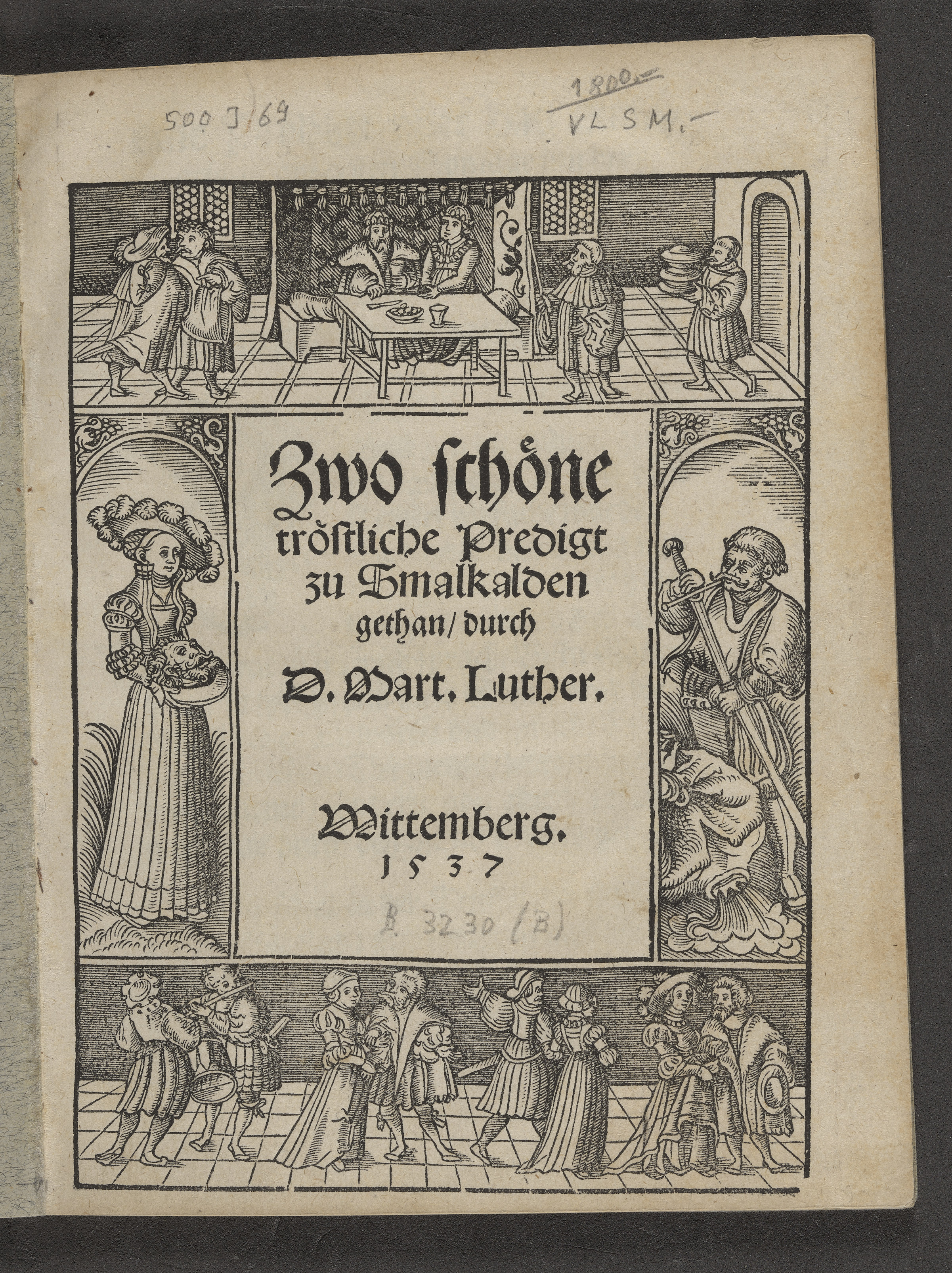
Summary: Two funeral sermons by Martin Luther on the occasion of John the Steadfast, Elector of Saxony, who had founded and headed the Smalcaldic League. John was succeeded by his son Johann Friedrich I.
Summary: Two funeral sermons by Martin Luther on the occasion of John the Steadfast, Elector of Saxony, who had founded and headed the Smalcaldic League. John was succeeded by his son Johann Friedrich I.
Summary: One sermon expanded by G. Rörer into two, preached February 18, 1537, on text: Matthew IV, 1-11. The subjects are Temptation, and Last Things.
Summary: One sermon expanded by G. Rörer into two, preached February 18, 1537, on text: Matthew IV, 1-11. The subjects are Temptation, and Last Things.
An engraving depicting the torture of Huguenots in Poitou. The image shows a man bound and forced to drink through a funnel (bottom right), a man having his hand boiled (center left), and a man forced to inhale smoke from a pipe (background center).
An engraving depicting the torture of Huguenots in Poitou. The image shows a man bound and forced to drink through a funnel (bottom right), a man having his hand boiled (center left), and a man forced to inhale smoke from a pipe (background center).
An engraved floorplan of the Basilica di Santa Maria Maggiore as restored by Pope Paul V, including outlying structures. Numbered areas are referenced within the text of the book and can be consulted for futher context.
An engraved floorplan of the Basilica di Santa Maria Maggiore as restored by Pope Paul V, including outlying structures. Numbered areas are referenced within the text of the book and can be consulted for futher context.
A facsimile of the recto of a Greek papyrus containing a treatise on the sphere based on the principles of Eudoxus, including diagrams and illustrations.
A facsimile of the recto of a Greek papyrus containing a treatise on the sphere based on the principles of Eudoxus, including diagrams and illustrations.
An eight panel folding screen supporting calligraphy of an interpretation of the Eight Beatitudes (Matthew 5) in Chinese. The artist, Rev. Eun-deok Choi, has signed the work with his sobriquet, 義山 (의산; Righteous Mountain). The artist, Rev. Choi, was an acquaintance of the former President of Methodist Theological University in Seoul, Bong-bae Park, and may have originally gifted the work to him. Park, in turn, was a friend and colleague of former Emory University President and US Ambassador to Korea, James T. Laney, and possibly gifted the work to him.
An eight panel folding screen supporting calligraphy of an interpretation of the Eight Beatitudes (Matthew 5) in Chinese. The artist, Rev. Eun-deok Choi, has signed the work with his sobriquet, 義山 (의산; Righteous Mountain). The artist, Rev. Choi, was an acquaintance of the former President of Methodist Theological University in Seoul, Bong-bae Park, and may have originally gifted the work to him. Park, in turn, was a friend and colleague of former Emory University President and US Ambassador to Korea, James T. Laney, and possibly gifted the work to him.
This calligraphy plays on the sounds of Chinese to evoke the name of God (Yahweh) and describe him (Jesus Christ) as the most "precious stone," the cornerstone.
This calligraphy plays on the sounds of Chinese to evoke the name of God (Yahweh) and describe him (Jesus Christ) as the most "precious stone," the cornerstone.
An embroidered depiction of the original building of the Chongkyo Methodist Church on silk. Chongkyo Methodist Church was built and founded by missionaries from the Methodist Episcopal Church, South, in Seoul, Korea, in the early 1900s and was part of the Seoul Circuit of the Korea Conference. The piece shows the original church building with a selection of Korean figures, men and women, approaching or walking by the church. A dedication is embroidered across the top of the work.
An embroidered depiction of the original building of the Chongkyo Methodist Church on silk. Chongkyo Methodist Church was built and founded by missionaries from the Methodist Episcopal Church, South, in Seoul, Korea, in the early 1900s and was part of the Seoul Circuit of the Korea Conference. The piece shows the original church building with a selection of Korean figures, men and women, approaching or walking by the church. A dedication is embroidered across the top of the work.
 Text
 Text
 Text
 Text
 Still image
 Still image
 Still image
 Text
 Text
 Still image