Search
5912 resources
347 item sets
5912 items
-
 Text
Discourses on various subjects relative to the being and attributes of God : and his works in creation, providence, and grace
Clarke, Adam, approximately 1762-1832Summary:Summary: -
 Still image
Disegno et sito del Sontovoso Giardino et Palazzo del Ser.mo Gran Duva di Toscana in Roma
Raphael, 1483-1520An engraving depicting the Villa Medici and gardens in Rome.An engraving depicting the Villa Medici and gardens in Rome. -
 Text
Dispensario Infantil Churchwell pamphlet
A pamphlet for the Dispensario Infantil Churchwell clinic for children's health.A pamphlet for the Dispensario Infantil Churchwell clinic for children's health. -
 Text
Disputaciones circulatim expediendae
Luther, Martin, 1483-1546Summary: This disputation centered around the question of whether the German princes could offer armed resistance to the Emperor, and whether they ought to support him in his war against the Turks. Luther came to believe that any support of the Emperor when he was acting in a religious capacity (in league with the pope) was wrong, because the pope was acting contrary to the Gospel. This is the first (and only) printing of this revised version of these theses. It contains 91 theses, whereas the first version (written before the Emperor and princes had come to terms) contained only 70 theses.Summary: This disputation centered around the question of whether the German princes could offer armed resistance to the Emperor, and whether they ought to support him in his war against the Turks. Luther came to believe that any support of the Emperor when he was acting in a religious capacity (in league with the pope) was wrong, because the pope was acting contrary to the Gospel. This is the first (and only) printing of this revised version of these theses. It contains 91 theses, whereas the first version (written before the Emperor and princes had come to terms) contained only 70 theses. -
 Text
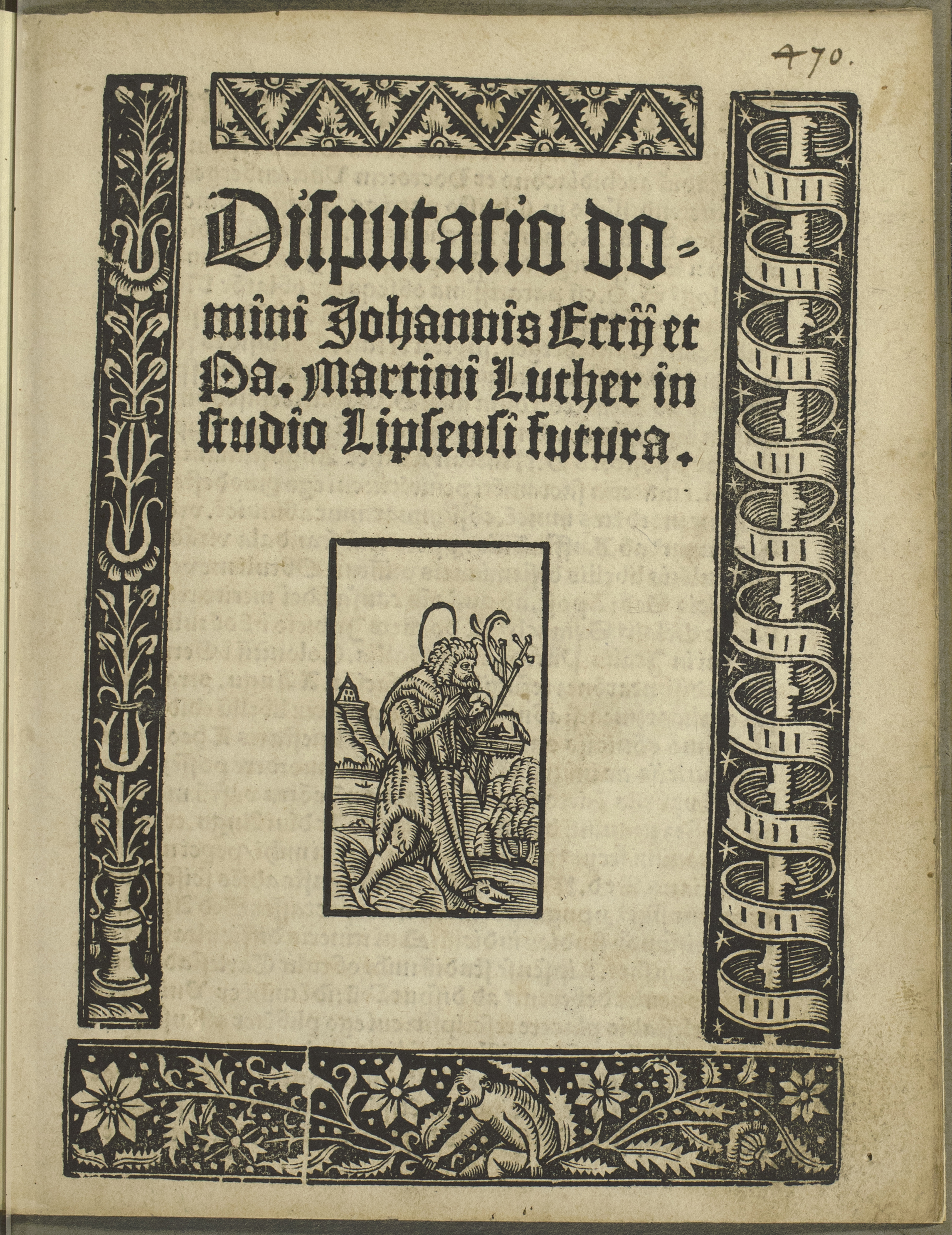
Disputatio D. Iohannis Eccij et P. Martini Luther in Studio Lipsensi. futura
Luther, Martin, 1483-1546Summary: Response by Luther to the theses of Johann Eck, who had previously been in debate with Luther's colleague, Karlstadt. The face to face clash would come some six months later at the end of June, 1519.Summary: Response by Luther to the theses of Johann Eck, who had previously been in debate with Luther's colleague, Karlstadt. The face to face clash would come some six months later at the end of June, 1519. -
 Text
Disputatio domini Johannis Eccij et P. Martini Luther in Studio Lipsiensi futura
Luther, Martin, 1483-1546Summary: This is Luther's first public attack on Johannes Eck. Included in this volume are Eck's letter of Dec. 24, 1518 in which he records his theological differences with Karlstadt, and Eck's own 12 theses with Luther's response.Summary: This is Luther's first public attack on Johannes Eck. Included in this volume are Eck's letter of Dec. 24, 1518 in which he records his theological differences with Karlstadt, and Eck's own 12 theses with Luther's response. -
 Text
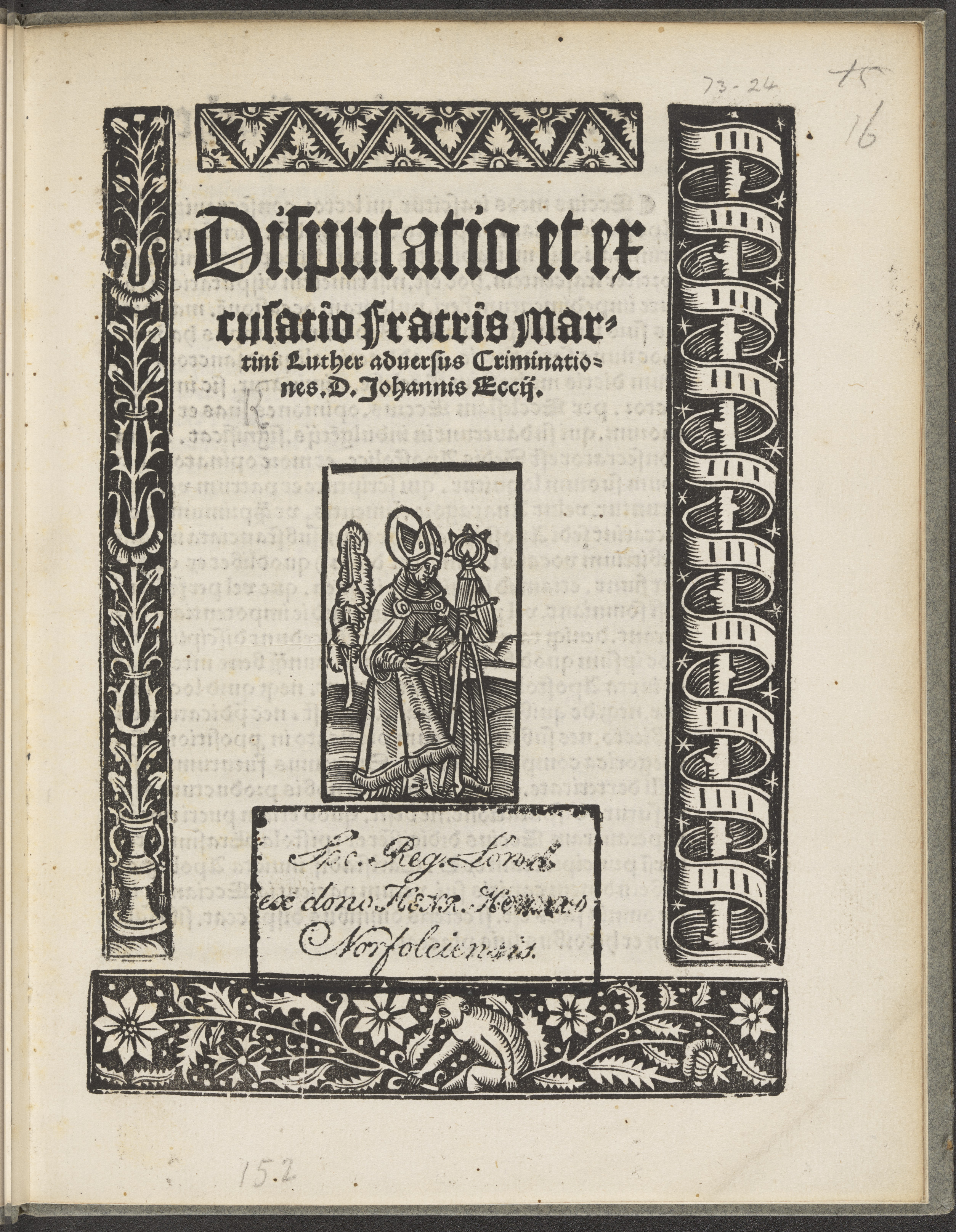
Disputatio et excusatio
Luther, Martin, 1483-1546Summary: A response by Luther to the accusations leveled at him at the Leipzig Disputation by his opponent, Johann Eck.Summary: A response by Luther to the accusations leveled at him at the Leipzig Disputation by his opponent, Johann Eck. -
 Text
Disputatio inter Egregios & praelatus virus ac doctores, Joannem Ecci[um] & Martinum Lutherum in p[rae]sentia notariorum habita
Luther, Martin, 1483-1546Summary: Unique printing of the original notarial protocol of the Leipzig Disputation between Andreas Karlstadt and Martin Luther on the one hand, and Johann Eck, on the other. Includes fully two thirds of the several day debate, and all of the famous "duel" between Luther and Eck on authority in the church. The debates were copied by two notaries, and, at the end of each day's sessions, were verified by two witnesses.Summary: Unique printing of the original notarial protocol of the Leipzig Disputation between Andreas Karlstadt and Martin Luther on the one hand, and Johann Eck, on the other. Includes fully two thirds of the several day debate, and all of the famous "duel" between Luther and Eck on authority in the church. The debates were copied by two notaries, and, at the end of each day's sessions, were verified by two witnesses. -
 Text
Disputatio. Secundum, & Octauum Decalogi praecepta, thesibus theologicis explicata, : quae publicè ad disputandum proponentur, pridiè idus Septemb. Quando reuerentia, dignitate, & eruditione praestanti uiro, D. Ioanni Schauppio Eckio, liberalium disciplinarum magistro, et ss. theologiae Licentiato, Officiali Passauiensi, etc. Supremus in professione theologica gradus decernetur.
Theander, Georg, 1508-1570Summary: An academic disputation presented Georg Theander, professor at the University of Ingolstadt, and defended by Sebastian Haydlauff, priest at the church of St. Moritz in Ingolstadt. The disputation was based on 30 theses on the 2nd and 8th commandments.Summary: An academic disputation presented Georg Theander, professor at the University of Ingolstadt, and defended by Sebastian Haydlauff, priest at the church of St. Moritz in Ingolstadt. The disputation was based on 30 theses on the 2nd and 8th commandments. -
 Text
Diss ist ain Anzayg: ainem meinem, etwann vertrawten Gesellen, über seyne harte Widerpart, des Sacrament vnd annders betreffend
Langenmantel, Eitelhans, -1528Summary: Since the city of Augsburg was fairly evenly divided between Catholic and Protestant in the early 1520s, several Anabaptists hoped that their movement might benefit from this stalemate. Eitelhans Langenmantel attacks both Catholics and Lutherans, whom he called neo-Papists. His critique in this pamphlet focuses on the eucharist, which Langenmantel views in Zwinglian terms as a symbolic commemoration of the Last Supper. Like many other Anabaptists in Augsburg, Langenmantel was arrested and executed in 1527.Summary: Since the city of Augsburg was fairly evenly divided between Catholic and Protestant in the early 1520s, several Anabaptists hoped that their movement might benefit from this stalemate. Eitelhans Langenmantel attacks both Catholics and Lutherans, whom he called neo-Papists. His critique in this pamphlet focuses on the eucharist, which Langenmantel views in Zwinglian terms as a symbolic commemoration of the Last Supper. Like many other Anabaptists in Augsburg, Langenmantel was arrested and executed in 1527. -
 Still image
Dissertation sur le Culte Religieux
Picart, Bernard, 1673-1733A series of four engravings depicting aspects of religious rituals and practices from ancient Mediterranean cultures, including Greek, Roman, and Egyptian. The engraving on the top right depicts a supplicant praying before a temple of Pomona, the Latin and Roman goddess of fruit trees, gardens, and orchards, who is depicted to the supplicant's left.A series of four engravings depicting aspects of religious rituals and practices from ancient Mediterranean cultures, including Greek, Roman, and Egyptian. The engraving on the top right depicts a supplicant praying before a temple of Pomona, the Latin and Roman goddess of fruit trees, gardens, and orchards, who is depicted to the supplicant's left. -
 Text
Disticha de uita et praecipuis rebus gestis uiri Dei et...
Stoltz, Johann, circa 1514-1556Twenty distichs (couplets) inspired by important events in the life of Martin Luther. The couplets, in Latin, were composed ca. 1550 and are written on paper. The author's name is found at the end of the piece as is his dedication of it to Johann Kestner. Pencil markings of a later owner are located in the upper left corner of the first page. Originally part of a signature, each of the two leaves has been encapsulated in Mylar for protection.Twenty distichs (couplets) inspired by important events in the life of Martin Luther. The couplets, in Latin, were composed ca. 1550 and are written on paper. The author's name is found at the end of the piece as is his dedication of it to Johann Kestner. Pencil markings of a later owner are located in the upper left corner of the first page. Originally part of a signature, each of the two leaves has been encapsulated in Mylar for protection. -
 Still image
District Charge; Bremen Circuit
a photograph of the District Line Church building.a photograph of the District Line Church building. -

-
 Text
Doctor Johan. dietenberger. [sic] Widerlegung des Lutherischen büchlins, da er schreibt von menschen leren zü meiden rc.
Dietenberger, Johann, approximately 1475-1537Summary: Johannes Dietenberger was a preaching monk who later became the grand inquisitor in the dioceses of Mainz and Cologne. He is best known for his German translation of the Bible, published in 1534. This work is an answer to Luther's writings on human doctrines and traditions in the Church.Summary: Johannes Dietenberger was a preaching monk who later became the grand inquisitor in the dioceses of Mainz and Cologne. He is best known for his German translation of the Bible, published in 1534. This work is an answer to Luther's writings on human doctrines and traditions in the Church. -
 Text
Doctor Martinus Luther Augustiners Vnterricht auff etlich Artickell die im vonn seynen Abgūrnern auff gelegt vn[d] zu gemessen werden
Luther, Martin, 1483-1546Summary: Luther was persuaded by Karl von Miltitz to write this public statement as a response to certain charges brought against him by his opponents, in particular Mazzolini da Prierio. In this tract, Luther still supports the invocation of the saints, an idea which he abandoned only shortly after.Summary: Luther was persuaded by Karl von Miltitz to write this public statement as a response to certain charges brought against him by his opponents, in particular Mazzolini da Prierio. In this tract, Luther still supports the invocation of the saints, an idea which he abandoned only shortly after.