Search
169 resources
169 items
Subject
Catholic Church
-
 Still image
224 Vaudois brulez prés de Thoulouse, A. 1243
Luiken, Jan, 1649-1712An engraving depicting the burning of 224 Waldensians outside of Toulouse. The image shows a large number of stakes with people tied to them being set ablaze as a crowd watches.An engraving depicting the burning of 224 Waldensians outside of Toulouse. The image shows a large number of stakes with people tied to them being set ablaze as a crowd watches. -
 Text
TextA Clothing Discourse; Luke 9:23
Archer, James, 1751-1834This sermon addresses the importance of self-denial for women seeking a religious profession, emphasizing that self-denial prevents one from falling victim to religious enemies, and explaining that entering into a religious life is the best form of religious penance.This sermon addresses the importance of self-denial for women seeking a religious profession, emphasizing that self-denial prevents one from falling victim to religious enemies, and explaining that entering into a religious life is the best form of religious penance. -
 Text
TextA Clothing Discourse; Mark 10: 29-30
Archer, James, 1751-1834This sermon celebrates the choice of a woman to join a religious order and take up the habit, outlining the virtues of such a choice and the level of dedication to Christ that is needed to undertake such a spiritual journey.This sermon celebrates the choice of a woman to join a religious order and take up the habit, outlining the virtues of such a choice and the level of dedication to Christ that is needed to undertake such a spiritual journey. -
 Text
TextA Discourse for Christmas Day; Luke 2:10
Archer, James, 1751-1834This sermon celebrates Jesus Christ, identifying certain qualities of Jesus and emphasizing his humility as a model for Christians to follow.This sermon celebrates Jesus Christ, identifying certain qualities of Jesus and emphasizing his humility as a model for Christians to follow. -
 Text
TextA Discourse for Sexagesima Sunday; Luke 8:11
Archer, James, 1751-1834This sermon explains the importance of ensuring that one is receptive to the word of God, describing how the word of God cannot be properly sown into a soul that is like concrete or thorns- one must be truly willing and receptive of God to reach salvation.This sermon explains the importance of ensuring that one is receptive to the word of God, describing how the word of God cannot be properly sown into a soul that is like concrete or thorns- one must be truly willing and receptive of God to reach salvation. -
 Text
TextA Discourse for the 1st Sunday after Pentecost; Luke 6:8
Archer, James, 1751-1834This sermon addresses judgments, encouraging Christians to be wary of making rash judgements and outlining multiple examples from scripture of figures who had been falsely or wrongly judged.This sermon addresses judgments, encouraging Christians to be wary of making rash judgements and outlining multiple examples from scripture of figures who had been falsely or wrongly judged. -
 Text
TextA Discourse for the 1st Sunday of Lent, "On Fasting and Abstinence"; Matthew 4:4
Archer, James, 1751-1834This sermon addresses the importance of eccumenical fasting, outlining the ways in which it should be properly observed and the purposes of observing the practice.This sermon addresses the importance of eccumenical fasting, outlining the ways in which it should be properly observed and the purposes of observing the practice. -
 Text
TextA Discourse for the Religious Profession; Canticles 2:16
Archer, James, 1751-1834This sermon celebrates the choice of a woman to join a religious order and denounce worldly possessions and vocations.This sermon celebrates the choice of a woman to join a religious order and denounce worldly possessions and vocations. -
 Text
TextA Discourse for the Sunday within the Oct. of Corpus Christi, "On the Sacrifice of the Mass;" Luke 14: 24
Archer, James, 1751-1834This sermon examines the process of Mass, explaining the importance and proper practice of its three sections: the offertory, the consecration, and the communion.This sermon examines the process of Mass, explaining the importance and proper practice of its three sections: the offertory, the consecration, and the communion. -
 Still image
A New Pope
Picart, Bernard, 1673-1733A series of six engravings depicting the events surrounding election of new pope. He is adored in the Sistine Chapel (top right), he is adored at thealtar of St. Peter (top left), he witnesses the burning of flax, which represents the fleeting nature of earthly glory (middle right), he is crowned (middle left), he receives a Torah scroll from the Jewish people (bottom right) and receives the keys symbolizing the keys to the Kingdom of heaven.A series of six engravings depicting the events surrounding election of new pope. He is adored in the Sistine Chapel (top right), he is adored at thealtar of St. Peter (top left), he witnesses the burning of flax, which represents the fleeting nature of earthly glory (middle right), he is crowned (middle left), he receives a Torah scroll from the Jewish people (bottom right) and receives the keys symbolizing the keys to the Kingdom of heaven. -
 Text
TextA Profession Discourse; Luke 9:23
Archer, James, 1751-1834This sermon addresses the importance of self-denial for women seeking a religious profession, emphasizing that self-denial prevents one from falling victim to religious enemies, and explaining that entering into a religious life is the best form of religious penance.This sermon addresses the importance of self-denial for women seeking a religious profession, emphasizing that self-denial prevents one from falling victim to religious enemies, and explaining that entering into a religious life is the best form of religious penance. -
 Text
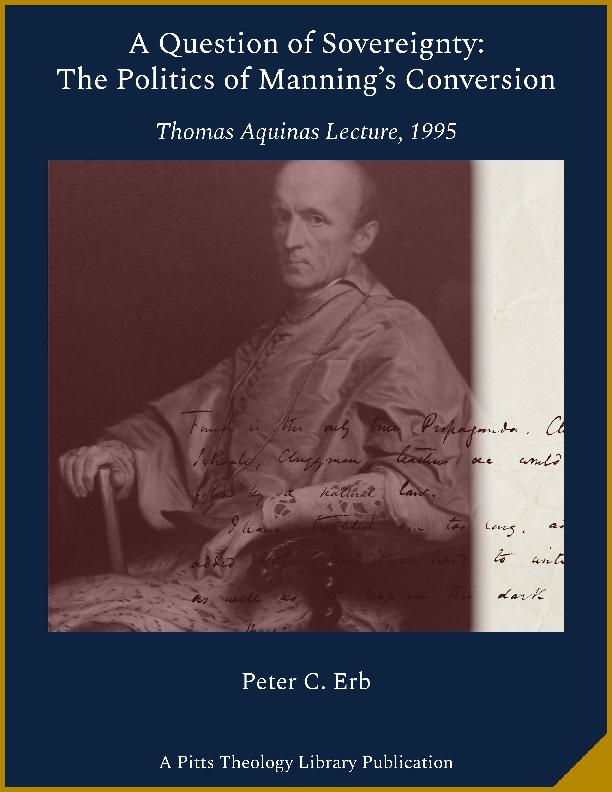
TextA Question of Sovereignty: The Politics of Manning’s Conversion
Erb, Peter C., 1943-The digital edition of an public lecture on the politics of Cardinal Henry Edward Manning's conversion to Catholicism presented on the afternoon of December 4, 1995, at White Hall (Emory University) as the Second Annual Thomas Aquinas Lecture and sponsored by the Aquinas Center of Theology at Emory University.The digital edition of an public lecture on the politics of Cardinal Henry Edward Manning's conversion to Catholicism presented on the afternoon of December 4, 1995, at White Hall (Emory University) as the Second Annual Thomas Aquinas Lecture and sponsored by the Aquinas Center of Theology at Emory University. -
 Text
TextA Sermon for the First Sunday of Advent; Luke 21: 27
Archer, James, 1751-1834This sermon describes the reprobate through horrifying imagery, characterizing the people who will be left behind on earth while Jesus carries his elect few to Heaven.This sermon describes the reprobate through horrifying imagery, characterizing the people who will be left behind on earth while Jesus carries his elect few to Heaven. -
 Text
TextA brief history of the Catholic Church in Plumstead
Wood, AlbertSummary: A history of the Catholic Church in Plumstead, England.Summary: A history of the Catholic Church in Plumstead, England. -
 Text
TextA letter to a Roman Catholick
Wesley, John, 1703-1791Summary: A published letter by John Wesley urging understanding and mutual respect between Protestants and Catholics.Summary: A published letter by John Wesley urging understanding and mutual respect between Protestants and Catholics. -
 Text
TextA sermon preached before the King at Chester : on August xxviii, 1687. Being the feast of S. Augustin ...
Sabran, Lewis, 1652-1732Summary: A sermon preached for the Feast of St. Augustine.Summary: A sermon preached for the Feast of St. Augustine. -
 Text
TextActa f. Martini Luther august. apud D. legatu[m] apostolicu[m] Augustae recognitum
Luther, Martin, 1483-1546Summary: In 1518 Luther was summoned to Rome. He appealed to Frederick, Elector of Saxony who was attending the imperial Diet in Augsburg. Frederick negotiated with the Papal Legate Cajetan who finally agreed to a hearing in Augsburg. Luther went there with an imperial escort and then returned safely to Wittenberg. This is Luther's report of what took place in Augsburg. It is the fifth printing of the "Acta Augustana."Summary: In 1518 Luther was summoned to Rome. He appealed to Frederick, Elector of Saxony who was attending the imperial Diet in Augsburg. Frederick negotiated with the Papal Legate Cajetan who finally agreed to a hearing in Augsburg. Luther went there with an imperial escort and then returned safely to Wittenberg. This is Luther's report of what took place in Augsburg. It is the fifth printing of the "Acta Augustana." -
 Text
TextAd criminatricem Martini Luders Uitte[n]bergen[sis] offensione[m] super iudicio iustissimo facto : ad articulos quosdam per minoritas de obserua[n]tia Reuere[n]dissimo Episcopo Brandenburgen[si] oblatos Eckiana responsio; Quia hactenus abusus est Mar. Luderus modestia Eckiana : tande[m] extorsit, vt mordaci, mordaciter quo[que] responderem ...
Eck, Johann, 1486-1543Summary: Johann Eck responds in this early work to Luther's pamphlet "Contra malignum Iohannis Eccii iudicium."Summary: Johann Eck responds in this early work to Luther's pamphlet "Contra malignum Iohannis Eccii iudicium." -
 Still image
Aguglia del Popolo, Aguglia di San. Pietro, Santi Apostoli, et C. Traj[an]
A pair of engravings depicting four obelisks (Vatican Obelisk, Lateran Obelisk, Flaminio Obelisk, and the Esquiline Obelisk), the Santi Apostoli, and Trajan's Column. All of these were part of Pope Sixtus V's urban reform program.A pair of engravings depicting four obelisks (Vatican Obelisk, Lateran Obelisk, Flaminio Obelisk, and the Esquiline Obelisk), the Santi Apostoli, and Trajan's Column. All of these were part of Pope Sixtus V's urban reform program. -
 Text
TextAin schöner Dialogus wie ain Bawr mit aim Frawe[n] Brůder Münch redt : das er die Kutten von jm würfft, und dem Münch Arbayt zůgeben, lustbarlich und lieblich zů lesen
Summary: Polemical dialogue between a peasant and a monk, who had lost his livelihood after the dissolution of his monastery. The peasant advises the monk to try his hand at "real work".Summary: Polemical dialogue between a peasant and a monk, who had lost his livelihood after the dissolution of his monastery. The peasant advises the monk to try his hand at "real work". -
 Text
TextAlbertus Dei et Apostolice Sedis gratia Maguntinen[sis] [sic] et Magdeburgen[sis] Archiepiscop[us] ac Halberstaten[sis] ecclesiar[m] Administrator, Germanie Primas ... Indulgence
Albert, of Brandenburg, Archbishop and Elector of Mainz, Cardinal, 1490-1545Indulgences were issued to defray the cost of building the basilica of St. Peter in Rome. Their distribution was often linked to the sacrament of penance, as believers were granted spiritual merits in exchange for financial donations. This particular indulgence, believed to be the only specimen of its kind thus far recovered, was issued specifically to clergy, granting them liturgical benefits in exchange for their contributions.Indulgences were issued to defray the cost of building the basilica of St. Peter in Rome. Their distribution was often linked to the sacrament of penance, as believers were granted spiritual merits in exchange for financial donations. This particular indulgence, believed to be the only specimen of its kind thus far recovered, was issued specifically to clergy, granting them liturgical benefits in exchange for their contributions. -
 Text
TextAliquot epistolae
Luther, Martin, 1483-1546Summary: M. Flacius Illyricus issued this edition of Luther's letters from Coburg Castle to the theologians at the Diet of Augsburg in an attempt to strengthen the Protestant resolve during the Interim. Intended for the widest possible distribution, both German and Latin versions were provided.Summary: M. Flacius Illyricus issued this edition of Luther's letters from Coburg Castle to the theologians at the Diet of Augsburg in an attempt to strengthen the Protestant resolve during the Interim. Intended for the widest possible distribution, both German and Latin versions were provided. -
 Text
TextAmbrosii Catharini olim La[n]cinoti co[n]tra Martinu[m] Lutherum super his verbis, Tu es Petrus [et cetera], Et tibi dabo claues regni celorum [et cetera], Mathei xvi. : Dialogus [i?]n minus disertus qua[m] elegans et festiuus : Roffensis Episcopi loca qu[a]edam quibus predicta[m] auctoritate[m] cu[m] duabus alijs Matthei scz xviij. & Ioa[n]nis xx. eiusdem monet[a]e, sed no[n] eiusdem valoris comparat, & discrimen earu[m] euidenti scripturaru[m] testimonio declarat.
Ambrosius Catharinus, Archbishop of Conza, 1484-1553Summary: A selection of criticisms of Luther's views on the spiritual origins of the Papacy by one of his early opponents, Ambrosius Catharinus, edited by another of his early opponents, Hieronymus Emser, and dedicated by Emser to a third Luther opponent, Paul Bachmann, Abbot of Altenzelle.Summary: A selection of criticisms of Luther's views on the spiritual origins of the Papacy by one of his early opponents, Ambrosius Catharinus, edited by another of his early opponents, Hieronymus Emser, and dedicated by Emser to a third Luther opponent, Paul Bachmann, Abbot of Altenzelle. -
 Text
TextAn den Christlichen Adel deutscher Nation : von des Christlichen Standes Besserung
Luther, Martin, 1483-1546Summary: Fourth edition of the "Address to the Christian Nobility of the German Nation," one of Luther's most important pamphlets, in which he develops some of the central ideas of his theology, including the principle of universal priesthood. He also discusses the possibility of a German national church.Summary: Fourth edition of the "Address to the Christian Nobility of the German Nation," one of Luther's most important pamphlets, in which he develops some of the central ideas of his theology, including the principle of universal priesthood. He also discusses the possibility of a German national church. -
 Text
TextAn den Stier zu Uuittenberg
Emser, Hieronymus, 1478-1527Summary: A reply to Martin Luther's "An den Bock zu Leipzig."Summary: A reply to Martin Luther's "An den Bock zu Leipzig." -
 Text
TextAnalectus siue libellus collectaneorum, continens tres tractatus de praecipuis capitibus doctrinae Christianae, quae à Papistis corrumpuntur, & oppugnantur
Selneccer, Nicolaus, 1530-1592Summary: Compilation of three anti-Catholic tracts by the Lutheran theologians and composer of hymns Nicolaus Selneccer.Summary: Compilation of three anti-Catholic tracts by the Lutheran theologians and composer of hymns Nicolaus Selneccer. -
 Text
TextAuff das Vermeint Keiserlich Edict : Ausgangen jm 1531 jare nach dem Reichs tage des 1530 Jars. Glosa
Luther, Martin, 1483-1546Summary: In response to an ultimatum to the Lutheran princes and cities from Emperor Charles V to return to the pre-Reformation status quo within six months, Luther here issues some of his strongest polemic.Summary: In response to an ultimatum to the Lutheran princes and cities from Emperor Charles V to return to the pre-Reformation status quo within six months, Luther here issues some of his strongest polemic. -
 Still image
Bishop's Mitre
A woodcut of a heavily decorated bishop's mitre accompanied by a poem, "The Daughter of Myst'ry, the child of Errour, / Mother of Tyranny, of Wars, of Terrour, / The Idol of Reproach, Rocke of offence / To Iew and Gentile, Source of Indulgence / For all Impieties, and th'usurping Crest / 'Bove Diademes, the State, the Churches Pest / Is now discov'red, and all the world awake, / Makes proud Rome, and th'opprobrious Myter shake."A woodcut of a heavily decorated bishop's mitre accompanied by a poem, "The Daughter of Myst'ry, the child of Errour, / Mother of Tyranny, of Wars, of Terrour, / The Idol of Reproach, Rocke of offence / To Iew and Gentile, Source of Indulgence / For all Impieties, and th'usurping Crest / 'Bove Diademes, the State, the Churches Pest / Is now discov'red, and all the world awake, / Makes proud Rome, and th'opprobrious Myter shake." -
 Still image
Blessing a New Church
Picart, Bernard, 1673-1733A series of six engravings depicting the process for blessing a new church as it is built. The scenes include a bishop blessing the first stone (top left) and the earth on which the church will be built (top right), a bishop then placing the first stone (middle left) and blessing the church foundation (middle right), a bishop sprinkling holy water on the completed church (bottom left) and making the sign of the cross at the door (bottom right).A series of six engravings depicting the process for blessing a new church as it is built. The scenes include a bishop blessing the first stone (top left) and the earth on which the church will be built (top right), a bishop then placing the first stone (middle left) and blessing the church foundation (middle right), a bishop sprinkling holy water on the completed church (bottom left) and making the sign of the cross at the door (bottom right). -
 Text
TextCantio de papa romanaque ecclesia, per Boemum quendam ante annos circiter 100 composita, secundum ordinem alphabeti
Summary: Satirical song about the office of the Pope, composed anonymously in response to the execution of Jan Hus in 1415 and published by Matthias Flacius to underscore his opposition to the Catholic Church in all matters following the Interim of Augsburg in 1548.Summary: Satirical song about the office of the Pope, composed anonymously in response to the execution of Jan Hus in 1415 and published by Matthias Flacius to underscore his opposition to the Catholic Church in all matters following the Interim of Augsburg in 1548. -
 Still image
Catholic Blessings
Picart, Bernard, 1673-1733A series of six engravings depicting a variety of Catholic blessings, including: blessing of priestly robes (top left), blessing of the cross (top right), adoration of the cross (middle left), blessing of the sun (middle right) blessing of a soldier (bottom left), and blessing of a flag (bottom right).A series of six engravings depicting a variety of Catholic blessings, including: blessing of priestly robes (top left), blessing of the cross (top right), adoration of the cross (middle left), blessing of the sun (middle right) blessing of a soldier (bottom left), and blessing of a flag (bottom right). -
 Still image
Ceremonie de Mariage et Benediction du Lit Nuptial
Picart, Bernard, 1673-1733A pair of engravings depicting a Catholic wedding ceremony (top) and a priest blessing a newlywed couple's nuptial bed (bottom).A pair of engravings depicting a Catholic wedding ceremony (top) and a priest blessing a newlywed couple's nuptial bed (bottom). -
 Still image
Ceremonie de la Confirmation et autre maniere de Confirmer
Picart, Bernard, 1673-1733A pair of engravings depicting the rites of confirmation including the anointment (top) and the laying on of hands (bottom).A pair of engravings depicting the rites of confirmation including the anointment (top) and the laying on of hands (bottom). -
 Still image
Ceremonie de laver les pieds à douze Pauvres le Jeudi Saint et l'Adoration de la Croix par le Peuple le Vendredi Saint
Picart, Bernard, 1673-1733A pair of engravings depicting the observance of Maundy Thursday (top) by washing the feet of twelve poor people, and Good Friday (bottom) by offering addoration to the Cross.A pair of engravings depicting the observance of Maundy Thursday (top) by washing the feet of twelve poor people, and Good Friday (bottom) by offering addoration to the Cross. -
 Text
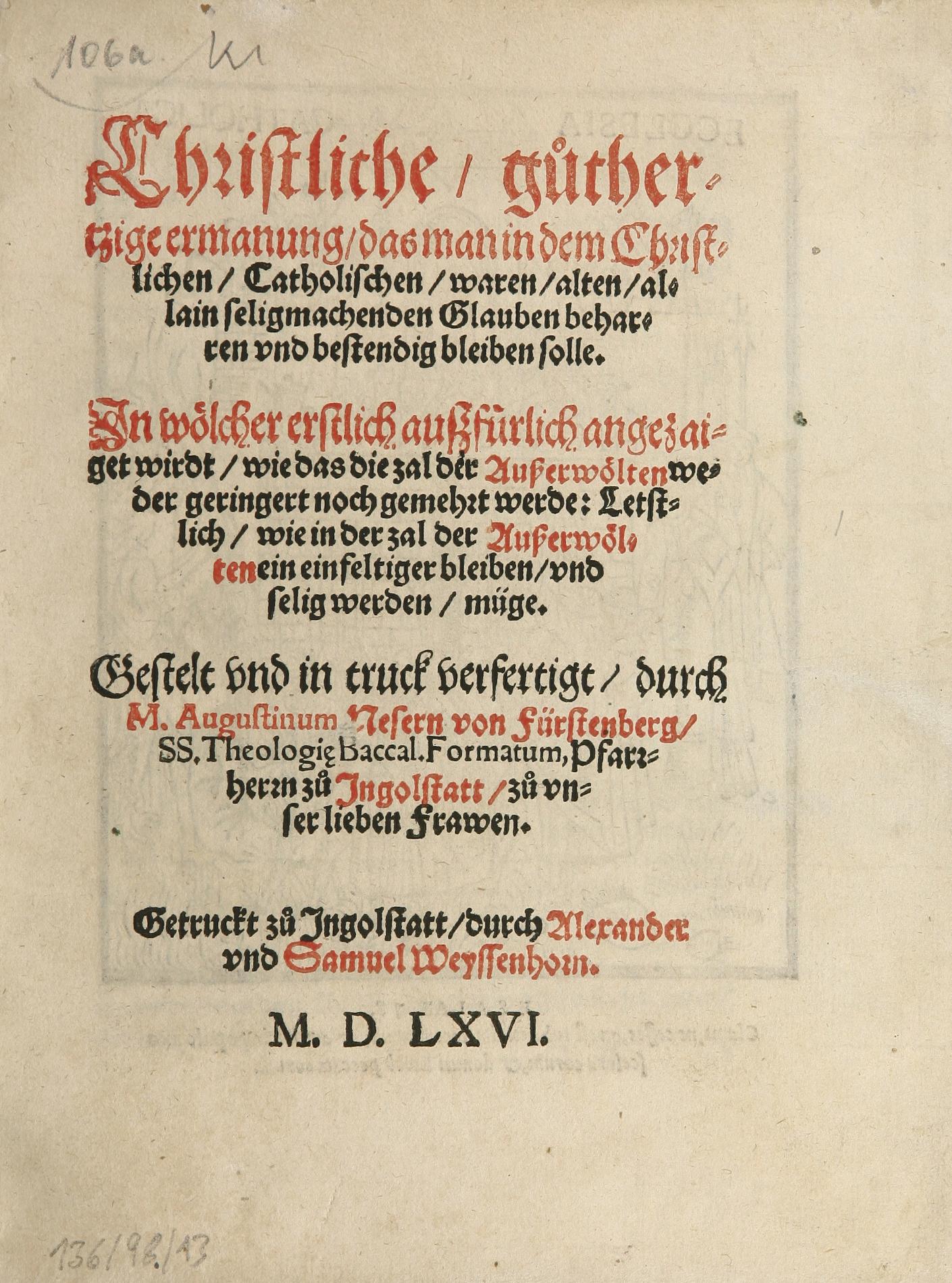
TextChristliche güthertzige Ermanung, das Man in dem Christlichen, Catholischen, waren, alten, allain seligmachenden Glauben beharren vnd bestendig bleiben solle : In wölcher erstlich auszfürlich angezaiget wirdt, wie das die Zal der Ausserwölten weder geringert noch gemehrt werde: letstlich, wie in der Zal der Ausserwölten ein einfeltiger bleiben, vnd selig werden, müge
Neser, AugustinusSummary: Augustinus Neser was a pastor in Ingolstadt. In this hortatory tract he discusses the importance of staying within the Catholic fold.Summary: Augustinus Neser was a pastor in Ingolstadt. In this hortatory tract he discusses the importance of staying within the Catholic fold. -
 Still image
Ciborium
A woodcut depicting an elaborate ciborium featuring several decorative spires and a crucifix at the top.A woodcut depicting an elaborate ciborium featuring several decorative spires and a crucifix at the top. -
 Still image
Conclave of Pope Urban VIII
An woodcut depicting the conclave of Pope Urban VIII. A group of cardinals sits around a table with the pope at the center, flanked by C. di Fiorenza, Francisco di Barbarini, and Antonio di Barbarini. On the bottom right corner of the table is a roll of paper that reads, "Tutto sta male" ("everything is bad").An woodcut depicting the conclave of Pope Urban VIII. A group of cardinals sits around a table with the pope at the center, flanked by C. di Fiorenza, Francisco di Barbarini, and Antonio di Barbarini. On the bottom right corner of the table is a roll of paper that reads, "Tutto sta male" ("everything is bad"). -
 Still image
Consecration of a Cross, a Bell, and a Statue
Picart, Bernard, 1673-1733A series of six engravings depicting the steps of consecration for new items within a church, including a cross, a bell and a statue.A series of six engravings depicting the steps of consecration for new items within a church, including a cross, a bell and a statue. -
 Still image
Consecration of the Altar
Picart, Bernard, 1673-1733A series of six engravings depicting the process of blessing an altar. The scenes include (top left), a bishop following behind a subdeacon spreading ash on the ground writing the Latin and Greek alphabets in a cross shape (top left), a bishop anointing the altar (middle left) and the floor (middle right) with holy water, a procession bringng relics into the church (bottom left), and a bishop placing the relics inside the altar (bottom right).A series of six engravings depicting the process of blessing an altar. The scenes include (top left), a bishop following behind a subdeacon spreading ash on the ground writing the Latin and Greek alphabets in a cross shape (top left), a bishop anointing the altar (middle left) and the floor (middle right) with holy water, a procession bringng relics into the church (bottom left), and a bishop placing the relics inside the altar (bottom right). -
 Still image
Consecration on the Church with Holy Oil
Picart, Bernard, 1673-1733A series of six engravings depicting the process of consecrating the interior of a church with holy oil. The scenes show a bishop anointing and consecrating parts of a church, known as chrism, including crosses on the walls, the trappings of the altar, and the altar itself.A series of six engravings depicting the process of consecrating the interior of a church with holy oil. The scenes show a bishop anointing and consecrating parts of a church, known as chrism, including crosses on the walls, the trappings of the altar, and the altar itself. -
 Text
TextContra Henricum regem Angliae
Luther, Martin, 1483-1546Summary: This is the second and much expanded edition of Luther's reply to Henry VIII's Assertion of the Seven Sacraments. Luther replies quite moderately (for him) to what he feels to be the King's unwarranted assertions on the Catholic Sacraments. This is the second printing of this edition.Summary: This is the second and much expanded edition of Luther's reply to Henry VIII's Assertion of the Seven Sacraments. Luther replies quite moderately (for him) to what he feels to be the King's unwarranted assertions on the Catholic Sacraments. This is the second printing of this edition. -
 Still image
Cupola di San Pietro fatta da Sesto et Libraria Vaticana
A pair of engravings depicting the dome atop St. Peter's Basilica and the Vatican Library, both of which were parts of Pope Sixtus V's urban reform program.A pair of engravings depicting the dome atop St. Peter's Basilica and the Vatican Library, both of which were parts of Pope Sixtus V's urban reform program. -
 Still image
Das Munchkalb zu Freyberg
A woodcut depicting the Monk-Calf of Freyberg, which was born with a tonsure-like irregularity on its head, resembling the common hairstyle of a Catholic monk.A woodcut depicting the Monk-Calf of Freyberg, which was born with a tonsure-like irregularity on its head, resembling the common hairstyle of a Catholic monk. -
 Text
TextDas Tauff Buchlin
Luther, Martin, 1483-1546Summary: Luther's German translation of the Wittenberg usage of the Catholic rite of Baptism (Ordo baptizandi). The work was reprinted fifteen times between 1523 and 1526, when Luther issued a revised edition.Summary: Luther's German translation of the Wittenberg usage of the Catholic rite of Baptism (Ordo baptizandi). The work was reprinted fifteen times between 1523 and 1526, when Luther issued a revised edition. -
 Text
TextDas lob der Pfarrer von dem vnnutzen kosten der gelegt wirt von dem gemainen vnuerstendigen volck auff mess lesen, volgungen, begrebnus, sybent, dreysigst, jartag, rc. : Vnd vo[m] lob der Pfarrer vnnd irer nötigen Caplan.
Eberlin von Günzburg, Johann, approximately 1470-1533Summary: One of the problems that led to the Reformation was the sad state of ecclesiastical finance that forced many priests to change fees for the sacraments and other services. Von Gunzburg subjects such practices to sharp sanitization in the form of "praise of priests."Summary: One of the problems that led to the Reformation was the sad state of ecclesiastical finance that forced many priests to change fees for the sacraments and other services. Von Gunzburg subjects such practices to sharp sanitization in the form of "praise of priests." -
 Text
TextDe Petro et Roma adversus Velenu[m] Lutheranum, libri quatuor
Cochlaeus, Johannes, 1479-1552Summary: Oldrich Velensky, Latinized as Ulrich Velenus, was a Bohemian Protestant who opposed the papal claims to power based on St. Peter's residence and martyrdom in Rome. Cochlaeus upholds the traditional Catholic view that St. Peter was martyred in Rome in the reign of Nero in this volume against Velensky's criticism.Summary: Oldrich Velensky, Latinized as Ulrich Velenus, was a Bohemian Protestant who opposed the papal claims to power based on St. Peter's residence and martyrdom in Rome. Cochlaeus upholds the traditional Catholic view that St. Peter was martyred in Rome in the reign of Nero in this volume against Velensky's criticism. -
 Still image
Der Bapstesel zu Rom
A woodcut depicting the "Papal Ass," a monster purported to have been pulled from the Tiber in Rome as a portent of the corruption of the Roman Catholic Church.A woodcut depicting the "Papal Ass," a monster purported to have been pulled from the Tiber in Rome as a portent of the corruption of the Roman Catholic Church. -
 Still image
Des Ehrwirdigen Herrn Doctoris Martini Lutheri, gottseligen, Triumph, und Verantwortung, wider die gottlosen Schmehschrifft, der newen Münch, der Jesuiter, welche sie vnter dem Titel, Anatomia Lutheri, ausgesprenget haben
Single sheet woodcut depicting Pope Leo X on a throne that is about to topple. Behind him are priests and monks and below them a group of Jesuits, who are trying to support the toppling throne. Leo's key, the symbol of the Petrine office is crumbling in the pope's hands. Facing Leo is Martin Luther holding an open Bible. Below him is a group of reformers led by Philipp Melanchthon, each holding a book (Bible). In the center below Leo is Friedrich Staphylus depicted as Judas Iscariot. Staphylus was a student of Philipp Melanchthon's, who rejoined the Catholic Church in 1553.Single sheet woodcut depicting Pope Leo X on a throne that is about to topple. Behind him are priests and monks and below them a group of Jesuits, who are trying to support the toppling throne. Leo's key, the symbol of the Petrine office is crumbling in the pope's hands. Facing Leo is Martin Luther holding an open Bible. Below him is a group of reformers led by Philipp Melanchthon, each holding a book (Bible). In the center below Leo is Friedrich Staphylus depicted as Judas Iscariot. Staphylus was a student of Philipp Melanchthon's, who rejoined the Catholic Church in 1553. -
 Text
TextDialogus ad Martinu[m] Lutherum : pro responsione ad impertinentem quanda[m] ipsius epistolam super posita[m] veluti collocutoris vice intermixtam
Dungersheim, Hieronymus, 1465-1540Summary: H. Dungersheim had exchanged several letters with Luther before he wrote this dialogue. It was his first formal controversialist tract, written in 1520, but not published until 1531. Luther burned a manuscript copy of this work when he burned the bull Exsurge Domine on December 10, 1520.Summary: H. Dungersheim had exchanged several letters with Luther before he wrote this dialogue. It was his first formal controversialist tract, written in 1520, but not published until 1531. Luther burned a manuscript copy of this work when he burned the bull Exsurge Domine on December 10, 1520. -
 Text
TextDoctor Johan. dietenberger. [sic] Widerlegung des Lutherischen büchlins, da er schreibt von menschen leren zü meiden rc.
Dietenberger, Johann, approximately 1475-1537Summary: Johannes Dietenberger was a preaching monk who later became the grand inquisitor in the dioceses of Mainz and Cologne. He is best known for his German translation of the Bible, published in 1534. This work is an answer to Luther's writings on human doctrines and traditions in the Church.Summary: Johannes Dietenberger was a preaching monk who later became the grand inquisitor in the dioceses of Mainz and Cologne. He is best known for his German translation of the Bible, published in 1534. This work is an answer to Luther's writings on human doctrines and traditions in the Church. -
 Text
TextDoctor Martinus Luther Augustiners Vnterricht auff etlich Artickell die im vonn seynen Abgūrnern auff gelegt vn[d] zu gemessen werden
Luther, Martin, 1483-1546Summary: Luther was persuaded by Karl von Miltitz to write this public statement as a response to certain charges brought against him by his opponents, in particular Mazzolini da Prierio. In this tract, Luther still supports the invocation of the saints, an idea which he abandoned only shortly after.Summary: Luther was persuaded by Karl von Miltitz to write this public statement as a response to certain charges brought against him by his opponents, in particular Mazzolini da Prierio. In this tract, Luther still supports the invocation of the saints, an idea which he abandoned only shortly after. -
 Text
TextEine Schrifft, wie die Pfarherrn an den Örtern, da man die Papisterey widerumb auffricht, die Euangelisch Lehr, welche sie Lutherisch nennen, verloben vnd verschweren müssen
Summary: An anonymous pamphlet, containing an oath German pastors had to swear to renounce the "Evangelical doctrine, which is called Lutheran" in order to be readmitted to the Roman Catholic Church. The copy of the oath is preceded by two satirical poems regarding the oath, the first one representing the opinion of a wise man, the second one the answer of an unwise man. On the titlepage are two verses from Matthew 10 against the taking of oaths. The work is published by Christian Rödinger, a printer who put his press in service of the Reformation.Summary: An anonymous pamphlet, containing an oath German pastors had to swear to renounce the "Evangelical doctrine, which is called Lutheran" in order to be readmitted to the Roman Catholic Church. The copy of the oath is preceded by two satirical poems regarding the oath, the first one representing the opinion of a wise man, the second one the answer of an unwise man. On the titlepage are two verses from Matthew 10 against the taking of oaths. The work is published by Christian Rödinger, a printer who put his press in service of the Reformation. -
 Text
TextEnchiridion locorum communium aduersus Lutheranos
Eck, Johann, 1486-1543Summary: In 1521, Melanchthon wrote the first Protestant dogmatics, the "Loci Communes." Eck countered in 1525 with his "handbook on Theological Topics". Possibly the most widely reprinted Catholic critique of Lutheran doctrine (Metzler lists 91 contemporary editions). Eck uses the same topical procedure and cites the Bible, Church Fathers, Councils, and Popes heavily in the presentation of his arguments.Summary: In 1521, Melanchthon wrote the first Protestant dogmatics, the "Loci Communes." Eck countered in 1525 with his "handbook on Theological Topics". Possibly the most widely reprinted Catholic critique of Lutheran doctrine (Metzler lists 91 contemporary editions). Eck uses the same topical procedure and cites the Bible, Church Fathers, Councils, and Popes heavily in the presentation of his arguments. -
 Still image
Environ 80 Vaudois brulez à Strasbourg, A. 1215
Luiken, Jan, 1649-1712An engraving depicting the burning of eighty Waldensians in Strasbourg. The image shows a number of individuals already tied to stakes (right) while others are being prepared to be led to the pyres (left).An engraving depicting the burning of eighty Waldensians in Strasbourg. The image shows a number of individuals already tied to stakes (right) while others are being prepared to be led to the pyres (left). -
 Text
TextExcusatio eckij : ad ea que falso sibi Philippus Melanchton gra[m]maticus Vuittenbergen[sis] super theologica disputatione lipsica adscripsit.
Eck, Johann, 1486-1543Summary: The participants in the Leipzig Disputation promised not to print their positions before the faculties of Paris and Louvain had issued their verdicts in the case. Both sides broke their promise. Melanchthon apparently got into print first, for this is Eck's reply to Melanchthon. This is the second printing of the work.Summary: The participants in the Leipzig Disputation promised not to print their positions before the faculties of Paris and Louvain had issued their verdicts in the case. Both sides broke their promise. Melanchthon apparently got into print first, for this is Eck's reply to Melanchthon. This is the second printing of the work. -
 Text
TextEyn Widerruff vom Fegefeur
Luther, Martin, 1483-1546Summary: Refutation, by Luther, of the teaching of Purgatory.Summary: Refutation, by Luther, of the teaching of Purgatory. -
 Text
TextEyn Wyderrueff vom Fegfewr
Luther, Martin, 1483-1546Summary: One of several 1530 editions of a tract in which Luther rejects the Catholic doctrine of purgatory, a topic not addressed in the Augsburg Confessions.Summary: One of several 1530 editions of a tract in which Luther rejects the Catholic doctrine of purgatory, a topic not addressed in the Augsburg Confessions. -
 Still image
Fall and Restoration in the Catholic Church
Picart, Bernard, 1673-1733A set of six engravings depicting various examples of separation and reconciliation in the Catholic Church. The upper engravings show the degradation and restoration of a bishop. The middle engravings show the extinguishing of a candle, symbolizing excommunication, and the restoration of the excommunicated person to the church . The lower engravings show a heretic seeking reconciliation and being led to the altar by a bishop.A set of six engravings depicting various examples of separation and reconciliation in the Catholic Church. The upper engravings show the degradation and restoration of a bishop. The middle engravings show the extinguishing of a candle, symbolizing excommunication, and the restoration of the excommunicated person to the church . The lower engravings show a heretic seeking reconciliation and being led to the altar by a bishop. -
 Text
TextFirst of three short discourses, all untitled, concerning candidates for a religious profession
Archer, James, 1751-1834This sermon explains the importance of renouncing both worldly pleasures and oneself when seeking a religious profession.This sermon explains the importance of renouncing both worldly pleasures and oneself when seeking a religious profession. -
 Still image
Floorplan of where the Conclave is held in the Vatican
A woodcut floorplan depicting the building complex in the Vatican where the Papal conclave is held. Buildings in this area include St. Peter's Basilica, the Sistine Chapel, and the Vatican Palace.A woodcut floorplan depicting the building complex in the Vatican where the Papal conclave is held. Buildings in this area include St. Peter's Basilica, the Sistine Chapel, and the Vatican Palace. -
 Text
TextFor the 8th Sunday after Pentecost; Luke 16:2
Archer, James, 1751-1834This sermon presents the four methods of general judgement by which humanity will be assessed in the end of days.This sermon presents the four methods of general judgement by which humanity will be assessed in the end of days. -
 Still image
Four Catholic Trials
Picart, Bernard, 1673-1733A series of four engravings depicting four different Catholic trials: trial by hot iron (top left), by boiling water (top right), and two by cold water (bottom).A series of four engravings depicting four different Catholic trials: trial by hot iron (top left), by boiling water (top right), and two by cold water (bottom). -
 Text
TextGegen die bekanntnus Martini Luthers auff den yetzigen angestellten Reychsstag zuo Augsburg, auff neuwe eingelegt in sibenzehe[n] Artickel verfasst. Kurtze vn[d] Christenlich vnderricht
Wimpina, Konrad, 1460-1531Summary: This pamphlet contains the Catholic response to the first, unauthorized edition of the Schwabach Articles, published in Coburg in 1530. Among the authors of this tract, Konrad Wimpina and Johannes Mensing helped draft the Catholic Confutation of the Augsburg Confession.Summary: This pamphlet contains the Catholic response to the first, unauthorized edition of the Schwabach Articles, published in Coburg in 1530. Among the authors of this tract, Konrad Wimpina and Johannes Mensing helped draft the Catholic Confutation of the Augsburg Confession. -
 Text
TextGründtliche anzaygung vnd bericht, ausz was vrsachen (deren fürnemlich siben seind) so mancherley, vnnd vilfaltige Ketzereyen, zwispaltung vnnd jtzthumb in Christlicher Religion, vnd der hailigen Catholischen Kirchen, von anfang biss auff dise zeit erwachsen seind, vnd jren grund genommen haben
Leib, Kilian, 1471-1553Summary: Second printing of a an anti-Protestant tract by Kilian Leib, prior of the Augustinian monastery at Rebdorf. Leib was a Catholic theologian in the humanist tradition who was a firm opponent of Martin Luther's reforms. In 1530 he had participated in drafting the Catholic response to the Augsburg Confession. In this work, Leib outlines 7 causes for the Lutheran heresy, which include among others an unfavorable constellation of the stars, ordained by God to punish humanity.Summary: Second printing of a an anti-Protestant tract by Kilian Leib, prior of the Augustinian monastery at Rebdorf. Leib was a Catholic theologian in the humanist tradition who was a firm opponent of Martin Luther's reforms. In 1530 he had participated in drafting the Catholic response to the Augsburg Confession. In this work, Leib outlines 7 causes for the Lutheran heresy, which include among others an unfavorable constellation of the stars, ordained by God to punish humanity. -
 Still image
Histoire des Conclaves Frontispiece
An engraved frontispiece of Histoire des conclaves depuis Clement V. jusqu'à present, augmentée, depuis la première édition, de plusieurs mémoires concernans le pape & les cardinaux d'aujourdhui, & les principales familles de Rome : où l'on apprend quantité de particularitez de cette cour. Avec un discours qui explique, suivant le taille douce, toutes les cérémonies qui s'observent depuis la mort du pape, jusqu'après l'élection de son successeur.An engraved frontispiece of Histoire des conclaves depuis Clement V. jusqu'à present, augmentée, depuis la première édition, de plusieurs mémoires concernans le pape & les cardinaux d'aujourdhui, & les principales familles de Rome : où l'on apprend quantité de particularitez de cette cour. Avec un discours qui explique, suivant le taille douce, toutes les cérémonies qui s'observent depuis la mort du pape, jusqu'après l'élection de son successeur. -
 Text
TextHistoria delle vite de sommi pontefici : dal Salvator Nostro sino a Gregorio XV
Platina, 1421-1481Summary: Translation, with additions, of Platina's Vitae pontificum.Summary: Translation, with additions, of Platina's Vitae pontificum. -
 Still image
Historiated title page of Bapsttrew Hadriani iiij. vnd Alexanders iii. gegen Keyser Friderichen Barbarossa geübt : Aus der Historia zusamen gezogen nützlich zu lesen
The title page of Robert Barnes' Bapsttrew Hadriani iiij. vnd Alexanders iii. gegen Keyser Friderichen Barbarossa geübt : Aus der Historia zusamen gezogen nützlich zu lesen featuring a woodcut of Pope Alexander III confronting the Holy Roman Emperor, Frederick I.The title page of Robert Barnes' Bapsttrew Hadriani iiij. vnd Alexanders iii. gegen Keyser Friderichen Barbarossa geübt : Aus der Historia zusamen gezogen nützlich zu lesen featuring a woodcut of Pope Alexander III confronting the Holy Roman Emperor, Frederick I. -
![The title page of Martin Schrot's Vrsprung vnd vrsach Gege[n]wertiger Vffrür, Teütscher Nation depicting the pope (in armor and the papal crown) leading an army, presumably set during the Schmalkald War, reinforcing the theme of the work which criticises the pope as a warrior attacking his sheep rather than leading them to God.](https://s3.us-west-2.amazonaws.com/omekacloud-main/large/P_300000098862_P00X/1546SCHR_300000098862_P00X.jpg) Still image
Still imageHistoriated title page of Vrsprung vnd vrsach Gege[n]wertiger Vffrür, Teütscher Nation
The title page of Martin Schrot's Vrsprung vnd vrsach Gege[n]wertiger Vffrür, Teütscher Nation depicting the pope (in armor and the papal crown) leading an army, presumably set during the Schmalkald War, reinforcing the theme of the work which criticises the pope as a warrior attacking his sheep rather than leading them to God.The title page of Martin Schrot's Vrsprung vnd vrsach Gege[n]wertiger Vffrür, Teütscher Nation depicting the pope (in armor and the papal crown) leading an army, presumably set during the Schmalkald War, reinforcing the theme of the work which criticises the pope as a warrior attacking his sheep rather than leading them to God. -
 Still image
How Food is Brought to the Cardinals in the Conclave
A pair of woodcuts with captions depicting the formal procession of food for the Cardinals (top) and the delivery of dishes to the Cardinals (bottom).A pair of woodcuts with captions depicting the formal procession of food for the Cardinals (top) and the delivery of dishes to the Cardinals (bottom). -
 Still image
Illustrated title page of Histoire du concile de Constance : tirée principalement d'auteurs qui ont assisté au concile
Picart, Bernard, 1673-1733The title page of Histoire du concile de Constance : tirée principalement d'auteurs qui ont assisté au concile with a decorative engraving depicting the council in session.The title page of Histoire du concile de Constance : tirée principalement d'auteurs qui ont assisté au concile with a decorative engraving depicting the council in session. -
 Text
TextIndulgencia Plenaria
Catholic Church. Pope (1513-1521 : Leo X)A Papal plenary indulgence, issued in the name of Pope Leo X to raise fund for work on the construction of a church and Carmelite convent (Santa Maria) on the island of Gorgona off the Tuscan coast. It was the sale of indulgences that had prompted Martin Luther to post his 95 Theses, which is generally seen as the beginning of the Protestant Reformation. Giacomo Mazzocchi, the printer of this indulgence used the same types in 1520 for the printing of Pope Leo's bull "Exsurge Domine," which called on Luther to retract 41 of his 95 theses or face excommunication.A Papal plenary indulgence, issued in the name of Pope Leo X to raise fund for work on the construction of a church and Carmelite convent (Santa Maria) on the island of Gorgona off the Tuscan coast. It was the sale of indulgences that had prompted Martin Luther to post his 95 Theses, which is generally seen as the beginning of the Protestant Reformation. Giacomo Mazzocchi, the printer of this indulgence used the same types in 1520 for the printing of Pope Leo's bull "Exsurge Domine," which called on Luther to retract 41 of his 95 theses or face excommunication. -
 Still image
Initial Letter C
An initial letter "C" featuring an elaborate ciborium.An initial letter "C" featuring an elaborate ciborium. -
 Text
TextJames Radcliffe's Speech from the Scaffold
Derwentwater, James Radcliffe, Earl of, 1689-1716This manuscript consists of a handwritten copy of the speech made by James Radcliffe, third Earl of Derwentwater, from the scaffold on February 24, 1716. Radcliffe was sentenced to death by King George I because of his participation in the conspiracy to reinstate the Stuarts. In the speech Radcliffe renounced his plea of guilt, affirmed his adherene to the Roman Catholic faith, and professed his loyalty to James III.This manuscript consists of a handwritten copy of the speech made by James Radcliffe, third Earl of Derwentwater, from the scaffold on February 24, 1716. Radcliffe was sentenced to death by King George I because of his participation in the conspiracy to reinstate the Stuarts. In the speech Radcliffe renounced his plea of guilt, affirmed his adherene to the Roman Catholic faith, and professed his loyalty to James III. -
 Still image
Jubilee Year
Picart, Bernard, 1673-1733A series of six engravings depicting a Catholic Jubilee year, during which faithful make prilgrimages to four basilicas in exchange for indulgences.A series of six engravings depicting a Catholic Jubilee year, during which faithful make prilgrimages to four basilicas in exchange for indulgences. -
 Still image
Jubilee Year Pilgrims
Picart, Bernard, 1673-1733A series of six engravings depicting pilgrims traveling to one of the seven basilicas that grants indulgence during a Jubilee year (top left). There the pilgrims climb the Scala Santa (Holy Stairs) on their knees (top right), and Roman prelates and barons wash their feet (left middle). The pope blesses the tables the pilgrims uses to eat with the Cardinals and the other prelates (right middle). The pope distributes rosaries, medallions, and Agnus Dei (a wax medallion imprinted with the Lamb of God) to the pilgrims as they kiss his feet (bottom left).A series of six engravings depicting pilgrims traveling to one of the seven basilicas that grants indulgence during a Jubilee year (top left). There the pilgrims climb the Scala Santa (Holy Stairs) on their knees (top right), and Roman prelates and barons wash their feet (left middle). The pope blesses the tables the pilgrims uses to eat with the Cardinals and the other prelates (right middle). The pope distributes rosaries, medallions, and Agnus Dei (a wax medallion imprinted with the Lamb of God) to the pilgrims as they kiss his feet (bottom left). -
![A pair of engravings depicting an amphitheater where full Inquisition tribunals took place before royalty and Catholic officials during the Spanish Inquisition in Madrid (top) and a procession making to an Inquisition trial in Goa, led by Dominicans carrying the Inquisition standard (which bears the Latin motto “Misericordia et Justitia” [“Mercy and Justice”]), followed by the guards and accused criminals, and the Grand Inquisitor. Both engravings are labelled.](https://s3.us-west-2.amazonaws.com/omekacloud-main/large/P_300000301762_P477/P_300000301762_P477-cr.jpg) Still image
Still imageJudgement de l'Inquisition dans la grande Place de Madrid et la Procession de l'Inquisition, a Goa
Picart, Bernard, 1673-1733A pair of engravings depicting an amphitheater where full Inquisition tribunals took place before royalty and Catholic officials during the Spanish Inquisition in Madrid (top) and a procession making to an Inquisition trial in Goa, led by Dominicans carrying the Inquisition standard (which bears the Latin motto “Misericordia et Justitia” [“Mercy and Justice”]), followed by the guards and accused criminals, and the Grand Inquisitor. Both engravings are labelled.A pair of engravings depicting an amphitheater where full Inquisition tribunals took place before royalty and Catholic officials during the Spanish Inquisition in Madrid (top) and a procession making to an Inquisition trial in Goa, led by Dominicans carrying the Inquisition standard (which bears the Latin motto “Misericordia et Justitia” [“Mercy and Justice”]), followed by the guards and accused criminals, and the Grand Inquisitor. Both engravings are labelled. -
 Still image
L'Auto-da-fé, ou l'Acte de Foi et suplice des Condamnez
Picart, Bernard, 1673-1733A pair of engravings depicting condemned heretics performing an auto-da-fé, or act of faith, as penance prior to being burned at the stake during the Inquisition (top) and condemned heretics during the Inquisition being publically burnt at the stake (bottom).A pair of engravings depicting condemned heretics performing an auto-da-fé, or act of faith, as penance prior to being burned at the stake during the Inquisition (top) and condemned heretics during the Inquisition being publically burnt at the stake (bottom). -
 Still image
L'Exposition du Corps à la Porte du Logis et L'Ôfrande de Pain et du Vin à la Mese des Morts
Picart, Bernard, 1673-1733A pair of engravings depicting the display of the body within a coffin before the house of the deceased or their family (top) and the offering of the Eucherist during a mass of requiem for the dead (bottom).A pair of engravings depicting the display of the body within a coffin before the house of the deceased or their family (top) and the offering of the Eucherist during a mass of requiem for the dead (bottom). -
 Still image
La Chapelle du Pape
Picart, Bernard, 1673-1733An engraving depicting the interior of the Sistine Chapel.An engraving depicting the interior of the Sistine Chapel. -
 Still image
La Communion et le Viatique
Picart, Bernard, 1673-1733A pair of engravings depicting parishioners taking Communion (top) and a priest delivering the Eucharist as part of the last rites (bottom).A pair of engravings depicting parishioners taking Communion (top) and a priest delivering the Eucharist as part of the last rites (bottom). -
 Still image
La Confession et Extreme Onction
Picart, Bernard, 1673-1733A pair of engravings depicting penitents stepping into the confessional to confess their sins to a priest (top) and a priest anointing a dying man as part of the last rites (bottom).A pair of engravings depicting penitents stepping into the confessional to confess their sins to a priest (top) and a priest anointing a dying man as part of the last rites (bottom). -
 Still image
La Sale de l'Inquisition et diverses manieres dont le St. Ofice fait donner la Question
Picart, Bernard, 1673-1733A pair of engravings depicting a pair of officials conducting the trial of a man during the Inquisition (top) and a dungeon where various methods of torture are being employed by Inquisitors during questioning (bottom).A pair of engravings depicting a pair of officials conducting the trial of a man during the Inquisition (top) and a dungeon where various methods of torture are being employed by Inquisitors during questioning (bottom). -
 Still image
Le Baptême administré par un Prêtre et le Baptême administré par la Sage-femme
Picart, Bernard, 1673-1733A pair of engravings depicting two methods of baptism. The top scene shows a Catholic priest baptising an infant at a font. The bottom scene shows a midwife baptising a child after birth.A pair of engravings depicting two methods of baptism. The top scene shows a Catholic priest baptising an infant at a font. The bottom scene shows a midwife baptising a child after birth. -
 Still image
Le Pape faisant l'ouverture de la Porte Sainte et vue des Loges d'où la Noblesse regarde la Ceremonie de l'ouverture de la Porte Sainte
Picart, Bernard, 1673-1733A pair of engravings depicting the Pope opening the Holy Door at one of the four basilicas which grant indulgences to pilgrims during the Holy Year (top) and a detailed view of the raised seating where members of the nobility can sit to watch the ceremony of opening the Holy Door (bottom).A pair of engravings depicting the Pope opening the Holy Door at one of the four basilicas which grant indulgences to pilgrims during the Holy Year (top) and a detailed view of the raised seating where members of the nobility can sit to watch the ceremony of opening the Holy Door (bottom). -
 Still image
Le Sacre du Roy
Picart, Bernard, 1673-1733An engraving depicting the coronation of a king, as overseen by a bishop within a cathedral.An engraving depicting the coronation of a king, as overseen by a bishop within a cathedral. -
 Still image
Le jour des Cendres et maniere dont on rend le Pain-Benit
Picart, Bernard, 1673-1733A pair of engravings depicting worshipers kneeling before a priest to recieve marks on their foreheads in observation of Ash Wednesday (top) and a woman recieving Communion (bottom).A pair of engravings depicting worshipers kneeling before a priest to recieve marks on their foreheads in observation of Ash Wednesday (top) and a woman recieving Communion (bottom). -
 Still image
Les Ceremonies des Petites Messes representées en Trente Cincq Figures avec leurs Conformitéz à la Passion de nôtre Seigneur Jesus-Christ
Picart, Bernard, 1673-1733A series of 35 engravings depicting the stages of a Roman Catholic mass. The engravings are displayed nine to a page across four pages, and each one is numbered in the upper left corner with the description of the stage of mass at the bottom. In each scene, a different picture hangs above the altar, depicting in sequence the Passion with a description of the scene at the above the engraving.A series of 35 engravings depicting the stages of a Roman Catholic mass. The engravings are displayed nine to a page across four pages, and each one is numbered in the upper left corner with the description of the stage of mass at the bottom. In each scene, a different picture hangs above the altar, depicting in sequence the Passion with a description of the scene at the above the engraving. -
 Still image
Les Vertus de L'Agnus Dei
Picart, Bernard, 1673-1733An engraving depicting facsimiles of items a pilgrim may recieve from the Pope during a Jubilee year. In the center of the engraving is the sheet that the pope would give to pilgrims with an Agnus Dei (a wax medallion imprinted with the Lamb of God) upon coming to one of the basilicas that grants indulgence during a Jubilee year. The sheet in this engraving bears the coat of arms of Pope Alexander VII and the image of the Agnus Dei, surrounded by the Latin motto “Agnus Dei, qui tollis peccata mundi, miserere nobis” (“Lamb of God, who takes away the sins of the world, have mercy on us”).An engraving depicting facsimiles of items a pilgrim may recieve from the Pope during a Jubilee year. In the center of the engraving is the sheet that the pope would give to pilgrims with an Agnus Dei (a wax medallion imprinted with the Lamb of God) upon coming to one of the basilicas that grants indulgence during a Jubilee year. The sheet in this engraving bears the coat of arms of Pope Alexander VII and the image of the Agnus Dei, surrounded by the Latin motto “Agnus Dei, qui tollis peccata mundi, miserere nobis” (“Lamb of God, who takes away the sins of the world, have mercy on us”). -
 Text
TextLetter from Albert of Brandenburg to Julius Plug, July 30, 1540
Albrecht, of Brandenburg, Archbishop and Elector of Mainz, Cardinal, 1490-1545A signed letter in German from Albert of Brandenburg to Julius Plug, dated 30th July 1540. The letter is a request to translate from Latin into German some articles on religion by Luther.A signed letter in German from Albert of Brandenburg to Julius Plug, dated 30th July 1540. The letter is a request to translate from Latin into German some articles on religion by Luther. -
 Text
TextLetter from Jesse Boring (San Francisco, California) to Robert Paine (Aberdeen, Mississippi) - March 28, 1851 and March 31, 1851
Boring, JesseA letter from Jesse Boring to Robert Paine mentioning his recovery from a grave illness, expressing his concerns over the apparent disregard for the California Mission as reflected in the reports from the Annual Conference, vehemently pleading the case of the mission and outlining the challenges they face in supplying literature and service to their congregations, requesting an allotment of books be sent, reporting on the work of the mission, observing that there is ample opportunity to extend missionary work (via Southern California) to Mexico, noting the success of Catholic missions,A letter from Jesse Boring to Robert Paine mentioning his recovery from a grave illness, expressing his concerns over the apparent disregard for the California Mission as reflected in the reports from the Annual Conference, vehemently pleading the case of the mission and outlining the challenges they face in supplying literature and service to their congregations, requesting an allotment of books be sent, reporting on the work of the mission, observing that there is ample opportunity to extend missionary work (via Southern California) to Mexico, noting the success of Catholic missions, -
 Text
TextLetter to Henry Edward Manning, dated January 16, 1840
Newman, John Henry, 1801-1890Letter to Henry Edward Manning discussing Roman Catholicism lay practices.Letter to Henry Edward Manning discussing Roman Catholicism lay practices. -
 Text
TextLetter to Henry Edward Manning, dated October 14, 1843
Newman, John Henry, 1801-1890Letter to Henry Edward Manning regarding Newman's departure from St Mary's, his strugles with the authority of the Anglican Bishops, the differences between his interpretation of the Articles and that of the Bishop, and Newman's perception on the differences in Catholic and Anglican doctrine.Letter to Henry Edward Manning regarding Newman's departure from St Mary's, his strugles with the authority of the Anglican Bishops, the differences between his interpretation of the Articles and that of the Bishop, and Newman's perception on the differences in Catholic and Anglican doctrine. -
 Text
TextLetter to Henry Edward Manning, dated September 4, 1836
Newman, John Henry, 1801-1890Letter to Henry Edward Manning discussing a publication by a Mr. Osborn discussing the Church Fathers? and doctrine, Catholic and Anglican doctrine, Newman's work on a book regarding the Church of England, and an inquiry about an open clergy position. Started September 4th and continued September 10th.Letter to Henry Edward Manning discussing a publication by a Mr. Osborn discussing the Church Fathers? and doctrine, Catholic and Anglican doctrine, Newman's work on a book regarding the Church of England, and an inquiry about an open clergy position. Started September 4th and continued September 10th. -
 Text
TextLiber sententiae magistri Petri Lom. una cum conclusionibus magistri Henrici Gorichen
Peter Lombard, Bishop of Paris, approximately 1100-1160Summary: The Four Books of Sentences by Peter Lombard are a compilation of biblical text, writings of the Church Fathers and of medieval thinkers on various theological topics. It became the standard theological textbook of the Late Middle Ages.Summary: The Four Books of Sentences by Peter Lombard are a compilation of biblical text, writings of the Church Fathers and of medieval thinkers on various theological topics. It became the standard theological textbook of the Late Middle Ages. -
 Still image
Life and Duties of a Catholic Bishop
Picart, Bernard, 1673-1733A series of six engravings depicting scenes in the life of a Roman Catholic bishop, including his blessing of holy oil (top right), a procession of holy oil (top left) , his encouragement of a parish (middle right), his visit to his diocese (middle left), a parishioner kissing his hand (bottom left), and the public display of his body after death (bottom right).A series of six engravings depicting scenes in the life of a Roman Catholic bishop, including his blessing of holy oil (top right), a procession of holy oil (top left) , his encouragement of a parish (middle right), his visit to his diocese (middle left), a parishioner kissing his hand (bottom left), and the public display of his body after death (bottom right). -
 Interactive Resource
Locust Grove Catholic Church Virtual Space
Roberts, SpencerA 3D rendering of the Locust Grove Catholic Church building.A 3D rendering of the Locust Grove Catholic Church building. -
 Still image
Luther in debate with Cathoic clergy
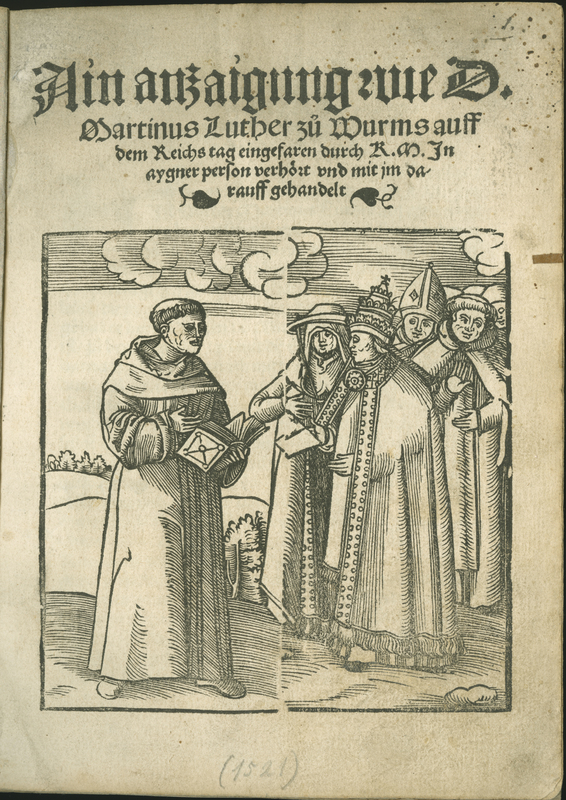
A woodcut depicting Martin Luther, in the garb of an Augustinian monk, debating a gathering of Catholic clergy members, including the Pope, a cardinal, a bishop, and a monk. This woodcut appears on the title page of a popular anonymous account of Luther's debate before the Diet of Worms in 1521.A woodcut depicting Martin Luther, in the garb of an Augustinian monk, debating a gathering of Catholic clergy members, including the Pope, a cardinal, a bishop, and a monk. This woodcut appears on the title page of a popular anonymous account of Luther's debate before the Diet of Worms in 1521. -
 Still image
Maniere de porter le S. Sacrement quand le Pape est en Vojage
Picart, Bernard, 1673-1733A pair of engravings depicting the proper way to transport the Eucharist when the Pope is travelling: either on a horse (top) or on a litter supported by two horses, front and back (bottom).A pair of engravings depicting the proper way to transport the Eucharist when the Pope is travelling: either on a horse (top) or on a litter supported by two horses, front and back (bottom). -
 Still image
Massacre de Tilly à Magdebourg, l'an 1631
Luiken, Jan, 1649-1712An engraving depicting the Siege of Magdeburg during the Thirty Years' War. The image shows the invading forces murdering civilians and burning the city.An engraving depicting the Siege of Magdeburg during the Thirty Years' War. The image shows the invading forces murdering civilians and burning the city. -
 Still image
Monk Fish
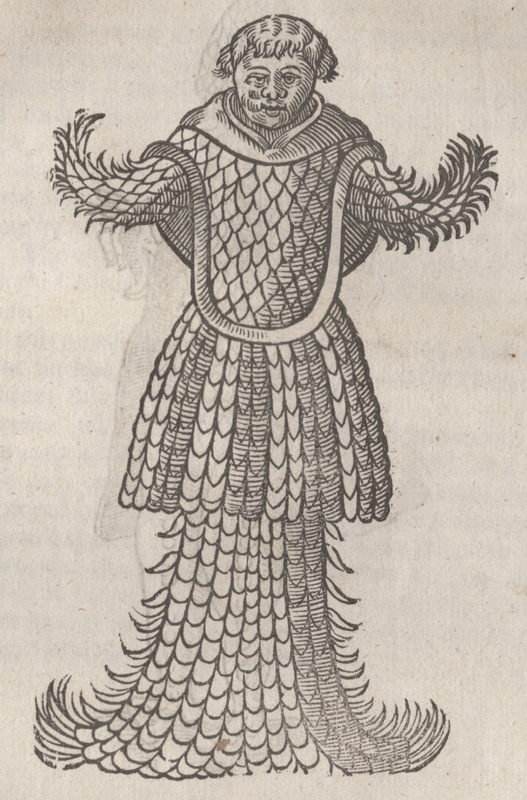
A woodcut depicting a monstrous fish purportedly pulled from the sea in Poland, which had the appearance of a Catholic monk.A woodcut depicting a monstrous fish purportedly pulled from the sea in Poland, which had the appearance of a Catholic monk. -
 Still image
Monstrance
A woodcut depicting an elaborate monstrance, or an ostensorium, somewhat in the shape of a cathedral with a crucefix on top.A woodcut depicting an elaborate monstrance, or an ostensorium, somewhat in the shape of a cathedral with a crucefix on top. -
 Text
TextNecrologium pontificum ac pseudopontificum Romanorum cum notis
Oldoini, Agostino, 1612-1683Summary:Summary: -
 Text
TextNorth Dutch Book of Hours
Catholic ChurchUsed at Utrecht between 1470 and 1500, the North Dutch Book of Hours includes the "Hours of the Eternal Wisdom," by Gerard Groot (a member of the Brothers of the Common Life), Hours of the Virgin, and Penitential Psalms.Used at Utrecht between 1470 and 1500, the North Dutch Book of Hours includes the "Hours of the Eternal Wisdom," by Gerard Groot (a member of the Brothers of the Common Life), Hours of the Virgin, and Penitential Psalms. -
 Still image
Observation of Catholic Holy Days
Picart, Bernard, 1673-1733A series of six engravings depicting the observation of various Catholic Holy Days, including: Candlemas (top), tenebrae (left middle), the Procession of the Eucharist into a tomb (right middle), the fire that begins Holy Saturday (bottom left), and the blessing of a new Paschal candle (bottom right).A series of six engravings depicting the observation of various Catholic Holy Days, including: Candlemas (top), tenebrae (left middle), the Procession of the Eucharist into a tomb (right middle), the fire that begins Holy Saturday (bottom left), and the blessing of a new Paschal candle (bottom right). -
 Text
TextOratio
Eck, Johann, 1486-1543Summary: This is the first printing of Eck's speech to the Diet of Regensburg on April 5, 1541, defining the Catholic understanding of the Lord's Supper. The Diet of Regensburg proved to be Eck's last appearance as a major theological political leader, for his health declined and he could no longer bear the weight of these grueling encounters.Summary: This is the first printing of Eck's speech to the Diet of Regensburg on April 5, 1541, defining the Catholic understanding of the Lord's Supper. The Diet of Regensburg proved to be Eck's last appearance as a major theological political leader, for his health declined and he could no longer bear the weight of these grueling encounters. -
 Still image
Ordinations
Picart, Bernard, 1673-1733A series of six engravings depicting a Roman Catholic cleric receiving tonsure (top left) and a surplice (top right), and the ordination of a sexton (middle left), a lector (middle right), an exorcist (bottom left), and an acolyte (bottom right).A series of six engravings depicting a Roman Catholic cleric receiving tonsure (top left) and a surplice (top right), and the ordination of a sexton (middle left), a lector (middle right), an exorcist (bottom left), and an acolyte (bottom right). -
 Still image
Ordinations
Picart, Bernard, 1673-1733A series of six engravings depicting the ordination of Roman Catholic subdeacons (top left), deacons (top right), and priests (middle left). The priestly ordination includes the bishop laying hands on the new priest (middle right), the bestowal of the power to consecrate (bottom left), and sharing in Communion (bottom right).A series of six engravings depicting the ordination of Roman Catholic subdeacons (top left), deacons (top right), and priests (middle left). The priestly ordination includes the bishop laying hands on the new priest (middle right), the bestowal of the power to consecrate (bottom left), and sharing in Communion (bottom right). -
 Text
TextOrdnu[n]g wie man tauffet, bissher im Latein gehalten, verteütscht : Hierin ist, auss etlichen Ursachen, was die andern, als uberflüssig, veracht haben, nicht aussgelassen
Catholic ChurchSummary: Osiander provides a fuller translation of the traditional Catholic rite of baptism than Münzer or Luther, who had both published baptism liturgies one year earlier, and who had eliminated certain ritual elements.Summary: Osiander provides a fuller translation of the traditional Catholic rite of baptism than Münzer or Luther, who had both published baptism liturgies one year earlier, and who had eliminated certain ritual elements. -
 Still image
Ornamental Tailpiece: Choir
Picart, Bernard, 1673-1733An engraved ornamental tailpiece appearing at the end of the fifth part of the section on Catholics. The engraving depicts a choir seated before an altar.An engraved ornamental tailpiece appearing at the end of the fifth part of the section on Catholics. The engraving depicts a choir seated before an altar. -
 Still image
Ornamental Tailpiece: Ritual Objects
Picart, Bernard, 1673-1733An engraved ornamental tailpiece appearing at the end of the introductory section. The engraving depicts a platform with the inscription "Finis" above which hangs a bell and drapery. Holding the drapery and bell up is a decorative boarder featuring a pair of cherubs, a censer, a stole, an open book (likely a Bible), and other Catholic ritual items.An engraved ornamental tailpiece appearing at the end of the introductory section. The engraving depicts a platform with the inscription "Finis" above which hangs a bell and drapery. Holding the drapery and bell up is a decorative boarder featuring a pair of cherubs, a censer, a stole, an open book (likely a Bible), and other Catholic ritual items. -
 Still image
Ornamental Tailpiece: Torture
Picart, Bernard, 1673-1733An engraved ornamental tailpiece to the preface of the section on the Inquisition, depicting the torture of heretics.An engraved ornamental tailpiece to the preface of the section on the Inquisition, depicting the torture of heretics. -
 Still image
Ornamental Tailpiece: Trial
Picart, Bernard, 1673-1733An engraved ornamental tailpiece to the first and second sections on the Inquisition, depicting a pair of Catholic officials trying a man during the Inquisition.An engraved ornamental tailpiece to the first and second sections on the Inquisition, depicting a pair of Catholic officials trying a man during the Inquisition. -
 Still image
Papal Conclave
Picart, Bernard, 1673-1733A series of six engravings depicting a conclave, the process by which Roman Catholic cardinals elect a new pope. The rules of the conclave, in which the cardinals are locked in seclusion, were established to prevent political interference and long delays. Food was delivered through a window; after three days, they only received one meal a day and after five days, only bread and water.A series of six engravings depicting a conclave, the process by which Roman Catholic cardinals elect a new pope. The rules of the conclave, in which the cardinals are locked in seclusion, were established to prevent political interference and long delays. Food was delivered through a window; after three days, they only received one meal a day and after five days, only bread and water. -
 Still image
Papal Funeral
Picart, Bernard, 1673-1733A series of six engravings depicting papal funeral rituals including the recognition of the pope’s body (top left), the procession of the body to Saint Peter’s basilica (second row), the body lying in state for three days at Saint Peter’s (third row left), the pope’s catafalque (a raised bier used to support the coffin) (third row right) and the funeral procession (bottom).A series of six engravings depicting papal funeral rituals including the recognition of the pope’s body (top left), the procession of the body to Saint Peter’s basilica (second row), the body lying in state for three days at Saint Peter’s (third row left), the pope’s catafalque (a raised bier used to support the coffin) (third row right) and the funeral procession (bottom). -
 Still image
Penance
Picart, Bernard, 1673-1733A series of six engravings depicting a Roman Catholic bishop leads worshipers through rites of penance, including putting on sackcloth, kneeling outside with extinguished candles, and reciting the litanies.A series of six engravings depicting a Roman Catholic bishop leads worshipers through rites of penance, including putting on sackcloth, kneeling outside with extinguished candles, and reciting the litanies. -
 Still image
Plan du Conclave et Description des Solomnités, qui s'observent à Rome aprés la mort d'un Pape, et pour l'Election d'un Successeur
Engraved title vignette, and other engravings.Engraved title vignette, and other engravings. -
 Text
TextPontificale Romanum
Catholic ChurchSummary: The Pontificale Romanum contains the liturgical rites for the sacraments of confirmation and Holy orders performed by bishops. The work is called "liber pontificalis" (pontifical or papal book) here, as books bearing pontifical authority often were prior to the 16th century, but it should not be confused with the papal annals, also called Liber Pontificalis, which is used by historians of the early Roman ChurchSummary: The Pontificale Romanum contains the liturgical rites for the sacraments of confirmation and Holy orders performed by bishops. The work is called "liber pontificalis" (pontifical or papal book) here, as books bearing pontifical authority often were prior to the 16th century, but it should not be confused with the papal annals, also called Liber Pontificalis, which is used by historians of the early Roman Church -
 Text
TextPopery calmly considered
Wesley, John, 1703-1791Summary: A tract in which Wesley reflects on a number of doctrines of the Catholic Church.Summary: A tract in which Wesley reflects on a number of doctrines of the Catholic Church. -
 Still image
Prisoners taken to Castel Sant'Angelo and the Nightly Patrol
A pair of woodcuts with captions depicting guards taking prisoners to Castel Sant'Angelo (while others are left alone) (top) and a depiction of the nightly patrol that occurs during the Conclave in Rome (bottom).A pair of woodcuts with captions depicting guards taking prisoners to Castel Sant'Angelo (while others are left alone) (top) and a depiction of the nightly patrol that occurs during the Conclave in Rome (bottom). -
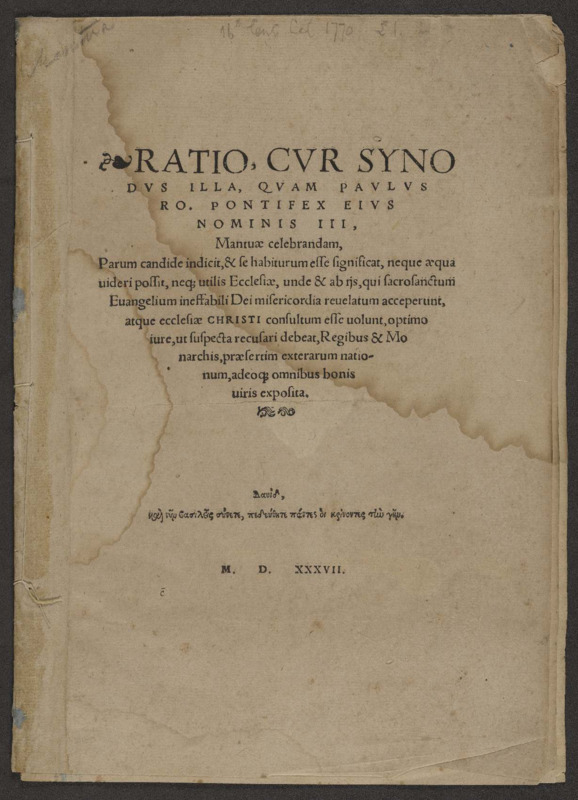 Text
TextRatio, cur synodus illa, quam Paulus Ro. Pontifex eius nominis III, Mantuae celebrandam, parum candide indicit, & se habiturum esse significat, neque aequa inderi possit, neq[ue] utilis Ecclesiae, unde & ab ijs, qui sacrosanctum Euangelium ineffabili Dei
Summary: When Pope Paul III called for a reform council at Mantua in 1536, the Protestants were faced with a dilemma. If they attended the council they would be recognizing the Pope's authority in such matters. If they refused, then it might appear that their calls for a general council had been insincere. The sticky task of responding to the pope's call fell upon Melanchthon. This is an edition of his response.Summary: When Pope Paul III called for a reform council at Mantua in 1536, the Protestants were faced with a dilemma. If they attended the council they would be recognizing the Pope's authority in such matters. If they refused, then it might appear that their calls for a general council had been insincere. The sticky task of responding to the pope's call fell upon Melanchthon. This is an edition of his response. -
 Text
TextReplica F. Sylvestri Prieriat[is] : sacri Palatii Apostolici Magistri, ad F. Martinum Luther Ordinis Eremitaru[m] ; Martinus Luther, optimo lectori salutem ...
Mazzolini, Silvestro, da Prierio, 1456?-1527?Summary: When Luther received the replies of S. Mazzolini, the first man to take up the cudgels against Luther, he found the best course of reply to be a reprinting with notes of Mazzolini's inept rejoinders. Even the Catholics had to admit that Mazzolini's answers simply did not meet Luther's objections. This is the second printing of the work.Summary: When Luther received the replies of S. Mazzolini, the first man to take up the cudgels against Luther, he found the best course of reply to be a reprinting with notes of Mazzolini's inept rejoinders. Even the Catholics had to admit that Mazzolini's answers simply did not meet Luther's objections. This is the second printing of the work. -
 Text
TextReplica contra periculosa scripta post Scrutinium diuine scripture iam pride[m] emissum emanata. ...
Schatzgeyer, Kaspar, 1463 or 1464-1527Summary: Casper Schatzgeyer, or Sasgerus, was a Franciscan friar who became provincial of the Province of Strasbourg in 1517. He wrote about 23 books on theological topics and against members of other orders and sects, notably J. von Staupitz and A. Osiander. This book, however, criticizes two of Luther's tracts: On Monastic Vows and On the Abolition of the Private Mass. Luther persuaded Johann Briessmann to reply, and Schatzgeyer replied to Briessmann. This is the work's first printing.Summary: Casper Schatzgeyer, or Sasgerus, was a Franciscan friar who became provincial of the Province of Strasbourg in 1517. He wrote about 23 books on theological topics and against members of other orders and sects, notably J. von Staupitz and A. Osiander. This book, however, criticizes two of Luther's tracts: On Monastic Vows and On the Abolition of the Private Mass. Luther persuaded Johann Briessmann to reply, and Schatzgeyer replied to Briessmann. This is the work's first printing. -
 Text
TextResolutio[n]es disputationum
Luther, Martin, 1483-1546Summary: This is Luther's final authorized edition of his Ninety-five Theses in book form with his own commentaries. The edition published by Rhau-Grunemberg had been so full of errors, that Luther gave the printing of this edition to Melchior Lotter in Leipzig.Summary: This is Luther's final authorized edition of his Ninety-five Theses in book form with his own commentaries. The edition published by Rhau-Grunemberg had been so full of errors, that Luther gave the printing of this edition to Melchior Lotter in Leipzig. -
 Text
TextS. Isidori hispalensis episcopi ... opera omnia
Isidore, of Seville, Saint, -636Summary: A collection of the works of Saint Isidore, of Seville.Summary: A collection of the works of Saint Isidore, of Seville. -
 Text
TextS.D.n.D. Pauli diuina prouidentia p.p. III : Bullla indictionis sacro sancti generalis concilii
Catholic Church. Pope (1534-1549 : Paul III)Summary: Latin text of the Papal Bull Ad Dominici gregis curam, issued June 4, 1536, for the Council of Mantua which was never held (council eventually took place in Trent).Summary: Latin text of the Papal Bull Ad Dominici gregis curam, issued June 4, 1536, for the Council of Mantua which was never held (council eventually took place in Trent). -
 Text
TextSacrarvm caeremoniarvm sive Ritvvm ecclesiasticorvm S. Rom. ecclesiae. : libri tres
Patrizi Piccolomini, Agostino, approximately 1435-1496Summary:Summary: -
 Still image
Scala Santa di Sisto et Cavalli del Quirinale
A pair of engravings depicting the Scala Sancta at St. John Lateran and statues of the Dioscuri with horses which were moved to the Piazza del Quirinale, both of which were a part of Pope Sixtus V's urban reform program.A pair of engravings depicting the Scala Sancta at St. John Lateran and statues of the Dioscuri with horses which were moved to the Piazza del Quirinale, both of which were a part of Pope Sixtus V's urban reform program. -
 Text
TextSendtbrieff an Pfarrer von Hohensynn. Doctor Martini Luthers Leer betreffende. Oder einem Jede[n] Prelatischen Pfarrer Seynes vaterlandes.
Summary: This is a Catholic pamphlet warning against Luther's errors. "Pastor Highmind" may be pseudonym or the name of a real Pastor von Hohensynn.Summary: This is a Catholic pamphlet warning against Luther's errors. "Pastor Highmind" may be pseudonym or the name of a real Pastor von Hohensynn. -
 Text
TextSerenissimi ac potentissimi Regis Anglie, Christiane fidei defensoris inuictissimi, ad illustrissimos ac clarissimos Saxoni[a]e principes, de coercenda abigendaq[ue] Lutherana factione, & Luthero ipso epistola : Item illustrissimi principis Ducis Georgii ad eundem Regem rescriptio
Henry VIII, King of England, 1491-1547Summary: Response by King Henry VIII of England to Luther's attack on his book, "Assertio septem sacramentorum", on the seven sacraments of the Catholic Church. This printing was issued in Leipzig by Hieronymous Emser, early opponent of Luther, with a reply by his ruler, Duke George of Saxony, and dedicated by Emser to Johann von Schleinitz, bishop of Meissen.Summary: Response by King Henry VIII of England to Luther's attack on his book, "Assertio septem sacramentorum", on the seven sacraments of the Catholic Church. This printing was issued in Leipzig by Hieronymous Emser, early opponent of Luther, with a reply by his ruler, Duke George of Saxony, and dedicated by Emser to Johann von Schleinitz, bishop of Meissen. -
 Text
TextSermon for Sexagesmia; Luke 8: 15
Archer, James, 1751-1834This sermon examines the virtue of patience, outlining multiple reasons for why patience is important and why Christians are obligated to practice patience.This sermon examines the virtue of patience, outlining multiple reasons for why patience is important and why Christians are obligated to practice patience. -
 Text
TextSermon for the 24th Sunday after Pentecost; Matthew 24:15
Archer, James, 1751-1834This sermon examines sin, describing the variety of kinds of sins, being corporal or spiritual, and the effects of sin on our bodies and on our soul.This sermon examines sin, describing the variety of kinds of sins, being corporal or spiritual, and the effects of sin on our bodies and on our soul. -
 Text
TextSermon for the 4th Sunday in Lent; John 20:23
Archer, James, 1751-1834This sermon examines the practice of confession, emphasizing the importance of revealing one's sins in order to receive forgiveness, and outlining the appropriate times in which absolution should be withheld.This sermon examines the practice of confession, emphasizing the importance of revealing one's sins in order to receive forgiveness, and outlining the appropriate times in which absolution should be withheld. -
 Text
TextSermon for the Sunday within the Oct. of the Holy Sacrament, Luke 14:16
Archer, James, 1751-1834This sermon addresses the sacrifice of Jesus and the continual practice of Mass, indicating the importance of attending mass, the situations in which people can be excused from Mass without sin, and the dispositions necessary to benefit from Mass.This sermon addresses the sacrifice of Jesus and the continual practice of Mass, indicating the importance of attending mass, the situations in which people can be excused from Mass without sin, and the dispositions necessary to benefit from Mass. -
 Text
TextSermon on the Feast of All Saints; Matthew 5:12
Archer, James, 1751-1834This sermon addresses the rewards promised to the blessed and faithful in Heaven, consistently emphasizing that these rewards are far more magnificent than any man-made riches or wonders.This sermon addresses the rewards promised to the blessed and faithful in Heaven, consistently emphasizing that these rewards are far more magnificent than any man-made riches or wonders. -
 Still image
St. Peter's Basilica
An engraving depicting St. Peter's Basilica and surrounding buildings and monuments, including the Papal Palace, the Sistine Chapel, the Vatican Obelisk, the Sacristy, and St. Peter's Square.An engraving depicting St. Peter's Basilica and surrounding buildings and monuments, including the Papal Palace, the Sistine Chapel, the Vatican Obelisk, the Sacristy, and St. Peter's Square. -
 Still image
Standards and Condemned of the Inquisition
Picart, Bernard, 1673-1733A series of four engravings depicting the standards of the Spanish and Goan Inquisitions (top), a man awaiting judgement (bottom left), and a nun who avoided being condemned to the stake by confessing (bottom right). The standard of the Spanish Inquisition features a cross made of rough logs, flanked by a sword and a branch with the motto, "EXURGE DOMINE ET JUDICA CAUSAM TUAM PSALM 73." The standard of the Goan Inquisition features a Dominican monk holding a sword and branch above a dog holding a torch to an orb with the motto, "MISERICORDIA ET JUSTITIA."A series of four engravings depicting the standards of the Spanish and Goan Inquisitions (top), a man awaiting judgement (bottom left), and a nun who avoided being condemned to the stake by confessing (bottom right). The standard of the Spanish Inquisition features a cross made of rough logs, flanked by a sword and a branch with the motto, "EXURGE DOMINE ET JUDICA CAUSAM TUAM PSALM 73." The standard of the Goan Inquisition features a Dominican monk holding a sword and branch above a dog holding a torch to an orb with the motto, "MISERICORDIA ET JUSTITIA." -
 Still image
Super hanc petram aedefi cabo ecclesiam meam
An engraving depicting Jesus leading the Apostles, with a hand on Peter's back, towards St. Peter's Basilica. Below the image is a passage from Matthew 16, "Super hanc petram aedificabo ecclesiam meam" (On this rock I will build my church).An engraving depicting Jesus leading the Apostles, with a hand on Peter's back, towards St. Peter's Basilica. Below the image is a passage from Matthew 16, "Super hanc petram aedificabo ecclesiam meam" (On this rock I will build my church). -
 Still image
The Announcement of the New Pope and the Burning of Flax
A pair of woodcuts with captions depicting the announcement of a successful election of a new pope (top) and the rite of burning flax at the Papal corronation (bottom).A pair of woodcuts with captions depicting the announcement of a successful election of a new pope (top) and the rite of burning flax at the Papal corronation (bottom). -
 Still image
The Arrival of the New Pope in St. Peter's Basilica
A pair of woodcuts with captions depicting the newly elected Pope being carried from the Sistine Chapel to St. Peter's Basilica (top) and the recognition of the new Pope as he sits upon the High Altar in St. Peter's Basilica (bottom).A pair of woodcuts with captions depicting the newly elected Pope being carried from the Sistine Chapel to St. Peter's Basilica (top) and the recognition of the new Pope as he sits upon the High Altar in St. Peter's Basilica (bottom). -
 Still image
The Cardinal Camerlengo retrieving the Ring of the Fisherman and the Destruction of the Papal Seal
A pair of woodcuts with captions depicting the Cardinal Camerlengo retrieving the Ring of the Fisherman from the body of the deceased Pope (top) and the sealing of the Papal office and destruction of the deceased Pope's seal (bottom).A pair of woodcuts with captions depicting the Cardinal Camerlengo retrieving the Ring of the Fisherman from the body of the deceased Pope (top) and the sealing of the Papal office and destruction of the deceased Pope's seal (bottom). -
 Still image
The Council of Trent
An engraving depicting a session of the Council of Trent with the label, "The Representation of the Fathers assembled in the Council of Trent: begun about the end of the year 1545. Concluded towards the end of 1563, under the Pontificate of Paul III, Julius III, Marcel II, Paul IV, and Pius IV. There were XXV Sessions, in which were present VII Cardinals, V whereof were the Popes LEgates, XVI Ambassadours from Kings, Princes & Republicks, CCL Patriarchs, Archbishops, Bishops, Abbots and Generals of Orders, All Divines and Doctours of the Civil and Canon Law."An engraving depicting a session of the Council of Trent with the label, "The Representation of the Fathers assembled in the Council of Trent: begun about the end of the year 1545. Concluded towards the end of 1563, under the Pontificate of Paul III, Julius III, Marcel II, Paul IV, and Pius IV. There were XXV Sessions, in which were present VII Cardinals, V whereof were the Popes LEgates, XVI Ambassadours from Kings, Princes & Republicks, CCL Patriarchs, Archbishops, Bishops, Abbots and Generals of Orders, All Divines and Doctours of the Civil and Canon Law." -
 Still image
The Crowning of the Pope
A woodcut depicting the newly elected Pope being crowned befored the gathered Cardinals.A woodcut depicting the newly elected Pope being crowned befored the gathered Cardinals. -
 Still image
The Entry to the Conclave and the Temporary Rooms
A pair of woodcuts with captions depicting the cardinals entering the conclave (top) and two examples (one complete and one with the framing) of the temporary rooms set up to house the cardinals during the conclave (bottom).A pair of woodcuts with captions depicting the cardinals entering the conclave (top) and two examples (one complete and one with the framing) of the temporary rooms set up to house the cardinals during the conclave (bottom). -
 Still image
The First Meeting of Cardinals and the Mass of the Holy Spirit
A pair of woodcuts with captions depicting the initial meeting of the Cardinals before the official conclave (top) and the Mass of the Holy Ghost preceeding the Papal conclave (bottom).A pair of woodcuts with captions depicting the initial meeting of the Cardinals before the official conclave (top) and the Mass of the Holy Ghost preceeding the Papal conclave (bottom). -
 Still image
The Funeral Procession of Pope Clement XI
A woodcut depicting the stages of the funeral procession of Pope Clement XI, showing the route of the procession and the elements of the procession.A woodcut depicting the stages of the funeral procession of Pope Clement XI, showing the route of the procession and the elements of the procession. -
 Still image
The Ordination of Nuns
Picart, Bernard, 1673-1733A series of six engravings depicting elements of the process of ordaining nuns. The bishop gives the nuns their rings (top left), the bishop crowns the nuns with wreaths (top right), the reading of the anathema (middle left), nuns present their candles (middle right), the bishop celebrates communion with the nuns (bottom left) and the bishop gives the nuns their breviaries (bottom right).A series of six engravings depicting elements of the process of ordaining nuns. The bishop gives the nuns their rings (top left), the bishop crowns the nuns with wreaths (top right), the reading of the anathema (middle left), nuns present their candles (middle right), the bishop celebrates communion with the nuns (bottom left) and the bishop gives the nuns their breviaries (bottom right). -
 Still image
The Ordination of a Catholic Bishop
Picart, Bernard, 1673-1733A series of six engravings depicting elements of the process of ordaining a Roman Catholic bishop, including his presentation (top left), his oath (top right), his bowing before the altar (middle left) anointing (middle right), the anointing of his hands, (bottom left), and the bestowal of his crosier (bottom right).A series of six engravings depicting elements of the process of ordaining a Roman Catholic bishop, including his presentation (top left), his oath (top right), his bowing before the altar (middle left) anointing (middle right), the anointing of his hands, (bottom left), and the bestowal of his crosier (bottom right). -
 Still image
The Ordination of a Catholic Bishop
Picart, Bernard, 1673-1733A series of six engravings depicting elements of the process of ordaining a Roman Catholic bishop: including the bestowal of his ring (top left), bestowal of a book of the gospels (top right), presenting the torches, the bread and the wine (middle left), dressing in his miter (middle right), receiving his crosier (bottom left), and dressing in his pallium (lower right).A series of six engravings depicting elements of the process of ordaining a Roman Catholic bishop: including the bestowal of his ring (top left), bestowal of a book of the gospels (top right), presenting the torches, the bread and the wine (middle left), dressing in his miter (middle right), receiving his crosier (bottom left), and dressing in his pallium (lower right). -
 Still image
The Ordination of an Abbot, an Abbess, and Nuns
Picart, Bernard, 1673-1733A series of six engravings depicting Elements of the processes of ordaining abbots, abbesses, and nuns: the abbot receiving his ecclesiastical habit (top left), the laying on of hands (top right), the abbess receiving her veil (middle left), nuns being consecrated (middle right), blessing the habits of the nuns (bottom left), and nuns receiving their veils (bottom right).A series of six engravings depicting Elements of the processes of ordaining abbots, abbesses, and nuns: the abbot receiving his ecclesiastical habit (top left), the laying on of hands (top right), the abbess receiving her veil (middle left), nuns being consecrated (middle right), blessing the habits of the nuns (bottom left), and nuns receiving their veils (bottom right). -
 Still image
The Two-day Election and Recognition of the New Pope
A pair of woodcuts with captions depicting the two-day election process by the Cardinals (top) and the initial process of the Cardinals formally recognizing and paying tribute to the new Pope (bottom).A pair of woodcuts with captions depicting the two-day election process by the Cardinals (top) and the initial process of the Cardinals formally recognizing and paying tribute to the new Pope (bottom). -
 Text
TextThe catholic doctrine of the Church of England : an exposition of the Thirty-nine articles
Rogers, Thomas, -1616Summary:Summary: -
Text
The works of John Jewel
Jewel, John, 1522-1571Summary: A sermon preached at Paul's cross. Correspondence with Dr. Cole. The reply to Harding's Answer...Summary: A sermon preached at Paul's cross. Correspondence with Dr. Cole. The reply to Harding's Answer... -
Text
The works of John Jewel
Jewel, John, 1522-1571Summary: The reply to Harding's Answer...[cont.] An exposition upon the two Epistles to the Thessalonians. Sermons. A treatise of the sacraments.Summary: The reply to Harding's Answer...[cont.] An exposition upon the two Epistles to the Thessalonians. Sermons. A treatise of the sacraments. -
 Text
TextThird of three short discourses, all untitled, concerning candidates for a religious profession
Archer, James, 1751-1834This sermon addresses the importance of renouncing wordly pleasures in order to enter the religious state, emphasizing that one seeking a religious profession must look to their instructors to learn about spiritual mysteries.This sermon addresses the importance of renouncing wordly pleasures in order to enter the religious state, emphasizing that one seeking a religious profession must look to their instructors to learn about spiritual mysteries. -
 Still image
Torture donnée aux Vaudois avec du fer ardent dans la main, A. 1214
Luiken, Jan, 1649-1712An engraving depicting the torture of Waldensians, who Pope Innocent III denounced as heretics, by pressing hot irons to their hands. The image shows a clergyman holding a burning iron above the hand of a Waldensian while a crowd watches.An engraving depicting the torture of Waldensians, who Pope Innocent III denounced as heretics, by pressing hot irons to their hands. The image shows a clergyman holding a burning iron above the hand of a Waldensian while a crowd watches. -
 Still image
Un Billet Papal [et] la Structure ex la charpente des cellules des Cardinaux
Picart, Bernard, 1673-1733A pair of engravings depicting a representation of a ballot for a papal election (top) and a design for the structure of the temporary living spaces for Cardinals during the papal conclave (bottom).A pair of engravings depicting a representation of a ballot for a papal election (top) and a design for the structure of the temporary living spaces for Cardinals during the papal conclave (bottom). -
 Text
TextUntitled; II Corinthians 6:2
Archer, James, 1751-1834This sermon defines the Jubilee, describing when it occurs, remittances for servitude, and the forgiveness of debt.This sermon defines the Jubilee, describing when it occurs, remittances for servitude, and the forgiveness of debt. -
 Text
TextUntitled; Matthew 22:39
Archer, James, 1751-1834This sermon addresses the importance of loving one's neighbor, explaining why God asks us to love our neighbors and the qualities of a healthy love for one's neighbors.This sermon addresses the importance of loving one's neighbor, explaining why God asks us to love our neighbors and the qualities of a healthy love for one's neighbors. -
 Text
TextUntitled; Romans 4:25
Archer, James, 1751-1834This sermon examines the cruxificition of Jesus Christ, describing the manner in which he died, the betrayal of the apostle Judas, and Jesus's persistent love of humanity despite their actions.This sermon examines the cruxificition of Jesus Christ, describing the manner in which he died, the betrayal of the apostle Judas, and Jesus's persistent love of humanity despite their actions. -
 Text
TextUom Missbrauch der Messen
Luther, Martin, 1483-1546Summary: Written in Latin in the fall of 1521 under the title De abroganda missa privata, this is the third printing of the first German edition of Martin Luther's important tract on the celebration of private masses. Luther opposed any celebration of the Eucharist that was not accessible to or provided for the congregation at large and felt so strongly about this material that he translated it into German himself.Summary: Written in Latin in the fall of 1521 under the title De abroganda missa privata, this is the third printing of the first German edition of Martin Luther's important tract on the celebration of private masses. Luther opposed any celebration of the Eucharist that was not accessible to or provided for the congregation at large and felt so strongly about this material that he translated it into German himself. -
 Text
TextUon Menschenn Lere zu meyden
Luther, Martin, 1483-1546Summary: A treatise by Luther on the relationship of belief and practice, intended for those "poor consciences, that lie captive to human laws in cloisters and monastic foundations", as he puts it in his preface. It is also noteworthy that Luther assumes his audience includes both those who could read his writings directly, and those who heard them read by others, when he dedicates his pamphlet "to all who read or hear this little book".Summary: A treatise by Luther on the relationship of belief and practice, intended for those "poor consciences, that lie captive to human laws in cloisters and monastic foundations", as he puts it in his preface. It is also noteworthy that Luther assumes his audience includes both those who could read his writings directly, and those who heard them read by others, when he dedicates his pamphlet "to all who read or hear this little book". -
 Text
TextUon der beycht ob die der Bapst macht hab zugepieten
Luther, Martin, 1483-1546Summary: This is Luther's tract on auricular confession. The sacrament of penance was the focus of Luther's most vehement criticisms. Not only was the sacrament the course of numerous abuses, indulgence selling among them, but attacks on the efficacy of priestly absolution called into question the sacramental authority of all priests, the pope included.Summary: This is Luther's tract on auricular confession. The sacrament of penance was the focus of Luther's most vehement criticisms. Not only was the sacrament the course of numerous abuses, indulgence selling among them, but attacks on the efficacy of priestly absolution called into question the sacramental authority of all priests, the pope included. -
 Text
TextVnderricht ausz göttlichen vnd gaystlichen Rechten : Auch ausz den flayschlichen bepstlichen Vnrechten, ob ain Priester ain Eeweyb, oder Concubin, das ist, ain Beyschlaff haben möge
Keller, MichaelSummary: Polemical tract against celibacy, attributed to Michael Keller, who was married August 10, 1526 in Augsburg.Summary: Polemical tract against celibacy, attributed to Michael Keller, who was married August 10, 1526 in Augsburg. -
 Text
TextVon Ceremonien der Kirchen : das ist von eusserlichem dienste Gottes, oder von Leiblicher vbunge Göttlicher Ampter ...
Bachmann, Paul, 1465-1538Summary: Defense of Catholic worship and priestly offices by Paul Bachmann, Abbot of Altzelle, a vehement opponent of Martin Luther.Summary: Defense of Catholic worship and priestly offices by Paul Bachmann, Abbot of Altzelle, a vehement opponent of Martin Luther. -
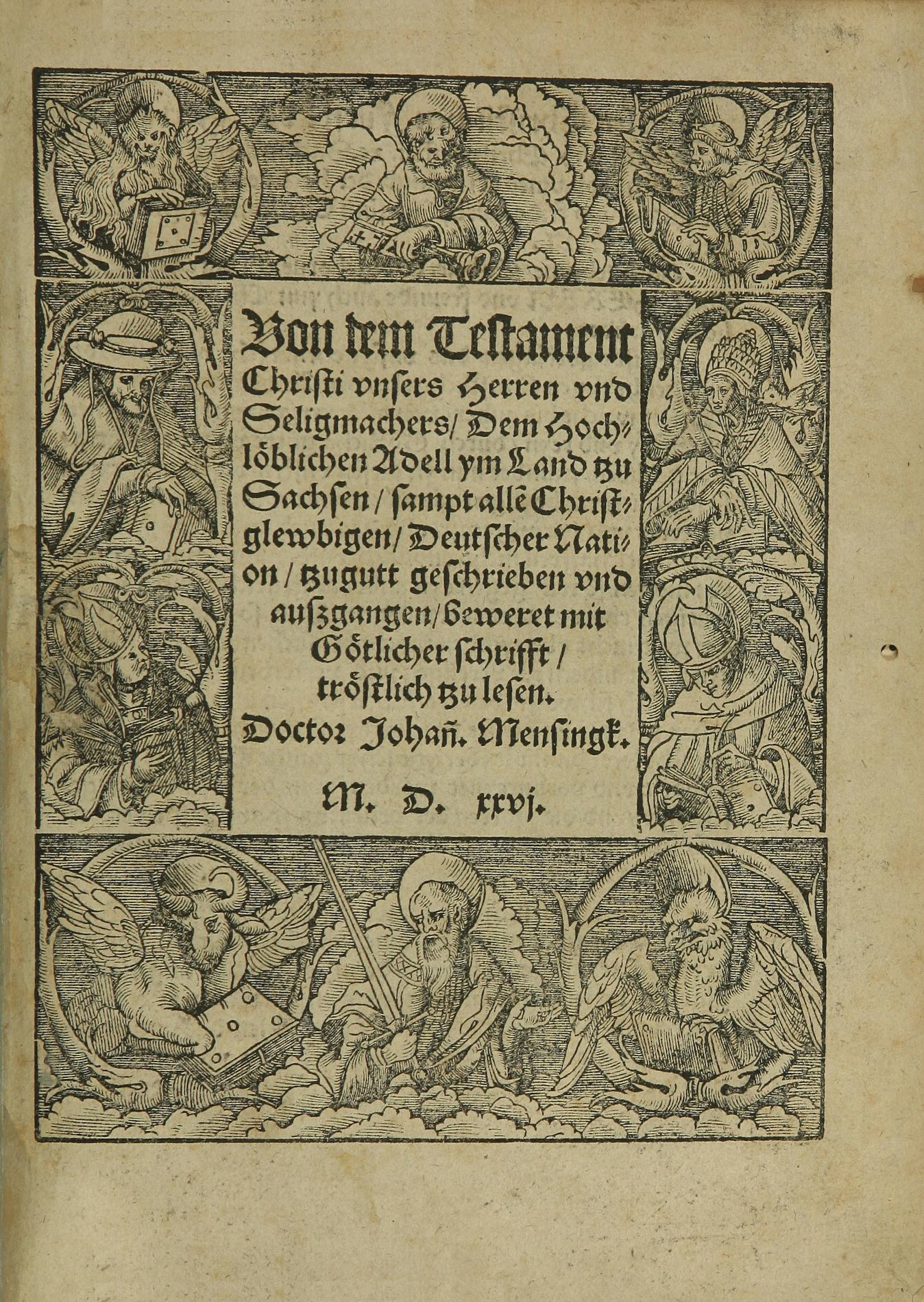 Text
TextVon dem Testament Christi vnsers Herren vnd Seligmachers : Dem Hochlöblichen Adell ym landt zu Sachsen, sampt alle[n] Christglewbigen, Deutscher Nation, tzugutt geschriben vnd auszgangen, beweret mit Götlicher schrifft, tröstlich zu lesen
Mensing, Johannes, active 1495-1541Summary: J. Mensing was a Dominican opponent of Luther. Born in either Mageburg or Zutphen, Holland, he studied in Wittenberg and Frankfurt an der Oder, where he took his doctorate. He preached at Mageburg Cathedral 1522-1524 against the Reformers. In 1530, he was one of the Confutators of the Augsburg Confession. In 1534, he became provincial of the Dominicans, and in 1539, suffragan-bishop of Halberstedt. In this tract, Mensing defends Catholic interpretation of the Lord's Supper through references to scripture.Summary: J. Mensing was a Dominican opponent of Luther. Born in either Mageburg or Zutphen, Holland, he studied in Wittenberg and Frankfurt an der Oder, where he took his doctorate. He preached at Mageburg Cathedral 1522-1524 against the Reformers. In 1530, he was one of the Confutators of the Augsburg Confession. In 1534, he became provincial of the Dominicans, and in 1539, suffragan-bishop of Halberstedt. In this tract, Mensing defends Catholic interpretation of the Lord's Supper through references to scripture. -
 Text
TextVon der Papisten Tauff : vnd andern Caeremonien oder Kirchendiensten ob die nach erkanter vnd angenomener Warheit durch jemand Christlich zu besuchen vnd zu gebrauchen sein
Summary: Only printing of a Lutheran pamphlet by an anonymous preacher from Southern Germany on the subject of baptism and other ceremonies in the Catholic church, with an introduction by Nicolaus Gallus.Summary: Only printing of a Lutheran pamphlet by an anonymous preacher from Southern Germany on the subject of baptism and other ceremonies in the Catholic church, with an introduction by Nicolaus Gallus. -
 Text
TextVon walfart
Erasmus, Desiderius, -1536Summary: Interpretive pamphlet by Erasmus on the true nature of pilgrimage, as espoused by Jesus in Matthew XI, 28. Erasmus says that true pilgrimage is undertaken with spiritual, and not with physical feet, and, that Jesus receives all sincere pilgrims equally, whether they be clergy or lay, rich or poor, etc.Summary: Interpretive pamphlet by Erasmus on the true nature of pilgrimage, as espoused by Jesus in Matthew XI, 28. Erasmus says that true pilgrimage is undertaken with spiritual, and not with physical feet, and, that Jesus receives all sincere pilgrims equally, whether they be clergy or lay, rich or poor, etc. -
 Text
TextWyder den Wittenbergischen Abtgot Martin Luther
Alveldt, Augustin von, active 16th centurySummary: The Franciscan Augustine of Alveldt wrote this polemical tract in response to Luther's pamphlet "Widder den newen Abgott und alten Teuffel" which criticized the recent canonization of Bishop Benno of Mainz.Summary: The Franciscan Augustine of Alveldt wrote this polemical tract in response to Luther's pamphlet "Widder den newen Abgott und alten Teuffel" which criticized the recent canonization of Bishop Benno of Mainz.
